On-Demand Webinars: What Changes When You Take the Date Away
A live webinar earns most of its value from the date. Removing it keeps the topic signal and the address, and loses the deadline, the burst and the room.
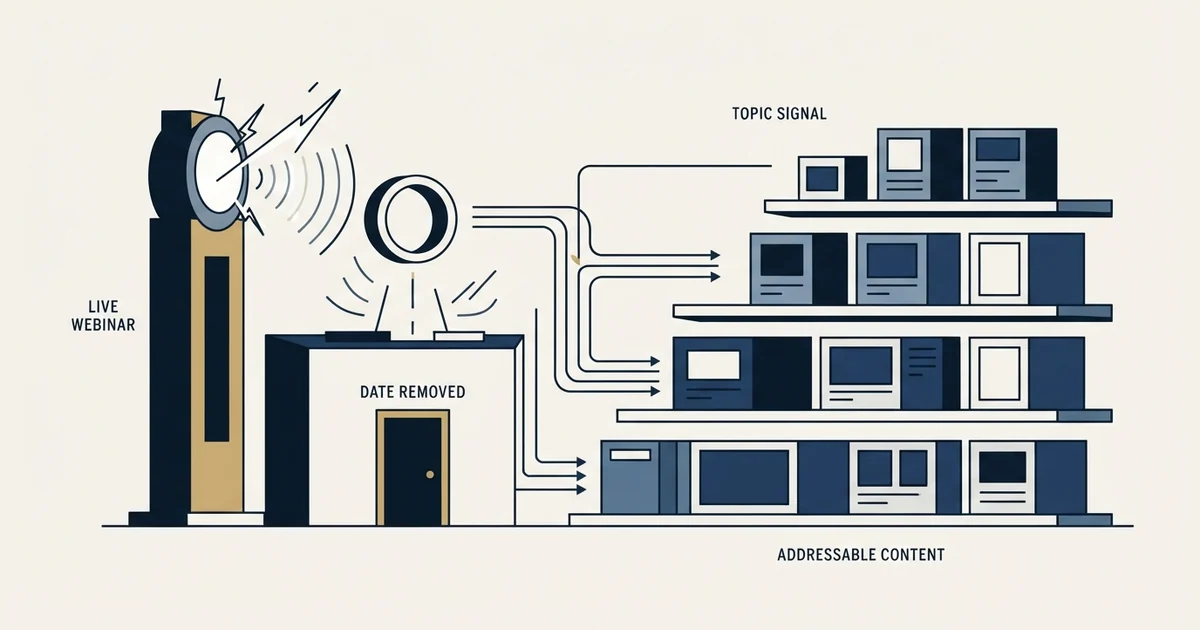
An on-demand webinar is a pre-recorded session behind a registration form that plays whenever somebody submits it. Removing the date removes the deadline, the registration burst and the live room, while keeping the topic signal and the work address. Decide which of the three formats you run, because simulive carries a disclosure obligation the others do not.
Key takeaways
- Three products share the name: true on-demand that plays on submit, scheduled replay or just-in-time that plays at set times, and simulive that runs a recording inside a live interface.
- On-demand registrations arrive one at a time and indefinitely rather than in a burst, so a weekly review treats a same-day self-declaration as a weekly batch.
- Gate the recording only after deciding what it is for: a session meant to make a category legible should be open, and a session meant to identify evaluators should ask one question rather than five.
- Vendor attendance comparisons flatter the format by construction, because an on-demand viewer registers and watches in one motion, so the interval where live sessions lose their audience barely exists.
Reviewed and updated September 2, 2026
On-Demand Webinars: What Changes When You Take the Date Away
Livestorm's own glossary defines the format in one line: "An on-demand webinar is a pre-recorded webinar that is accessible all of the time." Its glossary entry adds that registrations are always open for on-demand webinars, which makes them an excellent source of evergreen content.
Both statements are true, and together they hide the decision that actually matters. A live webinar earns most of its demand-generation value from the date. The date is what makes a promotional message worth sending twice, what makes a reminder honest, what concentrates a hundred people into one hour so they ask each other questions, and what creates the deadline that drives the registration spike in the final days. Take the date away and you keep the content, keep the registration form, and lose every one of those.
That trade is worth making in a lot of programmes. It is a different asset with a different operating model, and running it on the live playbook is what produces a library of recordings nobody watches and a spreadsheet of registrations nobody works.
Three products are sold under this name
The phrase covers at least three formats, and vendors do not always distinguish them in their marketing. The distinction decides what you owe the viewer.
True on-demand. The recording sits behind a registration form and plays the moment somebody submits it. There is no scheduled time and no pretence of one. The viewer knows they are watching a recording, because nothing suggested otherwise.
Scheduled replay, sometimes sold as just-in-time. The recording plays at fixed times, or at the next quarter hour after a visitor arrives. eWebinar's product page lists "Show just-in-time session" as an event setting alongside recurring and on-demand options. The viewer gets the convenience of near-instant access with a small wait attached, and the session behaves like an appointment they did not have to book.
Simulive, presented as live. The recording runs on a schedule with the live interface around it, and the framing invites the viewer to believe a person is presenting. StealthSeminar's homepage states the proposition without hedging: "Run pre-recorded webinars as if they are live events to leverage time and generate automated income."
- Plays on submit
- Viewer knows it is a recording
- Registrations arrive one at a time, indefinitely
- No reason to promote a date
- Plays at set times or the next quarter hour
- Viewer usually understands it is recorded
- Small concentration effect returns
- A start time is honest to promote
- Recording inside a live interface
- Viewer is invited to think a person is there
- Highest measured engagement claims
- Requires a disclosure decision
The third one carries an obligation the first two do not. A viewer who types a question into the chat of something they believe is live has done something on the basis of a belief you created. Whether the platform answers it in real time, queues it for an email, or drops it decides whether that belief was harmless. eWebinar's own demo animation stages exactly this exchange: an attendee types "Is this a recording?" and the host answers yes, in the chat, while the session runs.
Our position is the one we apply to every channel. If the format implies a person is present, either a person is present for the questions, or the viewer is told plainly before registering that the session is recorded and questions are answered by email. Getting attention through an impression the reader would object to if they understood it is the same defect as a subject line implying a prior conversation.
What an on-demand registration is worth

A registration is a person exchanging a work address for a promise about a named topic. That much is identical whether the session is live or recorded, and it is the reason the format is worth running at all. Our own argument for treating the registration list as the asset rather than the attendance rate does not change when the date disappears.
Two things do change, and both point the same way.
The signal arrives with better timing and less context. Somebody who registers for an on-demand session is looking at the topic today, on their own initiative, without a date having reminded them. Nothing pushed them. That is a cleaner read on interest than a registration collected during a promotional push three weeks before an event, when the person may have been reacting to the promotion as much as to the subject.
The signal arrives alone. A live session produces its registrations in a burst that the calendar organises for you, so a weekly review catches them. On-demand registrations arrive one at a time, forever, including at 02:00 on a Sunday. A programme that reviews them weekly is treating a same-day signal as a weekly batch, and the interest that made the person submit the form has usually gone quiet by then.
The distinction between an account that is researching and an account that has declared itself is the whole subject of demand creation, capture and conversion. A form submission is a self-declaration, and self-declarations have a shelf life measured in hours.
- Yes: A named owner for submissions, with a response window measured in hours
- Yes: A page that says whether the session is recorded, wherever the format implies a presenter
- Yes: One qualifying question on the form, chosen so the answer changes what you do next
- Yes: A record of which topic the person chose, kept as a targeting attribute rather than a line in a report
- No: A scheduled nurture sequence that fires on days elapsed since registration
- No: A weekly export of registrations for review at the marketing meeting
The gate question, answered by what you want back
The registration form is the whole reason the format produces anything, and it is also the reason a lot of on-demand libraries produce nothing. Two failure modes sit either side of it.
Registration and attendance are metered differently by the platforms themselves, and the attendee ceiling BigMarker publishes caps live attendance while registration stays unlimited.
An ungated recording is a piece of content. It builds familiarity, it can be linked from anywhere, it costs nothing to distribute, and it tells you nothing about who watched. That is a legitimate choice for a session whose job is to make the category legible, and it is the right choice more often than gating orthodoxy suggests.
A gated recording is a lead-capture surface, and every field on the form is a price the visitor pays before they know whether the content was worth it. That price is higher for a recording than for a live session, because a live session sells a scheduled experience while a recording is competing with every free video the person could watch instead. The full argument about form fields as pricing, message match, and what has to happen after somebody submits is in landing page lead generation, and a webinar registration page is the clearest instance of it.
The practical resolution is to decide what the recording is for before deciding whether to gate it, rather than gating by default and discovering later that the asset was supposed to build awareness. A session recorded to reach people who have never heard of the category should be open. A session recorded to identify who is evaluating a specific operational decision should be gated, with one question rather than five, because the answer to that one question is the thing you are actually buying with the friction.
Following up on something that happened, not on the calendar

Every guide to this format proposes a post-registration sequence. A confirmation, a nudge if they did not watch, a resource email, a meeting ask, spaced across a fortnight.
We do not run that, and the reason is not volume squeamishness. A sequence of unanswered messages under an unanswered message is a bump, and a bump asks for attention rather than earning it. Our campaigns carry one message each, and re-approaching somebody is a new campaign with a new premise, sent because something changed. The measured version of that decision is in why we stopped using follow-ups.
An on-demand programme is unusually well suited to that constraint, because it generates real events rather than scheduled ones. Somebody registered and watched to the end. Somebody returned to the recording a second time weeks later. Somebody asked a question. Somebody registered for a second session on an adjacent topic. Each of those is a thing the person did, each carries an angle that writes itself, and none of them needs a timer.
- Step 1Submission lands
Route to a named owner the same day, with the topic they chose attached to the record
- Step 2Watch behaviour recorded
How far they got is the qualifier the form could not ask for without costing you the registration
- Step 3One message, on the topic they chose
The premise is their declared interest, not the fact that a form was submitted
- Step 4A later return is a new event
A second visit months on is a fresh signal and a fresh campaign, never the next item on a sequence
The one message worth sending on the date is the one the date itself justifies, which for a scheduled replay is the session about to start. For a true on-demand session there is no date, so there is no reminder to send, and the absence of a reminder ladder is a feature of the format rather than a gap in the programme.
Measuring it without flattering it

Vendor marketing for this category leans hard on attendance comparisons. eWebinar's page advertises a "78% avg attendance rate" and says the product "gets 2x the attendance of your live sessions with zero effort after setup". Those are the vendor's own figures on the vendor's own page, and they measure something structurally easier: an on-demand attendee registers and watches in one motion, so the gap between registering and attending, which is where live sessions lose most of their audience, barely exists. A format that removes the interval between the two events will always compare well on the ratio between them.
The number that survives that objection is the one the format is genuinely good at. An on-demand asset should be judged on registrations per month at steady state, months after the promotion stopped, because that is the property a live session does not have. A recording that produces a small trickle indefinitely can outproduce a live session that produced a burst and then nothing, and it will look worse on every attendance chart while doing it.
Attribution will not help you see this. A recording watched in March, followed by a search in June and a demo request in July, is credited to search by any last-touch model. The practical response is not a better model. It is to treat the asset as permanent and unattributable, budget for it accordingly, and read branded search and direct arrivals as the leading indicator instead. That is the same measurement problem demand gen strategy sets out for every slow channel, and the same answer applies.
Where the format actually earns its place
An on-demand session is worth building when the topic is stable, the audience arrives continuously, and somebody owns the response. It is a poor choice when the content dates quickly, when the value of the session was the room rather than the material, or when nobody has been assigned the submissions, in which case the honest answer is to publish the recording ungated and stop pretending it is a lead source.
It is also worth being clear about what it is not. An on-demand library does not create demand for a category nobody can name, because the person still has to be looking for something to find it. It captures interest that already exists, which puts it alongside search and comparison content rather than alongside outbound. Where the two meet is the targeting attribute: somebody who registered for a session on a specific operational problem has told you which of your topics is live for them, and that is a fact you could not have bought. The three jobs that sit behind any capture surface, and the one that usually goes unowned, are laid out in inbound lead generation.
The short version

An on-demand webinar is a recording behind a registration form, and removing the date removes the deadline, the burst and the room while keeping the topic signal and the address. Decide which of the three formats you are running, because simulive carries a disclosure obligation the other two do not. Gate it only if you have decided what the registration is for, ask one question rather than five, and route submissions to a named owner within hours rather than reviewing them weekly. Follow up on what the person did, never on days elapsed. Judge the asset on registrations per month long after promotion stopped, not on the attendance ratio the format is built to win.
If the part you would rather not build is reaching the people who will never search for the topic at all, that is what a test campaign covers.
Vendor statements verified against each vendor's own published pages as of August 2026. Verify current terms with the vendor before relying on them.
Sources: Livestorm webinar glossary, on-demand webinar, eWebinar on-demand webinars, StealthSeminar
Frequently asked questions.
Frequently asked questions- What is an on-demand webinar?
- Livestorm's glossary defines it as a pre-recorded webinar that is accessible all of the time, normally sitting behind a registration form so the recording plays once somebody submits it. Registrations stay open permanently, which is what makes the asset evergreen. The content is the same as a live session; what is removed is the scheduled date and everything that depended on it.
- Should I gate an on-demand webinar behind a form?
- It depends what the recording is for. A session whose job is to make a category legible to people who have never heard of it should be open, because a form stops the reach you were trying to buy. A session whose job is to identify who is evaluating a specific operational decision should be gated, with one qualifying question rather than five.
- Is it dishonest to present a recording as a live session?
- It becomes a problem the moment a viewer acts on a belief you created, such as typing a question into a chat expecting a person to read it. Either somebody is present for the questions, or the page states plainly that the session is recorded and questions are answered by email. Vendors sell this format openly, so the disclosure is your decision rather than the platform's.
- How should you follow up with someone who watched an on-demand webinar?
- On something they did rather than on days elapsed. Watching to the end, returning to the recording weeks later, asking a question, or registering for a second session are all events that carry their own angle. A message sent because three days passed has nothing to say except that you would like a reply, and it lands under the one they already ignored.
About the author.

Ben Carden is CRO at RevenueFlow, which builds and operates outbound revenue engines for B2B companies. Previously at Gartner Enterprise. Studied at London School of Economics.
Ben Carden · CRO
Connect on LinkedIn →Explore more.
Ready to scale your outreach?
We build GTM engines that book real meetings. See the receipts.
Related articles.
BrightTALK Pricing: What the Vendor Does Not Publish
Six BrightTALK surfaces carry no price at all. The $500 figure filling that gap is a 2022 scrape on a listing the vendor says it does not manage.
eWebinar Pricing: Two Meters and a Level That Moves
eWebinar does not ask you to pick a plan. Published webinars set the level and registrants set the overage, and the two directions do not move on the same schedule.
Define Content Syndication: Two Purchases Behind One Word
One budget line, two different purchases. Republication buys reach; lead syndication buys contact records produced by a download. The deliverable tells you which.
SEO Lead Generation: What Organic Search Can and Cannot Do
Organic search reaches buyers who are already looking, on a horizon of months. Which queries are worth writing for, what the lag costs, and how to measure it.
Webinar Lead Generation: The Registration List Is the Asset
A webinar produces a registration list, an attendance figure and a recording. Most teams count the smallest of the three and discard the one that keeps working.
Drift Competitors: What Replaced It and What Each Costs
Drift is retired and drift.com now serves a Salesloft page. What the successors publish about price, who owns them now, and which one fits which job.