BigMarker Pricing: What the Vendor Publishes
BigMarker prints Request a Quote against all three plans. The structure it does publish, and the meter that caps attendance rather than registration.
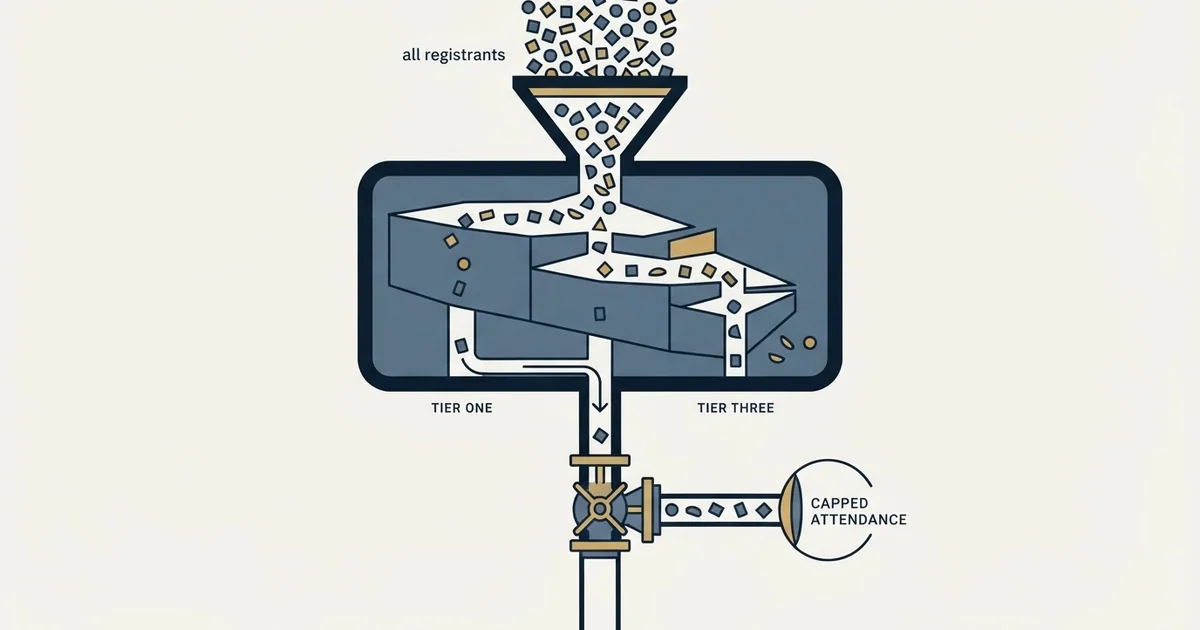
BigMarker publishes no prices. All three webcast plans read Request a Quote, so every figure circulating elsewhere is a report of somebody's contract. The page does publish the structure: live attendee ceilings of 1,000, 10,000 and 500,000, host licenses, an annual subscription and named add-ons.
Key takeaways
- All three BigMarker webcast plans carry no published rate and route to a quote request.
- The attendee ceiling caps live attendance while registration is explicitly unlimited.
- The subscription renews annually, with storage included for up to 100 on demand webinars.
- Ticketed events carry a 5% transaction fee, and hosts, channels and storage are sold as add-ons.
Reviewed and updated September 2, 2026
BigMarker Pricing: No Published Rate, and a Ceiling on the Wrong Half of the Funnel
Search for what BigMarker costs and the results fill with numbers. Procurement marketplaces, review directories and comparison blogs all carry a figure. BigMarker's own pricing page carries none. Against each of its three plans it prints the same thing: "Let's talk... Request a Quote".
That absence is the honest answer to the question, and it has a consequence worth understanding before booking the demo. Every number circulating about this product is somebody's negotiated contract rather than a rate card, so it tells you what one buyer agreed to at one volume rather than what you will pay.
What the pricing page does publish is a detailed plan structure, and inside it sits a meter that behaves in a way most webinar buyers get backwards.
What the page actually publishes
Three webcast plans, no rates.
| BigMarker plan | Rate on the page | Live attendees | Host licenses | Shared webcams |
|---|---|---|---|---|
| Basic, per the pricing page | Request a Quote | Up to 1,000 | 1 | Up to 9 |
| Enterprise, per the pricing page | Request a Quote | Up to 10,000 | 4 | Up to 64 |
| Enterprise+, per the pricing page | Request a Quote | Up to 500,000 | 6 | Not stated |
The page also splits the product three ways: webcast plans for webinars and live streams, configurable event packages for virtual, hybrid and in person events, and media hubs for content destinations. Everything above was read from BigMarker's pricing page on 30 August 2026 and re-read on 2 September 2026.
The attendee ceiling caps attendance, not registration
The single most useful line on the page is in its frequently asked questions, and it is easy to read past.
Explaining what an attendee is, the page says that if a plan includes up to 1,000 attendees, then 1,000 people can attend the live webinars, and "an unlimited number of people can register".
Read that against how a B2B webinar actually produces pipeline. The registration list is the asset. It is the set of people who raised a hand against a topic, and it keeps working after the session through the recording, the follow up and the sales conversation. Live attendance is a subset of it, usually a minority one, and the argument for why the list rather than the attendance rate is the thing to optimise is made in full in webinar lead generation.
So the meter that steps this ladder, and that will anchor the quote, is a ceiling on the half of the funnel that matters least. A team registering four thousand people and seating nine hundred of them live is inside the Basic ceiling on the vendor's own definition.
That is not a criticism of the packaging. Concurrent live capacity is a real cost to serve and it is reasonable to bill for it. It is a warning about how to size the quote: the number to bring to the conversation is peak concurrent live attendance, and the instinct is to bring the registration target, which is larger and buys capacity nobody will use.
- People in the room live
- Capped per plan
- Registration is explicitly unlimited
- Size this on peak concurrency
- People who can schedule and start sessions
- One, four and six across the tiers
- Purchasable as add-ons
- Not the same as team members
- Where webinars, series and hubs live
- One per subscription
- Extra channels sold as add-ons
- A second brand needs a second channel
The other billing axes the page discloses

Four more terms sit in the questions, and each one moves the real cost.
The subscription is annual. In the page's own words, "BigMarker is a subscription-based service, so your plan renews every year", with cancellation available during the term to stop the auto renewal. There is no month to month option described anywhere on the page, which matters for a team that wants to run one campaign and stop.
On demand storage is capped at 100 webinars. Each subscription includes unlimited live webinars and storage for up to 100 on demand recordings, with more available as an add on. For a programme that leans on evergreen content rather than live sessions, that ceiling arrives faster than the attendee one. What changes when the date comes off a webinar is worked through in on demand webinars.
Paid events carry a transaction fee. Where content is monetised through ticketing, the page states that "BigMarker charges a 5% transaction fee, which covers the costs of credit card networks and payment gateways".
Add-ons are the quiet axis. Additional host licenses, additional channels and additional on demand storage are all named as purchasable extras, so the quoted plan rate is a floor rather than the cost of the configuration a team actually needs.
That floor-and-extras shape repeats across marketing tooling, and the four separate lines on a Webflow bill show how far a card price can sit from an invoice.
- Yes: You sized peak concurrent live attendance rather than your registration target
- Yes: You counted how many people need to schedule and start sessions
- Yes: You know how many on demand recordings you will keep against the 100 included
- Depends: You know whether you need one channel or several
- No: You anchored your budget to a figure from a third party marketplace
- No: You treated the plan rate as the total, before add-ons
Where the capability boundaries fall
The tiers are not one product at three volumes, and the boundaries are worth knowing before the sales conversation frames them for you.
Basic is a webinar tool. Its card lists live and on demand webinars, streaming to Facebook and YouTube, chat, polls, question and answer, handouts, screen and file sharing, recording, pop up offers, "Full-service Registration" and emails, post session surveys, basic integrations and basic analytics.
Enterprise is where the demand generation machinery arrives: one CRM or marketing automation integration, simulive and evergreen webinars, always on sessions, webinar series, ticketing and payments, fifteen landing page templates, custom registration fields, custom UTM codes, embeddable registration, breakout rooms, API access, Zapier, advanced analytics and a customer success manager.
Enterprise+ is the branding and scale tier: white labelled domains, a custom page designer, custom email templates and fonts, live closed captioning and translation, multi language support, attendee dial in, embeddable webinar rooms, single sign on, multi factor authentication, a mobile SDK, negotiable data processing terms and live event monitoring.
The boundary that matters to most B2B teams is the CRM integration and the UTM and registration field controls, all of which sit on Enterprise rather than Basic. A webinar programme whose leads have to reach a CRM with campaign attribution intact is an Enterprise conversation on this ladder regardless of how few people attend, and that is a different reason to move up than the attendee ceiling.
Three product lines, and the quote you asked for may not be the one you get

The ladder above is only one of the three things this pricing page sells, and the distinction decides which quote arrives.
Webcast plans are the subscription described so far, sold for webinars, webcasts and live streams. Event packages are configured separately, described on the page as custom plans for virtual, hybrid and in person events, so a conference or a multi session field event is a different commercial conversation with a different shape. Media hubs are content destinations, described as customisable places to gather sessions for ongoing engagement and learning, and they are the surface a team would use to keep recordings working after the live date.
A demand generation team that wants recurring webinars plus an always on library is buying from at least two of those lines, and the request form on the page asks which products you are interested in for exactly that reason. Naming only the webcast plan produces a quote that covers the sessions and not the library they live in.
Reading the third party numbers
Because the vendor publishes nothing, a market has grown around guessing. Procurement benchmarking services, review directories and comparison blogs all quote figures for this product.
The same guessing market has formed around another webinar vendor, where the widely quoted BrightTALK figure is an old scrape on a listing the vendor says it does not manage.
Those numbers are not worthless, but they are a different kind of fact from a rate card. A benchmarking service reports what its customers agreed to pay, at their volumes, with their negotiating position and contract length. Quoting one back at a vendor is an anchoring tactic rather than a price check, and the vendor is under no obligation to recognise it.
The reliable move is to size the configuration yourself from the units above, ask for the quote against that configuration, and ask which of the add-ons are included at the volume you named. A quote that arrives without the add-on question answered is not comparable to any other quote you hold.
Where the platform sits in the programme

A webinar platform is a delivery mechanism. It does not produce the audience, and the common failure of a webinar programme is not a feature gap in the platform but an empty registration list.
Filling that list is the upstream problem, and the outbound approach to it is covered in cold email for webinar guest recruitment. The registration page itself converts demand that already exists rather than creating any, which is the argument in landing page lead generation. And when reporting the outcome, a registration or attendance rate computed over a small session is dominated by chance in the way conversion rate describes, so counts belong beside percentages.
The short version
BigMarker gives no rate anywhere on the page. All three webcast plans read "Request a Quote" as of 30 August 2026, so any figure you find elsewhere is a report of somebody's contract rather than a published rate.
What BigMarker's pricing page does give is the structure: live attendee ceilings of 1,000, 10,000 and 500,000, host licenses of one, four and six, an annual subscription, storage for 100 on demand webinars, a 5% transaction fee on ticketed events, and add-ons for hosts, channels and storage. The line worth carrying into the quote conversation is that the attendee ceiling caps live attendance while registration is explicitly unlimited, so the number to size against is peak concurrency rather than the size of the list you intend to build.
When the constraint is the size of that list rather than the platform hosting it, see what a first campaign produces against your own market.
Plan names, attendee ceilings, host license counts, storage limits, the transaction fee and the absence of any rate at all were read from bigmarker.com/pricing on 30 August 2026. Verify current terms with the vendor before relying on them.
Frequently asked questions.
Frequently asked questions- How much does BigMarker cost?
- Its pricing page publishes no rate. All three webcast plans, Basic, Enterprise and Enterprise plus, read Request a Quote as of 30 August 2026. Figures quoted by procurement marketplaces and review directories are reports of negotiated contracts at particular volumes rather than a published rate card, so they are an anchoring tool rather than a price check.
- What does the BigMarker attendee limit actually cap?
- Live attendance only. The pricing page states that a plan including up to 1,000 attendees allows 1,000 people to attend live while an unlimited number can register. Since the registration list is the durable asset of a B2B webinar, the tier meter caps the half of the funnel that matters less. Size the quote on peak concurrency.
- What else changes the cost beyond the plan?
- Four things the page names. The subscription is annual rather than monthly. Storage covers 100 on demand webinars, with more as an add on. Ticketed events carry a 5% transaction fee. Additional host licenses and additional channels are add-ons, so the plan rate is a floor rather than the cost of a real configuration.
- Which BigMarker plan does a B2B demand generation team need?
- Usually Enterprise rather than Basic, and for a reason unrelated to audience size. CRM and marketing automation integration, custom registration fields, custom UTM codes and embeddable registration all sit on Enterprise. A programme whose leads must reach a CRM with attribution intact needs that tier however few people attend.
About the author.

Ben Carden is CRO at RevenueFlow, which builds and operates outbound revenue engines for B2B companies. Previously at Gartner Enterprise. Studied at London School of Economics.
Ben Carden · CRO
Connect on LinkedIn →Explore more.
Ready to scale your outreach?
We build GTM engines that book real meetings. See the receipts.
Related articles.
BrightTALK Pricing: What the Vendor Does Not Publish
Six BrightTALK surfaces carry no price at all. The $500 figure filling that gap is a 2022 scrape on a listing the vendor says it does not manage.
eWebinar Pricing: Two Meters and a Level That Moves
eWebinar does not ask you to pick a plan. Published webinars set the level and registrants set the overage, and the two directions do not move on the same schedule.
Goldcast Belongs to Cvent Now: The Buying Question
Cvent announced its Goldcast acquisition in December 2025 and completed its ON24 acquisition in April 2026. Two shortlist names, one owner, one live contract question.
On-Demand Webinars: What Changes When You Take the Date Away
A live webinar earns most of its value from the date. Removing it keeps the topic signal and the address, and loses the deadline, the burst and the room.
Typeform Alternatives: Read the Response Meter First
Typeform meters responses with a hard ceiling and counts seats inside the plan. What Tally, Fillout, Formbricks and Jotform count instead, from their own pricing pages.
LeadMagic Pricing: What a Credit Buys Per Endpoint
LeadMagic publishes two different per credit rates for the same plan, and both are right. The four tiers, the endpoint costs, and the clock that separates them.