Webinar Lead Generation: The Registration List Is the Asset
A webinar produces a registration list, an attendance figure and a recording. Most teams count the smallest of the three and discard the one that keeps working.
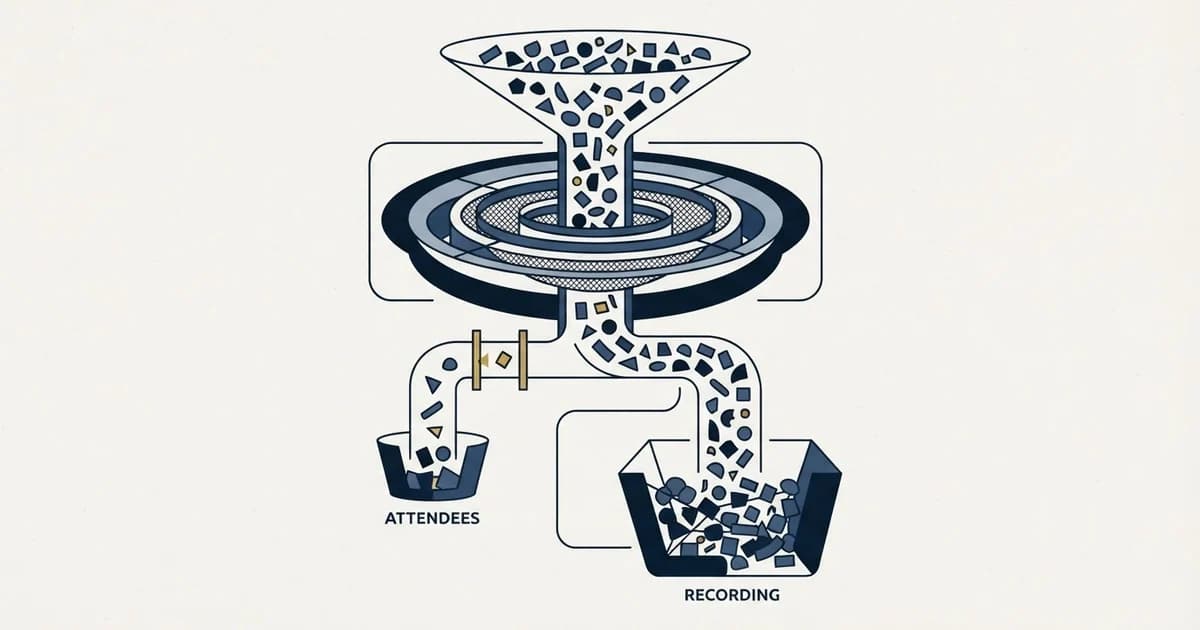
A webinar produces three assets: the registration list, the attendance, and the recording. The registration list is the one that compounds, because it records a declared interest in a named topic attached to a job title, and it survives a no-show. Attendance tells you about someone's Tuesday rather than their intent.
Key takeaways
- A registration records a narrow declared interest with a job title attached, which is a targeting fact you could not have bought.
- No-shows carry almost the same information as attendees, because what separates them is availability rather than interest.
- The recording often outproduces the live event over time and is rarely accounted for against the cost of running it.
- One qualifying question on the registration form segments the whole list for a few percent of registrations; five questions cost far more and produce fields nobody uses.
Reviewed and updated September 2, 2026
Take an invented but ordinary set of numbers. Four hundred and twelve people registered. A hundred and six attended. The post-event summary reports a 26 percent attendance rate, which is that invented arithmetic and nothing measured, treats it as the headline, and the debrief spends forty minutes on how to lift it. Meanwhile the three hundred and six people who registered and did not turn up are sitting in a spreadsheet that nobody will open again, and they are the most interesting group in the entire exercise.
A webinar produces at least three separate assets and most teams count one of them. Which one you treat as the output changes what the format is worth, and it changes what you should do the following week.
The same reading covers the wider category, because the types of virtual event a platform sells differ mostly in production cost while the durable benefit of a virtual event to a pipeline is the registration list rather than the room, so a virtual event strategy built around attendance is optimising the smallest of the three assets.
The three assets, and the one that gets counted
The registration list is everyone who gave you a work email in exchange for a promise about a specific topic on a specific date. That is a declared interest in a subject, attached to a person with a job title, at a company you can look up. It exists whether or not they attend.
The attendance is who showed up and for how long. It is the smallest of the three and it is the one on every summary slide, largely because the webinar platform puts it there.
The recording is an asset with no expiry that keeps producing registrations for as long as anyone links to it. In many programmes it eventually outproduces the live event that created it, and it is almost never accounted for against the cost of running the thing.
Declared interest in a named topic, with a job title attached
The number on the summary slide
The attendance figure that carries any signal
Keeps accruing for months, rarely attributed back
The registration is the asset that compounds, because it is the one that tells you something durable about a person. Attendance tells you about their Tuesday.
Durable does not mean accurate, and the six claims a lead record makes cover everything from whether the address resolves to whether writing to that person is lawful.
What a registration actually establishes
It establishes that on one day, this person considered this topic worth an hour. That is genuinely more than most inbound signals carry, and it is considerably less than the follow-up usually assumes.
It does not establish a buying process, a budget, or authority. The inbound lead entry makes the general version of this point: raising a hand tells you three things and everything else people infer from it is inference. A webinar registration is a narrow, well-specified hand-raise, and the narrowness is the useful part. Somebody who registered for a session on outbound deliverability has told you which of your topics is live for them, which is a targeting fact you could not have bought.
The registrations from people who did not attend carry almost the same information as the ones who did. They wanted the topic and their calendar won. Treating no-shows as a lower-quality tier is common and mostly wrong; what separates them from attendees is availability, not interest.
The follow-up problem, stated honestly
The one message people usually mean when they ask about a webinar registration email is the confirmation itself, which is not a follow-up at all: it delivers the thing the person just asked for, and the joining details are the entire reason it exists.
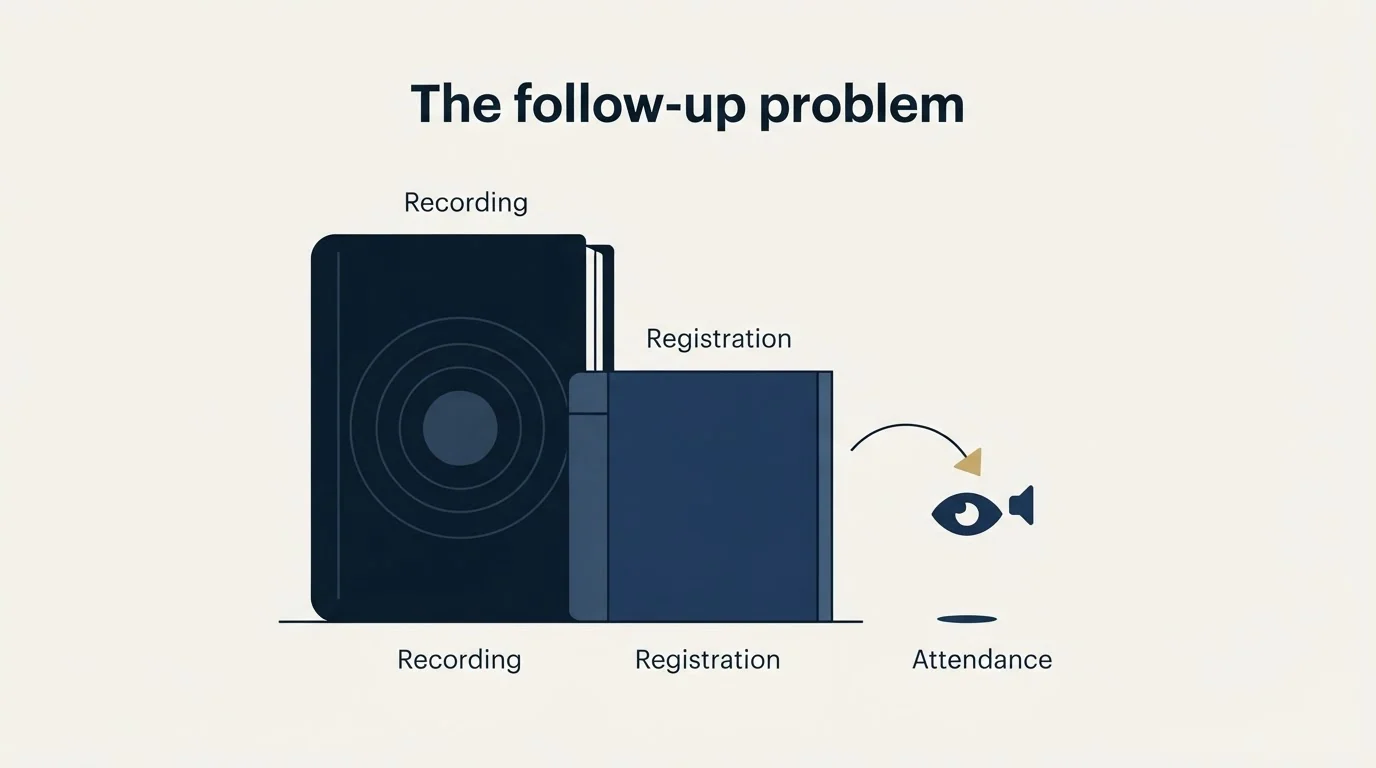
Every guide to this format arrives at the same place: a reminder ladder before the event and a nurture sequence after it. One week out, one day out, one hour out, then a recording email, then a value email, then a meeting ask.
We do not run that, and the reason is not squeamishness about volume. A sequence of unanswered messages under an unanswered message is a bump, and a bump is a request for attention rather than a reason to give it. Our campaigns carry one message each, and the way we re-approach someone is a new campaign with a new angle, sent because something changed rather than because the calendar advanced.
Applied to a webinar, that constraint turns out to be clarifying rather than limiting, because a webinar generates real triggers instead of scheduled ones.
- Yes: They registered and the session is tomorrow: one message, because the date is the reason
- Yes: They watched the recording six weeks later: a genuine new signal, and a new campaign
- Yes: They asked a question in the session: the question is the angle
- Yes: They downloaded the follow-up resource: a second, narrower declared interest
- No: Three days have passed and they have not replied
- No: It is the scheduled fourth touch in the post-event sequence
The distinction is whether the recipient did something. A person returning to a recording two months after the event has told you the topic is still live for them, and that is worth a message with a fresh angle. The passage of three days has told you nothing, and a message sent on that basis has nothing to say beyond a reminder that you would like a reply.
Teams who say they do very little after the webinar usually mean they never built the scheduled sequence, and that is a smaller gap than it feels. Nurturing the list after the event is worth doing on the events above rather than on a timetable, and the registration list keeps its value while nobody writes to it, because a declared interest in a named topic does not expire in a fortnight. The opportunity that is genuinely being missed is the questions asked in the session and the people who came back to the recording, both of which are things somebody did.
A webinar CRM integration earns its setup for exactly this reason: the registration, the question asked in the session and the return visit to the recording are the three facts worth acting on, and they are only actionable once they reach the record your team works from rather than staying inside the webinar platform's own reporting.
Designing the session so the registration is worth having
The topic decides the list, so the topic should be chosen for who it excludes. A session on a broad category attracts a broad audience and produces a list you cannot act on. A session on a narrow operational problem attracts fewer registrations and produces a list where every row shares a specific, known concern.
A virtual event plan built around the registration list rather than around the run of show makes the same choice: pick the topic for who it excludes, and the planning checklist follows from the list you want rather than from the agenda.
That trade is worth taking deliberately, and it runs against how these events are usually judged, since registration count is the number the calendar invite is measured on. The piece on demand gen strategy makes the underlying argument: funding every channel evenly is what not making a decision looks like, and the same applies inside a channel. It is also the point at which a webinar stops being a content exercise and becomes part of inbound lead generation, where attraction, capture and response are three separate jobs and the third decides the outcome.
Two design choices follow from treating the list as the output.
Ask one qualifying question on the registration form, not five. One well-chosen question, usually about the current state of the thing the session addresses, segments the entire list at a cost of a few percent in registrations. Five questions cost far more registrations and produce fields nobody uses.
Design the session so the questions asked in it are usable. The chat and Q and A are the highest-value output of the live hour, because each question is a person naming their own problem in their own words. Those questions are the raw material for the next session, for outbound copy, and for the follow-up to individuals that actually has something to say.
Promotion is most of the work, and it is usually the afterthought
A webinar promotion post on your own company page is the cheapest and weakest version of this, because it reaches the audience you already have, and the lever that actually moves registrations is borrowing somebody else's.

The production of a webinar takes a few days and the promotion decides the outcome, which is the reverse of how the calendar usually allocates attention. A session promoted for three weeks to a defined audience and a session announced twice on a company page produce results that differ by an order of magnitude, with identical content.
The same holds for a virtual event marketing strategy more broadly, because a virtual summit or a multi-session online event is promoted the way a single session is: the constraint is distribution and the registration list is still the durable output.
The distribution question is the same one every content channel faces, and it has the same honest answer: you either have an audience already, you borrow one, or you pay for reach. Borrowing is the underused option here, and it is the reason co-hosted sessions outperform solo ones so consistently. A partner with an adjacent audience brings a list you could not have reached, and the exchange costs nothing but the shared credit.
The other underused lever is a genuine deadline. Registration behaviour clusters heavily in the final days before an event, which is a real property of how people manage calendars rather than a persuasion trick. A session with a fixed date has an honest reason to be mentioned again as the date approaches, and that reason is the date rather than the absence of a reply.
Measuring it without flattering it
The metric worth tracking is registrations per unit of promotion effort, not registrations in total, because total registrations mostly measure how hard you pushed. Two sessions with 400 registrations each are not comparable if one took a week of promotion and the other took an afternoon and a partner's newsletter.
Attribution is the harder half. A recording watched four months later, by someone who then arrives through a search a fortnight after that, will be credited to search in almost every model. The practical response is not a better attribution system; it is to stop treating the format as a campaign with a close date and start treating the recording as a permanent asset whose value accrues quietly and unattributably. That reframing changes what you make: a session designed to be watched later is structured differently from one designed for a live hour, and the later audience is usually the larger one.
Teams that still measure a recording's search-driven arrival against a campaign close date will find what organic search can deliver explains why that feedback loop runs on months, not days.
Where the format sits against the alternatives
One distinction inside the format decides which number is worth chasing. A live virtual event runs in real time, an on-demand one is recorded and watched whenever somebody chooses, and a simulive session is pre-recorded content delivered to an audience at a scheduled moment. Only the first two ask anything of a specific date, so a programme built around registrations rather than attendance can often run the third and lose nothing that mattered.

A webinar sits between content and outreach, and it borrows a weakness from each. Like content, it depends on distribution: an excellent session nobody hears about produces nothing, which is why most of the work is promotion rather than production. Like outreach, it is a fixed cost every time, because a webinar does not compound on its own the way a library of writing does. The recording is the part that compounds, which is the argument for treating it as a permanent asset rather than a follow-up attachment.
The comparison with paid social and organic audience-building has the same shape as the one in social media lead generation: two motions, one of which accrues and one of which costs the same every month, and counting them as one number leaves neither manageable.
Outbound sits alongside this rather than inside it. The registration list is a strong outbound targeting input, because you know the topic and the title. The mistake is treating registration as consent for an unrelated pitch, which converts a warm, self-selected audience into an unsubscribe list. The angle that works is the one they already told you they cared about, which is the whole reason the registration was worth collecting.
Because a registration list only compounds when someone actually owns the follow-up, staffing the response function matters as much as the topic choice.
The short version
Count the registration list and the recording, not the attendance rate. A registration is a narrow declared interest with a job title attached and it survives a no-show, which is why no-shows are not a lower tier. Choose the topic for who it excludes, ask one qualifying question rather than five, and treat the Q and A as the session's real output. For follow-up, act on things people did rather than on days that passed, and re-approach with a new angle rather than a sequence of reminders.
If the outbound half of the promotion is the part you would rather not build, that is what a test campaign covers.
Frequently asked questions.
Frequently asked questions- Are webinars still effective for B2B lead generation?
- Yes, provided you count the right output. A session judged on attendance rate will look mediocre and get cut. The same session judged on the registration list, which is a set of named people who declared interest in a specific topic, and on the recording, which keeps producing registrations for months, usually looks like one of the better acquisition assets available.
- What should I do with people who registered but did not attend?
- Treat them as equivalent to attendees, because the difference between the groups is calendar availability rather than interest. Send the recording once, since that is a thing they asked for. After that, contact them when they do something, such as watching the recording weeks later, rather than on a schedule. The passage of days is not a reason to send a message.
- How many reminder emails should I send before a webinar?
- We do not run reminder ladders, because a sequence of unanswered messages under an unanswered message is a bump. A registrant has a genuine reason to hear from you once as the date approaches, and the date is that reason. Beyond that, act on things people did rather than on the schedule advancing, which is the same rule we apply to every campaign.
- How narrow should the webinar topic be?
- Narrower than feels comfortable, because the topic decides the list. A broad category attracts more registrations and produces a list where the only shared attribute is mild curiosity. A specific operational problem attracts fewer people and produces a list where every row shares a known concern, which is the difference between a list you can act on and a number on a slide.
About the author.

Ben Carden is CRO at RevenueFlow, which builds and operates outbound revenue engines for B2B companies. Previously at Gartner Enterprise. Studied at London School of Economics.
Ben Carden · CRO
Connect on LinkedIn →Explore more.
Ready to scale your outreach?
We build GTM engines that book real meetings. See the receipts.
Related articles.
Allbound: Merging Inbound and Outbound
Allbound runs inbound and outbound as one motion. Merging them creates two decisions: what a signal may trigger, and who is credited when both touched the deal.
5 ABM Campaign Examples and How Each One Is Built
Five worked account-based campaign examples, each built on the same five fields: account set, tier, plays in order, owner and handoff, and the exit condition.
Two Agencies, One Target List: Who Owns Which Accounts
Two outbound suppliers on one market will contact the same companies unless the buyer splits it first. How to cut the list, run the exclusion feed and check the overlap.
On-Demand Webinars: What Changes When You Take the Date Away
A live webinar earns most of its value from the date. Removing it keeps the topic signal and the address, and loses the deadline, the burst and the room.
Define Content Syndication: Two Purchases Behind One Word
One budget line, two different purchases. Republication buys reach; lead syndication buys contact records produced by a download. The deliverable tells you which.
IT Lead Generation: The Buyer Runs Your Playbook
Technology buyers evaluate outbound for a living, and their purchases carry a security review nobody in your meeting owns. Which triggers are real.