Inbound Lead Generation: Three Jobs, and the One Nobody Owns
Attraction, capture and response are three separate jobs. Publishing more only improves the first, which is why traffic can grow by two thirds and pipeline stay flat.
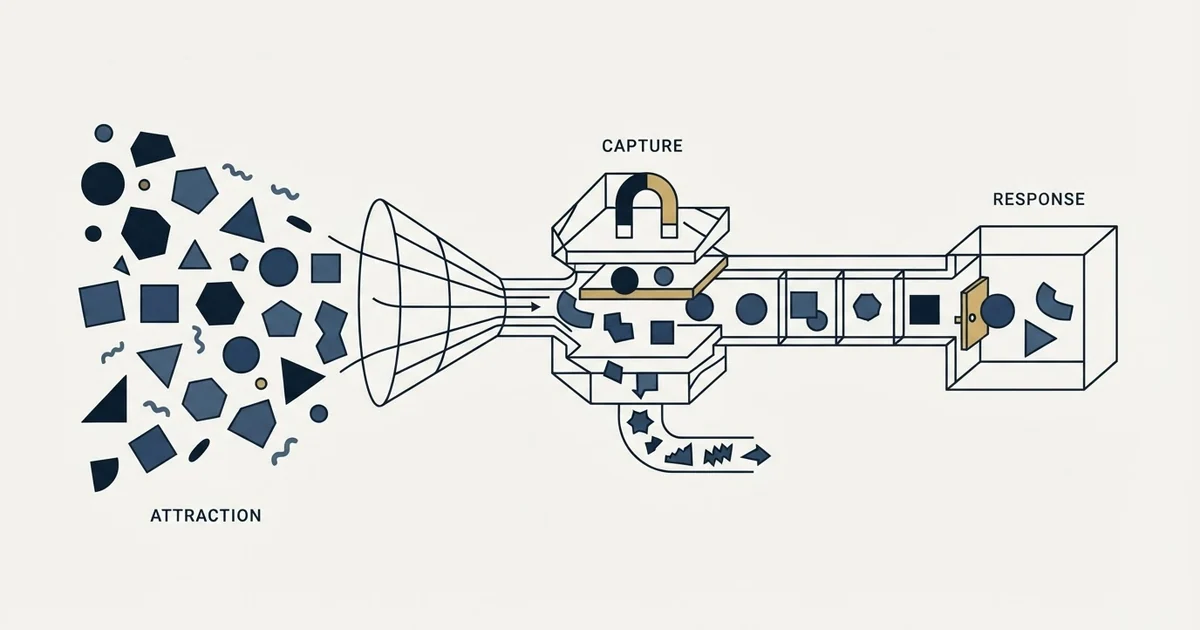
Inbound lead generation is three stacked jobs. Attraction brings anonymous readers, capture turns them into named people, and response is what a human does in the hours afterwards. Publishing more improves only the first. Most programmes leak at capture, where the offer sets the ceiling, and at response, which is rarely anybody's stated job.
Key takeaways
- Track two conversion rates separately, visitors to captured people and captured people to conversations, because different work moves each one.
- The capture offer decides both volume and quality; an offer that asks the reader to describe their situation produces fewer and better leads.
- Response is the job with no owner in most companies, because inbound arrives in marketing tooling and is worked by a sales process.
- Record where eventual customers first arrived separately from where they converted, since standard attribution credits only the second.
Reviewed and updated September 2, 2026
Inbound Lead Generation: Three Jobs, and the One Nobody Owns
A B2B site does 9,000 sessions a month and produces eleven conversations. The marketing team is asked to fix it and does the obvious thing, which is to publish more. Twelve months later the site does 15,000 sessions and produces fourteen conversations. Traffic grew by two thirds and the business outcome barely moved.
Nothing in that story is a content problem. Inbound lead generation is three separate jobs stacked on top of each other, and adding traffic only improves the first one. The second job leaks quietly and the third job usually has no owner at all.
SEO lead generation is this same attraction job with search as the surface, and the intent you pick decides whether the traffic converts long before the ranking does.
The industry name for this half of the job is speed to lead, and the routing and scheduling tools that market against the term are selling an assignment decision rather than the human reply that actually decides the outcome.
The three jobs
Attraction puts you in front of people who did not know you existed. Search, a podcast, comparison pages, documentation, someone's newsletter. This is the job most teams mean when they say inbound, and it is the one everybody measures.
Capture turns an anonymous reader into a named person who has told you something. A form, a calculator, a demo request, a reply to a newsletter. This is the join between the other two and it is where the arithmetic is decided.
Response is what a human does in the hours after capture. Who reads it, how fast they reply, what the first message says, and whether the person on the other end feels like they reached a company or a queue. This is where most inbound programmes lose the majority of their return, and it is almost never anybody's stated job.
The reason the site above did not improve is that it fixed the job that was already working.
Anybody drawing a lead generation funnel is describing these same three jobs with stage names laid over them, and the stage names are what hide which of the three is actually leaking.
- Step 1Attraction
Anonymous people arrive because they were looking for something. Measured in sessions, and the only job most teams staff.
- Step 2Capture
A fraction identify themselves and say what they wanted. Measured in named people, and set by what you offer rather than by how many arrive.
- Step 3Response
A human replies with something specific. Measured in conversations, and usually owned by nobody in particular.
Attraction: pick the intent, not the topic
The single decision that determines whether inbound works is which searches you decide to be present for. Categories of intent behave very differently, and volume is a poor guide to which is worth having.
Someone searching for a definition is early and mostly not buying. Someone searching for how to do a thing manually is often trying to avoid buying, and may buy later. Someone searching for a category name plus a qualifier like pricing, alternatives, or a competitor's name has already decided to spend money and is choosing where. That last group is small, expensive to compete for, and worth more than the other two combined.
The practical error is publishing exclusively at the definitional end because the volume is bigger there, then judging the whole programme on the traffic it produces. That produces the 15,000-session outcome above. A useful inbound portfolio has a base of definitional pages that build presence and a deliberate, defended set of pages at the decision end, and the second set is where the pipeline actually comes from.
Choosing between the two ends is a real strategic question rather than a mechanical one, and the honest comparison against reaching those same accounts directly is in inbound marketing vs outbound.
Capture: the offer sets the ceiling

Conversion rate on a page is mostly a property of what is being offered, not of the button colour. A page offering a newsletter and a page offering an audit of the reader's own setup convert differently by a wide margin and, more importantly, produce different kinds of people.
The distinction that matters is whether the offer requires the reader to describe their own situation. An offer that takes only an email address produces an address. An offer that asks for two facts about their setup and returns something computed from those facts produces a person you can write to specifically. The volume is smaller and the conversation afterwards is easier, and which of those two effects dominates decides whether the programme works. That trade is worked through in detail in lead magnets.
Form tooling meters that capture step in ways the plan card does not make obvious, and a form plan's four separate ceilings separate the monthly allowance from the stored total.
Three capture routes are usually underused:
The unbundled demo request. Most sites offer one high-commitment action. A second, lower-commitment, clearly-different action alongside it captures the people who are researching rather than deciding, without diluting the first.
Live chat that a person actually answers. The automation is beside the point. What earns its keep is a reader with a specific question getting it answered while they are still on the page. If nobody is going to answer, the widget is worse than nothing.
The reply. A newsletter or a documentation page that invites a reply and gets one has captured a person with far more context than any form provides. It scales badly and converts extremely well.
Response: the job with no owner
Software calls this third job lead management, and naming it does not assign it: the routing rules can be perfect and the job still belongs to nobody in particular.
This is the part worth the most attention because it is the part nobody has assigned.
An inbound enquiry has a short window in which the person is still thinking about the problem that made them enquire. They were on your site, in a state of active interest, and that state does not persist. A reply the following afternoon reaches someone who has gone back to their week.
Inbound prospecting is the seller-side name for working that window, and what it covers is this third job rather than a separate motion.
The failure is structural rather than lazy. Inbound arrives at the marketing team's tooling and gets handled by the sales team's process, and the seam between them is where hours disappear. The enquiry lands in a system, a routing rule fires, an owner is assigned, the owner sees it when they next work their queue. Nobody in that chain is doing anything wrong.
Three things fix most of it, and none of them require software:
Name the owner by hour, not by territory. Somebody is responsible for inbound between nine and one, somebody else after. Territory routing is a reporting convenience and it costs response time.
Write the first message from what they told you. If the capture produced a situation signal, use it. A first reply that references the specific numbers they entered is a different object from one that thanks them for their interest, and it takes the same amount of time to send.
Drafting that opening line from real detail is one of the few jobs a chatbot handles well, as explored in the safe jobs for chatbot lead generation.
Decide what happens to the ones you will not pursue. Most inbound is not a fit. Saying so quickly, in one sentence, is better for everyone than silence, and it keeps the list honest.
- Depends: Someone is named as owner of inbound replies for each part of the day
- Depends: The first reply quotes something the person actually told you
- Depends: Enquiries that are not a fit get a one-line answer rather than silence
- Depends: You know your median time from form submission to human reply
- Depends: Non-fit enquiries are counted and reviewed monthly against your targeting
What to measure, and what to stop measuring
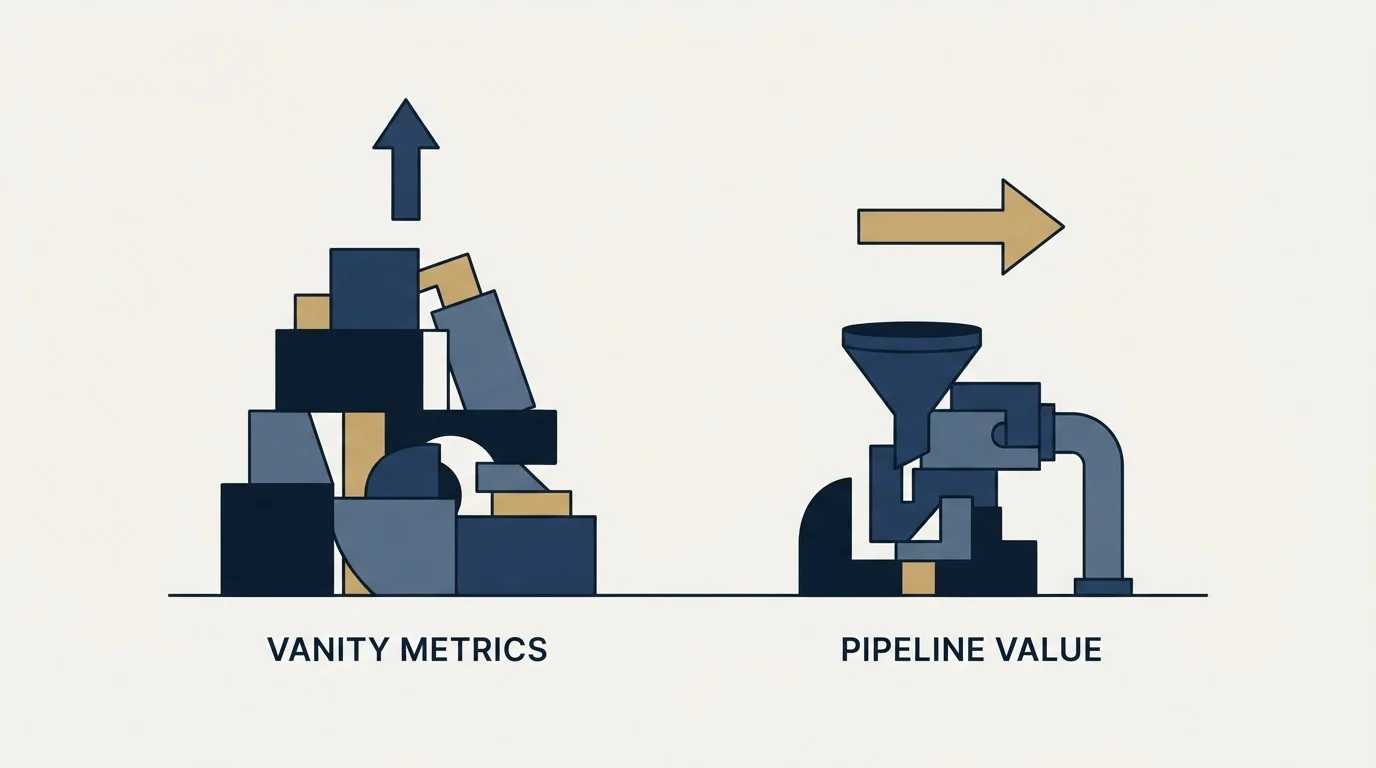
Sessions measure attraction only. Form fills measure attraction times capture. Conversations measure all three, and it is the only one of the three that a business decision should rest on.
Track the two conversion rates separately, because they are moved by completely different work. Visitors to captured people is an offer question. Captured people to conversations is a response question and a targeting question. A programme that is weak at the second one gets worse when you fix the first, because more of the wrong people arrive faster.
The one number worth adding is where the eventual customers first arrived, kept as a separate record from where they converted. Those are usually different pages and most attribution gives all the credit to the second. A page that creates demand and hands it to a comparison page to capture looks like a failure in every dashboard and is doing the most important work on the site.
An example of what the whole chain looks like when the response job is actually staffed is in 429 inbound leads in 10 days.
Where we differ from standard practice
Standard practice for a captured lead who goes quiet is a scheduled run of educational emails until they respond. We never run those. One message per campaign, sent once, built on one premise.
The reasoning applies with particular force to inbound. A person who identified themselves and then went quiet has given you real information: whatever they were doing that day, they are not doing now. Adding scheduled messages to that silence does not change the fact, it just puts your name next to the feeling. When a genuine new reason to write appears, we write once about that reason, and it is a new campaign rather than the next item on a timer. The full argument is in we stopped using follow-up emails.
Where inbound stops

Inbound reaches people who are looking. That is its strength and it is also its boundary: an account that has never searched for anything in your category is invisible to it, however good the content. If the accounts you want are nameable and are not searching, the instrument for reaching them is a different one, and the three-state model that decides which play an account needs is in demand creation, capture and conversion.
The short version
Publishing more helps only if attraction is the constraint, and it usually is not. Find out which of the three jobs is leaking by tracking two conversion rates rather than one. Change what you offer to make readers describe their situation, then give someone the actual job of replying to them quickly with something specific.
If you want to see the accounts that will never find you through search, and what one researched message to twenty of them would say, we will build it: free campaign.
Frequently asked questions.
Frequently asked questions- Why is our traffic growing but our pipeline flat?
- Almost certainly because attraction was never the constraint. Adding traffic multiplies whatever your capture and response rates already are, so a site that converts poorly converts the same proportion of a bigger number. Measure visitors to captured people and captured people to conversations separately, and fix whichever is lower.
- What should we offer to capture inbound leads?
- Something that requires the reader to tell you about their situation to get value, such as a calculator, an assessment or an audit of their own asset. It converts a smaller percentage than a general download and produces people you can write to specifically, which is the half that turns into conversations.
- How fast do we need to reply to an inbound enquiry?
- Fast enough to reach them while they are still thinking about the problem that made them enquire, which is usually the same working day rather than the next one. The fix is organisational rather than technical: name an owner by time of day instead of by territory, since territory routing is a reporting convenience that costs hours.
- Should inbound leads go into an automated email track?
- We do not run those. A person who identified themselves and then went quiet has told you that whatever they were doing that day, they are not doing now. Scheduled messages do not change that and put your name beside the feeling. When a genuine new reason to write appears, send one message about that reason.
About the author.

Ben Carden is CRO at RevenueFlow, which builds and operates outbound revenue engines for B2B companies. Previously at Gartner Enterprise. Studied at London School of Economics.
Ben Carden · CRO
Connect on LinkedIn →Explore more.
Ready to scale your outreach?
We build GTM engines that book real meetings. See the receipts.
Related articles.
eWebinar Pricing: Two Meters and a Level That Moves
eWebinar does not ask you to pick a plan. Published webinars set the level and registrants set the overage, and the two directions do not move on the same schedule.
BrightTALK Pricing: What the Vendor Does Not Publish
Six BrightTALK surfaces carry no price at all. The $500 figure filling that gap is a 2022 scrape on a listing the vendor says it does not manage.
Goldcast Belongs to Cvent Now: The Buying Question
Cvent announced its Goldcast acquisition in December 2025 and completed its ON24 acquisition in April 2026. Two shortlist names, one owner, one live contract question.
On-Demand Webinars: What Changes When You Take the Date Away
A live webinar earns most of its value from the date. Removing it keeps the topic signal and the address, and loses the deadline, the burst and the room.
Define Content Syndication: Two Purchases Behind One Word
One budget line, two different purchases. Republication buys reach; lead syndication buys contact records produced by a download. The deliverable tells you which.
Lead Generation Statistics: The Denominator Nobody States
One roundup lists the same budget statistic twice in different words, and three list one finding under three different attributions. The genre explains itself.