Three Buyer States: Demand Creation, Capture, Conversion
Every B2B buyer sits in one of three states: not aware, shortlisting, or ready to buy. Each needs a different play, a different stack, and a different metric.
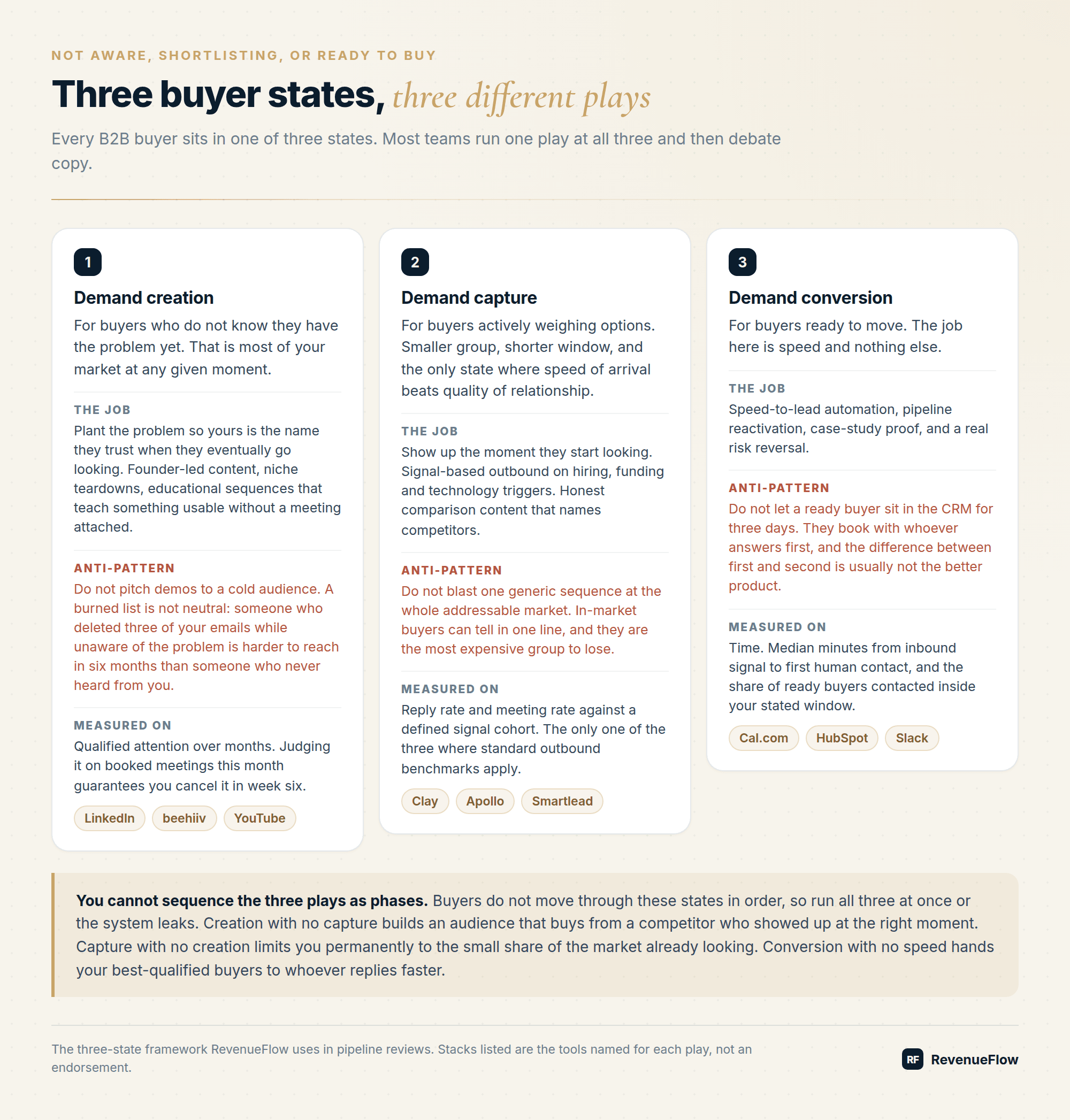
Every B2B buyer sits in one of three states: not aware, shortlisting, or ready to buy. Demand creation plants the problem with content for unaware buyers, demand capture uses signal-based outbound and comparison content for buyers weighing options, and demand conversion competes on speed for buyers ready to move. All three must run at once.
Key takeaways
- B2B buyers occupy one of three states at any moment: not aware, shortlisting, or ready to buy, and each state needs a different play and stack.
- Demand creation runs on founder-led content, niche teardowns, and educational sequences, with LinkedIn, beehiiv, and YouTube as the stack.
- Demand capture runs on hiring, funding, and technology triggers plus honest comparison content, with Clay, Apollo, and Smartlead as the stack.
- Demand conversion is a speed problem, run on speed-to-lead automation, pipeline reactivation, and risk reversal through Cal.com, HubSpot, and Slack.
- The three anti-patterns are pitching demos to a cold audience, blasting one generic sequence at the whole addressable market, and leaving a ready buyer in the CRM for three days.
- Buyers do not move through the states in order, so the three plays run in parallel rather than as phases, and each needs its own metric instead of one shared meetings-booked number.
Reviewed and updated September 5, 2026
Three Buyer States, Three Plays: Demand Creation, Capture, and Conversion
Demand creation and demand capture are different jobs. Mixing them up is costing you pipeline, and the symptom is a campaign that looks competent and produces nothing.
Every B2B buyer sits in one of three states. Not aware, shortlisting, or ready to buy. Each state needs a different play. Most teams run one play at all three and then debate copy.
- The job is to plant the problem so that yours is the name they trust when they eventually go looking
- The anti-pattern: do not pitch demos to a cold audience
- Measured on qualified attention over months
- Stack: LinkedIn, beehiiv, YouTube.
- The job is to show up the moment they start looking
- The anti-pattern: do not blast one generic sequence at the whole addressable market
- Measured on reply rate and meeting rate against a defined signal cohort
- Stack: Clay, Apollo, Smartlead.
- The job here is speed and nothing else
- The anti-pattern: do not let a ready buyer sit in the CRM for three days
- Measured on median minutes from inbound signal to first human contact
- Stack: Cal.com, HubSpot, Slack.
1. Demand creation
For buyers who do not know they have the problem yet. That is most of your market at any given moment, and it is the group that generic outbound damages rather than converts.
The job is to plant the problem so that yours is the name they trust when they eventually go looking. Founder-led content, niche teardowns, educational sequences that teach something usable without a meeting attached.
The anti-pattern: do not pitch demos to a cold audience. You burn the list before it warms up, and a burned list is not neutral. The person who deleted three of your emails while unaware of the problem is harder to reach in six months than someone who never heard from you at all.
Stack: LinkedIn, beehiiv, YouTube.
2. Demand capture
For buyers actively weighing options. Smaller group, shorter window, and the only state where speed of arrival beats quality of relationship.
The job is to show up the moment they start looking. Signal-based outbound on hiring, funding, and technology triggers. Honest comparison content that names competitors, because that is what people in this state are searching for.
The anti-pattern: do not blast one generic sequence at the whole addressable market. In-market buyers can tell in one line, and they are the most expensive group to lose because they were going to buy something from someone this quarter.
Stack: Clay, Apollo, Smartlead.
3. Demand conversion
For buyers ready to move. The job here is speed and nothing else. Speed-to-lead automation, pipeline reactivation, case-study proof, and a real risk reversal.
The anti-pattern: do not let a ready buyer sit in the CRM for three days. They book with whoever answers first, and the difference between first and second is usually not the better product.
Stack: Cal.com, HubSpot, Slack.
How to tell which state an account is in
The framework is easy. Diagnosing a specific account is where teams stall, and the post that started this article did not answer it. Here is the version we actually use.
Signals that an account is in creation. No relevant job postings. No relevant technology in their stack. No visits to your site. Nobody from the company has engaged with anything you published. Absence of signal is itself the signal, and the correct read is that you have not earned attention yet.
Signals that an account is in capture. A hire that implies the problem, such as a first RevOps or first SDR role. A funding round that unlocks the budget line. A competitor's tag appearing on their site. Repeat visits to a pricing or comparison page. The account is doing research, and research produces observable exhaust. That exhaust is what B2B intent data sells and what website visitor identification tools surface at the account level, with tools in the RB2B category pushing it toward the individual level.
Signals that an account is in conversion. They filled a form, replied to a thread, booked and cancelled, or asked a pricing question. Every one of these is a self-declaration, and it has a shelf life measured in hours.
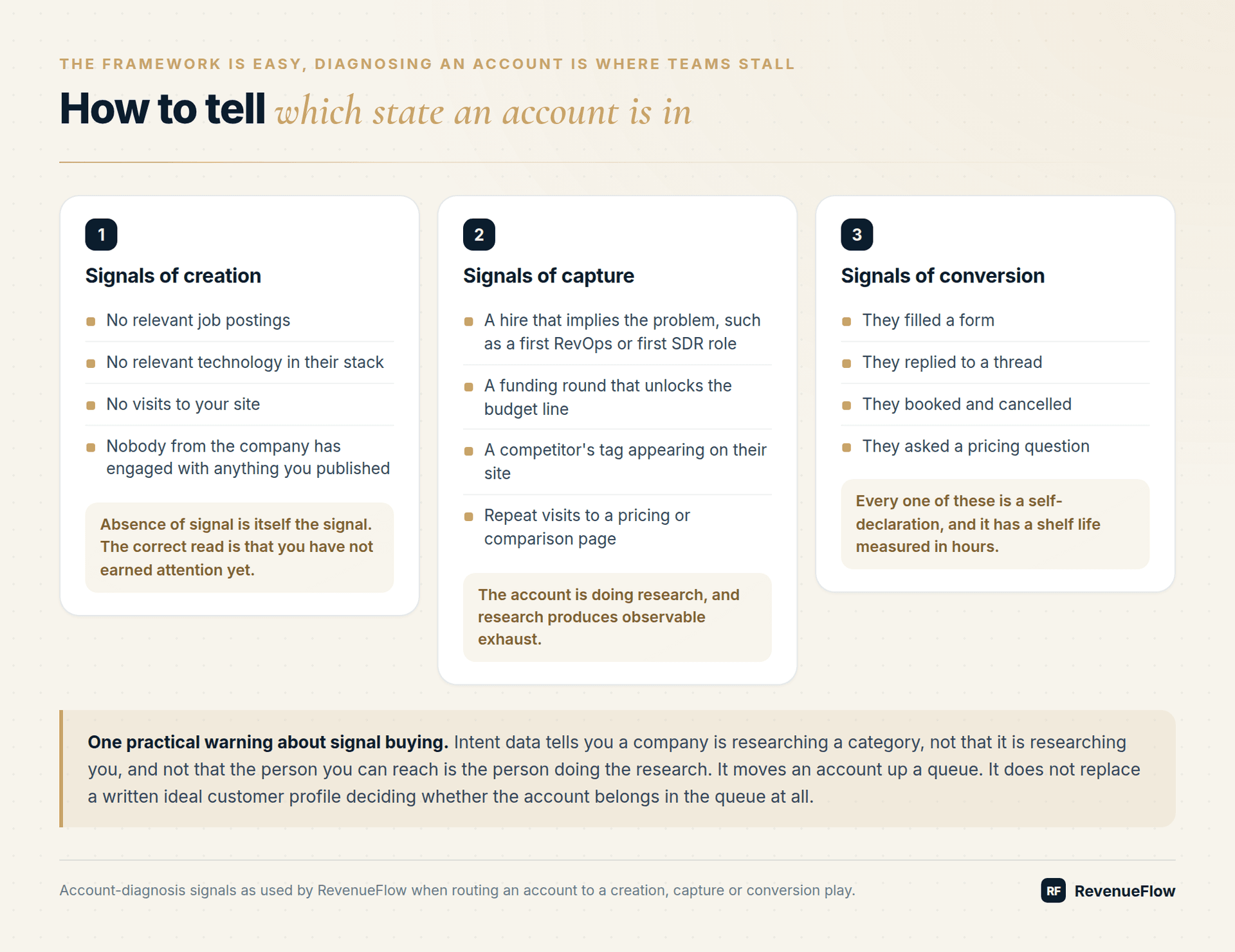
One practical warning about signal buying. Intent data tells you a company is researching a category, not that it is researching you, and not that the person you can reach is the person doing the research. It moves an account up a queue. It does not replace a written ideal customer profile deciding whether the account belongs in the queue at all.
Different states need different metrics
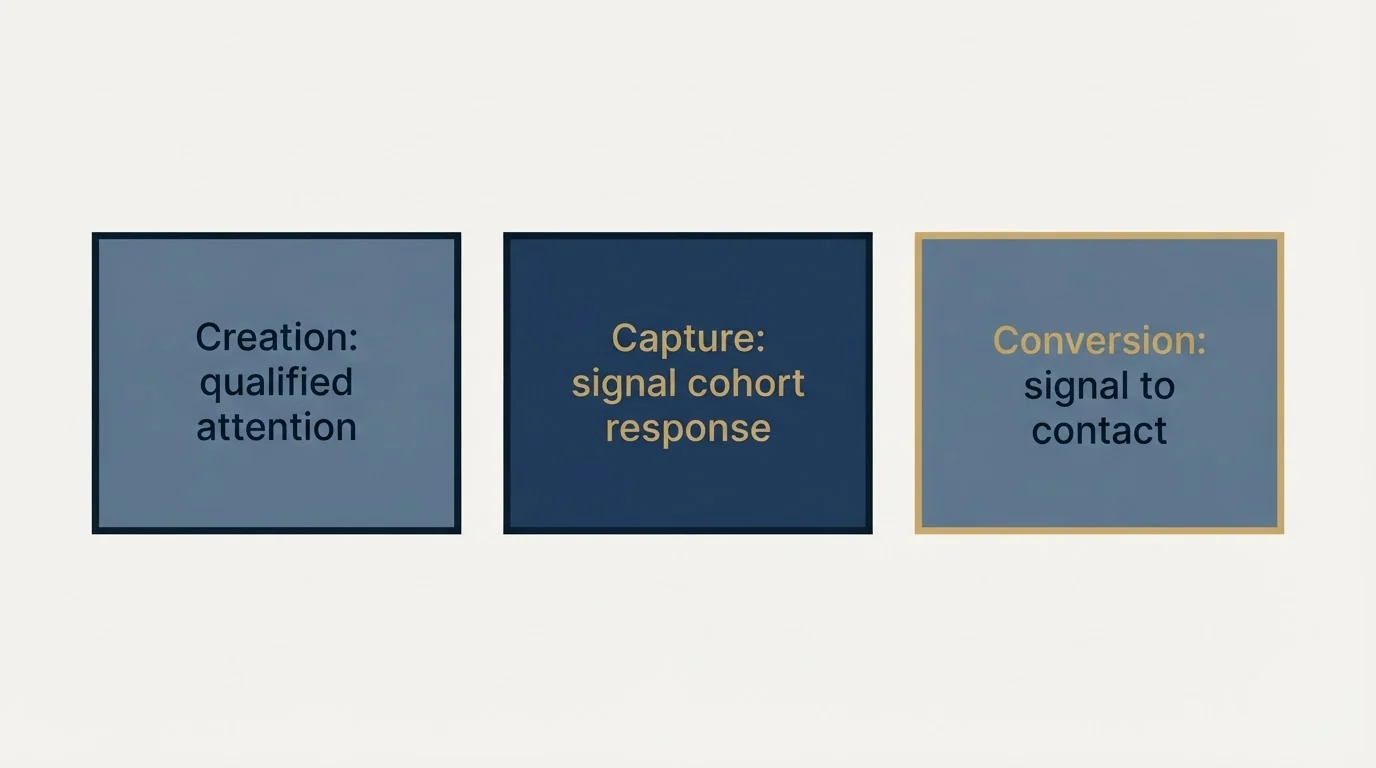
This is where most reporting goes wrong. Teams apply one number, usually meetings booked, to all three plays, and then kill the play that was working.
Rethinking how you measure pipeline against revenue matters more now that the collapse of per-seat pricing is reshaping what growth even means for GTM vendors.
Creation should be measured on qualified attention over months: who from your target accounts is reading, subscribing, replying to things that are not offers. Judging it on booked meetings this month guarantees you cancel it in week six.
Capture is measured on reply rate and meeting rate against a defined signal cohort. This is the only one of the three where standard outbound benchmarks apply, and it is the play the classic outbound sales playbook was written for.
Conversion is measured on time. Median minutes from inbound signal to first human contact, and the percentage of ready buyers contacted inside your stated window. If you have never measured that number, measure it before you change anything else. It is usually much worse than the team believes.
The caveat that breaks the neat diagram
Buyers do not move through these states in order.
A cold prospect who has never heard of you can hit your calendar link tomorrow because a peer mentioned you in a group chat. Someone who has been shortlisting for a month can fall out of market when a budget freezes. The three states are a description of where an account is right now, not a funnel it walks down.
Which means you cannot sequence the three plays as phases. Run all three at once, or the system leaks. Creation with no capture builds an audience that buys from a competitor who showed up at the right moment. Capture with no creation limits you permanently to the small share of the market already looking. Conversion with no speed hands your best-qualified buyers to whoever replies faster.
Where the work actually goes
For most teams the honest allocation is not equal thirds. Conversion is the cheapest to fix and gets fixed first, because it is an operations problem with a known answer: shorten the response window and remove the handoffs. Capture is next, because the signals are purchasable and the plays are well understood. Creation is last to show results and first to be cut, which is why so few companies have one.
A yearlong spending breakdown shows which creation and capture plays actually survived real budget testing, and which did not.
If you are choosing where to spend, fix conversion this week, build capture this quarter, and start creation now so that it exists in a year. The compounding version of that last one, turning published work into pipeline, is the view-to-value framework, and if you would rather buy the capability than build it, that is the job a demand generation agency should be doing.
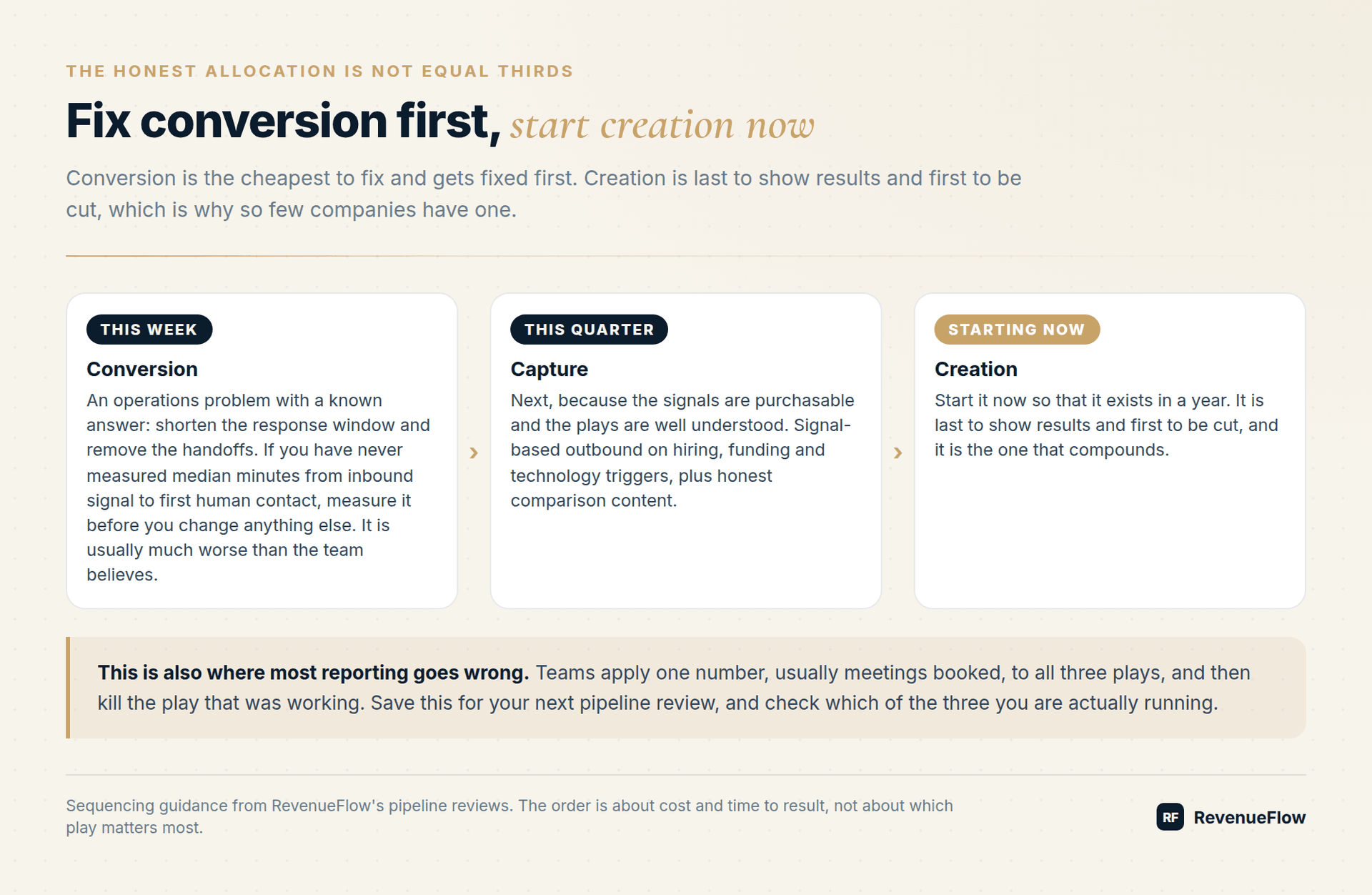
Save this for your next pipeline review, and check which of the three you are actually running.
RevenueFlow builds AI-native pipeline systems and you pay per qualified meeting, not a retainer. No paying for activity. You only pay when we book you a qualified sales meeting. See if you qualify.
Frequently asked questions.
Frequently asked questions- What is the difference between demand creation and demand capture?
- Demand creation targets buyers who do not yet know they have the problem, planting it through content so you are the trusted name when they start looking. Demand capture targets buyers already weighing options, reaching them through hiring, funding, and technology signals plus comparison content. Creation builds a future market. Capture competes for the current one.
- How do I tell which state a target account is in?
- Read the signals. No relevant hires, no relevant technology, no site visits, and no engagement means creation. A telling hire, a funding round, a competitor's tag, or repeat pricing-page visits means capture. A form fill, a reply, or a pricing question means conversion, and that state has a shelf life measured in hours.
- Can I run demand creation, capture, and conversion as sequential phases?
- No. Buyers do not move through the states in order. A cold prospect can book a call tomorrow after a peer mentions you, and a shortlisting account can drop out when a budget freezes. Running the plays as phases leaves the other two states unserved, which is where pipeline leaks.
- Which demand play should a small team fix first?
- Conversion, because it is the cheapest to fix and has a known answer: shorten the response window and remove handoffs. Capture comes next since the signals are purchasable and the plays are well understood. Creation takes longest to show results, so start it now if you want it working in a year.
About the author.

Tim Carden is CMO / CTO at RevenueFlow, which builds and operates outbound revenue engines for B2B companies. Studied at McGill University.
Tim Carden · CMO / CTO
Connect on LinkedIn →Explore more.
Ready to scale your outreach?
We build GTM engines that book real meetings. See the receipts.
Related articles.
ZoomInfo Renamed Its Ticker to GTM. It Now Trades Under $1B
ZoomInfo took the ticker GTM in May 2025. By late July 2026 it traded under $1B. Here is what the GTM software category is actually worth, with dates attached.
We Burned $430K on Go-To-Market. Here Is What Survived
In 2025 we spent more than $430K testing go-to-market plays. Six survived. Here is what the money bought, what it did not, and what I would do differently.
The 15 Most Valuable AI Companies Founded After ChatGPT
The 15 most valuable AI companies founded after ChatGPT are worth about $160B. The top sales agent company ranks last at $1.2B, and the gap has a cause.
Per-Seat Pricing Is Dying: The Market Is Pricing the Funeral
Six go-to-market software companies lost $224B in 19 months. Every one ships AI, so AI is not the variable. Seat pricing is, and HubSpot proved it publicly.
The Paris AI Map: 23 Companies and $35B
23 AI companies, more than $35B of reported value, and 10 of them inside one 2km circle. Here is the Paris AI map and why the density is the real asset.
We Spent $100K Testing Sales Tech. 8 Layers Survived
There are 4,664 tools in the sales tech market. We spent about $100,000 testing them and kept eight layers, in a fixed order, with one owner each.