We Spent $100K Testing Sales Tech. 8 Layers Survived
There are 4,664 tools in the sales tech market. We spent about $100,000 testing them and kept eight layers, in a fixed order, with one owner each.
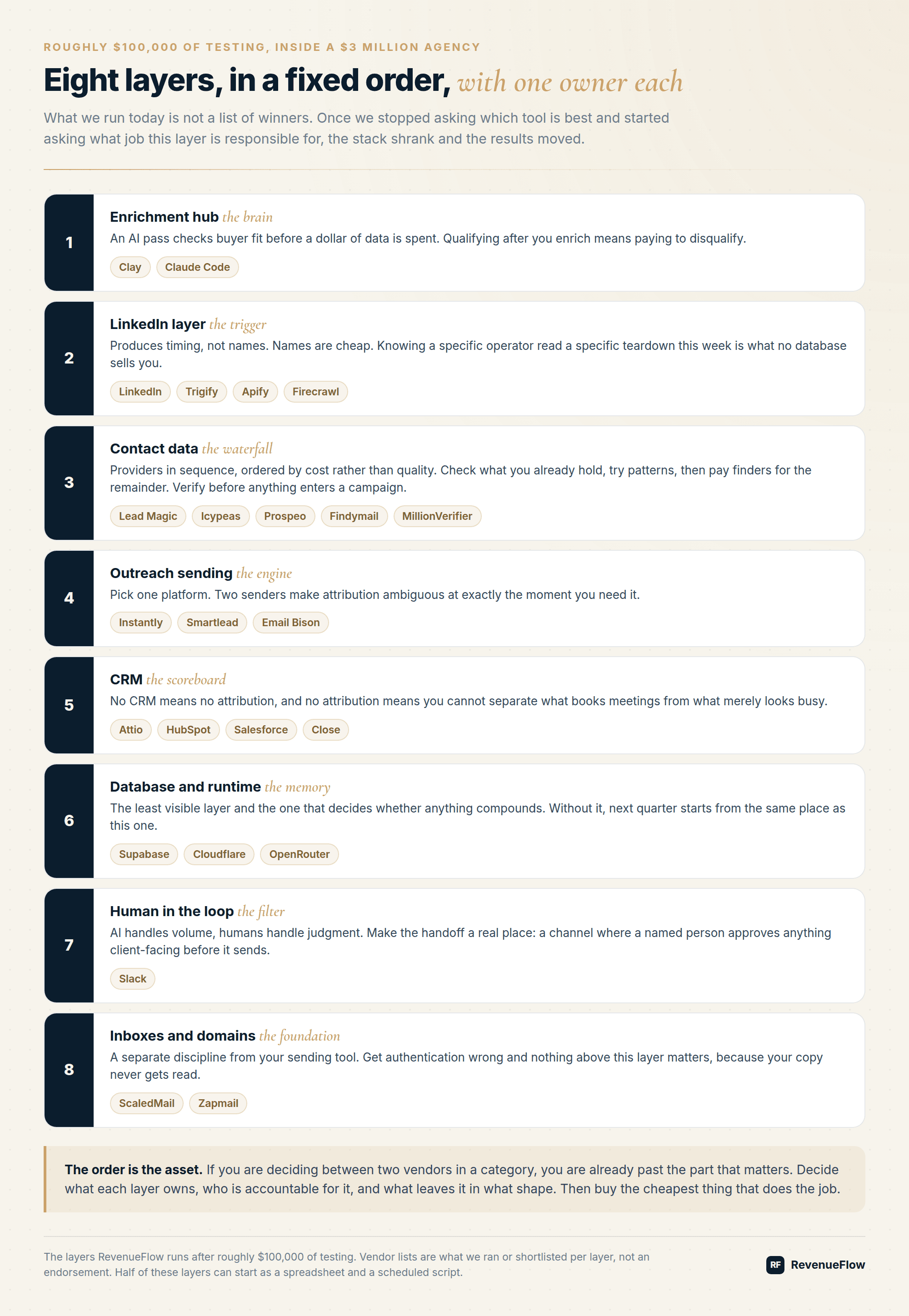
A working sales tech stack is organised as eight layers rather than a tool list: enrichment, LinkedIn signals, the contact data waterfall, sending, CRM, database and runtime, human review, and inbox infrastructure. Each layer gets one owner and one job. Scoring buyer fit before enrichment removes roughly 70 percent of leads before any data is bought.
Key takeaways
- RevenueFlow spent roughly $100,000 testing sales tech tools and reduced the working stack to eight layers rather than a list of preferred vendors.
- Running an AI buyer-fit check before enrichment filters out about 70 percent of leads on RevenueFlow's lists before any data spend.
- The contact data waterfall runs cheapest first: addresses already held cost nothing, pattern guesses cost a fraction of a penny, and paid finders run last.
- Running a single sending platform avoids the extra dashboards and analytics silos where campaigns break quietly.
- The operating rule is one owner per layer with clear handoffs and no overlap, against a common pattern of 12 tools doing 6 jobs with nobody owning the system.
- Inbox and domain infrastructure is a separate layer beneath the sending tool, so authentication and domain health decide whether copy quality matters at all.
Reviewed and updated September 5, 2026
We Spent $100K Testing Sales Tech. The 8 Layers That Survived.
There are 4,664 tools in the sales tech market by the count I was working from when we started buying them. We spent roughly $100,000 testing them. What we run today inside a $3 million agency is not a list of winners. It is eight layers, in a fixed order, with one owner each.
That distinction took most of the $100,000 to learn.
Those eight layers are a GTM tech stack, described from the execution side. The term is worth pinning down because it is drawn wider elsewhere: Apollo's own definition of a GTM tech stack has it spanning prospecting, outreach, pipeline management and customer success, and it explicitly separates the GTM tech stack from a traditional sales stack on the grounds of cross-functional alignment. Nothing below covers the post-sale half, so read this as the pre-sale core: the layers that decide whether a list ever becomes a booked meeting.
The market count is softer than it looks
Worth saying up front, because the number gets quoted without a source. Landscape maps disagree with each other, so any single figure is a boundary decision rather than a census. Scott Brinker's martech map has passed 14,000 solutions. Nancy Nardin's sales tech landscape counted closer to 600 vendors when she drew the line tightly around selling. Both are honest. They are measuring different things.
The practical version holds either way. There are more credible options inside any one category than a team can evaluate, and buying the best-reviewed product in every category still produces a stack that does not work. Ours did not work for about a year.
What the money actually bought
Mostly negative knowledge. Tools we ran for a month and removed. Two overlapping enrichment products billing us in the same week for the same records. A sequencer we could not cleanly get our own data back out of. None of that is glamorous and none of it shows up in a stack screenshot.
The useful output was structural. Once we stopped asking which tool is best and started asking what job this layer is responsible for, the stack shrank and the results moved. Here are the eight layers in the order they matter.
An SDR tech stack is these same eight layers seen from one seat, so the question worth asking is never which tools the rep has but which of the eight has an owner.
- Yes: Enrichment hub: the brain
- Yes: LinkedIn layer: the trigger
- Yes: Contact data: the waterfall
- Yes: Outreach sending: the engine
- Yes: CRM: the scoreboard
- Yes: Database and runtime: the memory
- Yes: Human in the loop: the filter
- Yes: Inboxes and domains: the foundation
1. Enrichment hub: the brain
Most teams enrich every lead the same way, then qualify whatever comes back. We do it in the other order. An AI pass checks buyer fit first, and if a company does not pass, we do not spend a dollar on data for it. On our lists that filters out about 70 percent of leads before enrichment starts.
The saving compounds because enrichment is priced per record. Qualifying after you enrich means paying to disqualify. Reversing the order turns a data budget into a budget for accounts you actually want. The gate is only ever as good as the document behind it, which is why a written ideal customer profile is the real first layer for most teams.
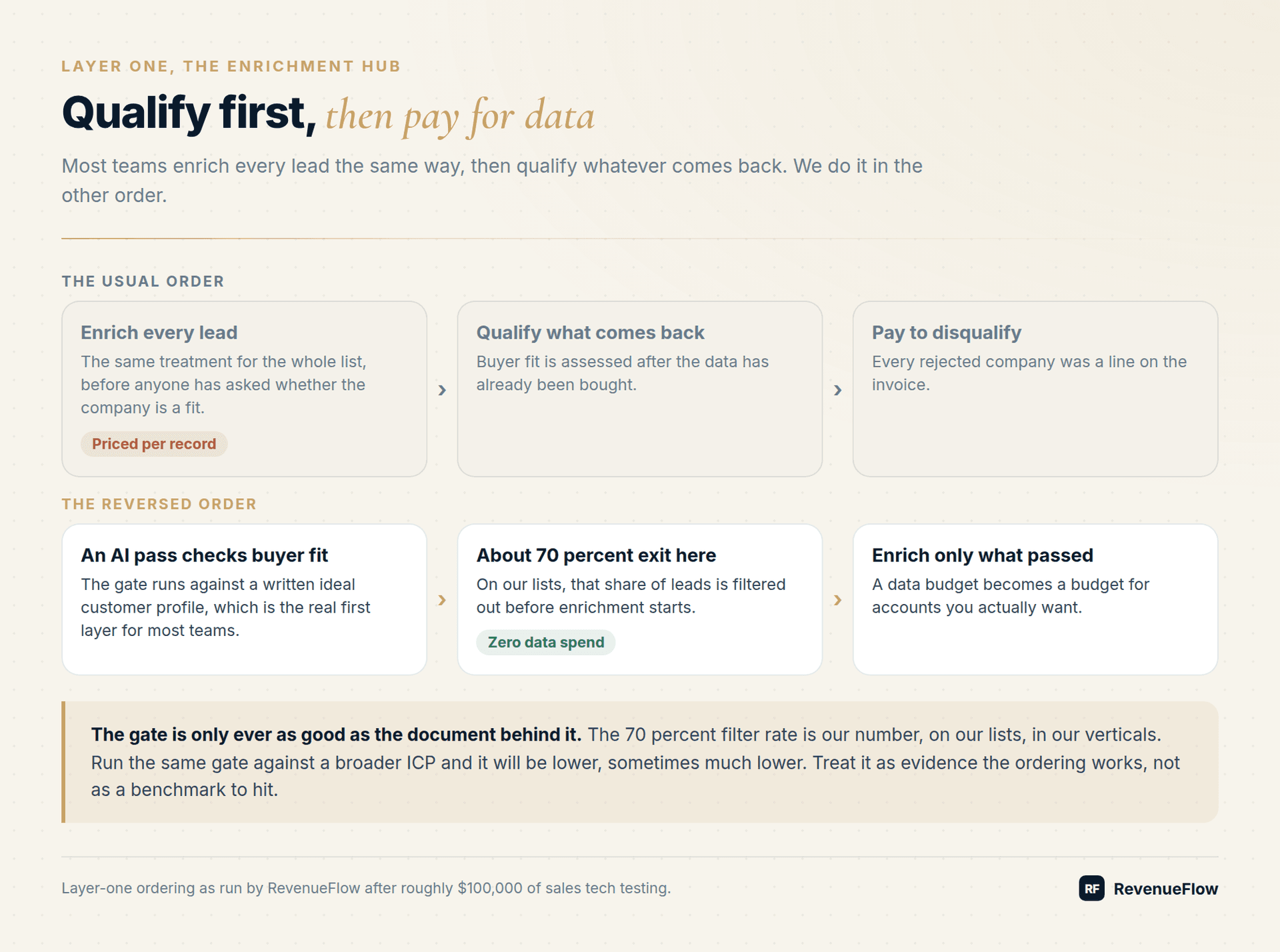
Tools: Clay, Claude Code.
2. LinkedIn layer: the trigger
Post content, track who engages with it, and feed those signals into outreach. Engagers are the warmest list you own because they already know who you are, and the list refreshes itself every time you publish.
The mechanism people miss: this layer produces timing, not names. Names are cheap. Knowing that a specific operator read a specific teardown this week is the thing no database sells you.
Tools: LinkedIn, Trigify, Apify, Firecrawl.
3. Contact data: the waterfall
One provider misses a large share of contacts on any real list. Running providers in sequence fixes coverage, but the order is a cost decision, not a quality decision. Check whether you already hold the address, which is free. Try common patterns next, which costs a fraction of a penny. Only hit paid finders for what is left.
Then verify before anything enters a campaign. Bounces are the fastest way to teach a mailbox provider to distrust you, and the damage outlives the campaign that caused it. If you are choosing between providers at that step, we compared the main options in our guide to email verification tools.
Tools: Lead Magic, Icypeas, Prospeo, Findymail, MillionVerifier. Icypeas's own tiers, its credit menu and its per-action rates as published on 4 September 2026 are on this site's Icypeas pricing page.
4. Outreach sending: the engine
Pick one platform. Every extra sending tool adds another dashboard, another analytics silo, and another place a campaign can break quietly for a week before anyone notices.
Two senders also make attribution ambiguous at exactly the moment you need it, which is when something stops working and you are trying to tell whether the cause is copy, list, or infrastructure.
Tools: Instantly, Smartlead, Email Bison.
5. CRM: the scoreboard
No CRM means no attribution, and no attribution means you cannot separate what books meetings from what merely looks busy. The requirement here is low. One system of record, fields that match your actual stages, and rules deciding ownership instead of reps deciding it.
Tools: Attio, HubSpot, Salesforce, Close.
6. Database and runtime: the memory
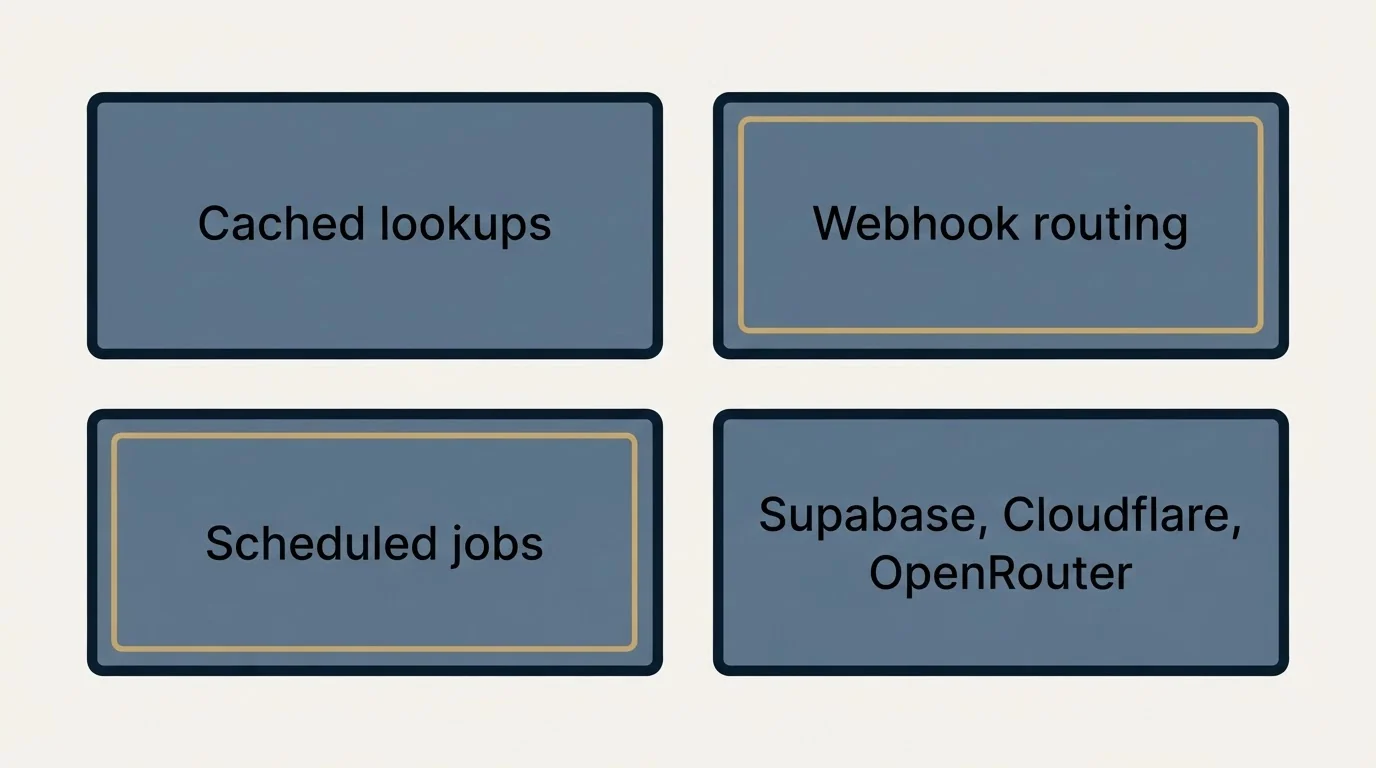
Cached lookups, webhook routing, scheduled jobs. This is the least visible layer and the one that decides whether anything compounds. Without it, every process stays manual, every result is thrown away after it is read, and next quarter starts from the same place as this one.
Tools: Supabase, Cloudflare, OpenRouter.
7. Human in the loop: the filter
AI handles volume. Humans handle judgment. Automate everything except decisions that need context, and make the handoff a real place rather than an intention. For us it is a Slack channel where a named person approves anything client-facing before it sends.
Tools: Slack.
8. Inboxes and domains: the foundation
Sender infrastructure is a separate discipline from your sending tool, with its own vendors and its own failure modes. Dedicated domains, warmed inboxes, authentication set up correctly, health monitored continuously. Get SPF, DKIM and DMARC wrong and nothing above this layer matters, because your copy never gets read.
This is also the layer where we deliberately overbuy. We explained the reasoning in why we buy three times more email infrastructure than we need, and the short version is that spare capacity is cheaper than a burned domain pool.
Tools: ScaledMail, Zapmail.
The one rule that holds it together
One owner per layer, clear handoffs, no overlap.
Most teams run 12 tools doing 6 jobs with nobody owning the full system. That is the actual failure mode, and it does not look like a failure from the inside. Every individual tool works. Every dashboard shows green. Meanwhile leads sit between two layers because both owners assume the other one has them, and the only person who could see the whole path is the founder, who is busy.
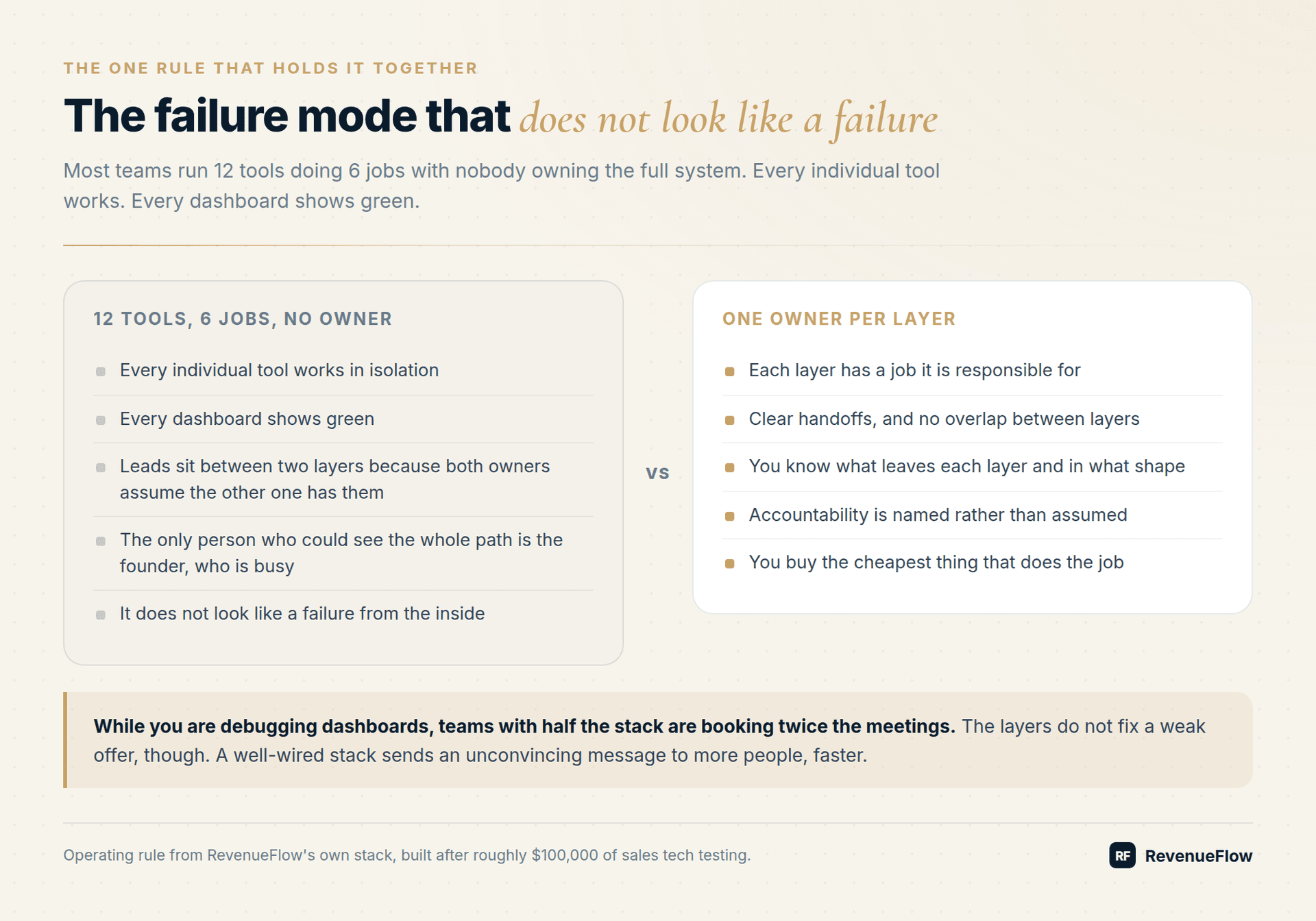
While you are debugging dashboards, teams with half the stack are booking twice the meetings.
What this does not fix
The layers do not fix a weak offer. A well-wired stack sends an unconvincing message to more people, faster.
The 70 percent filter rate is our number on our lists, in our verticals. Run the same gate against a broader ICP and it will be lower, sometimes much lower. Treat it as evidence the ordering works, not as a benchmark to hit.
And the layers are not a purchase order. Half of them can start as a spreadsheet and a scheduled script. If you want the version that maps layers to specific vendor choices, our breakdown of how 50-plus tools connect covers it, and the seven-layer GTM AI stack is the closest thing to this argument written for a team building from zero.
The order is the asset
If you are deciding between two vendors in a category, you are already past the part that matters. Decide what each layer owns, who is accountable for it, and what leaves it in what shape. Then buy the cheapest thing that does the job.
That is also the honest case for running an agent across the layers rather than more people. Claude Code operating the whole stack removed most of our handoff cost, and comparing it against what an in-house SDR really costs is the arithmetic that made the decision easy.
We paid $100,000 to find out that the tools were the cheap part.
RevenueFlow builds AI-native pipeline systems and you pay per qualified meeting, not a retainer. No paying for activity. You only pay when we book you a qualified sales meeting. See if you qualify.
Frequently asked questions.
Frequently asked questions- How many sales tools does a B2B team actually need?
- Fewer than most teams own, and the count matters less than the coverage. Eight layers need to be covered: enrichment, LinkedIn signals, contact data, sending, CRM, database and runtime, human review, and inbox infrastructure. One tool can cover two layers. The failure pattern is 12 tools covering 6 jobs with nobody accountable for the whole path.
- Should I qualify leads before or after enrichment?
- Before. Enrichment is priced per record, so qualifying afterwards means paying to disqualify. Running an AI buyer-fit check against your ICP first removes around 70 percent of leads on our lists before any data spend, and the saving compounds on every campaign. The gate is only as good as the ICP document behind it.
- Is it worth running two cold email sending platforms?
- Generally no. A second sender adds another dashboard, another analytics silo, and another place a campaign can break quietly. It also makes attribution ambiguous exactly when you need it, which is when results drop and you are trying to tell whether the cause is copy, list quality, or infrastructure.
- Why is inbox infrastructure separate from the sending tool?
- Because it has its own vendors and its own failure modes. Domains, warmed inboxes, and authentication records sit underneath whichever platform you send from. If that layer is broken, your emails do not reach the inbox, and copy quality becomes irrelevant. Five years ago this was a checkbox inside a sequencer. It is now a discipline.
- How many tools are there in the sales tech market?
- It depends entirely on where the boundary is drawn. The count we worked from was 4,664. Scott Brinker's martech map has passed 14,000 solutions, while Nancy Nardin's sales tech landscape counted closer to 600 vendors with a tighter definition. All three are honest, and none of them changes the practical problem of too many credible options per category.
About the author.

Tim Carden is CMO / CTO at RevenueFlow, which builds and operates outbound revenue engines for B2B companies. Studied at McGill University.
Tim Carden · CMO / CTO
Connect on LinkedIn →Explore more.
Ready to scale your outreach?
We build GTM engines that book real meetings. See the receipts.
Related articles.
ZoomInfo Renamed Its Ticker to GTM. It Now Trades Under $1B
ZoomInfo took the ticker GTM in May 2025. By late July 2026 it traded under $1B. Here is what the GTM software category is actually worth, with dates attached.
The Tel Aviv AI Map: 24 Companies and a $32B Exit
Google closed a $32B acquisition in Tel Aviv and 23 more AI companies sit within 3km. The map, the exit velocity behind it, and what it means for your stack.
We Burned $430K on Go-To-Market. Here Is What Survived
In 2025 we spent more than $430K testing go-to-market plays. Six survived. Here is what the money bought, what it did not, and what I would do differently.
The 15 Most Valuable AI Companies Founded After ChatGPT
The 15 most valuable AI companies founded after ChatGPT are worth about $160B. The top sales agent company ranks last at $1.2B, and the gap has a cause.
Per-Seat Pricing Is Dying: The Market Is Pricing the Funeral
Six go-to-market software companies lost $224B in 19 months. Every one ships AI, so AI is not the variable. Seat pricing is, and HubSpot proved it publicly.
The Paris AI Map: 23 Companies and $35B
23 AI companies, more than $35B of reported value, and 10 of them inside one 2km circle. Here is the Paris AI map and why the density is the real asset.