Why We Buy 3x More Email Infrastructure Than We Need
It seems wasteful. Why pay for 30,000 sending capacity if the client only has 10,000 leads? Because deliverability is a game of margins.
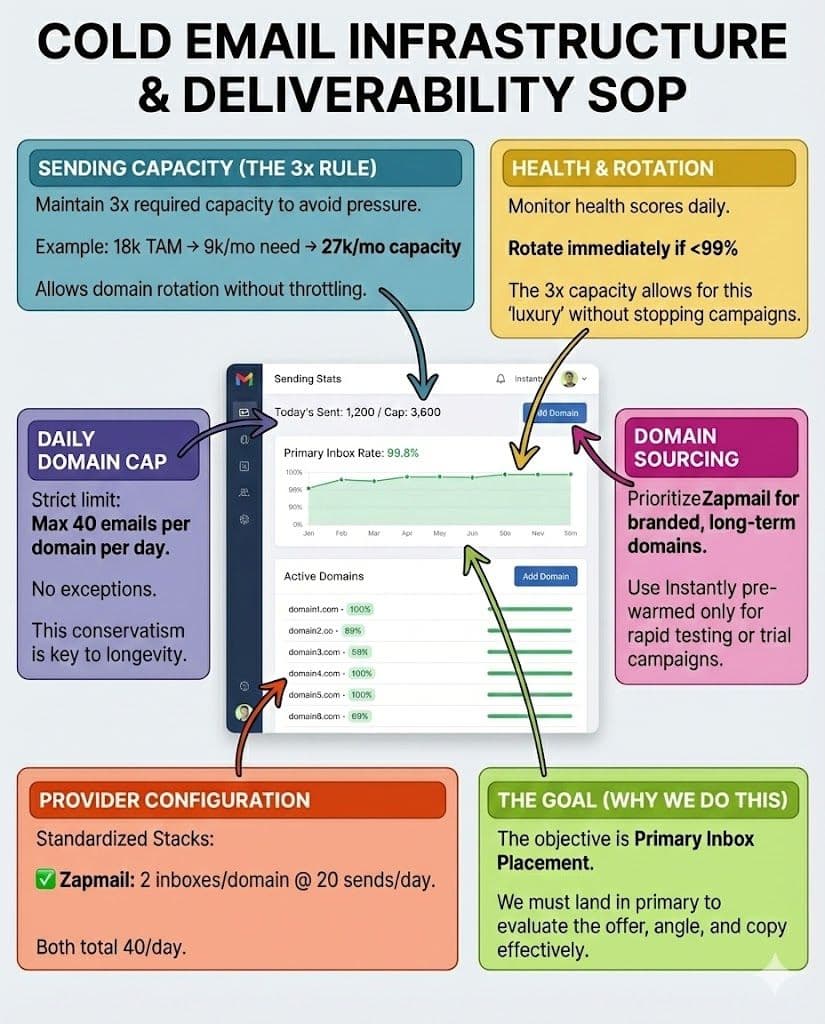
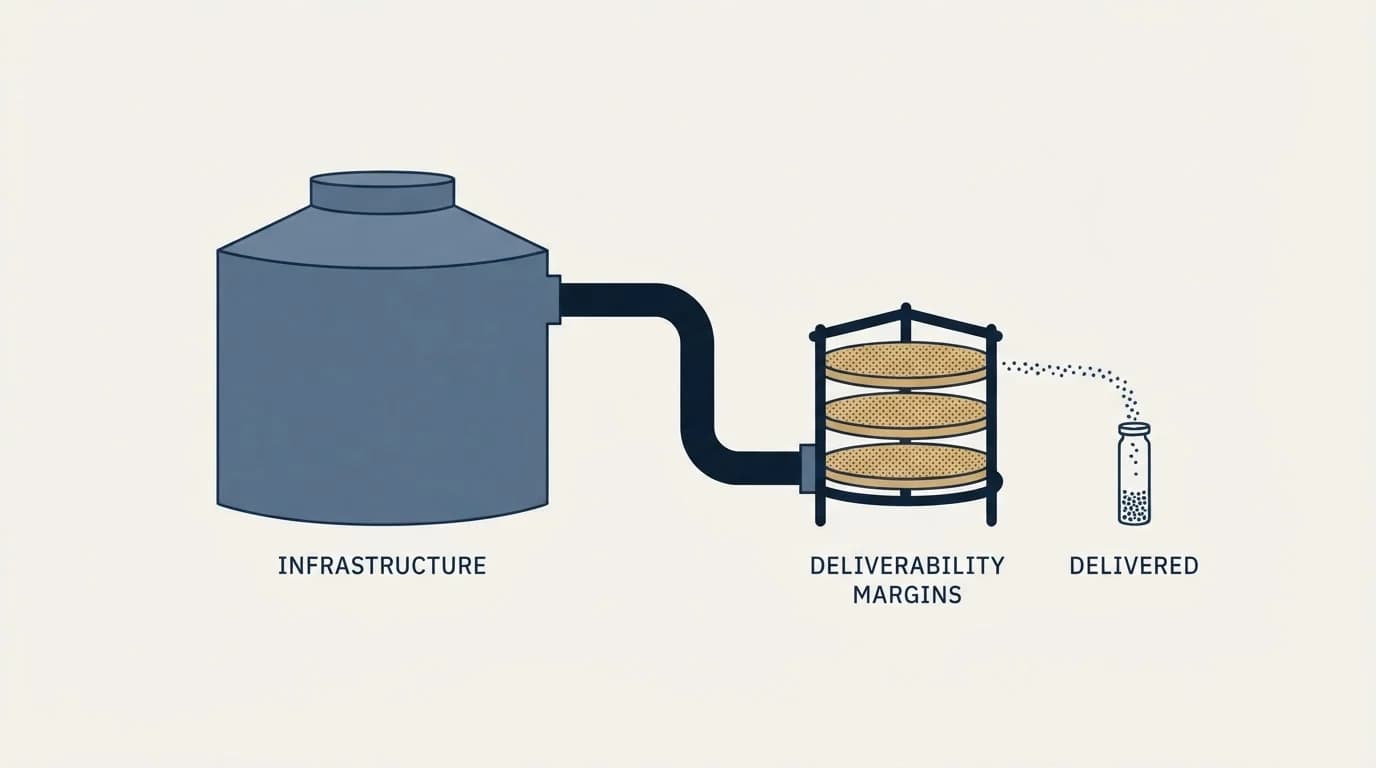
Buying roughly three times the sending capacity a campaign needs is what makes early action possible. A programme sized exactly to its plan cannot pull a slipping domain without losing volume, so it keeps sending from degrading infrastructure until the warning becomes an outage. Surplus capacity converts that reading into a same-day swap.
Key takeaways
- Capacity sized precisely to the plan removes every option. Pulling a domain costs volume the plan depends on, so the decision gets made by the constraint rather than by anyone's judgement.
- The replacement trigger is a domain falling below the health band it should be sitting in, never a domain performing well. A healthy domain stays in the pool.
- The surplus only works if the underlying sending stays conservative: two mailboxes on a domain at roughly 20 sends each, so about 40 sends a day from a domain, far below the provider ceiling.
- The cost comparison is between a small, known, recurring infrastructure line and a burned sending pool, which stops campaigns, has to be bought and warmed again anyway, and partly spends the audience that received mail into junk.
Reviewed and updated September 2, 2026
Why We Buy 3x More Email Infrastructure Than We Need
A client has 10,000 people to reach. We buy enough sending capacity for 30,000.
On the invoice that looks like waste. In practice it is the thing that keeps the programme running when a domain goes wrong, which one eventually does.
The Problem With Buying Exactly Enough
Capacity sized precisely to the plan removes every option you have when something moves.
A domain's reputation starts to slip, and you keep sending from it, because pulling it means missing the volume the plan depends on. Placement dips for two days running, and you push through and hope it recovers, for the same reason. An opportunity appears that would justify doubling volume next week, and the answer is no, because the runway does not exist.
Each of those is a decision made by the constraint rather than by anyone's judgement. You end up gripping the wheel tighter while sliding toward the junk folder, and the whole time you can see exactly what is happening.
What Surplus Capacity Buys

Three specific freedoms, all of which are unavailable to a programme running at its limit.
Rotation on the first warning rather than the last. A domain whose health reading drops below its healthy baseline gets replaced rather than nursed. This is the freedom that matters most, and it is worth being precise about the direction: the trigger for replacement is a domain falling below the band it should be sitting in, not a domain performing well. A programme with no spare capacity cannot act on an early warning at all, because acting means losing volume it cannot afford to lose. It waits for the warning to become an outage.
Volume that survives maintenance. Pulling a domain out of the pool changes nothing about what goes out that day, because other domains absorb it. There is no slow week while infrastructure gets fixed, and no conversation about why the campaign paused.
Room for the unplanned. A campaign that starts working can be scaled into. A new segment can be tested at real volume rather than at whatever volume is left over.
Teams with room to scale outreach still need every message to close well, and ending a cold email without a follow up explains how to finish with one clear ask.
- A domain's health reading slips
- Pulling it costs volume the plan needs
- The domain keeps sending while it degrades
- The problem is addressed once it is an outage
- Recovery competes with the campaign for attention
- A domain's health reading slips
- It comes out of the pool the same day
- Remaining domains absorb the volume
- The problem never reaches the campaign
- The domain recovers, or it is replaced
The Arithmetic
Take a client with 18,000 contacts to reach inside 60 days. That is 9,000 sends a month. Most providers would build capacity for 9,000 a month. We build for 27,000.
Those numbers are an illustrative example rather than a specific client's programme, and the multiplier is the part that carries over.
Illustrative example, not a specific client
To reach everyone inside 60 days
Three times the requirement
The capacity itself is assembled conservatively, because the surplus is pointless if the underlying sending is aggressive. Two mailboxes on a domain, roughly 20 sends per mailbox per day, so about 40 sends a day from a domain. Provider ceilings sit far above that. They mark the point at which the provider stops you rather than the point at which filters stop trusting you, and treating a ceiling as a target is how domains get consumed. The sizing arithmetic and the operating limits are set out in why we maintain 3x sending capacity.
Why Conservatism Wins
Pushing 60 to 80 sends a day through a single domain extracts more volume from the same inventory, which is the entire appeal. The cost arrives later than the benefit, and that gap is what makes the trade look good at the point of decision.
The mechanism is not mysterious. A mailbox running near its ceiling produces a volume pattern that is itself a signal, and it produces that pattern against recipients who have no relationship with the sender. When placement degrades, it degrades across the whole pool that was pushed the same way, so the failure is correlated rather than isolated. There is no version of this where the aggressive setting fails gently.
Recipients who have no relationship with the sender are the audience cold email targets, and what separates it from spam comes down to whether the sender can justify contacting them.
The conservative setting gives up month-one volume in exchange for a programme that is still sending in month twelve. It does not produce impressive numbers in a pitch deck. It produces domains that keep working.
Volume decisions also shape what each message can be, and the four-sentence BASHO format is documented as one that cannot be produced at high volume.
The Cost Calculation
The objection is obvious. Three times the infrastructure costs three times as much.
The infrastructure line does rise, and for most programmes it is a manageable number relative to what is spent on everything else in the outbound stack. Domains and mailboxes are among the cheapest components in the programme.
Set that against the alternative. A burned domain pool means campaigns stop, pipeline stops behind them, and the replacement inventory has to be bought and warmed anyway, which is the original cost arriving late plus four to six weeks of nothing. The list you were sending to is also partly spent, since the people who received mail that landed in junk cannot usefully be re-approached on the same angle.
The spare capacity is a known, small, recurring cost. The burned pool is an unknown, large, one-off cost that arrives at the worst possible time. Buying insurance that cheap is not a difficult decision once you have made the expensive version of it once.
How to Apply It
Scaling cold email without damaging the domain is this trade made deliberately: buy more inventory than the plan needs, send less from each part of it than the provider would allow, and keep the surplus so that an early warning can be acted on instead of noted.
Reply handling is the other half of that trade, and why a cold programme never sends from no-reply explains what an unmonitored mailbox costs a first contact.

-
Work out the real monthly send requirement. Contacts to reach, divided by the months you have to reach them. With one message per campaign this is simple arithmetic, because a campaign of 2,000 leads is 2,000 sends rather than a multiple of it.
-
Multiply by three. That is the capacity target, not the sending target.
-
Cap the per-domain rate and hold it. About 40 sends a day from a domain, spread across two mailboxes. The cap is the discipline that the surplus exists to protect.
-
Monitor daily and act on the first reading. Health, bounces, replies, placement. The surplus is what converts an early warning into an action instead of a note.
-
Rotate before you have to. Domains are consumable inventory with a working life. Treating them as permanent assets is what makes their eventual failure expensive.
This is an unexciting way to run infrastructure. It generates no case studies about tripling volume in 30 days. It does mean that when a domain goes wrong, which one will, the answer is to swap it out and carry on.
The Bottom Line
The cost of surplus capacity is known, small and recurring. The cost of a burned sending pool is unknown, large and badly timed.
Over-build the inventory. Under-send from each part of it. The programme that is still landing in month twelve beats the one that peaked in month one.
Related Reading
- Why We Maintain 3x Sending Capacity for Every Client Campaign
- Cold Email Infrastructure: What You Are Actually Buying
- How We Cut Cold Email Costs by $2,600/Month: The Exact Infrastructure Switch
Want help building sending infrastructure that holds? Book a call to see how we approach deliverability.
Frequently asked questions.
Frequently asked questions- Why buy more email sending capacity than a campaign needs?
- Because the spare capacity is what lets you act on an early warning. A programme running at its limit sees the same slipping health reading and cannot respond, since pulling the domain means missing volume. It keeps sending from degrading infrastructure and addresses the problem once it has already become an outage.
- How many emails should you send per domain per day?
- About 40, structured as two mailboxes sending roughly 20 each. Published provider limits sit far above that and mark the point at which the provider stops you rather than the point at which filters stop trusting you. Treating a ceiling as a target is the most reliable way to consume a domain pool quickly.
- When should a sending domain be rotated out?
- When its health reading drops below the band it should be sitting in. The direction matters, because the rule is easy to write backwards: a falling reading is the trigger, and a healthy domain stays where it is. Acting early is only possible when spare capacity exists to absorb the domain leaving the pool.
- Is three times the infrastructure worth paying for?
- Domains and mailboxes are among the cheapest components in an outbound programme, so holding more of them raises a small line rather than the total. Set that against a burned pool, where campaigns stop, replacement inventory has to be bought and warmed anyway, and four to six weeks pass before anything sends again.
About the author.

Tim Carden is CMO / CTO at RevenueFlow, which builds and operates outbound revenue engines for B2B companies. Studied at McGill University.
Tim Carden · CMO / CTO
Connect on LinkedIn →Explore more.
Ready to scale your outreach?
We build GTM engines that book real meetings. See the receipts.
Related articles.
SMTP Reply Codes: What Each Class Instructs
The digits are a verdict and the text is the reason. Separating an address failure from a policy refusal before reacting is what decides whether the fix works.
Cold Email Frameworks: Which One Fits Your Offer
AIDA, PAS and Before-After-Bridge arrange the same four elements in different orders. What each one assumes about the reader, and what none of them fix.
SURBL Blacklist: What It Lists and How to Get Removed
SURBL tests the domains inside your message rather than your sending IP. Which of its six lists fired, what the bitmask means, and the fix that works.
Cold Email Marketing Service: Four Things, One Name
An agency, an infrastructure provider, a software onboarding tier and a freelancer all use the phrase. What each hands over, and the four questions that tell them apart.
SMTP Relay: What It Is, How It Routes Mail, and Where It Breaks
An SMTP relay passes mail on toward its destination. Buying one means renting somebody else reputation, subject to their rules about what you may send.
BASHO Email: Four Sentences Built on One Insight
A BASHO email is four or five sentences built on one researched insight about a specific person. The format is documented, and it cannot be produced at volume.