How to End a Cold Email When There Is No Second One
The ending of a cold email is four separate decisions and only one of them is compulsory. What each one is for, and which closing lines a single-send campaign rules out.
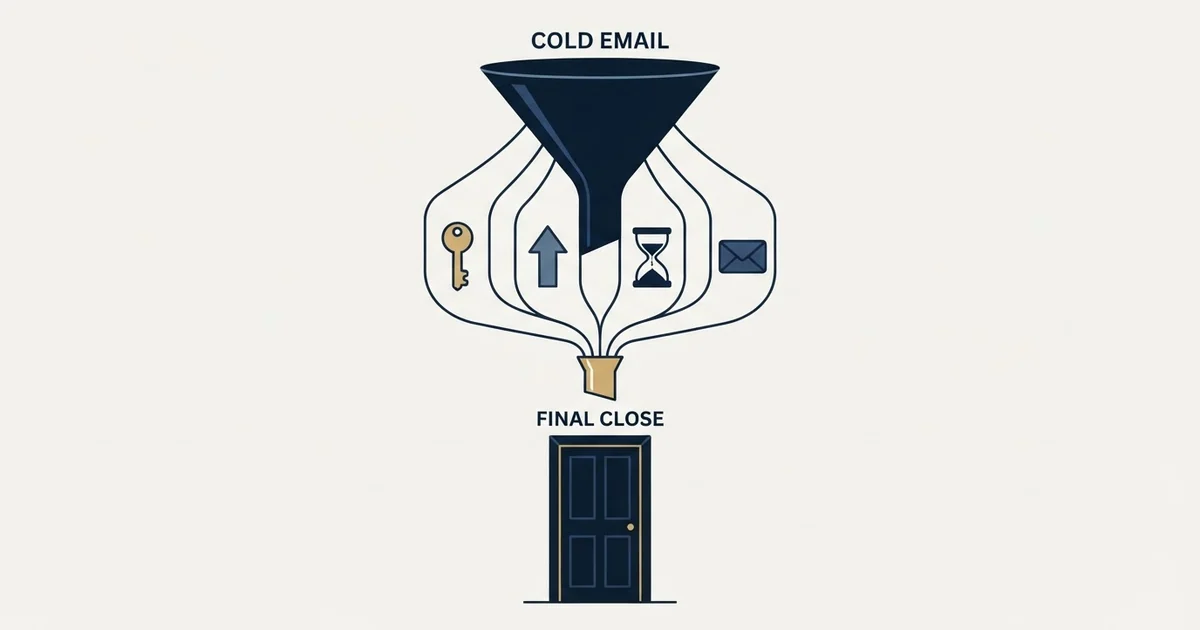
End a cold email with one specific, small ask that a stranger can answer in a sentence, a two or three word sign-off, and a signature carrying one checkable identity claim. Cut anything promising a follow-up you will not send. Make declining as easy as accepting, and keep the ending shorter than the argument above it.
Key takeaways
- An ending is four parts: closing line, ask, sign-off and signature. Only the ask has to be there.
- Two asks in one message produce none, because the reader has to choose and postponing is easier.
- Every 'I will follow up next week' variant is unusable in a campaign that sends one message.
- Read the last four lines with the body covered and ask what a stranger could do with them.
Reviewed and updated October 1, 2026
The first eleven lines of the draft are good. There is a real trigger, a premise that follows from it, and one claim sized to a stranger. Then the writer reaches the bottom of the message, types "Would love to connect and explore synergies. Let me know your thoughts, and I will follow up next week if the timing is off," adds a five-line signature with a logo in it, and sends. Everything above that paragraph was written for one named person. Everything below it was written for nobody, and it is the part that decides whether a reply happens.
The ending is where cold emails are lost most reliably, partly because it is written last and partly because almost nobody treats it as a set of separate decisions. It is four of them, and one of the four is the only part that has to be there.
The ending is four decisions, not a sign-off
Read from the bottom of a good message upward and the parts separate cleanly.
The closing line is the bridge out of the argument. Its job is to hand the reader from the claim you made to the thing you are about to ask, in one sentence, without restating either.
The ask is the request itself. This is the load-bearing part, and it is the only one a message cannot do without.
The sign-off is the register marker, two or three words that say what kind of relationship you think this is.
The signature is an identity claim, and it is read as one. A signature carrying a title, a company and one way to check both is doing its job. A signature carrying six links, an awards banner and a mobile number is telling the reader they are on a list.
A postscript is optional and sits outside the four, which is why it is worth a section of its own further down.
- Step 1Closing line
One sentence bridging from the claim to the ask. Not a summary of the email and not a second argument.
- Step 2The ask
The single request. Specific, small, and answerable without a meeting to decide whether to have a meeting.
- Step 3Sign-off
Two or three words setting register. Match it to a first message to a stranger, not to a colleague.
- Step 4Signature
Name, role, company, one verifiable link. Everything beyond that reads as a mailing list.
The ask is the only part that has to be there
Most weak endings are weak in the same way: the ask is missing, or it is present and costs more than the reader will pay.
Missing looks like "Let me know your thoughts" or "Happy to share more if useful." Neither of those is a request. Both hand the reader the work of inventing what they are supposed to do, and a stranger will not do that work on your behalf.
Expensive looks like a request for a thirty-minute call with somebody who has never heard of you, or a demo, or an introduction to a colleague. The size of an ask is judged against the relationship that exists, and on a first cold message the relationship is nothing at all. Ask accordingly.
Because a demo request often leads straight into a pricing conversation, how one vendor handles its quote-only tiers shows what that conversation actually involves.
The version that works is small, single and answerable in a sentence. A question they can answer from what they already know. A yes-or-no about whether a problem is theirs. A short call framed by what it is for rather than by its length. One ask, not two, because a message with two asks is a message with none: the reader has to choose, and choosing is easier to postpone than to do.
There is a second-order effect worth naming. A specific ask makes a reply cheap, and a cheap reply is the entire mechanism by which cold email works. Nobody replies to a cold message because they are convinced. They reply because answering is easier than deciding not to. Everything in the last paragraph either lowers that cost or raises it.
What one message per campaign does to the last paragraph
This is where our own practice diverges from most of what is written about endings, and since this page sits on our site it is worth saying where the difference is and what it costs.
We send one message per campaign. No bumps and no thread replies. The reasoning is mechanical rather than principled: a follow-up lands underneath a message somebody has already seen and chosen not to answer, which is the population most likely to complain about it, and the reputation cost of that complaint lands on the sending domain across everything else it sends. The full argument, including what it costs us, is in why we stopped using follow-ups.
Where such a campaign can be sent from is a separate constraint, since the complaint ceilings a bulk platform enforces rule a cold list out of that category of tool.
The consequence for an ending is specific and it disqualifies a whole family of standard closing lines. Every one of these is a promise of a second message:
- "I will follow up next week if I do not hear back."
- "Just circling back in case this got buried."
- "I will try you again in a few days."
- "If now is not the right time, I will check in next quarter."
Written into a one-message campaign, each of those is a statement the sender knows to be untrue at the moment of writing. That is reason enough on its own. But the more useful objection is that they are all doing the same job, which is deferring the ask, and deferring the ask is what the ending exists not to do.
- Closing line summarises the email again
- Ask is soft, because a firmer one comes later
- Promises a follow-up the reader did not request
- Offers two options so neither has to be chosen
- Sign-off borrowed from an internal thread
- Closing line bridges to the ask and stops
- One ask, specific enough to answer in a line
- No promise of a second message, because there is not one
- A single option, with declining made easy
- Sign-off matched to a stranger reading it once
There is one honest cost to state. A reader who was interested but distracted gets no second chance from us, and some replies are genuinely lost that way. We set that against the reputation damage a sequence does to the domain every other campaign is also sending from, and we take the trade deliberately. Nothing about the ending advice here depends on agreeing with that trade, but the closing lines above are unusable if you accept it, so it is better said than assumed.
Sign-offs, and the one thing they actually decide
Sign-off phrases attract more ranked lists than any other three words in outbound. Before adopting a phrase because a list ranked it, check which population the ranking was measured on, because a ranking derived from internal company email says nothing useful about a first message to a stranger.
What a sign-off decides is register, and register is a real variable. Two or three words, matched to the fact that this person does not know you, is the whole brief. "Best", "Thanks", "Regards" and their neighbours all clear that bar, and the differences between them are smaller than any of the ranked lists suggest.
That is the whole of what cold email sign-offs decide, and it is why the ranked lists of them are the least useful writing on the subject.
The failures are worth more attention than the winners, because they are not stylistic:
Gratitude for something that has not happened. Thanking somebody in advance for a reply asks them to feel obliged before they have decided anything, and readers notice.
Manufactured deadlines. A sign-off that mentions a closing window or a limited offer invites a check, and the check fails, because the deadline was invented to create urgency rather than reported.
Presumptive closes. "Looking forward to speaking" assumes the answer to a question you have just asked. It reads as either careless or pushy, and a reader cannot tell which.
Length. A three-line closing paragraph after a four-line email inverts the message. Whatever the ending is, it should be shorter than the argument it follows.
The postscript, and when it earns its line
A postscript survives skimming better than the middle of a message does, which is the only real argument for one. That argument works exactly once per message, and it works only if the P.S. carries something the body does not.
Uses that earn the line: the single most checkable piece of evidence, kept out of the body so the body stays short; an explicit and easy way to decline; a genuinely relevant detail that would have broken the flow above.
Uses that waste it: restating the ask, which makes the ask look weak; a second unrelated ask, which is the two-ask problem in a different position; a joke, which is a coin flip with a stranger's attention.
If a message has no P.S., nothing is missing. It is a device rather than a component, unlike the four above.
Reading the last four lines back
The test is mechanical and takes under a minute. Read only the ending, with the argument above it covered, and ask what a stranger could do with it.
- Yes: There is exactly one ask, and it is a request rather than an invitation to think
- Yes: The ask is answerable in one sentence by somebody who has never met you
- Yes: Declining is as easy as accepting, and a short no is clearly welcome
- Yes: Nothing promises a message you are not going to send
- Yes: The sign-off suits a first message to a stranger
- Yes: The signature makes one identity claim a reader could verify
- No: The closing paragraph is shorter than the argument above it
- No: The last line asks for a decision rather than for a feeling
Two of those fail more often than the rest. Closing paragraphs grow during editing because each pass adds a softener and none removes one, so the ending finishes longer than the case. And "let me know your thoughts" survives every review, because it looks like an ask and is a request for a feeling.
One structural point that sits underneath all of it: the ending cannot rescue a message whose premise was weak, and it is regularly asked to. If the last paragraph is where a draft keeps stalling, the problem is usually two paragraphs higher up, which is what writing the message when it is the only one you send works through. A worked message with its ending attached is in the annotated cold email sample, and the failure modes in their natural habitat are in the bad email teardown.
Where the length constraint bites
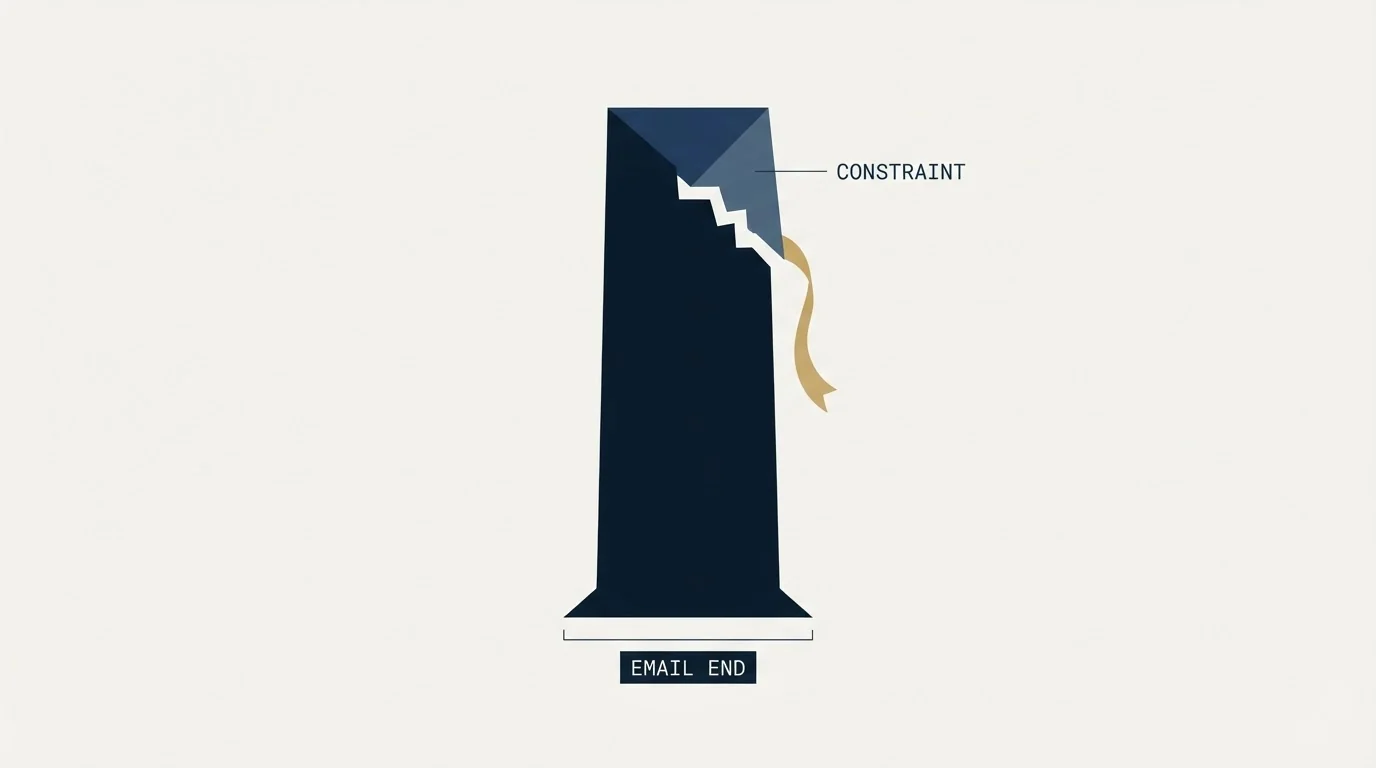
An ending competes for space with the argument, and the argument should win. Cold messages that get read are short, which means the ending is being asked to do its four jobs in perhaps fifty words. The way to fit is to cut the closing line first, because a bridge sentence is the most droppable of the four: a claim followed directly by an ask reads as decisive rather than abrupt. What cannot be cut is the ask itself, and what should not be cut is the ease of declining. The trade-offs between length and reply behaviour are covered in the cold email length benchmarks.
An opt-out belongs at the bottom too, kept plain and separate from the ask. The mechanics of the header version, which is a different thing from a line of copy, are in one-click unsubscribe.
The short version
An ending is four decisions and only one of them is compulsory. The closing line bridges, the ask requests, the sign-off sets register, and the signature makes a checkable claim about who is writing. A postscript is a device, not a part.
Make the ask specific, small, and singular, and make declining as cheap as accepting. Cut anything that promises a message you will not send, which on a one-message campaign is every "just following up" variant there is. Keep the ending shorter than the argument above it. Then read the last four lines with the body covered and ask what a stranger could do with them.
If the constraint is that the one message has to be good enough to work on its own, that is the half we run, on criteria agreed in writing before anything sends. See what a first campaign looks like.
Frequently asked questions.
Frequently asked questions- What is the best way to end a cold email?
- With one specific ask that can be answered in a single sentence by somebody who has never met you, followed by a short sign-off and a signature carrying one verifiable claim about who you are. Make declining as cheap as accepting. The most common failure is not a bad ask but a missing one, which is what phrases like let me know your thoughts actually are.
- Should a cold email end with a question or a statement?
- A question, provided it is answerable rather than rhetorical. A question invites a reply and a statement invites a decision to reply, which is a higher bar for a stranger. The distinction that matters is not the punctuation but the cost: asking whether a specific problem is theirs is cheap to answer, while asking for their thoughts on your product is not.
- Is a P.S. worth adding to a cold email?
- Sometimes, and only when it carries something the body does not. A postscript survives skimming better than the middle of a message, so it suits the single most checkable piece of evidence, or an explicitly easy way to decline. Using it to restate the ask makes the ask look weak, and using it for a second unrelated ask splits the reader's attention.
- What sign-off gets the most replies to cold email?
- The difference between ordinary sign-offs is smaller than the ranked lists suggest, and most of those lists come from studies whose population is not stated. Best, thanks and regards all clear the bar for a first message to a stranger. What genuinely costs replies is thanking somebody in advance, inventing a deadline, or assuming the answer with looking forward to speaking.
About the author.

Ben Carden is CRO at RevenueFlow, which builds and operates outbound revenue engines for B2B companies. Previously at Gartner Enterprise. Studied at London School of Economics.
Ben Carden · CRO
Connect on LinkedIn →Explore more.
Ready to scale your outreach?
We build GTM engines that book real meetings. See the receipts.
Related articles.
BASHO Email: Four Sentences Built on One Insight
A BASHO email is four or five sentences built on one researched insight about a specific person. The format is documented, and it cannot be produced at volume.
Cold Email Frameworks: Which One Fits Your Offer
AIDA, PAS and Before-After-Bridge arrange the same four elements in different orders. What each one assumes about the reader, and what none of them fix.
What a Cold Email Is, and What Separates It From Spam
A cold email is a first business email to somebody with no prior relationship with you. What that one condition rules in, rules out, and demands technically.
Can Buyers Tell an Email Was Written by AI?
Buyers are not running a classifier on your cold email. What they react to is a message containing nothing only somebody who looked could have written.
The Cold Email Signature Is an Identity Claim
A recipient who is mildly interested and mildly suspicious checks that you exist before replying. The signature is where that check either resolves or does not.
ABM Personalization at Scale: Automated vs Manual
Retrieval automates well and judgement does not. The three tiers of personalization, what we automate in every build, and the failure modes worth designing against.