How to Write a Cold Email When It Is the Only One You Send
Cold email writing is mostly deciding, and the deciding happens before the drafting. The order the work runs in, from one verifiable fact to a message worth sending.
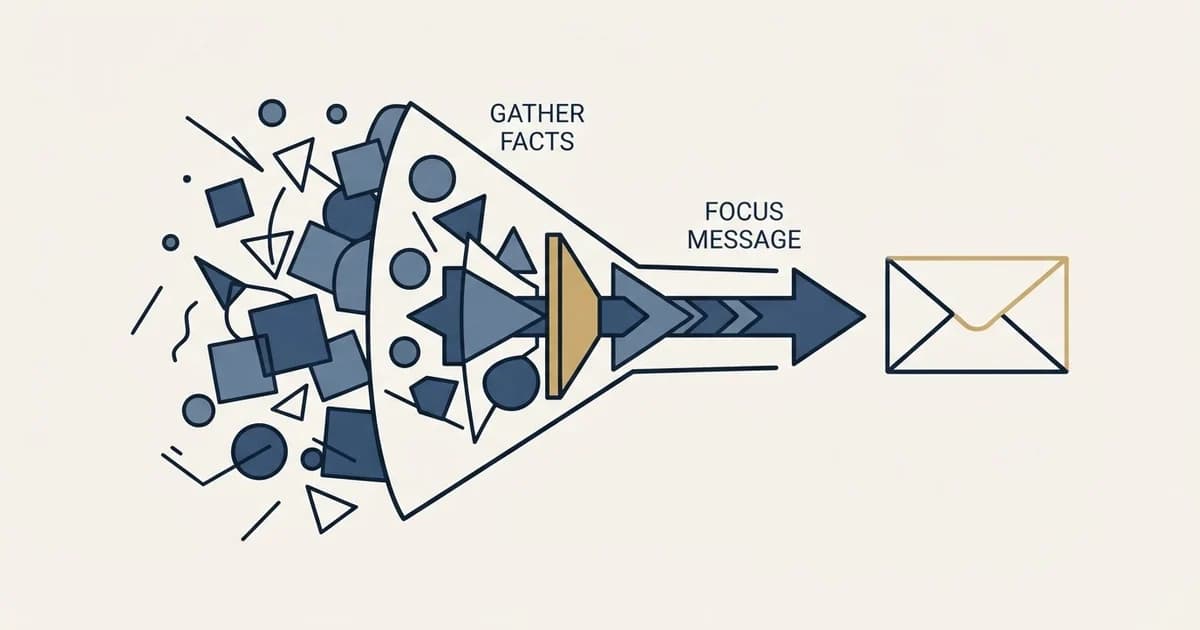
Write a cold email backwards. Find one verifiable fact about that specific company, turn it into a single premise a reasonable person could disagree with, attach one reason to believe you and one question answerable in a line. Write the subject line last, then read the message as a stranger on a phone.
Key takeaways
- A fact that is equally true of the next hundred companies on your list is a description of the segment, and recipients can tell the difference immediately.
- One premise per message beats three stacked arguments, because a claim nobody can disagree with is also a claim nobody can agree with.
- The ask has to be answerable in one sentence using information the recipient already has, which rules out most calendar requests.
- When nothing specific is findable, an honestly generic message outperforms an invented detail and carries none of the risk.
Reviewed and updated September 1, 2026
A blank draft window is the wrong place to start a cold email. By the time you are choosing words, every decision that matters has already been made or skipped: who this person is, what you know about their company that is specifically true, what you are actually asking for, and whether there is any reason for them to answer today rather than never.
Writing is the last twenty percent of the job. This page covers the whole of it, in the order the work actually happens, and it assumes the constraint we operate under: the message you are writing is the only one this person will get from this campaign. There is no later message to carry the thing you left out.
A cold call email, meaning the written approach people describe with that phrase, is the same artefact as a cold email and is written the same way.
Cold email prospecting is the same job as any other prospecting channel, with one property that changes the writing: the message has to earn its own reply, because there is no second one behind it.
Start from the one fact you can verify
Reading back a campaign, teams ask what made the responses that worked successful, and the answer is usually upstream of the wording: the messages that earn replies are the ones where a verifiable fact about that specific company survived into the premise rather than being replaced by a claim about the product.
Before any drafting, answer a single question about the recipient's company. Not a category fact that is true of every company on the list. A specific, checkable one.
They opened a second location. They posted a role that only exists once a certain problem has grown. Their pricing page changed. Their careers page lists eleven engineers and no one in support. A regulation that governs their sector took effect in their state.
The test is simple. If the fact would be equally true of the next hundred rows in your file, what you have is a description of the segment rather than anything about them. Segment facts are fine as targeting logic and useless as opening lines, because the recipient can tell the difference instantly. They know how many companies look like theirs.
If you cannot find one verifiable fact per company at the volume you want to send, you have a list problem rather than a writing problem, and the honest fix is a smaller list. Our own view on where the leverage sits is that the offer usually beats the copy, and the sharper version of that argument is the hierarchy of what actually decides a cold email's outcome.
Turn the fact into one premise
A premise is the sentence that connects what you noticed to what you sell. It is one sentence and it makes one claim.
You opened a second warehouse in Ohio, which usually means the person who used to know where every order was no longer does.
That is a premise. It is falsifiable, which is what makes it worth reading. The recipient can disagree with it, and that reaction is the whole mechanism: a message that cannot be disagreed with cannot be agreed with either.
Most cold emails carry three or four premises stacked on top of each other, because the writer could not decide which one was strongest and hoped one would land. Stacking halves the strength of each. The reader is not scanning for the argument that fits them; they are deciding in about a second whether this message was aimed at them at all.
The named version of that discipline, four or five sentences built on one researched insight about a specific person, is the BASHO email.
- Yes: It names something specific to this company, not to the segment
- Yes: A reasonable person at that company could disagree with it
- Yes: It connects to something you can actually help with
- Yes: It would still be true if you deleted your product from the sentence
- No: It stacks a second and third argument in case the first misses
- No: It flatters the recipient before making its point
Write the body around the premise, not around your product
Once the premise exists, the body has three jobs and no others: state the premise, give one reason to believe you can do something about it, and ask for one thing.
Filled in for the situations a prospect list actually contains, that shape becomes the ten B2B cold email templates written to be sent once, with nothing held back for a second message.
The belief half is where most drafts inflate. A named client in the same category, a specific outcome with the mechanism attached, or a plain description of how the work is done all function. Adjectives do not. If your proof is that you have worked with several companies of this shape, say which shape and stop; the reader will supply the significance, and the version they supply is more persuasive than the version you assert.
Length follows from this rather than being chosen. A message carrying one premise, one proof and one ask lands somewhere short by construction. If yours is long, that is usually a sign it is carrying two arguments. The structural anatomy of the message covers what each part is doing in the order the reader meets it, which is a different order from the one you write it in.
Where we differ from standard practice
Most advice about writing cold email assumes there will be more messages. It tells you to hold something back, to save the case study, to plan what the second and third message will add.
We do not work that way. One message per campaign, built on one premise, sent once. A later approach is a separate campaign with its own premise and its own reason to exist, and it earns a place on merit rather than on persistence. That is our position on both email and LinkedIn, where a second message is worse still because it lands directly beneath the one they already declined to answer.
Two things change in the writing when you accept it. Nothing is held back, because there is no later slot to hold it for. And the message has to be worth sending on its own, which removes the most common excuse for a weak first attempt.
There is a cost, and it is worth stating plainly: a person who was genuinely interested but busy that week is lost. We take that trade because the alternative costs the domain reputation that lets every future campaign reach an inbox at all, and because the volume of messages an inbox can absorb from a stranger is one.
The ask is where most drafts fail
Write the ask before you polish anything else, because it constrains the rest.
An ask should be answerable in one sentence by someone who has never heard of you, with information they already have. "Worth a look?" is answerable. "Are you the right person for this?" is answerable. A request to book a thirty-minute call to explore synergies is not answerable, because answering it requires the recipient to have already decided something they have no basis to decide.
The other failure is the ask that asks for two things at once: read this case study and also book a call. Pick the one you would rather have.
- Worth a look?
- Is this landing anywhere near a real problem?
- Are you the person who would own this, or is it someone else?
- Should I send the two-line version of how it works?
- Do you have thirty minutes on Thursday?
- Would you like to explore a partnership?
- Can I show you a demo of the platform?
- Which of these three options fits best?
Subject lines get written last
The subject line is a routing label rather than a headline. It is telling a person who does not know you what kind of message this is, so that they can decide whether it belongs in the ninety seconds they have.
Written last, it can simply describe the premise, which is the only honest thing it can do. Written first, it becomes a hook the body then has to live up to, and the gap between the two is what gets messages marked as spam. Reference material on what the personalization signals do to response is useful here mainly as a check on your own instincts.
Read it back as the recipient
Three passes, in this order, before anything sends.
Delete the first sentence. Roughly half the time the message is better, because the first sentence was throat-clearing that the writer needed and the reader does not.
Read only what appears in a phone preview. The sender name, the subject and about the first eight words. That is the entire message for most recipients, and if the aimed-at quality is not visible in that fragment, it is not visible.
Ask what a busy stranger loses by ignoring it. If the honest answer is nothing, the premise is weak and no amount of editing will fix it. Go back and find a different fact.
When there is genuinely nothing specific to say
Some segments resist research. A twelve-person firm with a two-page website and no press coverage gives you almost nothing to work with, and pretending otherwise produces the worst class of cold email, the one that invents a detail and gets it wrong.
The honest move is to change what the message is. Drop the pretence of personalisation entirely and write a short, plainly generic message that is straightforwardly about the offer, addressed to a role rather than to a researched individual. It performs less well than a specific message and considerably better than a fake one, and it does not carry the risk of being caught inventing something.
Teams weighing which sales platform can support this kind of targeted outreach may want to see what Amplemarket discloses before a quote.
The second option is to fix the input rather than the output. A list where nothing is knowable is usually a list assembled from the wrong source. Sending to addresses that were never verified compounds it, and the tooling for that half is a solved problem rather than a judgment call.
- Step 1Find the fact
One verifiable thing about this company that is not true of the segment
- Step 2Form the premise
One sentence connecting that fact to something you can help with
- Step 3Choose the ask
Answerable in a line, with information they already have
- Step 4Write the body
Premise, one reason to believe you, the ask. Nothing else
- Step 5Label it
Subject line describes the premise, written last
- Step 6Read it back
Delete the opener, read the preview fragment, test what ignoring it costs
The short version
Cold email writing is mostly deciding, and the deciding happens before the drafting. Find one fact that is true of this company and not of the category. Turn it into one premise a reasonable person could argue with. Attach one reason to believe you and one question they can answer in a line. Write the subject line last, read it back as a stranger on a phone, and send it once.
If nothing specific is findable, either write an honestly generic message or fix the list. Those are the only two respectable options, and inventing a detail is not among them.
If you would rather see this done against your own market before deciding whether it is worth building in house, we will run a campaign for you and you can judge the output.
Frequently asked questions.
Frequently asked questions- How long should a cold email be?
- Length follows from structure rather than being chosen. A message carrying one premise, one reason to believe you and one ask lands short by construction. If yours runs long, it is usually carrying a second argument the writer could not bring themselves to cut. Fix the argument count and the length resolves itself without counting words.
- Should I personalise every cold email?
- Personalise where a verifiable fact exists and be plainly generic where one does not. The failure mode worth avoiding is the invented detail, which is what happens when a writer is required to personalise a company they could learn nothing about. A short honest message addressed to a role beats a fabricated observation that gets the company wrong.
- What should the subject line say?
- It is a routing label rather than a headline, so write it last and let it describe the premise the body actually carries. Written first, it becomes a hook the body then has to justify, and that gap between promise and content is what gets messages marked as spam by people who felt misled before they finished reading.
- How many times should I email a prospect?
- We send one message per campaign, built on one premise, sent once. A person who did not respond has responded, and approaching them again with the same argument does not improve the argument. A genuinely different premise later belongs to a separate campaign that has to justify itself on merit rather than on persistence.
About the author.

Ben Carden is CRO at RevenueFlow, which builds and operates outbound revenue engines for B2B companies. Previously at Gartner Enterprise. Studied at London School of Economics.
Ben Carden · CRO
Connect on LinkedIn →Explore more.
Ready to scale your outreach?
We build GTM engines that book real meetings. See the receipts.
Related articles.
Cold Email Frameworks: Which One Fits Your Offer
AIDA, PAS and Before-After-Bridge arrange the same four elements in different orders. What each one assumes about the reader, and what none of them fix.
What a Cold Email Is, and What Separates It From Spam
A cold email is a first business email to somebody with no prior relationship with you. What that one condition rules in, rules out, and demands technically.
Can Buyers Tell an Email Was Written by AI?
Buyers are not running a classifier on your cold email. What they react to is a message containing nothing only somebody who looked could have written.
BASHO Email: Four Sentences Built on One Insight
A BASHO email is four or five sentences built on one researched insight about a specific person. The format is documented, and it cannot be produced at volume.
Cold Email Sender Name: Whose Name Goes On It
The from field is read before the subject line and is the only part of a cold email a recipient can independently verify. What has to agree, and what breaks it.
The Cold Email Signature Is an Identity Claim
A recipient who is mildly interested and mildly suspicious checks that you exist before replying. The signature is where that check either resolves or does not.