Cold Email Personalization Benchmarks: 2026 Performance Data
LeadMagic, Cognism, Explorium and others sell funding and competitor signals. What published data ties to higher reply rates, and how to turn a signal into a line.
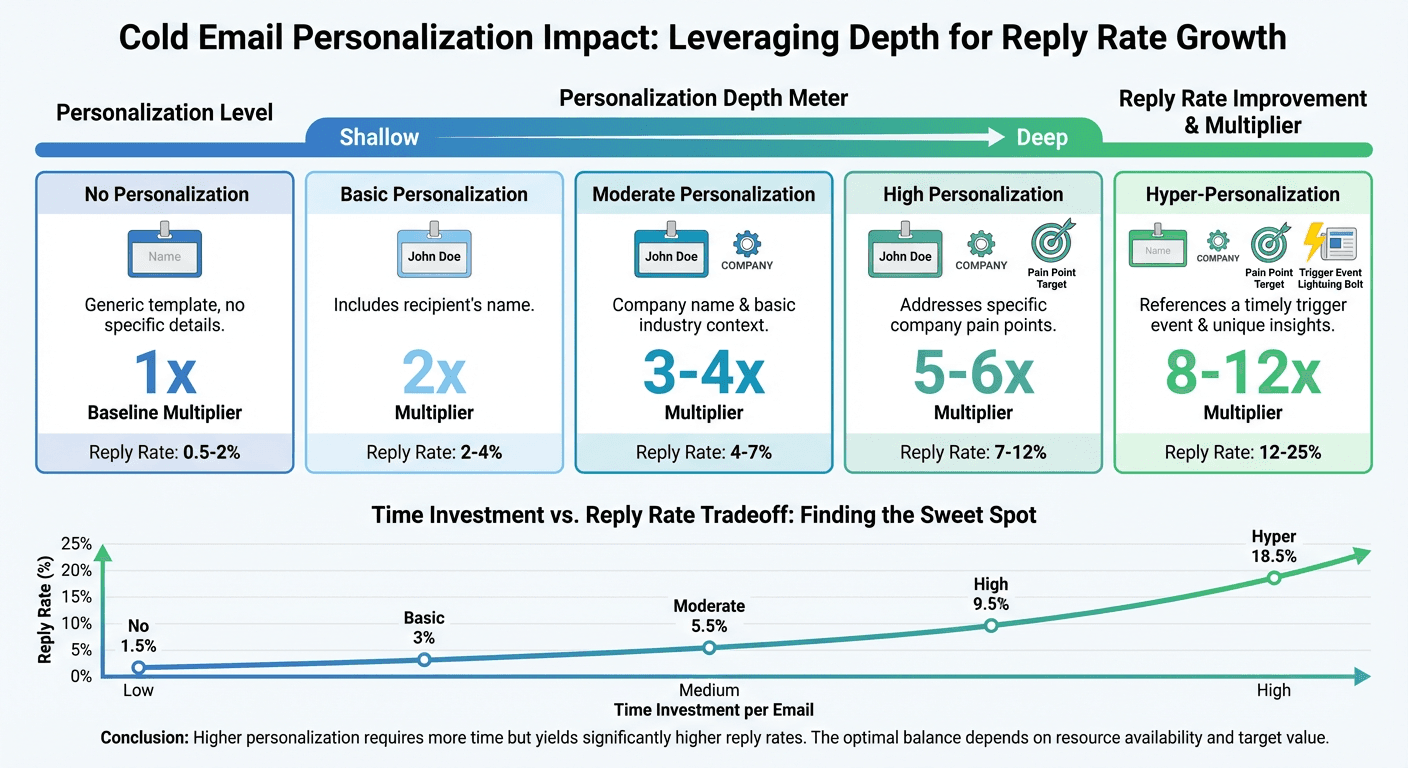
Several data vendors sell funding and competitor signals for cold email personalization: LeadMagic prices funding history and competitor lists per credit, Cognism sells funding and technographic signals, and Explorium carries funding data and named competitors. No dataset read here measures reply rate by personalization level; published data ties higher replies to tight segments and short, problem-first emails.
Key takeaways
- LeadMagic's credits page prices a Company Funding lookup at 4 credits and a competitor list at 5, beside tech stack data at 1 credit.
- Cognism sells contextual signals for hiring, funding and M&A, job changes and intent, and names funding rounds and technographics as personalization inputs.
- Instantly ties its elite senders, above a 10% reply rate, to hyper-relevant subject lines, emails under 80 words, one call to action and problem-first positioning.
- Woodpecker's smallest campaigns, 0 to 50 prospects, reply at a 2.7% median against 1.2% at 1,001 to 5,000, the closest published proxy for tight targeting.
Reviewed and updated September 21, 2026
Several data vendors now include competitor and funding signals for cold email personalization, and their own pages say which. LeadMagic prices a company funding lookup and a competitor list per credit, Cognism sells funding and technographic signals for personalised outreach, and Explorium carries funding and acquisition data with a key competitors field. Saleshandy, Lead411, HubSpot and LinkedIn Sales Navigator expose funding data too. What no dataset read for this page publishes is a reply rate by personalization level, so this report separates what the vendors sell from what the published numbers actually show.

Which vendors include competitor and funding signals in cold email personalization?
LeadMagic, Cognism and Explorium include both, each on its own site; Saleshandy, Lead411 and HubSpot pair funding data with technology data. A competitor signal comes in two forms: a list of a company's competitors, or the technology it already runs, which shows whether it uses a product you compete with. The table lists what each vendor's page names.
| Vendor | Funding signal | Competitor or technology signal |
|---|---|---|
| LeadMagic | Company Funding lookup, 4 credits | Competitors Search, 5 credits; Technographics, 1 credit |
| Cognism | Funding and M&A signals | Technology usage; technographic insights |
| Explorium | Funding and acquisitions dataset | A key competitors field |
| Saleshandy | Revenue and funding data | Tech stack filter |
| Lead411 | Lead scoring on recent funding | Technographic search |
| HubSpot | Funding levels in enrichment | The tools a company uses |
LeadMagic's credits page is the most explicit: a Company Funding lookup returns funding history for 4 credits, Competitors Search returns a competitor list for 5, and Technographics returns tech stack data for 1. Pulling all three for one company costs 10 credits on that list, so a campaign of 500 accounts spends 5,000 credits on signals before a single line is written, which is why the signal should be chosen for the message rather than collected by default. Cognism's signals page says to use signals "to uncover hiring trends, funding rounds, and technographic insights", and its pricing page lists contextual signals for hiring, funding and M&A, job changes and intent. Explorium's credit details list a funding and acquisitions dataset, with investors among its fields, and a key competitors field drawn from company filings.
Saleshandy's pricing page offers company financials to "View revenue and funding data to qualify accounts", beside a tech stack filter and hiring signals. Lead411 scores leads on "positive company activities like recent funding or hiring trends" and searches companies by technographic data. HubSpot's data enrichment adds context "like the tools they use, funding levels, and company location" to a record. LinkedIn Sales Navigator sends account alerts about new funding announcements. Instantly's 2026 benchmark report describes the same inputs as a trend, with right-time outreach that blends hiring, funding, product-launch and website-visit signals.
What the published data says about personalization
No dataset read for this page measures reply rate by personalization level. The multipliers that circulate for personalized against generic email, and the tables of lift by element or by industry, come without a named dataset behind them, so this page no longer carries them. Two platform datasets do publish findings that bear on personalization.
Instantly: elite senders
- Above 10% reply rate
- Hyper-relevant subject lines
- Under 80 words, one ask
Woodpecker: campaign size
- 0-50 prospects: 2.7%
- 1,001-5,000: 1.2%
- Median reply rates
Woodpecker: subject lines
- First-name tag in 4 of the top 10
- 20-29 characters reply best
- A name is common, not rare
Instantly's report puts its elite senders above a 10% reply rate and describes them as combining hyper-relevant subject lines, emails under 80 words, a single call to action and problem-first positioning. It names micro-segmentation, problem-focused messaging and frequent A/B testing among the biggest contributing factors. Relevance to one tight segment, in other words, rather than more fields per email.
Woodpecker's data is the closest published proxy for that. Independent companies get a 2.7% median reply rate on campaigns of 0 to 50 prospects and 1.2% at 1,001 to 5,000, more than double, and a smaller campaign is usually a tighter fit. Its list of the most-used subject lines shows how common surface personalization already is: the first-name merge tag appears in four of the top ten. Subjects of 20 to 29 characters had the best reply rate in both its populations. Our B2B cold email benchmarks set both datasets side by side.
Three kinds of personalization
The word covers three different things, and they cost and fail differently. We set out the distinction in personalization in sales.
Field-level. Merge fields filled from a database: first name, company name, job title, which sales engagement platforms insert automatically. It is cheap and universal, which is why a first name in a subject line no longer stands out, and it fails silently when a field is empty or dirty.
Grounded. A fact retrieved about the company and written into the email: a funding round, a hiring push, a tool it runs, a competitor it sits beside. This is what the vendor signals above supply, and it is only as good as the signal's date and accuracy.
Judged. A person decides that this account deserves a specific line and writes it. It is the slowest kind and the only one that can tell whether a true fact is also a relevant one.
Turning a signal into a line
A funding round is a reason to write only if it changes something for the reader: new headcount to support, a market to enter, a tool to replace. The steps below keep a grounded line honest.
A round, a hire, a tool in use. Undated signals go stale unseen.
Read the company's own page before writing about it.
What the event changes for them, not that you noticed it.
The sentence as sent, not the template with its fields.
The line has to carry the email on its own.
Where funding and competitor signals mislead
A funding signal dates quickly. The week a round is announced is the most crowded moment in that company's inbox, and a line that only congratulates arrives with dozens of identical ones. The useful version names what the money is for, as the company itself describes it: the market it is entering, the team it is hiring, the system it says it will replace.
A competitor signal misleads in a different way. Technographic data records that a tool was detected, not that a contract is live, how many seats it covers or when it renews, so a line asserting that the prospect uses a rival product can be wrong on the first word. Written as a question it survives being wrong. A competitor list is weaker still, because it names who a company competes with in general, not who its buyer is comparing this quarter. Either signal earns its place when it changes what the email offers, and not when it only proves that research happened.
Where personalization breaks: the rendered field
Most personalization failures are visible only in the sent email, not in the template. An empty first-name field renders as a greeting with nothing in it. A company name copied from a logo arrives in capital letters. A tagline stored in the company field turns a sentence into nonsense. Each one reads as machine output, which undoes the point of personalizing at all.
The fix is procedural: render a sample of real rows before launch and read them as the recipient would, and send nothing whose fields fail that read. A grounded line needs the same check against its source, because a funding round from two years ago, stated as news, is worse than no line at all.
Measuring personalization in your own campaigns
Test one variable at a time on a split of the same list, and judge on replies rather than opens, which Woodpecker calls the noisier number because tracking pixels get blocked or auto-loaded. A difference of a handful of replies is noise; wait for counts before calling a winner. Our cold email A/B testing benchmarks cover how to set a test up.
Keep the comparison honest about what changed. If the personalized variant also went to a smaller, better-fitted list, the list may have done the work, since Woodpecker's data shows reply rate falling steadily as campaigns widen. Send both variants to random halves of the same list, from the same mailboxes, in the same week, so the line is the only difference.
Common personalization mistakes
| Mistake | What it does | What to do instead |
|---|---|---|
| Fake personalization | Damages trust | Use only genuine observations |
| Over-personalization | Reads as surveillance | Keep it to business-relevant facts |
| Irrelevant details | Wastes words | Tie every detail to the reader's problem |
| Outdated information | Shows no research | Check the signal's date first |
| Unrendered fields | Reads as machine output | Read real rendered rows before sending |
Choosing how far to go
Personalization depth is a cost decision. Field-level personalization costs almost nothing and distinguishes almost nothing. Grounded lines cost a signal and a check, and they fit a segment whose members share the same event, such as companies that raised in the last quarter. Judged lines cost a person's time and are worth it on the accounts where one meeting matters, typically a short named list rather than a whole market. Matching the depth to the account value keeps the research budget where a reply is worth the most. The key is finding the right balance between depth and efficiency for your specific situation.
That same balance between depth and efficiency carries into full outreach sequences, where cold email sequence performance data shows how reply rates shift across message position.
We send one message per campaign, so the single email has to carry the personalization on its own. If you would rather have campaigns built and run for you, get a free campaign audit and we will read your current personalization against these checks.
Related Reading
Frequently asked questions.
Frequently asked questions- Which vendors provide funding signals for cold email?
- On their own pages: LeadMagic sells a Company Funding lookup, Cognism sells funding and M&A signals, Explorium has a funding and acquisitions dataset, Saleshandy shows revenue and funding data, Lead411 scores leads on recent funding, HubSpot enrichment adds funding levels, and LinkedIn Sales Navigator sends alerts about new funding announcements.
- What is a competitor signal in cold email personalization?
- It takes two forms. One is a list of a company's competitors, which LeadMagic sells as Competitors Search and Explorium carries as a key competitors field. The other is the technology a company already runs, sold as technographics by LeadMagic, Cognism and Lead411, which shows whether the prospect uses a product you compete with.
- Does personalization increase cold email reply rates?
- No dataset read for this page measures reply rate by personalization level, so a multiplier quoted without a named source is an estimate. Published data points one way: Instantly's elite senders combine hyper-relevant subject lines, short emails and problem-first positioning, and Woodpecker's smallest campaigns reply at more than double the rate of its 1,001 to 5,000 band.
- Should the first name go in the subject line?
- It will not make an email stand out. Woodpecker's list of the most-used subject lines shows the first-name merge tag in four of the top ten, so a name alone is common rather than distinctive. The same data found subjects of 20 to 29 characters with the best reply rate in both its US and rest-of-world populations.
About the author.

Hosun Chung is COO at RevenueFlow, which builds and operates outbound revenue engines for B2B companies. Previously at Gleacher Shacklock LLP. Studied at London School of Economics.
Hosun Chung · COO
Connect on LinkedIn →Explore more.
Ready to scale your outreach?
We build GTM engines that book real meetings. See the receipts.
Related articles.
Cold Email Spam Rate Benchmarks: 2026 Performance Data
Industry standards require keeping spam complaint rates below 0.1% to maintain sender reputation. Learn the benchmarks and strategies to protect your cold email deliverability.
Cold Email Follow-Up Benchmarks: 2026 Performance Data
The follow-up benchmarks kept intact and read against their own definitions, plus why RevenueFlow sends one message per campaign instead.
Cold Email Bounce Rate Benchmarks: 2026 Performance Data
A 3.04% platform bounce rate held 1.27% true hard bounces, 2.38% with blocks included, and 12.6% delay notices. What low bounce email data is made of.
Cold Email Subject Line Benchmarks: 2026 Performance Data
Industry data reveals that subject lines determine 35-50% of open rate variation. Discover the benchmarks for length, personalization, and format that drive the highest engagement.
Cold Email Sequence Benchmarks: 2026 Performance Data
Every industry sequence figure, kept intact and read honestly: the opening message produces 30-40% of replies, and here is what the rest of them cost.
Cold Email A/B Testing Benchmarks: 2026 Performance Data
Industry data shows systematic A/B testing improves cold email performance by 15-30% over time. Discover the benchmarks for test design, sample sizes, and expected lift.