BASHO Email: Four Sentences Built on One Insight
A BASHO email is a cold email of four or five sentences built on one verifiable piece of research about the person you are writing to, connected to why you are writing and closed with one small ask. Jeff Hoffman developed it, names it after the poet Matsuo Basho, and reserves it for high-value accounts.
Key takeaways
- Hoffman's page defines the format as one insight, one connection and one clear ask, in four sentences, occasionally five.
- The research has to be about the person rather than the company, and it has to connect logically to the reason for writing.
- At twenty minutes of research per email, Hoffman reserves the format for accounts where a single meeting could change your quarter.
- Woodpecker's benchmarks put the median cold email reply rate at 1.5% across 56,614 campaigns, the baseline a researched tier has to beat.
A BASHO email is a short, highly personalised cold email built on one specific piece of research about the individual you are writing to, rather than about their company. Jeff Hoffman's own page describes it as an email "built on a single piece of relevant research about the specific person" you are contacting, with the structure reduced to "One insight. One connection. One clear ask." and a length of "four sentences, occasionally five", as published on sellhoffman.com.
The name is not an acronym, which is the first thing most people get wrong about it. The same page attributes it to the Japanese poet Matsuo Basho, whose haiku it describes as "precise, spare, and earned every word", and that is the standard the format is asking a rep to hold: every line has to earn its place or come out.
What is a BASHO email?
A BASHO email is a cold email of four or five sentences built on one verifiable piece of research about the person you are writing to, connected to why you are writing and closed with one small ask. Jeff Hoffman developed the format and publishes it on his firm's site, which reserves it for the accounts where a single meeting could change your quarter.
In sales usage the name is shorthand for that standard rather than a methodology of its own. Hoffman's site lists its sales methodology as five stages, Start the Deal, Work the Deal, Close the Deal, Grow the Deal and Lead the Deal, and publishes the BASHO email as a feature on how to get a response from anyone, describing it as "a precision tool, not a volume play". The same page recommends it for anyone who gets a lot of mail: senior executives, VPs, C-suite contacts.
What separates it from an email with a merge tag in it
Almost every cold email claims to be personalised. What it usually means is that a field was filled in. First name, company name, industry, headcount, a funding round scraped from a database and dropped into the opening line. That is a template with a variable in it, and the people receiving it have seen the same variable in many other messages.
A BASHO email starts somewhere else. The research is about the person, not the account, and it has to be something a machine could not have supplied: a post they wrote, a panel they spoke on, a report they published, a role change, an initiative they are visibly running. Hoffman's page calls for "one specific, verifiable, relevant piece of information about this person" and is explicit that it should not be about the company.
The second requirement is the one that gets skipped. The insight has to connect logically to why you are writing. A researched opening that leads nowhere is worse than no opening, because it advertises effort and then wastes it. If the only bridge from their post to your product is that both involve sales, the research did not qualify the send and the email should not go.
| A filled field | A researched insight | |
|---|---|---|
| What it is | First name, company, industry, headcount | One verifiable thing this person said, wrote or did |
| Where it comes from | A database export | A post, a panel, a report, a role change |
| Cost | Nothing extra per row | Real minutes per recipient |
| Why this person | Says nothing about it | Connects to the reason for writing |
| Scale | Any list size | The accounts worth the minutes |
The structure, and why it is this short
The published shape is five steps and it is short on purpose. The opening sentence surfaces the insight, so the page tells the writer to "open with something specific about them". The second draws the line from their situation to your reason for writing. The third adds one relevant proof point. The fourth makes one focused, low friction ask. That is four sentences, and the fifth is optional.
Length is doing real work here rather than being a style preference. A four sentence email can be read in full on a phone screen. It contains no space for hedging, no space for a paragraph about your company, and no space for the three secondary asks that usually creep in. Hoffman's page gives its own reason the restraint helps: "by being shorter and more restrained than a typical cold email, it conveys more confidence." That is why the format survives as a named technique rather than as generic advice to write shorter.
The ask is the part teams get wrong most often after the research. A twenty minute call is proportionate to a first message. An hour, a demo, a discovery call with two of your colleagues and a shared document are not, and an ask that is out of proportion to the relationship reads as a request for a favour from a stranger.
To: one person, researched individually
[The insight: one verifiable thing about them] 1
[Why that connects to your reason for writing] 2
[One relevant proof point] 3
[One focused, low friction ask] 4
- 1"open with something specific about them", about the person rather than the company.
- 2"connect it directly to why you're writing", or the research did not qualify the send.
- 3"show a relevant proof point or insight", one only.
- 4"make a focused ask", proportionate to a first message, such as a twenty minute call.
Why it matters to a sending programme
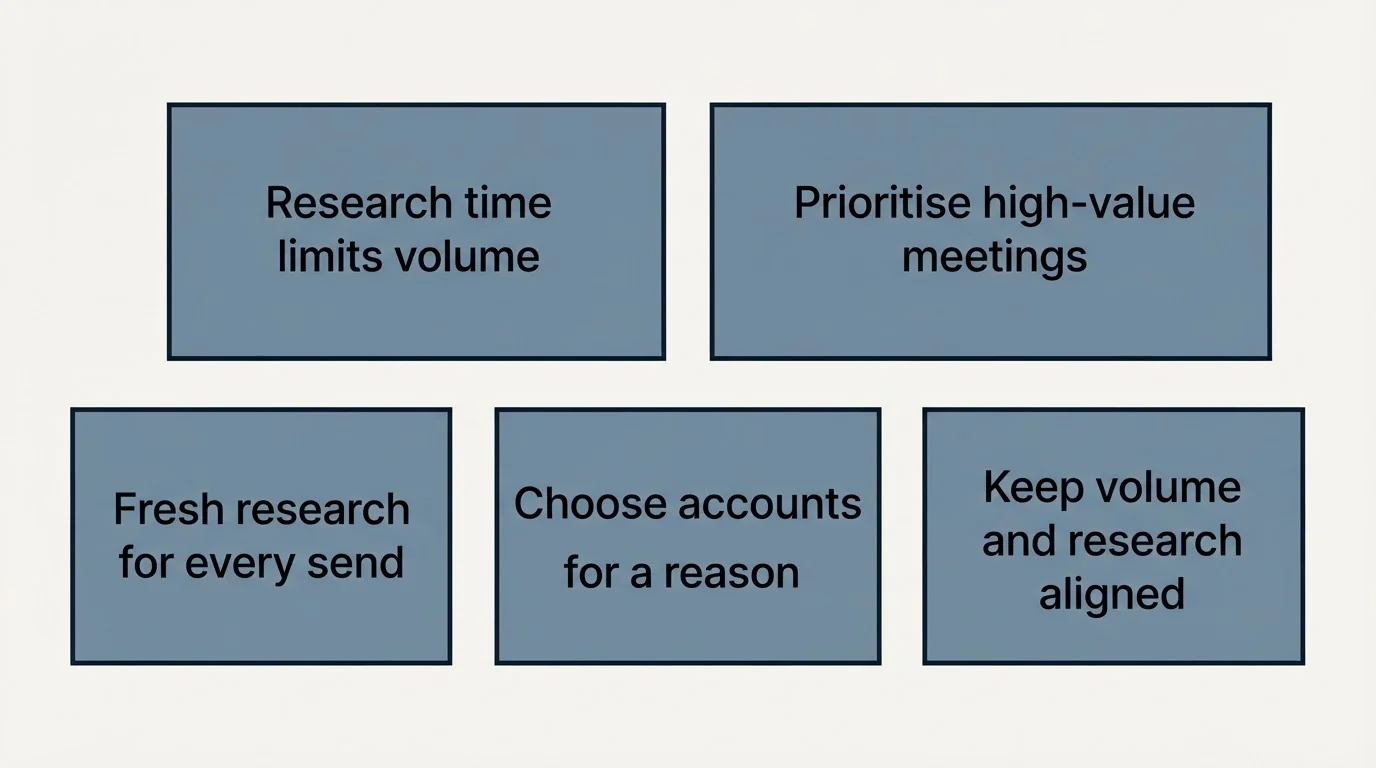
The obvious cost of a BASHO email is time. Hoffman's page puts it at "twenty minutes of research per email" and reserves the format for "the ones where a single meeting could change your quarter". That number is what makes the technique a decision rather than a template, because twenty minutes per recipient is a hard ceiling on volume and an equally hard floor on which accounts deserve it.
The less obvious cost is the one that decides whether a programme should use it at all. A researched email cannot be delegated to a sequence builder, so it does not accumulate. Every send is a fresh act of work, and a team that commits to BASHO across a whole target list has quietly committed one person full time to producing a few dozen emails a week.
The argument in its favour is that the alternative fails differently. A high volume programme running weak personalisation puts pressure on the sending infrastructure while producing replies from a small fraction of a large audience, and every non reply is a person who now associates the brand with something irrelevant. Woodpecker's cold email benchmarks, drawn from campaigns sent through its own platform, put the median reply rate at 1.5% across 56,614 campaigns, and find that mailboxes averaging 1 to 20 emails a day reach a 2.0% median reply rate, four times the 0.5% of mailboxes sending 101 to 200 a day. A small number of researched emails to accounts that were chosen for a reason produces fewer conversations from fewer sends, on a domain that is not being asked to carry the volume.
Both are legitimate motions. What is not legitimate is describing the first as the second, which is what happens when a team adopts the vocabulary of the format and keeps the send volume of a sequence.
How it is used in outbound
In a live programme, BASHO sits at the top of the account list rather than across it. The practical pattern is a tiered send: a researched message to the accounts where one meeting justifies the research time, and a house standard cold email to the rest, sent on the same authenticated infrastructure and against the same criteria.
Three operational points decide whether the tier works.
The research has to be recorded, not remembered. The insight goes in a field on the record with its source URL, for the same reason a price belongs to a page. A researched claim you cannot show the source of is a claim you will eventually get wrong in front of a senior buyer, and the correction costs more than the meeting was worth.
The insight decays. A post from last week is a reason to write. The same post in eleven weeks reads as an admission that the message sat in a queue. Research that is not sent inside its own window has to be redone, which means the research step and the send step belong in the same working session rather than in separate sprints.
One message per campaign still applies. The format's discipline is one insight, one connection, one ask, and that is the same rule the rest of the programme runs on. A BASHO email followed by four automated bumps has replaced a precise message with a sequence, and the person who did not reply to the first one is not more likely to reply to the fourth.
Worth the twenty minutes
- One meeting at this account would materially change the quarter
- The insight is about the individual, not the company
- It is verifiable and its source is recorded on the record
- The bridge to your reason for writing is logical, not forced
- The ask is one low friction step
- It is recent enough to send this week
Not a BASHO email
- The opening of an automated multi step sequence
- A funding round or a headcount band used as the insight
The measurement question is the one teams skip. A BASHO tier is worth running when its reply rate and its meeting rate justify the labour against the base lane, and that comparison is only meaningful if both lanes ran against comparable accounts in the same period. Comparing a researched tier aimed at the best fifty accounts against a broad send aimed at everybody measures the account list rather than the technique. The open rate benchmarks are the wrong instrument for that comparison too, because they describe programmes rather than tiers.
What the format does not fix
A BASHO email inherits every constraint the rest of the programme has. It arrives through the same mailbox, on the same domain, under the same sender requirements as everything else, and a researched message from a domain with a reputation problem lands in the same folder as an unresearched one. Google requires senders to authenticate, and its published guidance asks senders to "Set up SPF or DKIM email authentication for your sending domains", which is a floor rather than an advantage.
It also does not fix a list. If the person is genuinely not a buyer for what you sell, twenty minutes of research produces a well written email to the wrong reader, and the polite reply you get is not pipeline. The account list is upstream of the technique, and no amount of craft in the message compensates for a target chosen because they were available rather than because they fit.
The last thing it does not fix is the follow up problem. The format is built for a first touch. What happens after a non reply is a separate decision, and copying the researched message into a sequence is the move that converts a precision technique back into volume.
Related terms
A BASHO email is one shape of cold email, and the surrounding vocabulary is where the operational detail lives. Plain text email covers the format the message should be sent in, and spintax covers the variation technique that belongs to the volume lane rather than this one. Lead list is where the account selection that decides whether the research is worth spending gets made, and hiring signal is one example of an insight class that carries a live reason to write.
On the writing itself, how to write a cold email walks the structure the volume lane runs on step by step, and quality leads over quantity sets out the account-selection argument that decides which tier a send belongs in. If the question is which tier a given account belongs in, B2B prospecting is the filter versus signal argument that decides it.
The short version
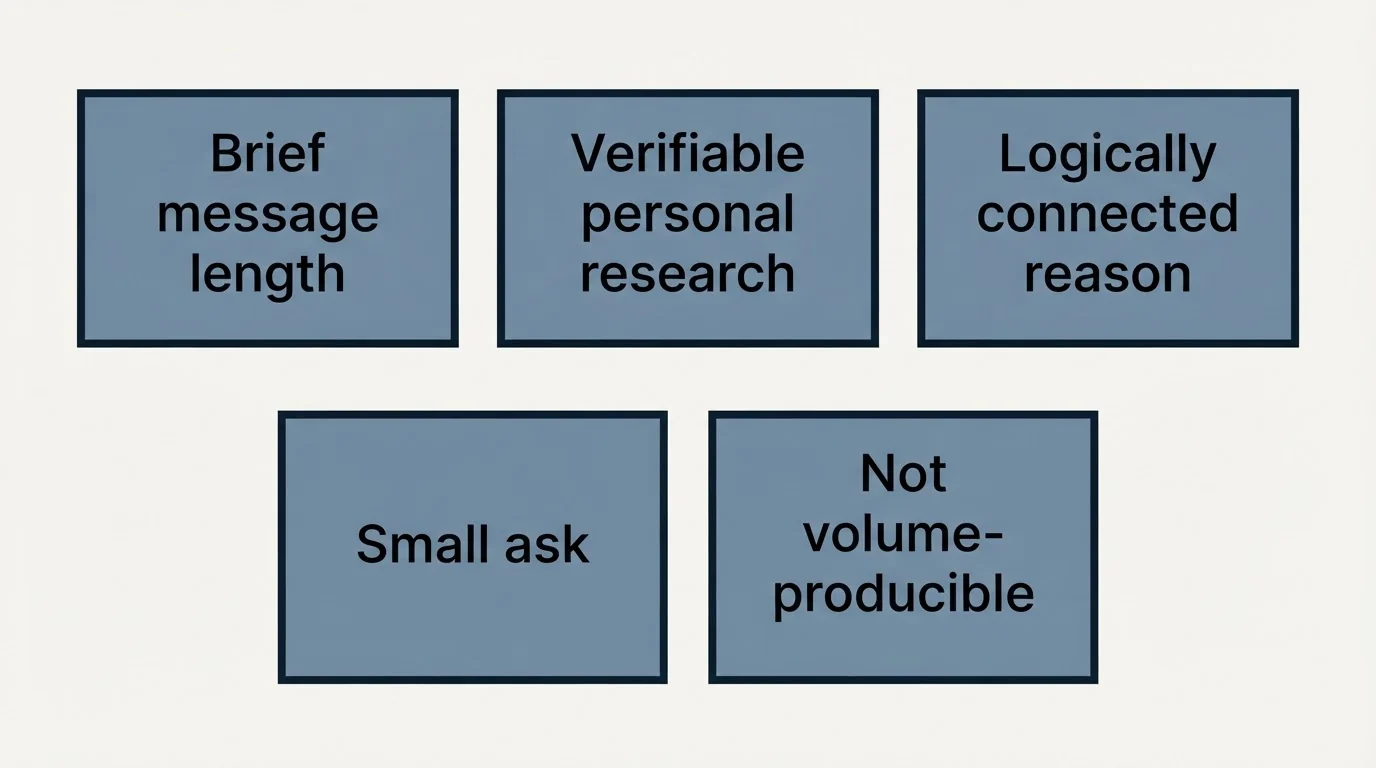
A BASHO email is four or five sentences built on one verifiable piece of research about a specific person, connected logically to one reason for writing and closed with one small ask. It is named after a poet rather than an acronym, it is documented by the person who developed it, and its defining property is that it cannot be produced at volume.
That constraint is the whole technique. Used on the accounts where a single meeting matters, it earns its time. Used as a template across a whole list, it becomes an ordinary cold email with a longer first sentence, and the twenty minutes go to waste.
RevenueFlow runs cold email and LinkedIn outreach for B2B teams, one message per campaign, against criteria agreed in writing before launch. See how the campaigns work.
Technique description taken from Hoffman's own page, sender requirements from Google's sender guidelines, and reply-rate figures from Woodpecker's cold email benchmarks. Verify current guidance with the source before relying on it.
Frequently asked questions.
Frequently asked questions- What is a BASHO email?
- A BASHO email is a short cold email, four sentences and occasionally five, built on one verifiable piece of research about the individual recipient rather than their company. It opens on that insight, connects it to why you are writing, adds one proof point and makes one focused ask. Jeff Hoffman developed the format and publishes it on his firm's site.
- What does BASHO stand for?
- Nothing. It is not an acronym, which is the most common misunderstanding about the term. Hoffman's own published page attributes the name to the Japanese poet Matsuo Basho and describes his haiku as precise, spare, and earned every word. The point of the reference is that every line in the email has to earn its place.
- Is BASHO a sales methodology?
- Not on Hoffman's own site. The site lists its sales methodology as five stages, Start the Deal through Lead the Deal, and publishes the BASHO email as a feature on getting a response from anyone. It describes the format as a precision tool rather than a volume play, for senior executives and other people who get a lot of mail.
- How long should a BASHO email be?
- The published format is four sentences, occasionally five. The opening surfaces one researched insight, the second connects it to the reason for writing, the third adds one relevant proof point, and the fourth makes one focused ask proportionate to a first message, such as a twenty minute call rather than an hour or a demo.