B2B Prospecting: A Filter or a Signal
Filters describe a durable state and signals describe a dated event. How to test a candidate signal, and how to keep the signal in charge of the list.
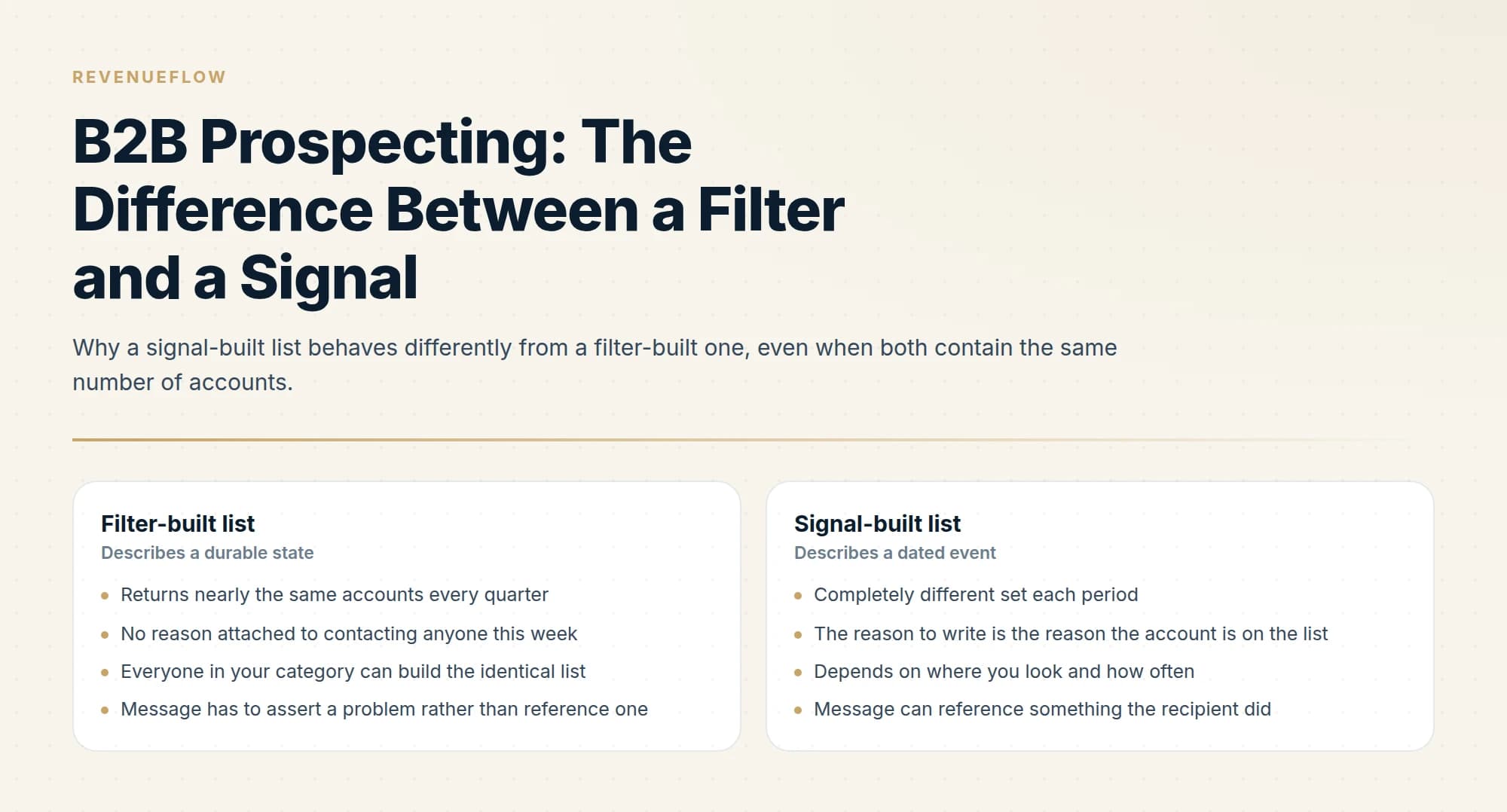
B2B prospecting works better when the list is built from dated events rather than durable attributes. A filter tells you an account could plausibly buy. A signal such as a job posting, a leadership change or a technology switch tells you this week is a better week than an arbitrary one.
Key takeaways
- A filter returns nearly the same accounts every quarter, which makes it useful for defining a market and useless for deciding who to contact this week.
- The sharpest test of a candidate signal is to delete the reference to it from your draft and see whether the message still reads fine without it.
- Hiring posts, leadership changes, technology adoption or removal, expansion and public statements of intent are all observable without a budget.
- Published signals can appear in the copy while unpublished ones should only decide timing, because naming a page visit reads as monitoring.
Reviewed and updated September 1, 2026
Two teams build a list of 500 accounts in the same week. The first filters for industry, headcount band and geography, and gets a list that will return almost exactly the same 500 companies next quarter. The second filters for companies that posted a specific job in the last thirty days, and gets a list that will be completely different next quarter.
Both lists are 500 accounts. Only one of them contains a reason to write this week, and that difference is what most prospecting advice skips past on its way to talking about subject lines.
A filter describes a state, a signal describes an event
When a team says it wants outbound lead generation to be more targeted, this distinction is usually what it is reaching for: not a tighter filter on the same durable attributes, but a dated event that gives one specific person a reason to read something this month.
Scope arguments usually trace back to the phrase itself, and the outbound lead generation definition settles which activities the two words actually include.
This distinction is the whole article, so it is worth making precisely.
A filter is a condition that is true for a long time. Two hundred employees, headquartered in Texas, running Shopify, in the logistics sector. Filters answer the question of who could plausibly buy, and they are stable by design. Stability is what makes them useful for defining a market and useless for deciding who to contact on a Tuesday.
A signal is something that happened, and it has a date attached. A company posted a role, replaced a VP, announced a funding round, added a technology, opened a location, launched a product line. Signals answer a different question: who has a reason to reply now.
You need both. The filter tells you an account is worth talking to at all. The signal tells you this week is a better week than an arbitrary one. Teams get into trouble when they build a list from filters alone and then try to manufacture urgency in the copy, which produces the whole genre of cold email that opens by asserting a problem the sender has no evidence the recipient has.
It is also why a generic company pitch reads the way it does to a recipient: with no dated reason behind it, the message has to assert that a problem exists, and every other sender that week is asserting the same thing.
Beyond this filter versus signal distinction, a broader breakdown of repeatable ways to build a working list shows how signal-led outbound fits alongside referral, partner and volume approaches.
- Returns nearly the same accounts every quarter
- No reason attached to contacting anyone this week
- Everyone in your category can build the identical list
- Message has to assert a problem rather than reference one
- Never expires, so it gets reused until it is exhausted
- Completely different set each period
- The reason to write is the reason the account is on the list
- Depends on where you look and how often
- Message can reference something the recipient did
- Expires, which forces the list to be rebuilt
Four questions that separate a signal from noise
This is the honest version of tailoring outreach to different intent levels. What varies is not the number of touches somebody receives but which signal justified writing at all, and a message built on a stronger signal is a different campaign rather than a warmer position in the same one.
Most published advice on identifying buying signals stops at a list of examples, which is the half that does not travel: the same event is a signal for one product and a filter for another, so the four questions below decide it rather than the event's name.
Not everything with a timestamp is worth building a list around. Run any candidate signal through these before it earns a place in the motion.
- Yes: Can you observe it yourself, or are you buying it from someone who also sold it to your competitors
- Yes: Does it name a person, or only an account
- Yes: Does it imply a problem you actually solve, or just activity
- Yes: Can you act on it inside the window where it is still true
- Yes: Would your message read differently without it
The last question is the sharpest one and it takes ten seconds. Write the message the signal justifies, then delete the signal reference and read it again. If the message still works, the signal contributed nothing and you have added cost for no reply. That test kills more candidate signals than the other four combined.
Which signals are relevant to your own situation is answered by those five questions rather than by a list, and that is the useful part of them. A signal that names a person, implies a problem you actually solve, and can be acted on inside its own window is relevant whatever category it belongs to; one that fails question five is decoration however popular it is in your market. Run three candidates through the test before buying any feed, because the answer is specific to what you sell and to how fast you can act.
Question two matters more than teams expect. Account-level signals tell you a company is doing something and leave you guessing which of forty people to write to. Person-level signals name someone. A job posting for a demand generation manager tells you the demand generation function exists, is under-resourced, and probably reports to someone you can find. A topic surge across an account tells you somebody in a building of four hundred people read some articles.
The signals that are cheap and observable
Teams asking how to tell whether prospects have an appetite for the solution before writing to them are asking for a signal rather than a filter, and the four questions above are the test that separates the two.

These need effort rather than budget, which is exactly why they stay useful. A signal anyone can buy gets bought by everyone in your category.
Hiring. A posted role is a budgeted, approved, publicly declared problem. It names the function, frequently names the tools in the requirements, and carries a date. It also tells you something about direction: three roles in the same function is expansion, one replacement role is churn, and the two justify completely different messages. Read the company's own careers page as well as the job boards, because the careers page is usually more current.
Leadership change. A new head of a function rewrites their stack, their agency roster and their process in the first two quarters, because that is what they were hired to do. This signal is unusually good because it comes with a built-in window and a named person, and because incumbency is at its weakest.
Technology adoption or removal. Visible in page source, in job requirement lists, and in public integration directories. Adoption tells you a budget line exists. Removal tells you the previous answer failed, which is a far stronger signal and much less commonly used.
For software sellers this is where SaaS prospecting earns its name: a competitor's tool leaving a page source, or a public integration directory gaining an entry, is a dated event about exactly the budget line you sell into.
Expansion. A new office, a new market page, a new product line, a pricing page that changed. Each implies operational strain somewhere, and the strain is usually predictable from what you sell.
Public statements of intent. Conference speaker lists, podcast appearances, a post about a problem, a funding announcement on the company's own newsroom. Somebody stood up and said what they are working on. Taking them at their word is legitimate and it is not surveillance.
The signals that cost money
Paid signals are not worse. They are worse value when bought before a motion exists to consume them, which is the usual sequence.
Third-party intent feeds tell you an account is consuming more content on a topic than its own baseline. That is genuinely useful as a prioritisation layer and it is account-level, refreshes on a schedule, and gets sold to your competitors as well. What it can and cannot predict, and what the providers charge, is covered properly in the B2B intent data guide.
A supplier-provided intent list is the paid case of exactly this: the feed narrows a market you already defined, and if removing the intent flag leaves you with the same accounts you would have filtered for anyway, you bought a filter with a marketing name.
Website visitor identification tells you an anonymous visit came from a company. It fires on your own team, on bots, and on people with no purchase intent whatsoever, so suppression lists are mandatory rather than advisable.
Technographic databases at scale, and enriched firmographic or hiring APIs, are worth paying for once you have proven the signal works when you gathered it by hand. The connection method and refresh rate matter as much as the data, because a nightly pull is by definition a day stale, and some signals do not survive a day. The landscape by connection type is in intent signal APIs for outbound.
The sequence that works is to prove the play manually on twenty accounts, then buy the API that removes the manual step. The sequence that wastes money is to buy the data first and then look for a play, which produces a dashboard nobody opens and a renewal conversation nobody enjoys.
The manual step of proving a signal by hand is precisely the kind of time-bound task explored in how AI prospecting changes that workflow, which shortens some steps and leaves judgment calls untouched.
Noise dressed as intent
Five things get sold or self-reported as buying signals and mostly are not.
Anything that resolves to firmographics. "Companies in your ICP showing activity" often decomposes to companies in your ICP. If removing the signal leaves the same list, it was a filter with a marketing name.
Aggregate topic surges with no person and a weekly refresh. Useful for prioritising an account list you already have. Weak as a reason to contact a specific individual this week.
Engagement on your own social posts. A like is an act of politeness far more often than it is an act of evaluation. Treating a reaction as a hand raise produces awkward outreach and burns a warm audience.
Aged content downloads. A whitepaper download from nine months ago is a filter now. The event happened, the window closed, and the person may have changed jobs.
Any signal you cannot act on inside its window. This is the general case of all of the above. A signal you respond to three weeks late is a filter that cost you money, and a slow response is by far the most common way good signal data produces bad results.
Building the list from the signal

The mechanical order matters, because doing it backwards produces the filter-built list with extra steps.
- Step 1Pick one signal and write the message first
Write the message that only makes sense if the signal is true. If it reads fine without the signal, choose a different signal.
- Step 2Set the window
Decide how many days after the event the message still makes sense, and build the expiry into the list rather than into somebody's memory.
- Step 3Find the person the signal implicates
The signal usually points at a specific function. Write to that person, not to whichever title your standard filter returns.
- Step 4Apply firmographics as an exclusion pass
Run the filters last and only to remove: wrong size, wrong region, existing customer, live opportunity, competitor.
- Step 5Send once, then let the list expire
One message per campaign. The reason to write existed in a particular window, and a follow-up after it closes has no reason attached.
Step five is house doctrine and it earns its place here specifically. We run one message per campaign with no thread replies and no bumps, and a signal-built list is the clearest argument for that policy. The whole justification for the message was something that happened on a date. Two weeks later the hiring manager has been hired, the new VP has picked their vendor, and a bump lands underneath an ignored message with nothing new to say. Rebuild the list from this period's signals instead. That is a better use of the same effort and it is the reason signal-led prospecting produces work rather than saving it.
Referencing the signal without being creepy
There is a clean line and it is about whether the company published the thing. A job posting, a funding announcement, a conference talk, a new product page: the company put those in public deliberately, and referencing them is ordinary attentiveness. A page visit, an anonymous session, a content consumption score: the person did not choose to tell you, and saying so out loud converts a useful timing signal into a reason to block your domain.
The practical rule is to let unpublished signals decide timing and let published ones appear in the copy. Write to the problem the signal implies rather than to the signal itself, and the message reads as relevance rather than as monitoring.
Where the ICP still does the heavy lifting
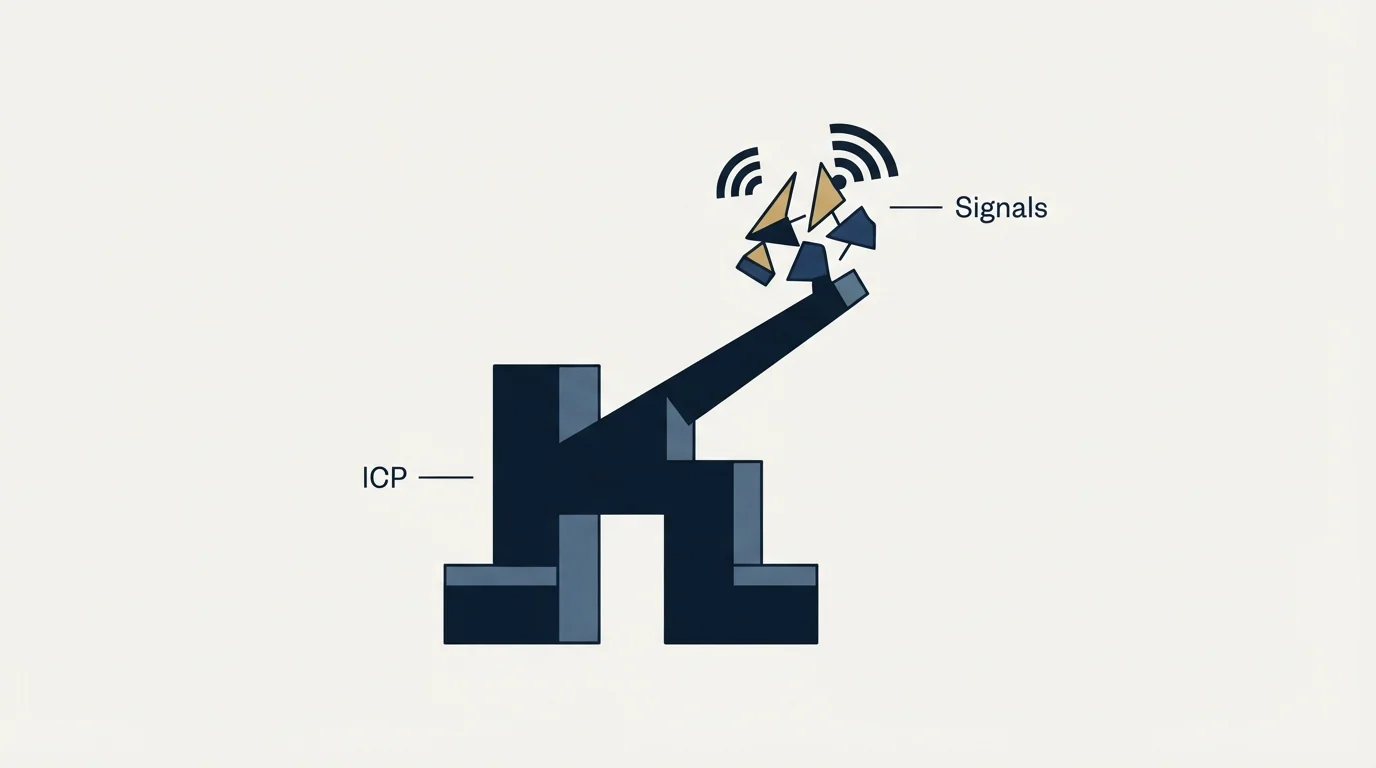
None of this replaces knowing who you sell to. A signal narrows a market you have already defined, and applied to an undefined market it just produces a smaller pile of the wrong accounts. If the profile is a personality description rather than a set of filters that returns a count, the exclusion pass in step four has nothing to run on. Building one that actually changes the target list is covered in how to build an ICP, and the boundary between a lead worth passing to sales and one worth nurturing is in MQL versus SQL.
The short version
Filters describe a durable state and signals describe a dated event, and only the second gives you a reason to write this week. Test a candidate signal on five questions, and lean hardest on the last one: delete the signal reference from your draft, and if the message still reads fine, the signal added nothing. Hiring, leadership change, technology adoption and removal, expansion and public statements of intent are observable without a budget, which is what keeps them valuable. Paid feeds are worth buying after a manual version of the play has worked, never before. Build the list by writing the message first, setting an expiry window, finding the person the signal implicates, applying firmographics last as an exclusion pass, and sending once.
RevenueFlow builds signal-led campaigns and is paid on attended meetings that meet criteria agreed in writing before launch. You can see what a campaign would look like for your market.
Frequently asked questions.
Frequently asked questions- What is the difference between a signal and a filter in prospecting?
- A filter is a condition that stays true for a long time, such as headcount band, industry or geography. A signal is something that happened on a date, such as a posted role or a leadership change. Filters define which accounts are worth talking to at all, and signals decide which week is the right week to write.
- Which buying signals can you gather without paying for data?
- Hiring posts, leadership changes, technology adoption or removal, expansion into a new office, market or product line, and public statements of intent such as conference talks and funding announcements. All of these carry a date and most name a function. Read the company careers page as well as the job boards, because the careers page is usually more current.
- Is intent data worth buying?
- It is worth buying after a manual version of the play has already produced replies, and rarely before. Third-party intent feeds work as an account-level prioritisation layer, refresh on a schedule, and are sold to your competitors as well. Buying the data first and then looking for a play produces a dashboard nobody opens.
- How do you reference a signal without sounding invasive?
- Let published signals appear in the copy and let unpublished ones decide timing only. A job posting, a funding announcement or a conference talk was put into public deliberately, so referencing it is ordinary attentiveness. A page visit or a consumption score was not, and naming it converts a useful timing signal into a reason to block your domain.
About the author.

B2B cold email experts helping companies generate qualified leads through done-for-you outreach campaigns.
RevenueFlow Team
Explore more.
Ready to scale your outreach?
We build GTM engines that book real meetings. See the receipts.
Related articles.
Readymode Pricing: The Seat Is Dear for What Is Inside It
Readymode publishes $199 and $249 per licence per month, near the top of the dialer range. What the seat includes that others bill separately, and when that pays.
PhoneBurner Pricing: What the Seat Price Covers
PhoneBurner publishes all three seat prices in both billing states. The metered resource is contact imports, not minutes, and the spam layer is an add-on at every tier.
Koncert Dialers: Line Counts Published, Price Is Not
Koncert publishes the parallel line ceiling on every tier, which most of this category will not. It publishes no price. What its pages state, and what the quote decides.
The Agoge Sequence: What Sam Nelson Actually Built
A documented 15-touch, 27-day cadence built by Sam Nelson at Outreach. What the primary sources say, which part transfers, and where our own practice differs.
Sales Navigator Lead Generation: Lists That Export Cleanly
Building searches that map to a real ICP, why saved searches are the actual product, and the export constraint that shapes every workflow around the tool.
Fractional SDR: When a Shared Seat Works and When It Stalls
A shared seat keeps the machinery around the rep and gives up exclusive ownership of the person. The conditions that decide whether that trade works.