Fractional SDR: When a Shared Seat Works and When It Stalls
A shared seat keeps the machinery around the rep and gives up exclusive ownership of the person. The conditions that decide whether that trade works.
A fractional SDR arrangement gives you the operations, oversight and infrastructure around a seat without exclusive ownership of the person in it. It works when your addressable list has a real ceiling, when there is one ideal customer profile and one message to learn, and when somebody answers a good reply the same day.
Key takeaways
- Ramp, oversight and sending infrastructure barely scale down, so a shared arrangement costs well above a proportional share of a full seat.
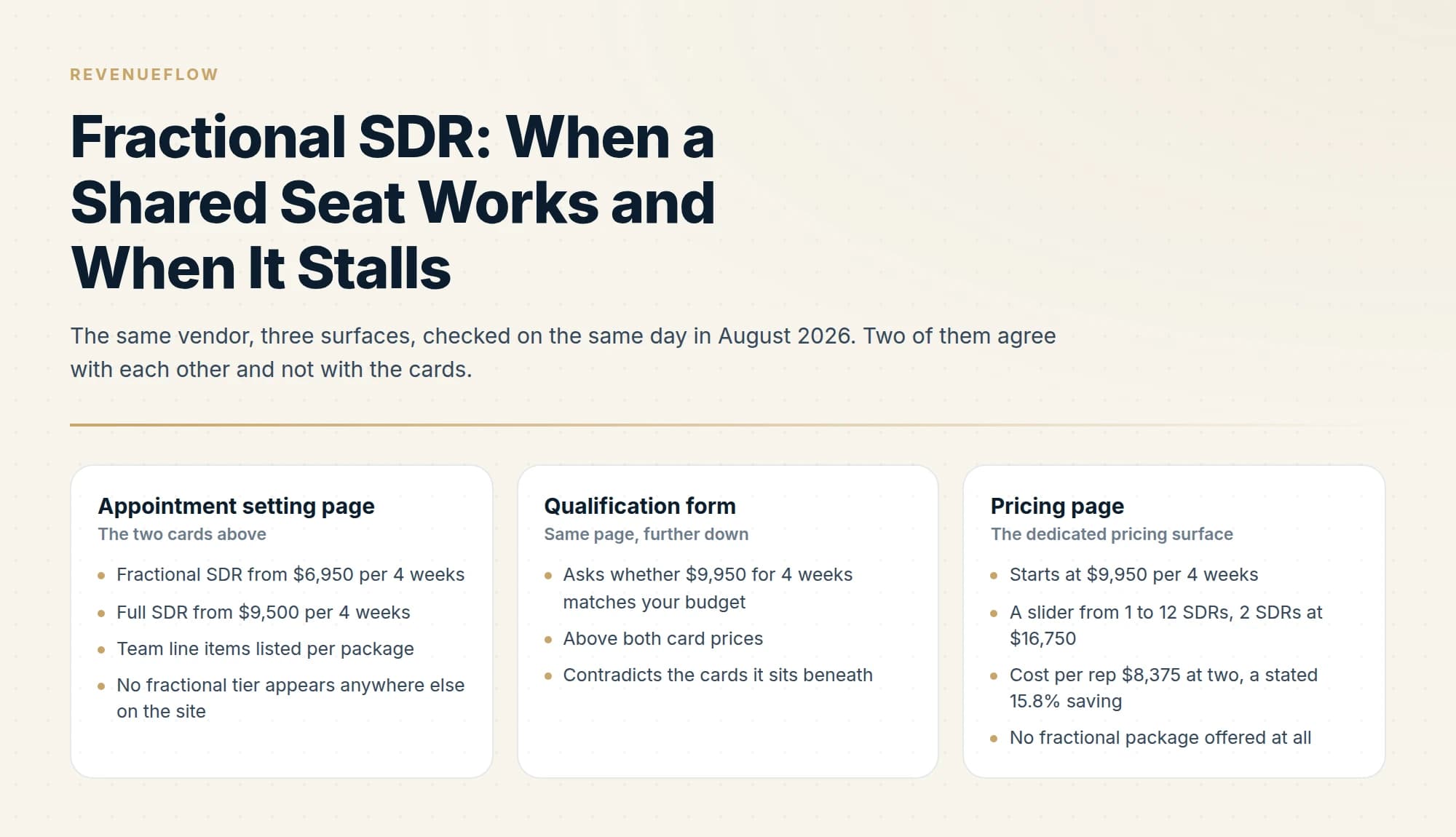
- SalesRoads still shows a fractional card on its appointment setting page, while its pricing page offers no fractional tier and starts at $11,950 for one dedicated SDR per four weeks.
- Low volume destroys your ability to tell a bad list from a bad angle, which is the hidden cost of a small arrangement.
- The word fractional covers both a named person working a defined share of their week and a pod carrying several accounts, so establish which one you are signing.
Reviewed and updated September 21, 2026
SalesRoads' appointment setting page publishes two packages, and the difference between them is one line in a list. The Fractional SDR package starts at $6,950 per four weeks and its stated team is a sales operations team, a director of client success and a talent development manager. The Full SDR package starts at $9,500 per four weeks and its stated team is all of those plus a dedicated SDR.
That is the fractional model in a single comparison. You keep the machinery around the seat and you give up exclusive ownership of the person in it. Whether that trade works depends almost entirely on how much volume your market can absorb and whether anyone on your side is ready to catch a reply the same day it arrives.
How this decision plays out depends on the seat you sit in. We keep persona-specific outbound guides for founders, SaaS founders, VPs of sales, SDR managers, RevOps leads, agency owners, consultants, recruiters, professional-services firms, and heads of marketing.
Read the price gap before you trust the prices
Run the arithmetic on those two cards. The fractional package is roughly 73 percent of the full package's starting price. Both are quoted per four weeks rather than per calendar month, so the annual comparison uses thirteen periods: about $90,350 against about $123,500, a difference of roughly $33,150 a year.
Now the caution, because it is larger than a footnote. Those cards are not what the same vendor publishes on its pricing page.
- Fractional SDR from $6,950 per 4 weeks
- Full SDR from $9,500 per 4 weeks
- Team line items listed per package
- No fractional tier on the pricing page
- Asks for your expected monthly investment
- Bands: under $5,000, $5,000 to $10,000, $10,000 or more
- Names no engagement price of its own
- One SDR at $11,950 per 4 weeks
- A slider from 1 to 12 SDRs, 2 SDRs at $16,750
- Cost per rep $8,375 at two, a stated 30% saving
- No fractional package offered at all
The reasonable reading is that the fractional cards are older pricing the vendor has left standing, and that the pricing page, from $11,950 for one dedicated SDR per four weeks, is closer to what you will actually be quoted. It offers no fractional package at all, and the form beneath the cards asks for a budget band rather than naming a price.
That matters beyond one vendor, because it is the general case rather than a curiosity. Service pages age. Pricing pages get maintained. If you build a budget or a vendor comparison from the first figure a search result hands you, you are quite likely reading a page nobody has updated in a year. Check the pricing page, check whether any form or calculator on the site quotes a different starting point, and treat a figure that appears on only one surface as a lead rather than a fact.
So use the 73 percent as what it is: a published illustration of how one vendor priced a shared seat against a dedicated one. Do not use it as a current quote, and do not annualise it into a budget.
As an illustration it is still the most instructive number here, because a fractional arrangement is not priced as a fraction. The costs behind it are not fractional. Whoever works your account has to learn your product, your buyers' objections, which titles genuinely own the decision, and what a real reply in your market sounds like. That education costs the same whether they spend two days a week on you or five. The operations layer, the client success oversight and the sending infrastructure are also close to fixed. What actually scales down is contact volume, which is the one input you were probably hoping to reduce anyway.
So the honest read is that fractional buys you a lower absolute commitment at a worse rate per unit of output. That is a good trade in specific conditions and a bad one outside them.
When it genuinely works
- The addressable list is small enough that a full seat would exhaust it
- One narrow ICP with one repeatable message
- A founder or AE who can take a good conversation the same day
- You are testing whether a market responds at all
- Success is measured in a handful of right meetings, not in volume
- Several ICPs, each needing its own message and objection set
- Volume too low to tell a bad list from a bad angle
- Nobody named on your side owns the reply
- Your account is the vendor's flex capacity
- You need a result inside one quarter
The list has a ceiling. This is the strongest case for fractional and the one people underuse. If your ideal customer profile resolves to a few hundred accounts, a full-time rep works through them and then faces a choice between re-contacting people who already ignored a message or drifting outside the profile. Both are bad. We do not re-contact: one message per campaign, no thread replies and no bumps, which means a small list is a genuinely finite resource. Sizing the arrangement to the list rather than to a headcount plan is the correct move, and fractional is how you do that.
One ICP, one message. The per-person education cost is the thing that makes fractional expensive per unit. Narrow the surface area and that cost shrinks. A single buyer type with a single problem is a week of context. Four segments with four value propositions is a month, and you are paying for that month at a rate calculated on partial output.
Someone can catch the reply today. Fractional produces lumpy reply flow. A handful of good conversations arrive in the same two days and then nothing arrives for a week. If a founder or an AE can respond within hours, that lumpiness is fine. If replies sit until the weekly sync, the arrangement fails at the last step, which is where fractional arrangements almost always fail.
You are testing a market. Committing to a full seat to find out whether a segment replies at all is an expensive way to run an experiment. A smaller commitment with a clear read-out is a reasonable way to buy that information, provided you have decided in advance what result would make you scale and what result would make you stop.
When it stalls

Context switching costs depth, not hours. The usual objection to shared reps is that you get fewer hours, and that is the least important part. The real cost is that pattern recognition needs continuity. A rep who reads your replies twice a week never accumulates the objection library that makes month three better than month one. They stay in month one indefinitely, and the output looks flat for a reason nobody can point at.
Low volume destroys your ability to learn. At small send volumes, a fortnight of silence is genuinely ambiguous. It could be the list, the angle, the subject line, the timing, or the market. There is no way to separate those, because you do not have enough sends to compare anything against anything. Teams respond by changing several variables at once, which guarantees they learn nothing from the next fortnight either. Going in, decide what volume gives you a readable signal, and if the arrangement cannot produce it, accept that you are buying meetings rather than buying learning.
Nobody owns follow-through. The seam in every fractional arrangement sits at the handoff. The vendor sends and triages. Somebody on your side has to answer the ambiguous reply, decide whether the account is worth a meeting, and turn up to it. When that person is unnamed, the arrangement degrades into a monthly report about activity. Name one person, give them the authority to book, and give them a same-day response expectation.
You are the flex capacity. From your side, a week where your rep was pulled onto somebody else's urgent launch looks exactly like a slow week in your market. You cannot tell the difference and you will never be told. Ask directly how many accounts the person carries and whether that number is capped in writing.
What you have to supply for it to work at all
Fractional arrangements have less slack than full ones. A full-time rep can absorb a vague ICP and a slow approval loop by spending time on it. A shared rep cannot, so every gap on your side turns straight into lost weeks.
- Yes: An ICP that resolves to a list of named accounts, not a description
- Yes: Approved messaging and a claims boundary, agreed before day one
- Yes: One named owner who answers replies within the same working day
- Yes: A suppression list covering customers, live opportunities and partners
- Yes: Real calendar availability, wide enough that a hot reply can book this week
- Yes: A written definition of a qualified meeting, agreed before launch
- Depends: A decision in advance about what result scales this and what result stops it
- Depends: Clarity on who owns the sending domains when the engagement ends
The last item catches people. If the vendor bought and warmed the sending domains, ending the engagement means leaving behind the warmed infrastructure your results were built on. That is a switching cost, and it is worth knowing about at signature rather than at cancellation.
The qualified meeting definition matters more here than in a full engagement, for a counterintuitive reason. Low volume means small numbers, and small numbers make every disputed meeting a large percentage of the month. Two arguments about whether a meeting counted can consume the entire commercial conversation in a way they would not at higher volume. Agree the criteria in writing before launch, and keep budget, timing and decision authority out of them, because requiring those means paying outbound rates to reach only people already running an evaluation.
Questions that tell you which shape you are actually buying

The word fractional covers at least two arrangements. In one, a named person spends a defined share of their week on you. In the other, a pod handles several accounts and no individual is assigned. Both are legitimate and they behave differently, so find out which one you are signing.
Ask who specifically will work the account and whether you can speak to them before signing. Ask how many other accounts that person or pod carries and whether the number is contractually capped. Ask what happens in the week they leave, and whether the replacement's first weeks bill at full rate. Ask what share of the fee is fixed overhead against variable contact work, because that ratio tells you how much of your money moves if you scale up. And ask what happens to your monthly output when another client has an urgent month.
A vendor with clean answers to those has thought about the model. A vendor who answers all five with the word flexible is selling you a pod and calling it a person.
Where fractional sits against the alternatives
Fractional is one of four delivery shapes, and the others solve different constraints: a dedicated agency pod, an offshore seat, and outcome-based pricing where you buy meetings and the staffing question disappears. Those trade-offs, including what you can and cannot direct in each, are in SDR outsourcing. The billing unit is a separate axis from the staffing shape and determines who absorbs a bad quarter, covered in outsourced SDR pricing. If the real question is whether to buy any of this rather than hire, the loaded comparison is in outsourced SDR versus in-house, and the specific clauses that make an outcome-based arrangement safe are in pay per appointment B2B.
One alternative deserves naming, because it often fits the same constraint. If your list is small and your reason for going fractional is that a full seat would exhaust it, an outcome-based arrangement solves the same problem from the other direction. You pay for the meetings the list actually produces and nothing for the weeks it produces none, which is a closer match to a finite pool than any per-seat rate.
The short version

Fractional priced at roughly 73 percent of a full seat on the one set of published cards in this category, because ramp, oversight and infrastructure barely scale down while contact volume does. Those cards now disagree with the same vendor's pricing page, which is its own lesson about where to check a number. It works when your addressable list has a real ceiling, when there is one ICP and one message to learn, and when somebody on your side can answer a good reply the same day. It stalls when the rep never accumulates depth on your market, when volume is too low to tell a bad list from a bad angle, and when nobody owns the reply. Before signing, find out whether you are buying a named person's week or a share of a pod, how many accounts they carry, and whether that number is capped in writing.
RevenueFlow sits in the outcome-based category and is paid on attended meetings that meet criteria agreed in writing before launch. You can see what a campaign would look like for your market.
Pricing and stated package composition are taken from SalesRoads' own pages. Annualised figures are arithmetic on those published starting prices, shown in the text. Verify current terms with the vendor before relying on them.
Frequently asked questions.
Frequently asked questions- What is a fractional SDR?
- An arrangement where you buy part of a sales development seat rather than a dedicated one, keeping the operations team, client success oversight and sending infrastructure around it while giving up exclusive ownership of the person doing the work. It may mean a named person spending a defined share of their week on you, or a pod covering several accounts at once.
- How much does a fractional SDR cost?
- Published figures need care here. SalesRoads lists a fractional package on its appointment setting page, while its pricing page offers no fractional tier and starts at $11,950 for one dedicated SDR per four weeks. The reasonable reading is that the fractional card is older pricing left standing, so ask for a current quote.
- When does a fractional arrangement work?
- When the addressable list has a real ceiling, so a full seat would exhaust it. When there is one ideal customer profile and one repeatable message, which keeps the education cost low. When a founder or account executive can answer a good reply the same working day. And when you are testing a market, with the result you would act on decided in advance.
- What should you ask a fractional SDR vendor?
- Who specifically will work the account, and whether you can speak to them before signing. How many other accounts that person or pod carries, and whether the number is capped in writing. What happens in the week they leave, and whether the replacement bills at full rate while learning. And who owns the sending domains when the engagement ends.
About the author.

B2B cold email experts helping companies generate qualified leads through done-for-you outreach campaigns.
RevenueFlow Team
Explore more.
Ready to scale your outreach?
We build GTM engines that book real meetings. See the receipts.
Related articles.
Superhuman Prospecting Pricing: Two Entry Prices, Two Pages
The pricing page starts at $1,998 a month and the appointment setting page says as low as $1,125. Both are live, and the gap is the useful part.
Cold Call Appointment Setting: The First Ten Seconds
The opening decides the call, and what wins it is a specific reason for phoning this person today. That is a property of the list before it is a property of the script.
Readymode Pricing: The Seat Is Dear for What Is Inside It
Readymode publishes $199 and $249 per licence per month, near the top of the dialer range. What the seat includes that others bill separately, and when that pays.
PhoneBurner Pricing: What the Seat Price Covers
PhoneBurner publishes all three seat prices in both billing states. The metered resource is contact imports, not minutes, and the spam layer is an add-on at every tier.
Koncert Dialers: Line Counts Published, Price Is Not
Koncert publishes the parallel line ceiling on every tier, which most of this category will not. It publishes no price. What its pages state, and what the quote decides.
The Agoge Sequence: What Sam Nelson Actually Built
A documented 15-touch, 27-day cadence built by Sam Nelson at Outreach. What the primary sources say, which part transfers, and where our own practice differs.