Outbound for VPs of Sales: Diagnosing the Gap
Coverage problems, conversion problems and distribution problems all present as a short quarter, and only the first one is fixed by more created pipeline.

A short quarter has three causes that look identical: a coverage problem, a conversion problem, and output concentrated in two reps. Only the first is solved by more created pipeline. If coverage is genuinely short, the build versus buy choice turns on timing and retention rather than on monthly price.
Key takeaways
- Aggregate quota attainment hides a distribution problem, because the mean and the median come apart and only the mean gets reported. Adding top-of-funnel volume makes the concentration worse.
- Adding created pipeline to a conversion problem produces a bigger pipeline with the same output and a worse forecast, and the cost lands in the following quarter.
- The build versus buy comparison is not the salary line. It is fully loaded cost, ramp and the probability the hire does not work out, and the answer flips depending on how many quarters you have.
- Development reps without an owner for the list, the qualification standard and weekly coaching are unmanaged with a manager in place, and that layer is the part hiring plans leave out.
Reviewed and updated September 1, 2026
A VP of Sales carries one number that is not negotiable and a set of inputs that mostly are. The number is the quarter. The inputs are headcount, territory, price, the marketing contribution, and whatever pipeline can be created that is not waiting to arrive on its own. Outbound sits in that last category, and it is the input that gets asked to close the gap when the others have already been spent.
This page is for the sales leader deciding what to do about created pipeline: whether to build the function, extend it, or buy the output. It covers the coverage arithmetic that drives the decision, the capacity question underneath it, how a bought motion is structured, and the questions that reveal what a provider is actually selling.
The gap, before anyone proposes a solution
The conversation almost always starts in the same place. Coverage for the quarter after next is short, the reps who are hitting their number are the reps who were already hitting it, and marketing's contribution is forecast rather than banked. Somebody proposes more outbound.
Before that becomes a plan it is worth being precise about which problem is being solved, because three different problems produce the same symptom.
A coverage problem. There is not enough open pipeline against the target, on any reasonable multiple. That is a volume problem and outbound is a legitimate answer to it. The multiple itself deserves more scepticism than it usually gets, because both of its inputs are softer than the ratio implies, which is the argument in pipeline coverage.
A conversion problem. There is enough pipeline and it does not close. Adding created pipeline to a conversion problem produces a bigger pipeline with the same output and a worse forecast, and the cost lands in the next quarter rather than this one.
A distribution problem. The team total looks acceptable and it is carried by two people. Aggregate quota attainment hides this completely, because the mean and the median come apart and only the mean gets reported. More top-of-funnel does not fix it, and it will make the concentration worse, since the reps already performing are the ones who will work the new pipeline hardest.
Two answers sit at the ends of that diagnosis and both are legitimate. A company whose gap is conversion or distribution does not need outbound, and a provider who says so is being accurate rather than modest; adding created pipeline there makes the existing problem more expensive at the same rate. A company whose gap is coverage does need it, and the remaining question is whether to build or buy rather than whether to run it at all. The diagnosis is worth doing before the conversation with any vendor, because it is the one part of the decision no vendor is well placed to make for you.
- Yes: Coverage is short against the target on the multiple you derived yourself
- Yes: Stage-to-stage conversion has held steady across the last several quarters
- Yes: Output is spread across the team rather than carried by two reps
- Yes: Meetings that get booked are being attended
- No: Deals are stalling in the middle of the funnel rather than at the top
- No: The qualification standard has drifted under pressure this quarter
- Depends: Whether the reps have capacity to work more accounts at all
That last row is the one that decides how much of this page applies. A team already at capacity does not need more meetings, it needs either more sellers or better ones, and buying meetings into a full calendar produces no-shows and resentment.
The capacity decision, which is the real decision
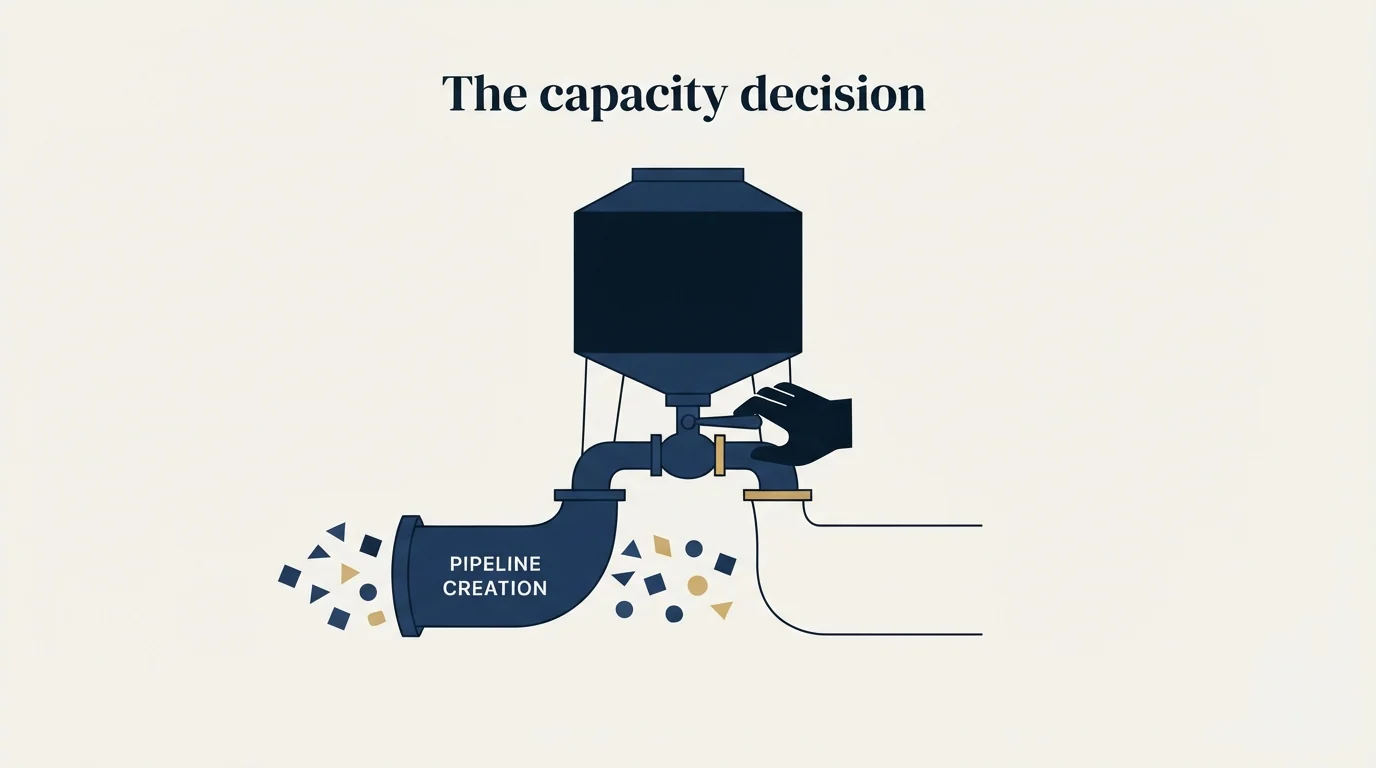
Assume it is genuinely a coverage problem. The choice is between building capacity and buying output, and it is worth stating what each one is actually a purchase of.
Building means headcount: more sellers, more development reps, or both, plus the management layer that makes them productive. The layer is the part that gets forgotten. Development reps without an owner for the list, the qualification standard and the weekly coaching are unmanaged with a manager in place, and what that role owns is set out in what an SDR manager actually owns. Under roughly three reps the function usually gets managed by somebody who is also carrying a number, and the coaching is the first thing that gets cancelled when the quarter is tight.
Buying means output: a provider runs the sourcing, the infrastructure and the sending, and hands over conversations. The staffing question becomes somebody else's, and the risk changes shape rather than disappearing. It is now provider risk and definition risk instead of hiring risk.
The arithmetic that compares them is not the salary line. It is the fully loaded cost, the ramp, and the probability the hire does not work out, all three of which the hiring plan tends to omit. That is the argument in the hire more reps arithmetic, and the method for comparing the two properly is laid out in outsourced SDR versus in-house.
Every figure in the next paragraph is invented for the worked example. None of it is a benchmark and none of it is a RevenueFlow result. Substitute your own before deciding anything.
Suppose a development rep costs 6,000 units a month fully loaded, ramps for four months at half output, and one hire in three does not reach the standard. Over a first year, the loaded cost is twelve months of salary plus four months of half-productivity plus a one in three chance of repeating the whole exercise, and the meetings arrive from month five rather than month one. Suppose a bought motion costs 7,000 units a month and produces meetings from the first month at a defined standard. On invented numbers like these the bought motion is more expensive per month and cheaper per meeting for the first two or three quarters, and the in-house build wins from roughly the fourth quarter onward provided the hire stays. The whole decision therefore turns on how long you expect the person to stay and how urgently the coverage is needed, rather than on the monthly price.
Invented example figure
Invented example figure
Arithmetic on the invented figures above
The reason this matters more to a sales leader than to anyone else in the building is that the timing term is the one you are actually judged on. A build that wins on a two-year view and misses the next two quarters is a correct decision that costs you the year.
How a bought motion is structured
Stated as policy rather than as a performance claim, and it is a fair template for what to expect from any provider running outbound end to end.
Qualification agreed in writing before launch. What counts as a qualified meeting is defined before the first send, not argued about when one lands. Budget, timing and authority are not billing conditions. For a sales leader this is the single most important clause in the arrangement, because a definition that is settled afterwards always settles in the provider's favour and a definition that quietly excludes work makes two quotes incomparable. The pricing units that sit on top of it are separated in what a lead generation agency actually costs.
One message per campaign, sent once. Each campaign carries one premise. No bumps, no thread replies. A later approach is a separate campaign with its own reason to exist. The practical effect for a leader is attribution: reply patterns belong to a single premise and a single segment, so a dead segment is visible in weeks rather than argued about for a quarter.
Copy approved before anything sends. The client signs off on the message.
Email and LinkedIn, not phone. That is the channel set, and a team expecting cold calling coverage should know it before signing.
- Step 1Agree the segment and the disqualifiers
Which accounts are in scope, and what takes a company off the list.
- Step 2Write the qualification standard
Agreed before launch, applied by both sides, and not renegotiated under quota pressure.
- Step 3Approve one message per campaign
One premise, sent once, so a segment result is readable.
- Step 4Route meetings to the right seller
Ownership and capacity decided before the first meeting is booked, not after.
- Step 5Read segment-level reply rates weekly
Leading indicators move first, and they are what tells you which segment to cut.
What to ask any provider, including us

What is the exact definition of the thing you are billing for? Booked, attended, and qualified-and-attended are three different products at three different prices. Ask which one, and ask what happens to a meeting that no-shows.
Ask to see the targeting criteria and the disqualifiers. A provider who will not is selling volume. Disqualifiers are more revealing than qualifiers, because they show whether anyone has thought about who wastes your sellers' time.
Whose sending infrastructure is this? Outbound must not run on the domain your team's real email runs on. Ask which domains are being used and who else sends from them.
Who owns reply handling, and inside what response time? Reply handling is where most of the value sits and the first thing a thin provider hands back to you.
How does this attach to the team that already exists? Meeting routing, calendar ownership, no-show recovery and what your reps are expected to do differently. A motion that produces meetings nobody has capacity to hold produces a worse quarter, not a better one.
When is your service the wrong answer? Any provider worth hiring can name the cases. Ours: a target market of a few hundred named accounts where relationship depth beats reach, a cycle that needs the same person from first touch to close, regulated or consent-only channels, and a team that genuinely needs a development bench to promote from later. That last one is a legitimate reason to accept a worse cost per meeting and it never appears in an agency pitch.
The short version
Diagnose the gap before buying a solution to it. A coverage problem, a conversion problem and a distribution problem all present as a short quarter, and only the first one is fixed by more created pipeline. The other two get worse with volume added.
If it is genuinely coverage, the choice between building capacity and buying output turns on timing and retention rather than on monthly price. Run the arithmetic with the ramp and the failed-hire probability included, and notice that the answer flips depending on how many quarters you have.
Whichever route you take, settle the qualification definition in writing first. It is the clause that decides whether the number you report at the end of the quarter means anything.
If the coverage is needed sooner than a hire can ramp, we run outbound end to end and are paid on attended meetings that meet criteria agreed in writing before launch. You can see what a campaign would look like for your market.
Frequently asked questions.
Frequently asked questions- How do I know whether we have a pipeline problem or a closing problem?
- Check where deals stall. Short coverage against a multiple you derived yourself is a volume problem that outbound can answer. Deals stalling in the middle of the funnel, or a team total carried by two reps, are not volume problems, and more meetings will make the forecast worse rather than better.
- Is it cheaper to hire SDRs or outsource them?
- It depends almost entirely on timing and retention. A bought motion tends to cost more per month and less per meeting in the early quarters because it produces from month one, while an in-house build overtakes later provided the hire stays. Include ramp and the failed-hire probability or the comparison is meaningless.
- What should be in the contract about qualified meetings?
- The definition itself, written before the first send, plus what happens to a no-show and how a disputed meeting is resolved. Budget, timing and authority should not be billing conditions. A definition settled after launch always settles in the provider's favour, and one that quietly excludes work makes two quotes incomparable.
- Will more meetings help if my team is already at capacity?
- No, and it usually backfires. Meetings booked into a full calendar turn into no-shows and reschedules, and the reps read the whole programme as noise. A team at capacity needs more sellers or better ones, which is a different purchase from more created pipeline.
About the author.

Ben Carden is CRO at RevenueFlow, which builds and operates outbound revenue engines for B2B companies. Previously at Gartner Enterprise. Studied at London School of Economics.
Ben Carden · CRO
Connect on LinkedIn →Explore more.
Ready to scale your outreach?
We build GTM engines that book real meetings. See the receipts.
Related articles.
Sales Call Planning: The Plan a Booked Call Needs
A call cannot produce a commitment nobody named in advance. The four fields a call plan carries, and why the ask has to be decided before the meeting opens.
Sales Manager Compensation Plans: Paying for a Team
A manager is paid on other people work, so the aggregate team number hides the job. Which components to weight beside the override, and the player coach trap.
Lead Generation for Digital Agencies: Referral to Outbound
Referrals hide their own risk and take about three months to replace. The sequence, who owns it, what breaks in month one, and how to judge it before meetings arrive.
Cross-Sell vs Upsell: Different Trigger, Different Owner
An upsell has a trigger that arrives on its own. A cross-sell has none and needs a diagnosis somebody funds. That is the difference that decides the work.
Sales Kickoff Meeting: The Decisions It Has to Leave With
A kickoff is the one moment a whole sales organisation can change at once. The four decisions it has to publish, and the week-six check that tests them.
Lifecycle Stage, Lead Status, Deal Stage: Three Fields
Lifecycle stage records position, lead status records activity, and deal stage lives on the deal. Merging them breaks funnel reporting in ways nobody notices for a year.