The SDR Manager Role: What the Job Owns and When to Hire One
Promoting your best rep fails often enough to be predictable, because the two jobs share a vocabulary and almost no daily work. What the manager owns that the rep cannot.
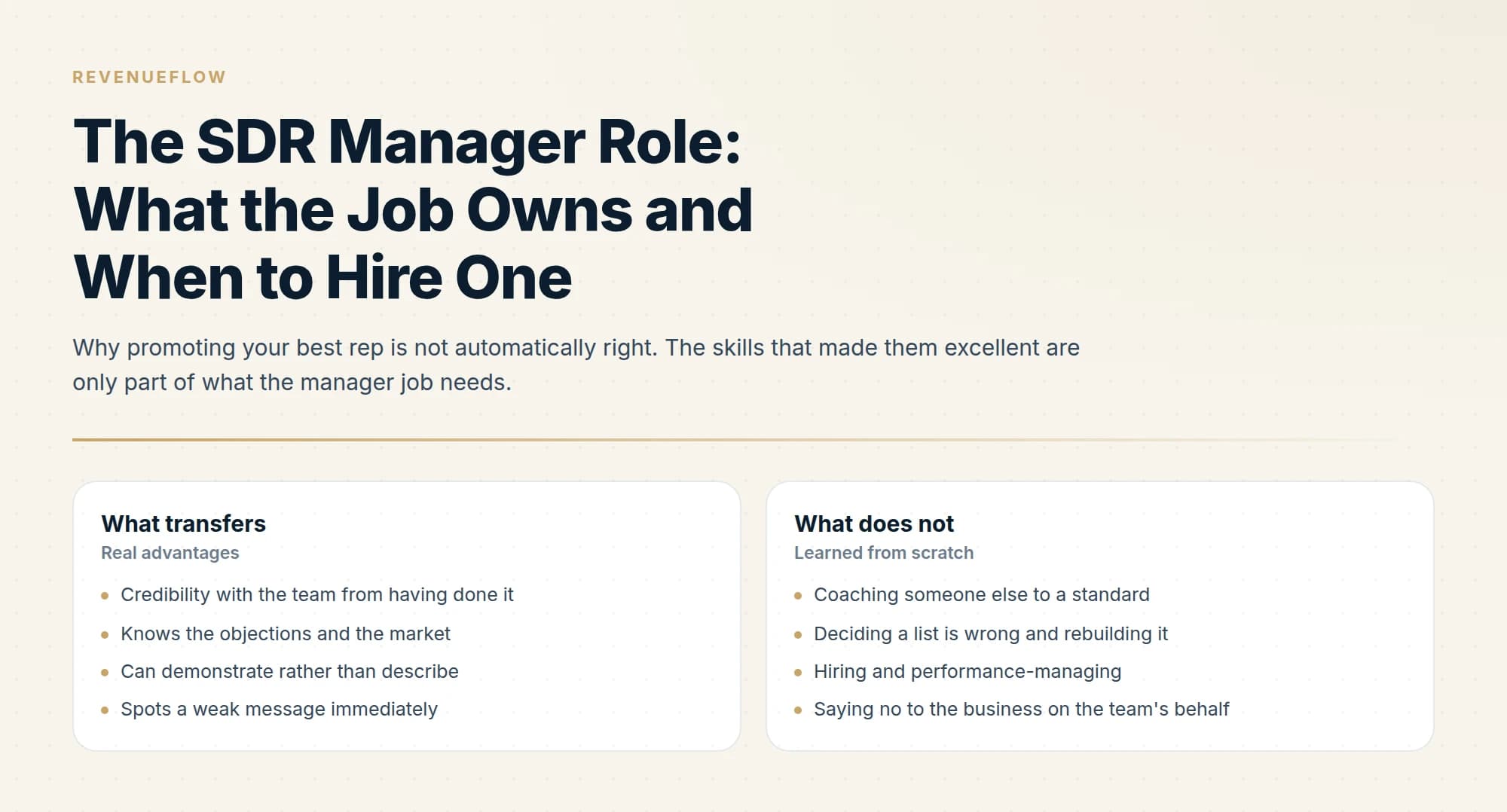
An SDR manager owns the four inputs a rep cannot fix from inside the job: the target list and the criteria, weekly coaching against real recordings, the definition of qualified and its defence under pressure, and the protection of contact time from everything else the business wants.
Key takeaways
- Coaching capacity rather than span of control on an org chart decides how many reps one manager can carry.
- A rep reporting to a leader who is busy closing gets no coaching and no list ownership, which is worse than no manager because it looks like management.
- Candidates who go straight to activity levels when told a team is missing target are a warning, while those asking about contact coverage and segment reply rates are diagnosing.
- A manager carrying a personal quota prioritises their own number under pressure, and the team's output falls by more than their individual contribution adds.
Reviewed and updated August 28, 2026
The first SDR manager most companies hire is their best SDR, promoted. It fails often enough to be predictable, and the reason is not that the rep was bad. It is that the two jobs share a vocabulary and almost no daily work.
An SDR manager's output is other people's output, produced through coaching, list decisions and protecting the team from everything that is not contact time. Here is what the role owns, when you actually need one, and the ratio that decides whether they can do any of it.
What the manager owns that the rep does not
Four things, and all four are the inputs a rep cannot fix from inside the job.
The list and the criteria. Which accounts the team works, and what qualifies. A rep can work a list well or badly; only the manager can decide the list is wrong and change it. This is the single highest-leverage thing the role does and the one most often left with marketing by default.
Coaching against recordings. Not pipeline review, coaching. Listening to actual calls and reading actual messages, weekly, per rep. This is the part that gets cancelled when the quarter is tight, and cancelling it is what makes the next quarter tight.
The definition of qualified, and defending it. Written criteria agreed before contact starts, applied consistently when a rep wants a borderline meeting to count. A manager who lets the definition drift under quota pressure destroys the number's meaning within a quarter.
Protecting contact time. Every internal meeting, tooling migration and reporting request lands on the team through the manager. The job includes saying no to a lot of it.
Teams trying to protect contact time often find that the right sequencing platform quietly does part of that work, which makes comparing options like those in email sending tools for SDR teams worthwhile.
- Credibility with the team from having done it
- Knows the objections and the market
- Can demonstrate rather than describe
- Spots a weak message immediately
- Coaching someone else to a standard
- Deciding a list is wrong and rebuilding it
- Hiring and performance-managing
- Saying no to the business on the team's behalf
When you actually need one
The trigger is not headcount alone, though headcount is the usual proxy.
With one or two reps, the sales leader can manage them directly if they genuinely have the time, and mostly they do not. The failure mode at this size is a rep reporting to someone who is busy closing, which means no coaching and no list ownership. That is worse than no manager, because it looks like management.
At three to five reps the role becomes a real job, and this is where most companies hire one. The work is now too much for a part-time owner, and the consistency problem starts to bite: three reps with three different qualification standards produce a pipeline nobody trusts.
Beyond roughly eight reps you are into a second manager or a team lead layer, because the coaching cadence stops fitting in a week.
The ratio that decides it is coaching capacity, not span of control on an org chart. If the standard is a weekly recorded-call review plus a weekly message review per rep, that is a real number of hours. A manager carrying seven reps plus their own reporting, hiring and internal meetings will quietly drop the coaching first, and then the team is unmanaged with a manager in place.
- Step 1Monday: list and priorities
Which accounts and segments this week, and what changed from last week's results.
- Step 2Midweek: coaching per rep
Real recordings and real messages, one rep at a time, against a standard.
- Step 3Ongoing: unblock
Data problems, deliverability, handoff friction. Remove them rather than asking the rep to route around them.
- Step 4Friday: read the leading indicators
Reply rate by segment and response time, not just meetings, because those move first.
Hiring an SDR manager

Whether promoting internally or hiring externally, three things predict performance better than a track record of personal quota attainment.
Can they coach in front of you? Give them a real recorded call and ask them to coach it aloud. Strong candidates identify one or two specific changes and explain why. Weak ones summarise what happened or offer generic encouragement.
Do they reach for the list before the effort? Describe a team missing target and see what they ask about. Candidates who go straight to activity levels are a warning. Candidates who ask about contact coverage, segment-level reply rates and whether the offer was tested are diagnosing rather than pushing.
Can they say no? Ask what they would do when the CRO asks the team to run a one-off campaign mid-quarter. The role exists partly to absorb that pressure, and a manager who cannot will pass every interruption straight to the reps.
The external-versus-internal question usually resolves on market knowledge. An internal promotion knows the market and needs coaching skill; an external hire brings the craft and needs a quarter to learn the buyers. Both work. What does not work is promoting a strong rep and giving them no support in learning the actual job.
What the manager should be measured on
Not their own activity, and not raw team meeting count either.
Held and qualified meetings across the team, which is the output.
Consistency across reps. A team where one rep produces most of the output is a coaching failure that a healthy team total can hide. Look at the spread, not just the sum.
Ramp time for new reps, which is close to a pure measure of the manager's onboarding and coaching. It is the number that most directly reflects the role, covered further in SDR training and ramp.
Retention. The function has a turnover problem, and a manager who retains reps through a hard quarter has done something real that no activity report shows.
Deciding how to keep top performers through a rough stretch often points toward recognition programmes like president's club criteria and rewards, which hold status through the year rather than move a single quarter.
- Yes: Weekly coaching against real recordings happens and is not cancelled
- Yes: The manager owns the target list and has changed it on evidence
- Yes: Qualification criteria are written and applied consistently under pressure
- Yes: Output is spread across reps rather than concentrated in one
- No: The manager carries their own contact quota alongside managing
- No: Reps route around data and deliverability problems themselves
- Depends: Whether span of control leaves real hours for coaching
The player-coach row deserves its own note, because it is presented as efficiency and is usually the opposite. A manager carrying a personal quota will always prioritise their own number under pressure, since it is the one with their name on it. The coaching goes first, and the team's output falls by more than the manager's individual contribution adds.
The first ninety days in the role

A new SDR manager, promoted or hired, has a predictable set of first moves and a predictable temptation.
The temptation is to change the process immediately, because that is visible and feels like leadership. It is almost always premature, since the new manager does not yet know which parts of the current process are load-bearing.
A better sequence starts with listening to recordings. Twenty real calls in the first fortnight, across every rep, tells them more about the team's actual problems than any amount of dashboard review. It also establishes the coaching relationship on the right footing, because the manager arrives with specifics rather than opinions.
Second, audit the inputs before touching the outputs. Contact coverage on the current lists, reply rate by segment, whether the qualification criteria exist in writing, and whether the suppression list is real. Managers who skip this spend their first quarter coaching reps on problems the reps did not cause.
Third, fix one input and one behaviour, and only those. A new manager who changes the list, the criteria, the cadence and the scorecard simultaneously has made attribution impossible and destabilised a team at the same time.
By ninety days there should be a weekly coaching cadence that has never been cancelled, one documented change to the list or criteria with the evidence behind it, and a clear view of which reps need what. What there should not be is a rebuilt process, because that decision is better made in month four with real information.
The part of the job nobody writes down
Most of what makes a good SDR manager is judgement about which problem is which.
A rep with falling reply rates might need coaching, or might have been handed a worse segment. A team missing target might be underperforming, or might be working a list whose contact coverage collapsed when a data source changed. A rep who suddenly stops booking might have a personal problem, a technical problem, or a confidence problem, and the three need opposite responses.
The manager is the only person positioned to tell those apart, because they see the recordings, the data and the person. That diagnostic work is the actual job, and it is why the role cannot be done by someone who is only reading a dashboard.
For the role being managed, see what a sales development rep does and outbound SDR versus inbound SDR. If the conclusion is that you need the function without building the management layer, SDR outsourcing covers the delivery models.
The short version

An SDR manager owns the list, the qualification standard, the coaching and the protection of contact time, which are precisely the inputs reps cannot fix themselves. Hire when you have three or more reps, or earlier if nobody currently has hours for weekly coaching. Test candidates by having them coach a real call and by watching whether they diagnose the list before questioning effort. Measure them on output spread across reps, ramp time and retention, and do not give them a personal quota.
If the honest answer is that you need the output without building the team and the management around it, we run outbound on a pay-per-qualified-meeting basis, and you can see what a campaign would look like for your market.
Frequently asked questions.
Frequently asked questions- What does an SDR manager own?
- The list and the criteria, since only the manager can decide the list is wrong and change it. Coaching against real recordings and real messages, weekly and per rep, which is distinct from pipeline review. The written definition of qualified and its defence when a rep wants a borderline meeting to count. And protection of contact time, which means saying no to a lot of internal requests.
- When should you hire an SDR manager?
- At three to five reps the role becomes a real job, and this is where most companies hire. With one or two reps a sales leader can manage directly if they genuinely have the time, and mostly they do not. Beyond roughly eight reps you need a second manager or a team lead layer, because the coaching cadence stops fitting in a week.
- How do you test an SDR manager candidate?
- Give them a real recorded call and ask them to coach it aloud, since strong candidates name one or two specific changes and explain why. Describe a team missing target and watch whether they reach for the list or for activity levels. And ask what they would do when a senior leader asks the team to run a one-off campaign mid-quarter.
- What should an SDR manager be measured on?
- Held and qualified meetings across the team, which is the output. Consistency across reps, because a healthy team total can hide one person producing most of it. Ramp time for new reps, which is close to a pure measure of onboarding and coaching. And retention, since keeping reps through a hard quarter is real work that no activity report shows.
About the author.

B2B cold email experts helping companies generate qualified leads through done-for-you outreach campaigns.
RevenueFlow Team
Explore more.
Ready to scale your outreach?
We build GTM engines that book real meetings. See the receipts.
Related articles.
President's Club in Sales: How the Criteria Decide Who Goes
A rep finishes at 134 percent of plan and the bar was 135. What a President's Club actually buys, and the two ways to set the criteria.
Sales Rep Coaching: The Cadence That Survives a Busy Quarter
Coaching that changes behaviour needs an artifact on the table and one named focus. The weekly loop, and the three layers a flat number can be hiding.
Outbound for SDR Managers: Finding the Constraint
A short month is usually the list, the message or the infrastructure. Capacity is the least common cause and the only one more people actually fix.
Sales Performance Improvement Plan Samples: What to Include
Three worked sales PIP samples, and the diagnosis that comes first. Most published plans set a target on an outcome the rep does not control alone.
Sales Rep Scorecard: What the Rep Cannot Control
Most rep scorecards carry lines the rep cannot move. The controllability test, the six lines that earn a place, and the two ways the document stops meaning anything.
Cold Calling Sales Training: Diagnose Before You Buy It
Calling results come from the list, the offer and the execution. Training reaches the third, and the third is frequently not the one that broke.