SDR Training and Ramp: The Order That Protects the List
Ramp cost is usually counted as salary during the unproductive period, which is the smallest part. The accounts a learning rep spends do not come back.
SDR training should follow the order that protects the target list: the buyer's world, the offer, real objections from recordings, writing as a skill, then tools. A new rep should not contact a real prospect until they can demonstrate competence on something that costs nothing.
Key takeaways
- The larger parts of ramp cost are the accounts consumed while learning, the sending reputation damaged by early mistakes, and the manager hours spent coaching.
- A concrete gate assesses three written messages to real target accounts on whether the reason is specific and checkable, the ask is proportionate, and the message would read the same for any company in the segment.
- Onboarding gets the attention while ongoing weekly coaching produces the results, and a rep reviewed only in pipeline meetings plateaus within a quarter.
- Enablement built as a project decays, so keep the four worthwhile artefacts current by making the coaching cadence feed them.
Reviewed and updated September 1, 2026
Every account a ramping rep contacts badly is spent. Not paused, spent. On a named target list of a few hundred companies, a new SDR working through their first fortnight of clumsy messages can remove five percent of the addressable market before anyone reviews their work.
That is the real cost of SDR training, and it is why the sequence matters more than the curriculum. Train in the order that protects the list.
Inside sales training covers the same ground for reps who prospect and close over the phone and inbox, and the ordering argument below applies to it unchanged.
Prospecting training is the half of this that decays fastest without coaching, which is why the order below matters more than curriculum coverage.
What a new sales development rep should focus on first is set by this order rather than by a list of tips, because the early weeks spend accounts that do not come back.
SDR ramp is the interval this sequence is designed to shorten, and the ramp cost that matters is the accounts spent rather than the salary paid.
s opening line: 'SDR coaching is the half that produces the results, and it starts where onboarding stops.
What follows is the SDR onboarding plan itself, ordered so the first weeks protect the target list rather than consume it.
If you are reading this as one of the SDR managers it is written for, the persona-specific version of this playbook lives in our guide to outbound for SDR managers.
The cost nobody puts in the ramp budget
Ramp cost is usually calculated as salary during the unproductive period. That is the smallest part.
The larger parts are the accounts consumed while learning, the sending reputation damaged by early mistakes, and the manager hours spent coaching instead of on everything else. None appear on a spreadsheet, and the first one is permanent within any reasonable time horizon.
The consequence is a specific sequencing rule: a new rep should not contact a real prospect until they can demonstrate competence on a fake one. This sounds obvious and is routinely skipped, because getting the rep "live" feels like progress and a certification gate feels like delay.
Our own operating constraint sharpens this further. We run one message per campaign, with no follow-up sequences and no bumps, so there is no second attempt to correct a weak first one. When the first message is the only message, the training bar is higher by construction.
- Days 1 to 3Market and buyer, not product
Who buys, what they are measured on, what breaks in their week. Product knowledge without this produces feature-led messages.
- Days 4 to 7The offer and the objections
What we ask for, what we give, and the three reasons people say no. Sourced from real recordings, not from a deck.
- Week 2Practice on real accounts, no contact
Research live target accounts and write real messages that are reviewed and never sent.
- End of week 2Certification gate
Written messages and a role-played call assessed against a standard. Pass to go live, fail to repeat the week.
- Weeks 3 to 6Live at reduced volume
Real contact on a limited account set, with every message reviewed before sending.
- Week 7 onwardFull volume, weekly coaching
Volume opens up, review moves from pre-send to sampled, coaching continues indefinitely.
What to train, in priority order
The order is deliberate, because each layer only works if the one before it is in place.
The buyer's world first. What the target's job involves, what they are measured on, and what a bad week looks like for them. A rep who understands this writes relevant messages without being given lines. A rep who does not will interpolate product features into a template forever.
The offer second. What you are actually asking for and what the prospect gets. Most weak outbound is not badly written, it asks for something unreasonable given the relationship, and the rep never questions the ask because nobody explained the reasoning behind it.
Objections third, from recordings. Not a battlecard written by marketing. The three or four things real people actually say, in their words, taken from real calls. This is also the fastest way to teach the market.
Writing fourth, and taught as a skill. Most outbound contact is written and most training programmes treat writing as an afterthought behind call practice. A rep who cannot write three clear, specific sentences will underperform regardless of how well they speak.
Tools last. The CRM, the sequencer, the dialer. These are the easiest to teach and the most commonly taught first, because they are concrete and have documentation. A rep who knows the tooling and not the buyer produces high-volume irrelevance.
Beyond training sequence, the choice of sending platform still shapes outcomes, and a comparison of sequence automation and CRM sync tools covers the options built for pipeline-focused SDR teams.
The certification gate

The single change that most improves ramp outcomes is refusing live contact until a standard is met.
Make it concrete. Three written messages to three real target accounts, assessed on whether the reason for writing is specific and checkable, whether the ask is proportionate, and whether the message would read the same for any company in the segment. Plus one role-played call assessed on discovery rather than pitch.
Pass and go live at reduced volume. Fail and repeat the week. The gate should be genuinely failable, and the first time you let someone through who did not pass, it stops functioning.
The objection to this is always that it delays productivity by a week. The arithmetic goes the other way: a week of delay against an unrecoverable share of the target list, plus the reputation cost of poor early sending, plus the coaching time spent unpicking habits formed in week one.
- Yes: Can explain what the buyer is measured on, unprompted
- Yes: Can state the offer and why the ask is proportionate
- Yes: Writes a specific, checkable reason for contact rather than a product line
- Yes: Handles the three most common objections without a script in front of them
- Yes: Knows which accounts to leave alone and why
- No: Has memorised the product feature list
- Depends: Whether their written messages need editing before sending
Coaching after ramp, which is where the value actually is
Onboarding gets the attention and ongoing coaching produces the results. A rep who is coached weekly against real recordings improves continuously; a rep who is onboarded well and then reviewed only in pipeline meetings plateaus within a quarter.
The cadence that works is weekly, per rep, against real artefacts: a recorded call and a set of sent messages. Not a pipeline review, which is a different meeting about different objects. The distinction matters because pipeline review discusses outcomes and coaching discusses behaviour, and only one of them can change next week.
Two habits make it stick. Coach one thing at a time, because a rep given five improvements applies none. And have the rep self-assess first, since a rep who can identify their own weak opener has learned something transferable, while a rep told about it has received a correction.
Training for the parts that are not the rep's fault

A distinct category of training is worth naming because it prevents wasted coaching: teaching reps to recognise when the problem is not theirs.
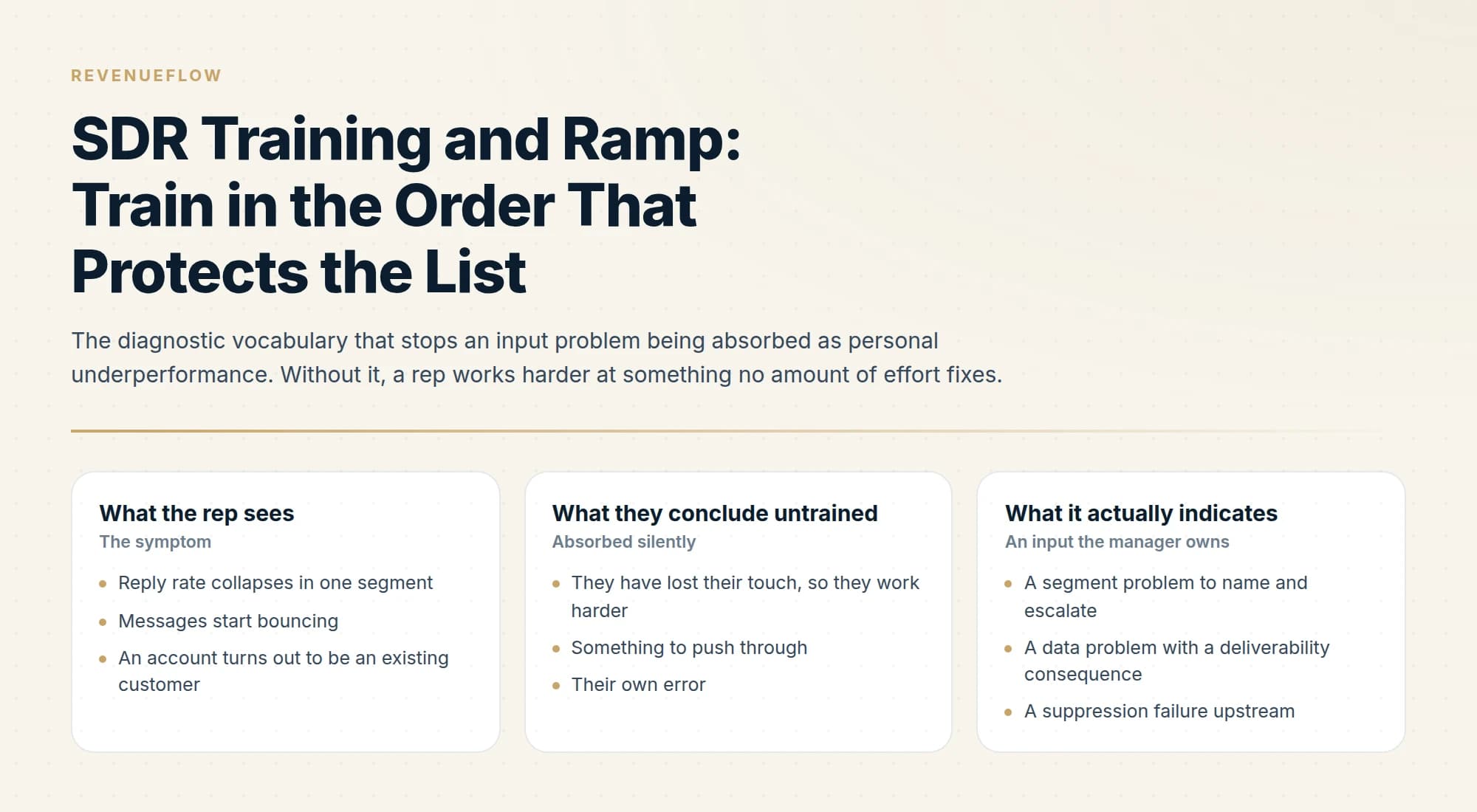
A rep whose reply rate collapses in one segment should be able to say so and escalate, rather than conclude they have lost their touch and work harder. A rep hitting bounces should know that is a data problem with a deliverability consequence, not something to push through. A rep contacting a company that turns out to be an existing customer should know that indicates a suppression failure, not their error.
- Reply rate collapses in one segment
- Messages start bouncing
- An account turns out to be an existing customer
- They have lost their touch, so they work harder
- Something to push through
- Their own error
- A segment problem to name and escalate
- A data problem with a deliverability consequence
- A suppression failure upstream
Teaching the diagnostic vocabulary makes reps useful sensors on the inputs their manager owns. Without it, every input problem is absorbed silently as personal underperformance, which is how good reps churn quietly. The manager-side view of those inputs is in the SDR manager role.
Training materials that are worth building
Most enablement libraries are large, unused and out of date. Four artefacts earn their maintenance.
A recording library organised by objection, not by rep. Three real examples of each common objection being handled well, and ideally one being handled badly. New reps learn faster from a bad call with commentary than from a polished one.
A one-page buyer brief per segment. What that buyer is measured on, what their week looks like, the vocabulary they use, and the three things that make them care. One page, because a longer document does not get read a second time.
A message bank with reasoning attached. Not templates to copy, examples with a note explaining why each one worked. Templates without reasoning produce reps who can only operate inside the template.
One worked example, a full set of SDR scripts for a single prospect with the reasoning beside each touch, is in SDR scripts for call, email and LinkedIn.
A written qualification standard with edge cases. The criteria plus five real borderline examples and how each was decided. The edge cases are the useful part; the criteria alone leave every hard call to be re-litigated.
What is not worth building is a product feature deck for SDRs, a long onboarding slide library, or a certification quiz on internal terminology. Those measure attendance rather than capability.
Keep all four current by making the coaching cadence feed them: when a rep handles an objection unusually well, that recording goes in the library that week. Enablement built as a project decays; enablement built as a by-product of coaching stays current.
What good looks like at 90 days
A useful checkpoint rather than a target: at ninety days a rep should be at full volume, coached weekly, holding meetings that pass the written qualification criteria, and able to explain why a given account is or is not worth contacting this week.
They should also be able to say which part of their own process is weakest, because a rep who can self-diagnose improves between coaching sessions rather than only during them.
What they should not be is fully independent on list decisions. Account selection stays with the manager for considerably longer, and treating that as a graduation is how criteria drift starts.
For the role being trained into, see what a sales development rep does, and for the outbound-specific version of the job, outbound SDR versus inbound SDR. If the ramp cost is what is putting you off building the function, outsourced SDR versus in-house covers that comparison directly.
The short version
Train in the order that protects the list: buyer's world, offer, real objections, writing, then tools. Put a genuinely failable certification gate before live contact, because the accounts a ramping rep handles badly are spent rather than paused. Keep pre-send review for the first month, then move to weekly coaching against real recordings, one improvement at a time. And teach reps to recognise input problems, so a bad list does not get absorbed as personal failure.
If you need the output while the internal team ramps, we run outbound on a pay-per-qualified-meeting basis with the criteria agreed in writing first, and you can see what a campaign would look like for your market.
Frequently asked questions.
Frequently asked questions- What should SDR training cover, and in what order?
- The buyer's world first, since a rep who understands what the target is measured on writes relevant messages without being handed lines. The offer second, including whether the ask is proportionate. Objections third, taken from real recordings rather than a marketing battlecard. Writing fourth, taught as a skill. Tools last, because a rep who knows the tooling and not the buyer produces high-volume irrelevance.
- What is a certification gate and why does it matter?
- A pass or fail assessment before live contact: three written messages to real target accounts plus one role-played call assessed on discovery rather than pitch. Pass and go live at reduced volume, fail and repeat the week. It matters because a ramping rep spends real accounts, and the delay costs a week against an unrecoverable share of the target list.
- What coaching cadence works after ramp?
- Weekly, per rep, against real artefacts: a recorded call and a set of sent messages. That is a different meeting from pipeline review, which discusses outcomes rather than behaviour, and only behaviour can change next week. Coach one thing at a time, because a rep given five improvements applies none, and have the rep self-assess first.
- Which training materials are worth building?
- Four. A recording library organised by objection, including one handled badly, since new reps learn faster from a poor call with commentary. A one-page buyer brief per segment. A message bank with the reasoning attached rather than templates to copy. And a written qualification standard with five real borderline cases and how each was decided, because the edge cases are the useful part.
About the author.

B2B cold email experts helping companies generate qualified leads through done-for-you outreach campaigns.
RevenueFlow Team
Explore more.
Ready to scale your outreach?
We build GTM engines that book real meetings. See the receipts.
Related articles.
Outbound for SDR Managers: Finding the Constraint
A short month is usually the list, the message or the infrastructure. Capacity is the least common cause and the only one more people actually fix.
The SDR Manager Role: What the Job Owns and When to Hire One
Promoting your best rep fails often enough to be predictable, because the two jobs share a vocabulary and almost no daily work. What the manager owns that the rep cannot.
Cold Calling Sales Training: Diagnose Before You Buy It
Calling results come from the list, the offer and the execution. Training reaches the third, and the third is frequently not the one that broke.
Inbound vs Outbound Sales: How the Two Motions Differ
Inbound and outbound sales compared as motions: what the rep knows at first touch, what each costs, the team each needs, and the metrics that belong to each.
Readymode Pricing: The Seat Is Dear for What Is Inside It
Readymode publishes $199 and $249 per licence per month, near the top of the dialer range. What the seat includes that others bill separately, and when that pays.
PhoneBurner Pricing: What the Seat Price Covers
PhoneBurner publishes all three seat prices in both billing states. The metered resource is contact imports, not minutes, and the spam layer is an add-on at every tier.