Outbound SDR and Inbound SDR: One Title, Two Jobs
One rep decides which fifty companies are worth contacting today. The other answers overnight form fills. Same title, different constraints and fixes.
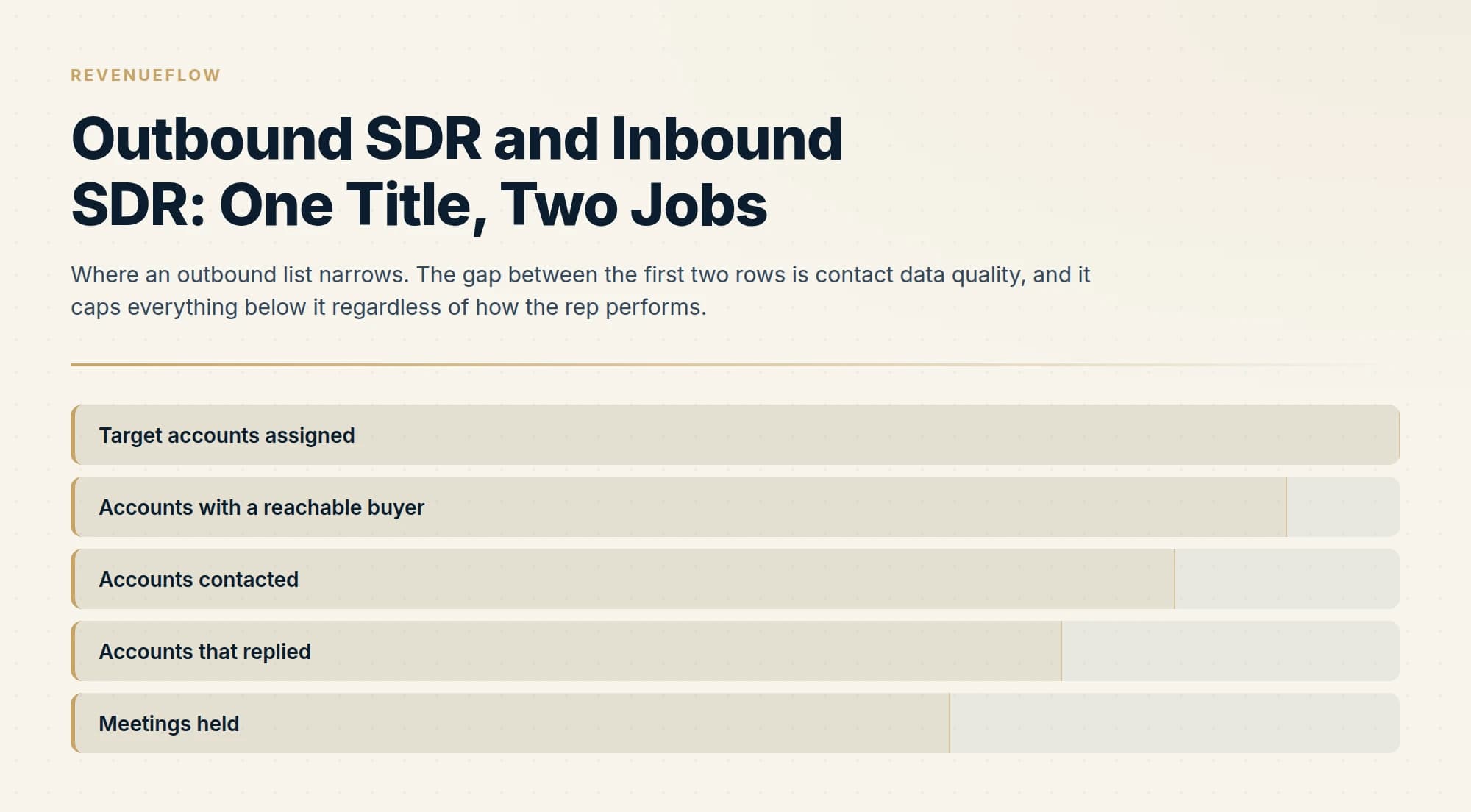
An outbound SDR creates conversations from a target list with no prior signal, constrained by relevance and contact data. An inbound SDR qualifies interest that already exists, constrained by speed and the volume of hand raises. The two constraints have nothing in common, so an underperforming rep needs a different intervention in each case.
Key takeaways
- Inbound converts at rates outbound cannot approach, so a shared meetings target makes the inbound rep look like a star and the outbound rep look marginal.
- Reply rate split by segment is a targeting finding available weeks before any meeting is booked, and it is invisible in a blended number.
- Outbound rejection is mostly nobody answering at all for weeks, which is a different psychological demand from a person saying no and the main reason outbound reps churn.
- A rep splitting the day between inbound triage and outbound prospecting will always do the inbound, so the outbound simply stops.
Reviewed and updated August 28, 2026
Two people with the same job title, sitting on the same floor, doing genuinely different jobs. One spends the morning deciding which fifty companies are worth contacting today. The other spends it answering people who filled in a form overnight. Both are called SDRs, both report to the same manager, and hiring for one when you needed the other is a mistake that takes two quarters to show up.
The outbound SDR generates conversations from nothing. That is a different job from qualifying interest that already exists, and the differences run through skills, metrics, tooling and temperament.
The structural difference
Inbound sales development starts with a signal. Someone downloaded something, requested a demo, or visited a pricing page. The rep's job is triage: work out who is worth a conversation, disqualify politely, and book the rest quickly. The scarce resource is speed and judgement.
Outbound sales development starts with a blank list. The rep's job is to decide who to contact, work out why that company might care right now, and earn a reply from someone who did not ask to hear from anyone. The scarce resource is relevance.
Deciding to initiate contact with someone who never asked comes down to supplying your own timing and framing, which the case for outbound prospecting explores in depth.
- Starts from a target list, no prior signal
- Success depends on relevance and reason to write
- Reply rate is the daily leading indicator
- Rejection is the default state of the job
- Judgement about accounts is the core skill
- Starts from a hand raise
- Success depends on speed and triage
- Speed to first response is the daily leading indicator
- Most contacts are receptive
- Disqualification discipline is the core skill
The reason this matters commercially: an inbound rep's output is capped by how much inbound you generate, and an outbound rep's output is capped by list quality and message relevance. Those two constraints have nothing in common, so an underperforming rep in each case needs a completely different intervention.
What outbound work actually consists of
Strip out the tooling and four activities remain.
Deciding who to contact. Not receiving a list, deciding within it. Which accounts this week, which people inside them, and in what order. The best outbound reps spend real time here and it is the part least visible to a manager watching activity counts.
Establishing why now. A reason the message arrives this week rather than in general. A hire, a launch, an expansion, a change in their market. Without this, the message is a description of your product with a name at the top.
Making contact. Email, phone, LinkedIn, in whatever mix the deal size supports. This is the visible part and the smallest part.
Handling the reply. Including, and especially, the negative ones. Outbound generates far more "no" than inbound, and how those are handled determines whether the account is still reachable next year.
Those four are the SDR process, in the order they consume the week rather than the order they appear on an org chart. A process document that opens with the tooling and treats the first two as inputs has described the visible tenth of the job and left the part that decides its result to whoever happens to be doing it.
SDR outreach is the name most teams give to those four activities taken together, and the order above is what the week actually looks like once the tooling is stripped out of the description.
The metrics diverge completely

Managing both types against one scorecard is the most common failure in a mixed team, and it always penalises the outbound rep.
Inbound converts at rates outbound cannot approach, because the contacts asked to be contacted. Put both on a shared meetings target and the inbound rep looks like a star while the outbound rep looks marginal, when they may be doing harder work better.
For outbound specifically, the numbers worth watching are reply rate split by segment, meetings held, and cost per held meeting. Reply rate by segment is the one that earns its place daily: a rate that is fine in one segment and near zero in another is a targeting finding, available weeks before any meeting is booked, and it is invisible in a blended number.
The list the rep is asked to work
Verified contact for the right title. Frequently far below the row above
One message each, per campaign
The leading indicator worth watching by segment
The output the rep is actually paid for
Hiring for outbound specifically
The traits that predict success differ from the inbound profile in ways that matter at interview.
Tolerance for silence, not just rejection. Inbound rejection is a person saying no. Outbound rejection is mostly nobody answering at all, for weeks, while you keep going. That is a different psychological demand and it is the main reason outbound reps churn.
Curiosity about businesses. The reps who do this well are genuinely interested in how the target company makes money. That interest is what produces a relevant first line, and it cannot be trained into someone who does not have it.
Written clarity. Most outbound contact is written. A rep who cannot write a clear, specific three-sentence message will struggle regardless of how well they speak.
Comfort with ambiguity in the list. Outbound reps constantly hit accounts that do not fit, data that is wrong, and companies that turn out to be a competitor's customer. Reps who need a clean queue find this intolerable.
At interview, the single most informative exercise is to give the candidate a real target company and thirty minutes, then read what they write and ask why they chose that angle. It tests research, judgement and writing at once, and it is far more predictive than a role-played cold call.
What outbound reps should not be asked to do
Three things get loaded onto the role and quietly destroy it.
Follow-up sequences into silence. We run one message per campaign, no bumps. A second and third touch into an unresponsive account teaches nothing the first did not, and it consumes the sending reputation the whole programme depends on. If the first message earns nothing, the account returns to the pool for a genuinely different angle later.
Their own data problem. A rep spending half the day fixing contact data is a badly paid data analyst. Coverage should be established before the list reaches them.
Both jobs at once. A rep splitting the day between inbound triage and outbound prospecting will do the inbound, every time, because it is easier and more immediately rewarding. Inbound will always win that contest, so the outbound simply stops.
- Yes: Contact coverage on their list was measured before assignment
- Yes: Reply rate is reported split by segment, not blended
- Yes: Outbound and inbound duties are separated by person or by protected block
- Yes: Sending runs on domains separate from the primary company domain
- No: The scorecard's primary target is activity volume
- No: The rep is expected to fix bad contact data themselves
- Depends: Whether the offer has been tested on any segment yet
The domain row is easy to miss and expensive. Outbound sending belongs on domains separate from the company's primary one, so a reputation problem in prospecting cannot reach the invoices and contracts.
The tooling an outbound rep genuinely needs
Outbound tooling stacks get elaborate quickly, and most of the elaboration serves reporting rather than the rep. Four things do real work.
Verified contact data. The single highest-impact input. A rep working a list with poor coverage spends the day on companies they cannot reach, and no tool downstream compensates.
Separate sending infrastructure. Outbound belongs on domains separate from the primary company domain, so a reputation problem in prospecting cannot reach the invoices, contracts and support mail. This is infrastructure rather than tooling, and it is the thing that most often gets discovered too late.
A way to see replies fast. Whatever surfaces replies within minutes rather than at the end of a batch. Response time is the rep's most controllable variable and the tooling either supports it or gets in the way.
A record of what was sent to whom. Both for the handoff and for suppression, so nobody gets contacted twice by two people who did not know about each other.
What is usually oversold is the layer promising volume: multi-step sequencing, automated follow-up chains, aggressive send scheduling. We do not use follow-up sequences at all, so that entire category is irrelevant to how we work, and the volume it produces is exactly the volume that damages a domain when the list underneath is weak.
Another angle worth considering: the term virtual SDR also masks a split between a human contractor and AI software, each failing in its own way, as explained in the buyer's guide to virtual SDR options.
The honest test for any addition to the stack is whether it improves relevance or reply handling. Tools that only increase throughput make a good list slightly more productive and a bad list considerably more damaging.
Where the two roles meet

The best structure most teams land on is not a strict split but a deliberate one: separate people where volume justifies it, and protected time blocks where it does not.
Where volume does not justify two people, the workable compromise is protected blocks: outbound happens in a defined window that inbound is not allowed to interrupt, and the rep knows which mode they are in.
The two also feed each other. Outbound teaches you which segments respond and which framing lands, and that learning improves inbound conversion because it sharpens the argument. Inbound tells you which problems people arrive with, which improves outbound relevance. Teams that keep the two functions from talking lose both effects.
For how the whole role fits together, see what a sales development rep does. For the management side, the SDR manager role covers span of control and coaching. If the question is whether to run outbound in house at all, outbound sales outsourcing covers the decision.
The short version
Outbound and inbound sales development share a title and very little else. Outbound creates conversations from a list and is constrained by relevance and contact data; inbound qualifies existing interest and is constrained by speed and volume of hand raises. Do not put them on one scorecard, do not ask one person to do both without protected time, and when an outbound rep underperforms, check list coverage and segment-level reply rate before questioning effort.
If you want outbound running without building the function, we do it on a pay-per-qualified-meeting basis with the criteria agreed in writing first, and you can see what a campaign would look like for your market.
Frequently asked questions.
Frequently asked questions- What is the difference between an outbound and an inbound SDR?
- Outbound starts from a blank target list and has to decide who to contact, work out why that company might care now, and earn a reply from somebody who asked for nothing. Inbound starts from a hand raise and triages it: work out who is worth a conversation, disqualify politely and book the rest quickly. The scarce resource is relevance in one and speed in the other.
- What does outbound work actually consist of?
- Four activities. Deciding who to contact within the list, which is the least visible to a manager watching activity counts. Establishing why the message arrives this week rather than in general. Making contact across whichever channels the deal size supports, which is the visible part and the smallest. And handling the reply, especially the negative ones, which decides whether the account is reachable next year.
- How should you interview an outbound SDR?
- Give the candidate a real target company and thirty minutes, then read what they write and ask why they chose that angle. It tests research, judgement and writing at once and is far more predictive than a role-played cold call. Look for tolerance for silence, genuine curiosity about how businesses make money, written clarity, and comfort with a messy list.
- What should an outbound SDR not be asked to do?
- Follow-up sequences into silence, since a later touch reaches only people who saw the first message and chose not to answer while consuming the sending reputation the whole programme depends on. Fixing their own contact data, which makes them a badly paid data analyst. And both jobs at once, because inbound always wins that contest.
About the author.

B2B cold email experts helping companies generate qualified leads through done-for-you outreach campaigns.
RevenueFlow Team
Explore more.
Ready to scale your outreach?
We build GTM engines that book real meetings. See the receipts.
Related articles.
SDR Role Definition: The Work Automation Left
List building, enrichment, sequencing, data entry and first-draft personalisation have moved. What remains is judgment, which changes how you scope the seat.
Sales Productivity: Four Different Ratios Wear the Same Name
Sales productivity names four ratios that share no denominator, and improving one can move another the wrong way. The version you mean decides what happens next.
Sales Performance Improvement Plan Samples: What to Include
Three worked sales PIP samples, and the diagnosis that comes first. Most published plans set a target on an outcome the rep does not control alone.
Sales Rep Scorecard: What the Rep Cannot Control
Most rep scorecards carry lines the rep cannot move. The controllability test, the six lines that earn a place, and the two ways the document stops meaning anything.
SDR Salary and the Fully Loaded Cost: The Real Number
A worksheet rather than a benchmark. Seven inputs, the order to combine them in, and the two adjustments that move the answer more than base pay does.
SDR Metrics: Which Numbers the Rep Controls
A sales development scorecard mixes three kinds of number and only one is about the person being reviewed. Sorting them by who controls what turns it into a diagnosis.