Outbound Prospecting: When Nobody Raised Their Hand
Going first means supplying the attention, timing, framing and permission that inbound gets free. Where outbound earns its cost, and what it really charges.

Outbound prospecting is the decision to initiate contact with people who have not asked for it. Because the recipient allocated no attention and framed no problem, the motion has to supply attention, timing, framing and permission itself, which is why a dated reason for contact matters more here than anywhere else.
Key takeaways
- Inbound arrives with attention allocated, timing self-evident, the problem framed in the buyer own words and implicit permission to reply. Outbound has to create all four, and the cost of doing so is the real cost of the motion.
- Outbound earns its keep in three cases: a countable market too small to generate inbound, timing that is observable from outside the account, and a category new enough that nobody knows what to search for.
- Running one message per campaign moves the entire burden onto selection and premise, makes reply rate a clean read on population and message together, and spends less of a market finite tolerance for mail from strangers.
- The costs that catch teams out are research time, infrastructure attention, data decay and audience tolerance. Only the first three can be bought back once spent.
Reviewed and updated September 1, 2026
A company with a working content engine gets a form fill from someone who has already read three articles, compared two competitors and decided there is a problem worth solving. A company running outbound writes to someone who was doing something else entirely thirty seconds earlier. The second company has to supply, at its own cost, every piece of context the first one received for free.
Outbound prospecting is the decision to initiate contact with people who have not asked for it. That is the whole definition, and everything difficult about it follows from the second half.
A prospecting funnel is the name for the front half of that motion drawn as stages, from the target list through to a qualified opportunity, and it is a narrower object than the sales funnel it is routinely confused with.
An outbound prospecting strategy is the part most teams skip: deciding who to pursue and why, before any activity starts, which is what the rest of this page works through.
The four things inbound supplies that outbound has to buy
When somebody arrives on their own, four conditions are already true. Outbound has to create each one deliberately.
Attention. An inbound visitor allocated the time. An outbound recipient did not, so the message competes with everything else in a working morning and loses unless it earns the first three seconds.
Timing. An inbound enquiry is evidence that now is a relevant moment. Outbound has to infer the moment from outside, which is why a dated reason matters so much more here than in any other motion.
Framing. An inbound visitor arrived with a problem already named in their own words. An outbound recipient has to be handed a frame that matches a problem they recognise, using words they use rather than the ones on your product page.
Permission. An inbound form is a small grant of permission. Outbound has none, which is a legal question in some jurisdictions and a reputational one in all of them.
- Attention already allocated
- Timing self-evident
- Problem already framed in their words
- Implicit permission to reply
- Volume is capped by demand you do not control
- Attention has to be earned in one message
- Timing has to be inferred from outside
- Frame has to be supplied and may be rejected
- Permission is absent and has to be respected
- Volume is capped by what you can research and send responsibly
The trade is real in both directions. Inbound produces better conversations and gives you no control over when they arrive or which accounts they come from. Outbound gives you the account list and charges you for every condition inbound got free. Neither replaces the other, and the case for running both, with different owners, is set out in inbound lead generation.
What outbound is actually good at
Outbound earns its cost in three specific situations, and it struggles everywhere else.
When you know exactly who your buyer is and there are not many of them. A market of a few hundred named accounts will never generate enough inbound to matter. Going and getting them is the only motion that covers the market at all.
When the timing is observable from outside. If something visible happens at an account that changes their need, an outbound motion can arrive inside that window. Inbound cannot be aimed at a window.
When the category is new enough that nobody searches for it. Search-led demand requires people to know what to search for. Outbound is how a genuinely new category gets its first conversations, because it does not depend on the buyer already having a name for the problem.
That third condition covers a case worth naming separately, which is the referral-based market where buyers do not search for the category at all. In professional services, hospitality, specialist industrial supply and anywhere else that runs on introductions, there is often no search demand to capture, so the question is not whether outbound beats inbound but whether anything else exists. It does the same job it does in a new category: it manufactures a first touch with somebody who was never going to look for you, and in a relationship market that first touch is frequently what makes a later introduction possible rather than a substitute for one.
Outbound is weak where the buyer is diffuse, the purchase is small, or the value only becomes obvious after a period of self-education. In those cases the arithmetic of research time per account will not close, whatever the tooling promises.
Asked whether outbound works across all industries or sectors, the honest answer is that it is not the industry that decides but the three conditions above, so a countable market with observable timing works in any sector and a diffuse market with a small purchase fails in every one.
Teams weighing which tool will close that research gap should first see how many overlapping jobs their current stack already claims in this breakdown of prospecting tool jobs.
- Step 1Define the population
A filter set that returns a count. If it does not return a count it is a description, and nothing downstream can run on it.
- Step 2Find the dated reason
Something observable that changed at the account and implies a problem you solve. No reason means the approach waits, rather than going out anyway.
- Step 3Write one message
One verifiable fact, one implication, one small ask. Written before the list is finalised, so the list is defined by what the message needs to be true.
- Step 4Send once, then let it expire
The reason had a window. When the window closes the campaign ends, and a later approach is a new campaign with a new reason.
The constraint that shapes everything else

Our own outbound runs one message per campaign. No bumps, no thread replies, no second attempt landing under the first one. That is a policy rather than a technique, and stating it here matters because it changes what outbound prospecting has to be.
A programme allowed to send five messages can afford a weak first one. The premise can be vague, the research thin, the timing approximate, because four more attempts are coming. Removing them moves the entire burden onto selection and premise. The list has to be smaller and better, the reason has to be real, and the message has to be worth reading the first time, because there is no first time twice.
The second effect is on measurement. When each account receives exactly one message, reply rate is a clean read on the population and the premise together. When accounts receive five, reply rate measures persistence as well, and separating the two after the fact is guesswork.
The third effect is on the audience. A market has a finite tolerance for mail from strangers, and every additional message spends some of it. Spending five units of tolerance where one would do is a decision about the market's future receptiveness, made on behalf of everyone who sells into it next year. The operating detail of running a programme under this constraint, from segment definition through to reply handling, is in the outbound sales playbook.
Who should be doing it
The seat matters more than most org charts admit, because the research half and the sending half reward different people.
A founder or a senior seller doing outbound produces the best messages available to the company, because they can recognise a real problem in an account's published surfaces without a script telling them what to look for. They also have the least time, so the motion they run is small and stops the moment something more urgent appears. That is a real constraint rather than a discipline failure, and it is why founder-led sales tends to produce excellent early conversations and no repeatable motion.
A dedicated seat solves the time problem and creates a knowledge one. Somebody hired to prospect full time will cover far more accounts and will, at the start, recognise far less in each of them. Closing that gap is a training and enablement job, and the teams that skip it end up with a well-staffed volume motion wearing a signal-led label. What the seat actually does, and how the inbound and outbound versions of it differ, is in outbound SDR and inbound SDR.
The split that tends to work is to keep the judgement about which accounts and which reasons close to whoever understands the market, and to move the finding, the verification and the operation of the campaign to whoever has the hours. Splitting it the other way, junior judgement plus senior execution, is the expensive arrangement.
A team with no in-house outbound expertise is choosing between those two seats rather than between tools, and the split that works keeps the market judgement with whoever has it and moves the operation to whoever has the hours.
What outbound prospecting costs, honestly

The costs that catch teams out are not the ones on the invoice.
A frequent objection is that the timing is wrong for a purely outbound approach, and the four costs above are the useful way to test it: where research time and infrastructure attention cannot be protected this quarter, the timing objection is accurate, and where they can, it is usually a statement about the offer instead.
Research time. Signal-led outbound needs somebody reading accounts. That time competes with every other demand on a seller's week and has no external deadline, so it disappears unless it is protected explicitly.
That reading burden is exactly what how AI changes account reading examines, showing which prospecting steps speed up and which stay bound by judgement.
Infrastructure attention. Sending at any volume means domains, mailboxes, authentication and a reputation to keep intact. It is ongoing work rather than a setup task, and it is invisible until it fails.
Data decay. Contact data ages continuously. A list built three months ago and left alone is a list with a growing share of wrong addresses and departed people in it, which costs deliverability as well as accuracy.
Audience tolerance. The least visible cost, and the only one that cannot be bought back. It is spent by every message that had no reason attached.
Buyers put the same cost from the other side, saying they receive too many cold emails from agencies every day, which is audience tolerance being spent by messages that had no reason attached, and it is the only cost on this list that a later campaign cannot buy back.
To make the shape of the research cost visible, here is an invented illustration with no measurement behind it: if reading an account takes ten minutes and yields a usable reason four times in ten, then a hundred usable reasons costs roughly forty hours of reading. That is one person's week, for one campaign's worth of population. The numbers are made up to show the arithmetic, and the point is that the input is time rather than budget.
Getting the outbound decision right
Start from the count. If the addressable market is smaller than what your team can cover with attention, outbound is the correct motion and the only question is how well it is run. If it is much larger, decide which slice deserves attention before building anything, because the alternative is a motion that covers everything shallowly and learns nothing.
The same question arrives as which industries outbound works best for, and it is worth answering with the count rather than a sector list: whichever market you can enumerate and describe precisely is the one it works best for, which is why two companies in one industry can get opposite results from the same motion.
Then test whether a dated reason exists in your market at a useful rate. Watch it for a month before buying anything to automate it. If the events are there, the motion has something to run on. If they are not, no amount of tooling will manufacture them, and the honest conclusion is a different method. The test for whether a candidate reason is a real signal or a filter with a marketing name is in B2B prospecting.
Finally, decide what you will measure before the first send, and write the qualification criteria down. We agree them in writing before launch, which removes the most common argument in this category: what a meeting had to be worth for the programme to have worked.
The short version
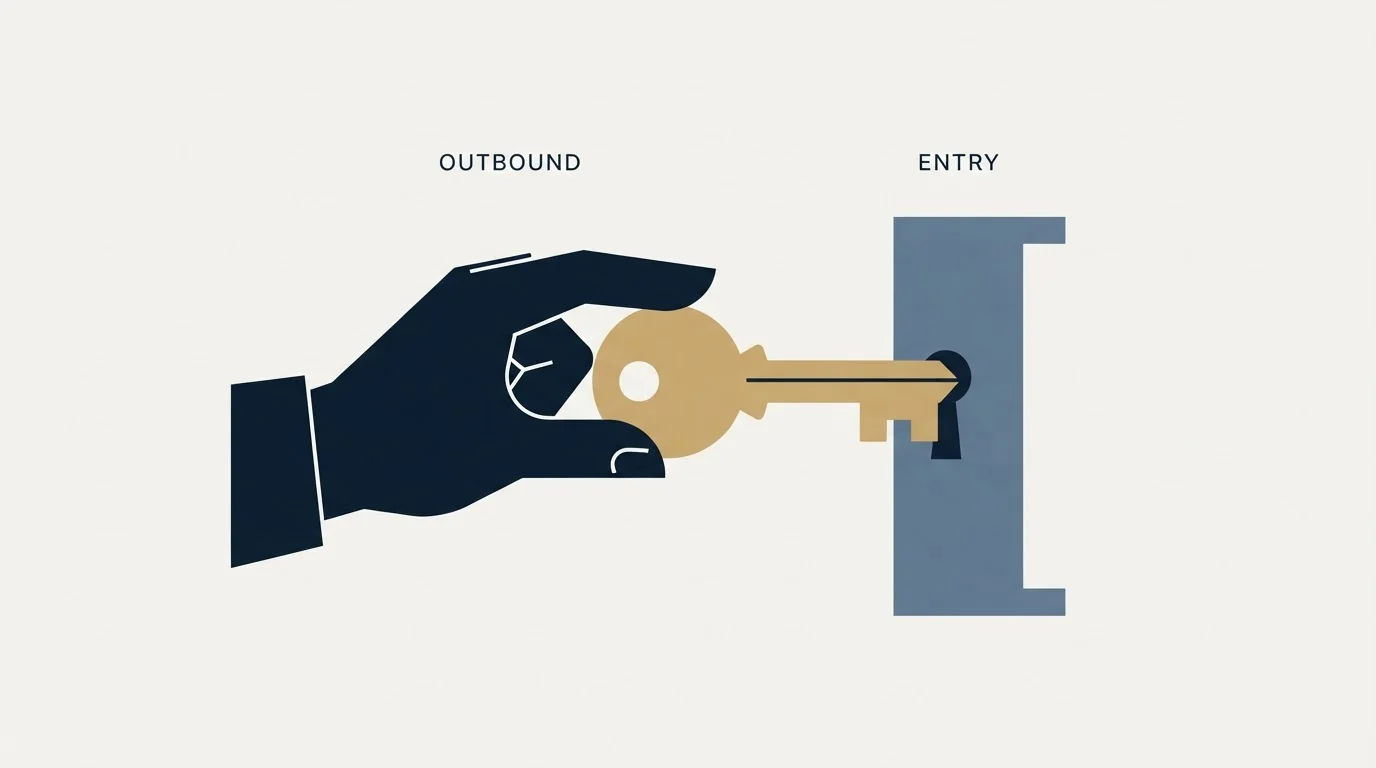
Outbound prospecting means going first, and going first means supplying the attention, timing, framing and permission that inbound receives for free. It is the right motion for a countable market, for observable timing, and for a category nobody searches for yet. Running one message per campaign moves the whole burden onto selection and premise, which makes the population smaller, the reason real and the measurement clean. The costs that matter are research time, infrastructure attention, data decay and audience tolerance, and only the first three can be bought back.
If you want the outbound arithmetic run against your own market before committing to it, we will build the campaign and show you what the population looks like.
Frequently asked questions.
Frequently asked questions- What is outbound prospecting?
- It is initiating contact with accounts and people who have not expressed interest, based on your own judgement that they fit and your own evidence that now is a reasonable moment. Everything difficult about it follows from the second half of that sentence, because the recipient was doing something else entirely when the message arrived.
- Is outbound still worth running?
- In the three situations where it fits, yes. A market of a few hundred named accounts will never produce enough inbound to matter, and observable timing cannot be exploited by a channel that waits. Where the buyer is diffuse and the purchase is small, the research cost per account will not close and a different motion is the honest answer.
- How is outbound prospecting different from cold calling?
- Cold calling is one channel inside outbound. The outbound decision is to go first; the channel decision is how the message travels, and each channel carries its own economics and regulatory surface. We run email and LinkedIn, so our writing about calling describes what the wider industry does rather than what we operate.
- How many messages should an outbound campaign send to one account?
- Ours send one. A campaign built on a dated reason has a window, and a second message arriving after that window has nothing new to say, so it lands underneath an ignored message as a repeat rather than as information. A later approach is a separate campaign built on a separate reason.
About the author.

B2B cold email experts helping companies generate qualified leads through done-for-you outreach campaigns.
RevenueFlow Team
Explore more.
Ready to scale your outreach?
We build GTM engines that book real meetings. See the receipts.
Related articles.
Prospecting Methods: Six Ways In, and What Each One Demands
Six prospecting methods, grouped by economics rather than preference: what each one needs before it works, where it stops scaling, and how to choose.
Virtual SDR: One Term Covering Two Different Purchases
One vendor sells a vetted remote person, another sells software from $250 a month. The term does not separate them, and they fail in opposite directions.
Sales Prospecting: Most of the Job Happens Before You Send
Prospecting is selection, not sending. The five decisions inside the motion, the one most teams never make, and what changes when you buy it as a service.
The Agoge Sequence: What Sam Nelson Actually Built
A documented 15-touch, 27-day cadence built by Sam Nelson at Outreach. What the primary sources say, which part transfers, and where our own practice differs.
Prospect Meaning in Sales: A Name Is Not a Prospect
A prospect is a name that passed a fit check, not a name that replied. What lead, prospect and opportunity each assert, and what the boundary decides.
Cold Calling Prospecting: Start From the Coverage Ceiling
One caller covers accounts in the low hundreds a week, not the low thousands. That ceiling decides whether calling is your coverage channel or a sample.