Founder-Led Sales: The Advantage That Does Not Transfer With the Job
Founder-led sales is the phase in which the founder personally handles outreach, discovery, pricing and closing. It works because the founder can change scope, price and roadmap inside the conversation, which is also the reason the advantage cannot be handed to a first hire.
Key takeaways
- The founder's edge is authority in the room: scope, price and roadmap can change mid-conversation, and no first hire inherits that.
- The phase is worth extending while it is still teaching you the buyer, the price and the words the market uses.
- A handover survives only if the buyer, the message, the promises and the refusals are written down before the hire starts.
- Founder conversion rates are not a baseline for a first seller, and measuring one against them replaces people just before they become effective.
Founder-led sales is the arrangement in which the founder personally runs the selling: writing the outreach, taking the discovery conversations, setting the price and closing the deal, before a dedicated sales team exists. It describes a period in a company's life rather than a technique, and almost every company that ends up with a sales organisation passes through it first.
The period has a defining property that explains both its effectiveness and the difficulty of ending it. A founder in a sales conversation can change the product, the scope, the price and the roadmap while the conversation is happening. Nobody hired afterwards can do that. The advantage is real, and it is the one thing that cannot be transferred along with the job title.
What is actually happening in the room
It is tempting to attribute founder success in sales to conviction or energy. Those help. The mechanical advantages matter more, and they are worth listing because each one has a different fate at handover.
The founder holds full authority over what is being sold. A request that would take a seller three internal conversations to answer gets settled immediately, and the buyer experiences that as competence.
The founder can price. Discounts, structures, pilots and unusual terms are all available in the moment, and the willingness to invent one on the spot frequently closes an early deal that no price list would have.
The founder carries the whole context. Every technical question, every roadmap question and every objection about the company's staying power reaches the person with the actual answer.
And the founder learns from the conversation in a way an employee structurally cannot, because the founder is the one who will act on what they heard. A seller who hears the same objection thirty times files it as an objection. A founder who hears it three times changes something.
- Can change scope, price or roadmap mid-conversation
- Answers every technical and strategic question first-hand
- Hears an objection and can act on it that week
- Credibility comes from ownership rather than from a script
- No internal approval loop between question and answer
- Must take pricing and scope questions away and return
- Answers from documented material, or escalates
- Reports objections into a queue somebody else prioritises
- Credibility has to be built from evidence and preparation
- Every unusual request costs a round trip
What the period is genuinely good at
Three things, and it is worth being specific because they are the reason not to hire a seller too early.
Learning what the product is for. Early buyers describe the problem in words the company did not write, and those words are where positioning comes from. A founder hearing them directly compresses months of research into a handful of conversations. Where the audience is still a hypothesis rather than a definition, running lead generation while the ICP is still being worked out is a specific discipline, and it is one only the founder can really do.
Finding the price. Pricing discovery happens in the gap between what the founder asks for and what the buyer accepts without hesitation, and that gap is only visible to someone allowed to change the number. Delegating pricing before it is settled produces a seller who defends a figure nobody has tested.
The first reference customers. Early buyers are buying the founder as much as the product, and the relationships formed at that stage carry disproportionate weight later, in references, case material and renewal. A founder who hands this over too early loses the relationships as well as the learning.
The signals it is time to hand over
The signal arrives as a statement that the founder cannot be the bottleneck in the sales process, which is the bandwidth version of the list above, and it is a reason to write the handover down rather than a reason to hire immediately.
Said plainly by the people living it, the founder is the bottleneck in pipeline generation: every meeting traces back to one person's network and one person's week, and the constraint is not effort but the fact that the advantage below cannot be worked harder without being handed over.

The transition is normally made late, because the founder is good at it and the numbers look fine. The signals are rarely about performance in the room.
- Yes: The same objection has stopped teaching you anything new
- Yes: Pricing has been stable across the last several closed deals
- Yes: You can predict who will buy before the conversation starts
- Yes: Sales conversations are displacing product and hiring decisions
- Yes: Demand exists that nobody has capacity to answer
- Yes: You are declining conversations because the week is full
- No: Deals still stall on questions only you can settle
The last row is the one people misread. If deals routinely die on questions only the founder can answer, the company has an authority and documentation problem rather than a hiring signal, and hiring into it produces a seller who fails for reasons that were never theirs.
What has to be written down before the handover survives
The conclusion people reach is that a founder-dependent pipeline cannot scale, which is true in a narrow and useful sense: it scales exactly as far as one person's available hours and existing relationships reach, and then stops, whatever the market would otherwise support.
The handover fails most often because the thing being transferred was never written anywhere. Four documents, none of them long, do almost all of the work.
Who the buyer is. Not a market, a buyer: the company shape, the role, the situation that makes this urgent, and the disqualifiers. A founder carries this implicitly and can recognise a fit in a sentence. A new seller cannot, and will spend their ramp on the wrong companies unless somebody writes it down. Building an ideal customer profile with the arithmetic attached is the format that survives contact with a real list.
What the message is. The premise that earns a stranger's attention, in the words that have actually worked, with the ones that have not worked recorded alongside them. Founders reconstruct this fresh each time and rarely notice they are doing it.
What is promised. The commitments the company makes on scope, timing, support and outcomes, with the boundary marked. Without it, a new seller either promises nothing and loses, or promises everything and creates a delivery problem the founder inherits.
What is refused. The deals not to take. This is the least documented and the most valuable, because a founder refuses bad-fit business instinctively and a seller carrying a quota has every incentive not to.
- Before the hireWrite the four documents
Buyer, message, promises and refusals, in whatever rough form is honest
- First weeksFounder still takes the conversations
The new seller observes real deals rather than reading a deck about them
- Early dealsShared calls, seller leading
The founder attends and stays quiet unless authority is genuinely required
- After the first independent winsFounder on exceptions only
Pricing outside the sheet, unusual structures, strategic accounts
- OngoingFounder keeps the refusals
Which business to decline stays a founder decision long after the rest transfers
The two shapes the first hire takes
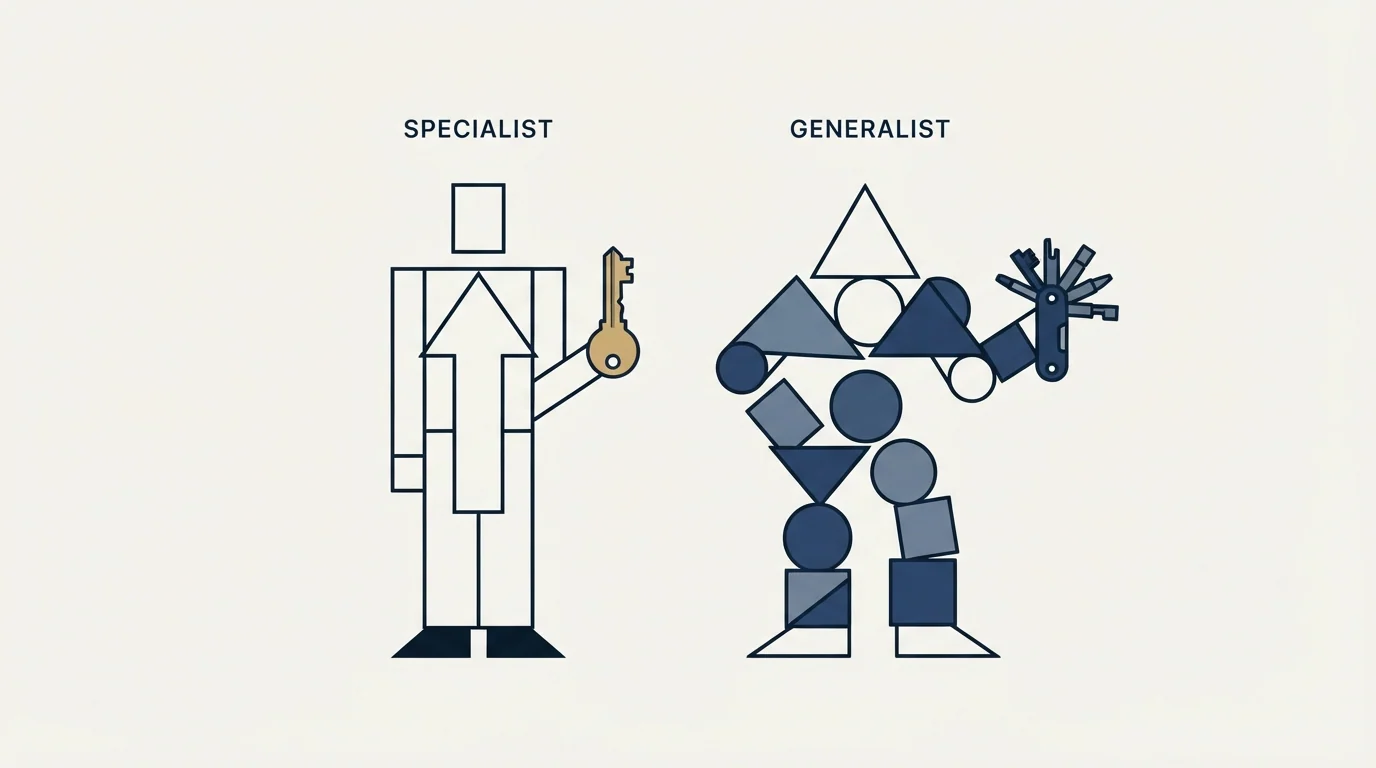
There are broadly two ways out of the phase, and they fail differently.
The first is hiring a seller: somebody who takes conversations, works deals and reports to the founder. The founder keeps the strategy, the pricing authority and the refusals, and gives away the calendar. This is the cheaper experiment and the more common one, and its failure mode is a seller left without the four documents, judged against founder numbers, and replaced before anything was learned.
The second is hiring a leader: somebody senior who is expected to build the function, hire under themselves and own the number. The appeal is obvious, since it appears to solve the whole problem at once. The failure mode is subtler. A leader hired before the motion is understood ends up either reconstructing it themselves, which is the founder's job done second-hand, or importing the motion from their previous company, which was built for a different buyer at a different size. Both outcomes consume a year.
The general rule that survives contact with most companies is that a leader should be hired to scale a motion that already works, and a seller should be hired to prove one can be run by someone other than the founder. Getting those two in the wrong order is expensive in a way that takes several quarters to become visible.
Where the model breaks
Founder conversion rates are not a baseline. This is the most expensive mistake in the whole transition. The founder's rates were produced with authority, full context and the ability to change the product mid-sentence, and no first hire has any of those. Measuring a new seller against them produces a person who looks like a failure in month four and is often replaced just before they would have become effective. Judge the hire against their own trend and against the time the motion actually takes to learn, which is what ramp time exists to describe.
The founder becomes the bottleneck without noticing. Demand arrives and gets served, so nothing looks broken. What has actually happened is that the founder's calendar, rather than the market, is now setting the growth rate.
Nothing is repeatable because nothing was ever specified. A founder can win without a defined audience, since they adapt live. That flexibility is precisely what leaves no artefact behind, and a company can arrive at its first sales hire with a strong revenue line and no written account of who buys or why.
Authority never actually moves. A handover on paper, with pricing and scope still requiring the founder in every deal, is not a handover. The buyer notices immediately, and the seller's credibility is spent asking permission.
Reading it well

Treat founder-led sales as a phase with a job to do rather than as a stage to escape. Its job is to produce the four documents above, tested against real buyers. A company that leaves the phase with revenue and no documents has monetised the founder and learned nothing transferable.
The handover is also not a single event. Authority moves in pieces, and pricing usually moves last and by design. The founder's remaining role after the transition is narrow and permanent: the decisions about which business to refuse and where the product goes next, both of which stay founder-owned in most companies that grow well. Knowing who inside a prospect can actually release money remains part of the same judgment, which is why the economic buyer is worth teaching explicitly rather than leaving to instinct.
On capacity, the honest order of operations is to fix the definitions before adding the headcount. A first hire dropped into an undefined audience burns their ramp discovering things the founder already knew. How outbound gets structured once the premise is settled covers the shape of that work, and what training a new development hire actually consists of is the part most founders underestimate.
Our own outbound is deliberately narrow, and it fits this phase for a specific reason: one message per campaign, one premise, sent once, with any later approach existing as a separate campaign with its own reason to exist. A founder testing a positioning hypothesis gets a clean read that way, because the response belongs to one premise and one audience rather than to accumulated attempts. When the constraint is the founder's calendar rather than the founder's message, our pay per qualified meeting offer buys conversations without buying headcount first.
Frequently asked questions.
Frequently asked questions- When should a founder stop selling?
- When the conversations have stopped teaching anything new, pricing has settled across several closed deals, and demand exists that nobody has capacity to answer. If deals still stall on questions only the founder can settle, the constraint is authority and documentation rather than headcount, and hiring into it sets the new person up to fail.
- Why do first sales hires fail after founder-led sales?
- Usually because they were measured against founder numbers produced with authority and full product context, and because the buyer definition, the message, the promises and the refusals were never written down. The hire spends their early months rediscovering things the founder already knew, then gets judged on the result.
- Should a startup hire a sales leader or a seller first?
- A seller proves the motion can be run by somebody other than the founder. A leader scales a motion that already works. Hiring a leader before the motion is understood usually means they either rebuild it second-hand or import one built for a different buyer at a different company size. Both take about a year.
- What should a founder write down before handing sales over?
- Four short documents: who the buyer is, including the disqualifiers; what the message is, in the words that have actually worked; what the company promises on scope, timing and support; and what business to refuse. The last is the least documented and the most valuable, since a seller carrying a quota has no incentive to write it.