The Outbound Sales Playbook: Building a One-Message Program
The operating model behind one message per campaign: segments, list building, deliverability, the message itself, account coverage, replies and measurement.
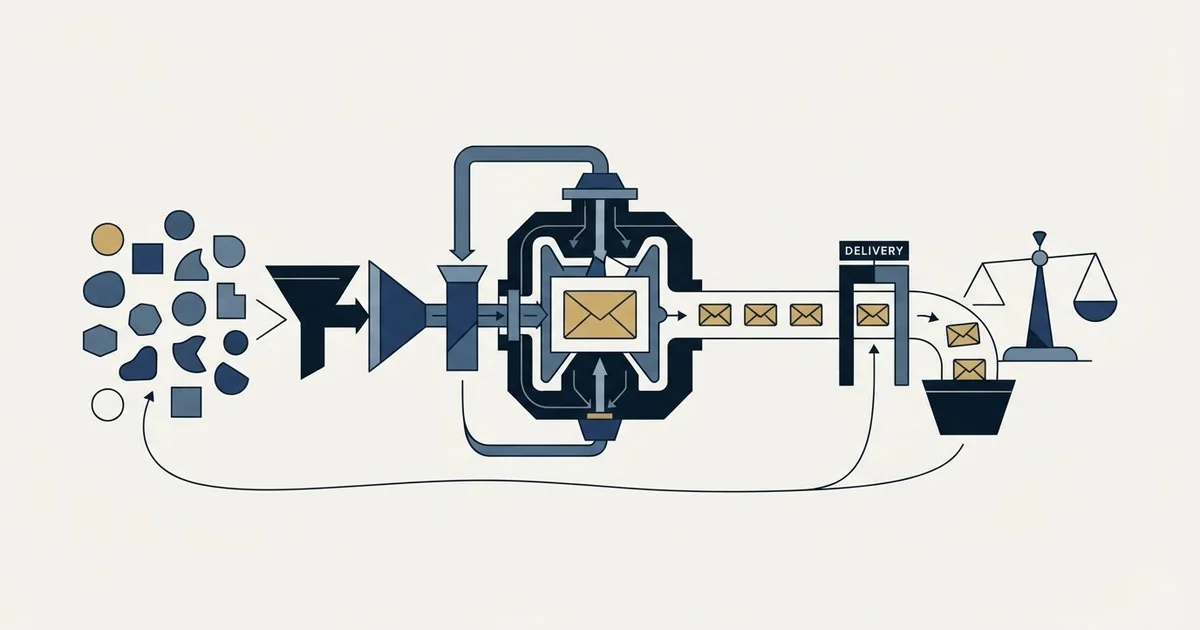
An outbound sales playbook is the written operating model for starting conversations with companies that have not contacted you: the segment, the list, the sending infrastructure, the message, reply handling and measurement. This one runs as a six-stage loop on a single rule, one message per campaign, with no bumps and no thread replies.
Key takeaways
- An outbound sales playbook covers six stages in order: define the segment, build and verify the list, prepare infrastructure, write the message, send once, read the result.
- A segment is a group of companies sharing one situation you can check from outside, and it has to be checkable, uniform and exhaustible to carry a campaign.
- One message per campaign means variation happens across campaigns and not inside them, so each new approach needs a premise that stands without the first message.
- Reaching several people at an account is coverage when each would have been written to anyway, and escalation when the trigger is somebody else's silence.
Reviewed and updated September 18, 2026
Most outbound playbooks are contact schedules. They open with targeting, spend eighty percent of their length on scripted day-by-day scripts, and finish with a permission-to-close email. This one is not that, and the difference is deliberate.
RevenueFlow runs outbound on a single rule: one message per campaign. No thread replies, no bumps, no second scheduled attempt at a stranger who did not answer. Everything below is the operating model that rule forces you into, written as a playbook you can run. It is more demanding than a contact schedule, because when there is only one message the list, the premise and the infrastructure have to carry the whole result.
What is an outbound sales playbook?
An outbound sales playbook is the written operating model a team follows to start conversations with companies that have not contacted it: who to target, how the list is built, what infrastructure sends the mail, what the message says, how replies are handled and what gets measured. This one runs as a six-stage loop.
What this playbook covers
Part 1: The segment is the unit of work
Read end to end, the six stages are how to structure and implement a B2B outreach campaign, in the order the work has to happen: a message written before the segment exists has nothing true to say, and infrastructure started after copy approval adds its whole warmup interval to the end of the project.
Conventional targeting produces an ICP: an industry, a headcount range, a title list, a geography. That is a filter, and a filter is not a reason to write to somebody. The distinction is the single highest-leverage idea in this playbook, and it is set out at length in B2B prospecting: the difference between a filter and a signal.
A sales outreach strategy that opens with the channel has skipped this, because the channel decides how a message is delivered and the segment decides whether there is anything true to say in it.
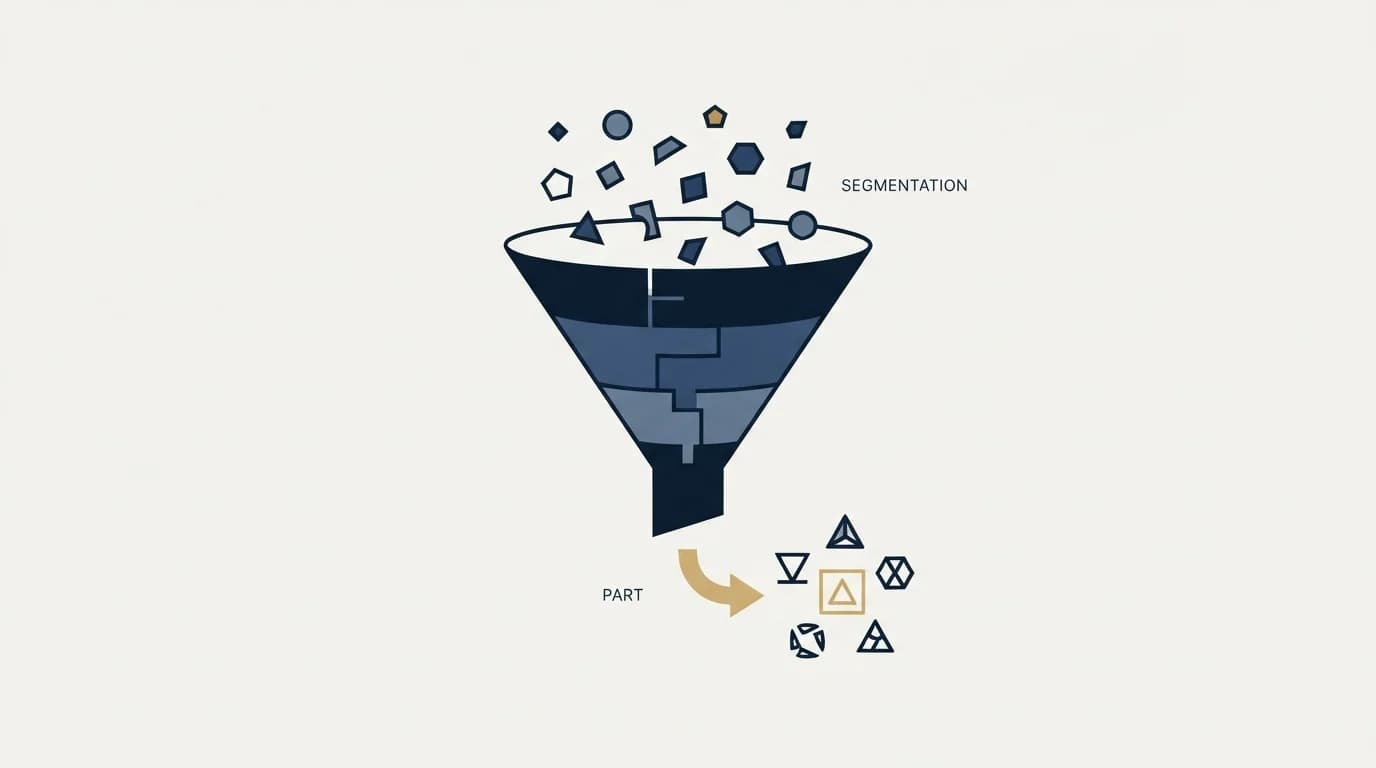
A segment is a group of companies that share one situation you can check from the outside and that your offer speaks to directly. "Series B SaaS companies, 50-200 employees" is a filter. "SaaS companies that posted a first enterprise AE role in the last sixty days" is a segment: it is checkable, it is time-bounded, and it tells you what the message is about before you write a word.
Three tests for a segment worth building a campaign around.
It is checkable. Someone can verify each company belongs, from public evidence, in under a minute. If membership is a guess, the message's premise is a guess.
It is uniform. The same sentence is true of every company on the list. If you find yourself writing two versions, you have two segments.
It is exhaustible. You can enumerate it. A segment you cannot count is a filter wearing a segment's clothes, and it will quietly become a volume play.
Segment definition sits on top of the firmographic groundwork of an ICP, including TAM maths, and does not replace it.
A team with no documented ICP and no playbook should write the segment definition first, since a playbook is a set of plays and a play cannot be written before the group it runs against can be named.
Scoring a segment before you build the list
| Test | What good looks like | What disqualifies it |
|---|---|---|
| Checkability | Public evidence, verifiable per account | Membership inferred from a database field alone |
| Uniformity | One premise true of every account | Needs branching copy to make sense |
| Size | Large enough for a campaign, small enough to enumerate | Unbounded, or fewer than a few dozen accounts |
| Reachability | Named decision makers findable with verified addresses | Only generic inboxes at mid-market and above |
| Offer fit | Your existing proof speaks to this exact situation | You would need to invent a claim to make it land |
| Timing | The situation is live now | The situation was true two years ago and is stale |
A segment that fails the last row is the most common expensive mistake, because everything else about it looks fine. Trigger events decay. A funding round from eighteen months ago is history, not a reason to write. Signals differ in what they predict and in how fast they decay.
The objection that outbound does not align with the current strategy is usually a question about the segment, and the scoring table answers it: where no segment passes the three tests, outbound does not fit yet.
Part 2: The list

Under a one-message rule the list is not an input to the campaign. It is most of the campaign.
Source against the situation, not the filter. Build from the evidence that defines the segment, then enrich for contact data. Building from a database export and looking for a story afterwards inverts the work and produces the generic message that a contact schedule then has to compensate for.
Verify every address before the send. There is no second attempt to catch a bounce, which makes verification load-bearing rather than hygienic. Bounces on a single-message campaign are pure loss, and they damage the sending domain for every campaign that follows.
Find the named person. At mid-market and above a generic inbox is a triaged black hole. At genuine small-business scale a general inbox is often read by the owner, which is a real exception rather than a general licence.
Suppress before you send, not after. Existing customers, live opportunities, current vendors, anyone who has asked not to be contacted, and anyone another campaign is already speaking to. A prospect should be in exactly one live campaign at a time; two campaigns racing through the same list is how one person receives two pitches in a week.
Part 3: Infrastructure comes before copy
The best message on the best list is worth nothing in a spam folder, and a single-message campaign has no second chance to arrive.
| Layer | What it decides |
|---|---|
| Domains | Reputation, and whether one bad campaign can damage the main brand |
| Mailboxes | Per-inbox volume, and how much capacity a campaign can draw on |
| Authentication | SPF, DKIM and DMARC, all three, verified live rather than assumed |
| Warmup | Whether a new mailbox has the engagement history to be trusted |
| Headroom | Spare capacity so a campaign never forces a mailbox past a safe rate |
Two positions here are ours rather than the market's, and both come from running this at volume. We buy substantially more sending capacity than a campaign needs, so that no campaign forces a mailbox past a safe rate. And we never use client-branded sending domains: the client's identity belongs in the sender name and the signature, not in a lookalike domain bought for one campaign.
Part 4: The one message

Everything the conventional playbook spreads across five or six positions has to fit in one message. That constraint is the point, and it is why single-message campaigns are harder to write, not easier.
A message that can carry a campaign on its own has five parts.
A premise. The specific, checkable thing about this account that made you write today. It is the segment definition, made concrete for this reader. If the premise would be equally true of a company outside your segment, it is not a premise.
A relevance sentence. Why that situation creates the problem you solve. One sentence, in their language, without a product name.
A claim you can prove. A named outcome for a named comparable company, or a specific number you can stand behind. Never a superlative and never an unverifiable statistic. Nothing goes into a message that we could not defend to the person receiving it.
One ask, easy to answer. A single question with a low cost of replying. Two asks in one message halves the chance of either being answered.
A clean exit. An unsubscribe path and a plain sign-off. A recipient who does not want to hear from you should be able to end it in one click, and that click is more valuable to you than a spam complaint.
The word budget
| Element | Words |
|---|---|
| Subject line | Under 50 characters, lowercase, specific |
| Premise | 15-25 |
| Relevance | 20-30 |
| Proof | 20-30 |
| Ask | 10-15 |
| Total body | 75-125 |
That total is the same range the industry recommends for an opening message, which is the tell. Everyone already agrees the first message should be the good one.
Subject: under 50 characters, lowercase, specific
Premise, 15 to 25 words: the checkable thing about this account that made you write today 1
Relevance, 20 to 30 words: why that situation creates the problem you solve, in their language, no product name 2
Proof, 20 to 30 words: a named outcome for a named comparable company, or a number you can stand behind 3
Ask, 10 to 15 words: one question that costs almost nothing to answer 4
Exit: an unsubscribe path and a plain sign-off 5
- 1If the premise would be equally true of a company outside the segment, it is not a premise.
- 2One sentence. This is where the segment definition becomes the reader's problem.
- 3Never a superlative, never an unverifiable statistic.
- 4Two asks in one message halves the chance of either being answered.
- 5One click to end it is worth more to you than a spam complaint.
Part 5: One message per campaign
Buyers frequently ask how many campaign playbooks a supplier keeps on the shelf, expecting a count. The answer here is one loop and a new premise on every pass, because variation lives across campaigns and not inside them.
A sample sales playbook is usually asked for as a document to fill in, and the fields above are what make one runnable, because a section with no owner, no volume and no expiry date is a heading rather than a play.
This is the rule the rest of the playbook is built around, and it is worth stating precisely, because it is narrower than it sounds.
A campaign is one segment, one premise, one message, sent once. When it has sent, it is finished. There is no position two, no thread reply, no scheduled bump, and no closing message asking whether the file should be closed.
What replaces the contact schedule is variation across campaigns rather than within them. A conventional programme tests message two against message two. We test whole campaigns: a different segment, a different premise, a different proof point, each one sent to people who have not been asked this question before. The learning rate is comparable and the cost of being wrong is a campaign rather than a burned list.
Two things the rule explicitly permits, though they are not bumps.
Two-way correspondence. Someone who replies, attends, or asks a question is in a conversation. Answering them is not a follow-up in any sense this rule governs. Reply handling is human work and should be fast.
A genuinely new campaign to a previously contacted list. If the market changes, or a trigger event gives you a reason to write that did not exist before, a fresh campaign on a fresh premise is legitimate. The test is whether the new message would stand up if the reader had never received the first one. "I did not hear back" fails that test. "Your competitor just did X" passes it.
The evidence behind the whole rule, including what happened to our own meeting rate, is in why we send no follow-ups.
Part 6: Covering an account without a contact schedule
Reaching several people at one company is legitimate and often necessary. The line between coverage and pressure is the trigger, not the head count.
Role coverage: how we run accounts
- Four roles, four opening messages, each written for that person's own accountability
- Each message stands on its own premise and would make sense if it were the only one sent
- Sent in parallel or independently, on their own timing
- Nobody is contacted because somebody else stayed quiet
Escalation by silence: what we refuse
- Approach a secondary contact because the first one did not answer
- Work up the org chart as pressure once lower contacts go quiet
- Ask person A to forward you to person B after non-response
- Reach the economic buyer only once there is momentum
The practical test before adding a second person at an account: would you have written to them anyway, on this premise, if the first person had never existed? If yes, it is coverage. If the only reason they are on the list is that somebody else stayed quiet, that is not coverage, it is a bump with a different recipient. The account-level version of this play is covered in B2B account-based marketing, and the LinkedIn-specific constraints in LinkedIn for ABM.
Part 7: Replies are the product
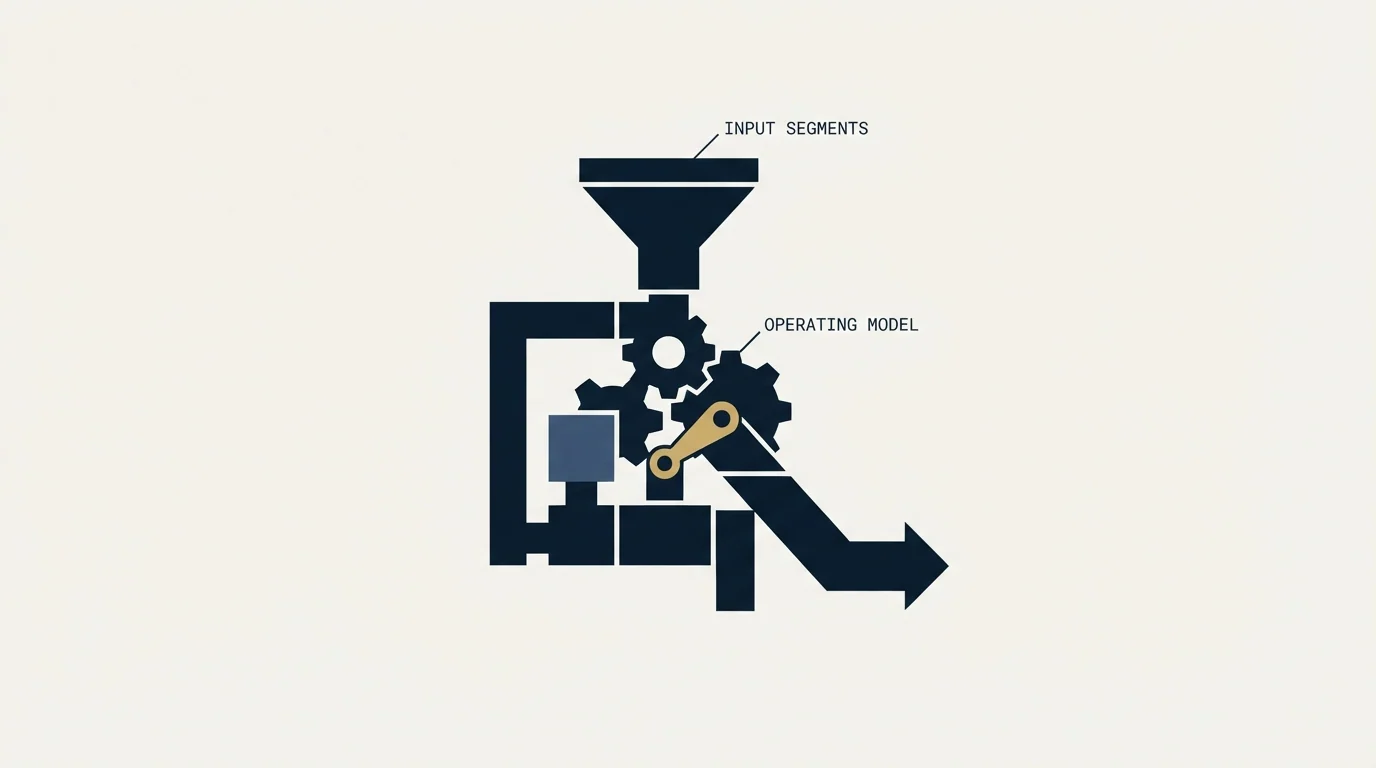
A single-message campaign concentrates all of the value in the inbox that comes back, which changes how reply handling should be resourced.
Answer fast. Response speed is one of the few levers that reliably moves a positive reply into a held meeting.
Book directly. When someone fits the agreed audience and the qualification bar, put them on the calendar rather than holding them for review. A review step protects against a rare mis-book and costs momentum on every single booking.
Classify honestly. Out-of-office replies and auto-responders are not replies. Reporting them as such overstates performance by a wide margin in holiday months, and a benchmark built on that number is worse than no benchmark.
Suppress on a no. A negative reply ends contact everywhere, not just in the campaign that produced it.
Define the meeting in writing before the first send. Agree what counts as qualified, who may reject one and on what grounds, and how long they have.
Part 8: Measurement
| Metric | What it tells you | Where it points when it is bad |
|---|---|---|
| Bounce rate | Data quality and verification | The list build |
| Inbox placement | Infrastructure health | Domains, authentication, warmup |
| Reply rate | Premise relevance | The segment definition |
| Positive share of replies | Offer fit | The offer, or the segment |
| Meetings held | The only number that pays | Everywhere upstream |
| Unsubscribe rate | Whether the premise felt earned | The segment, again |
The discipline that matters is reading each number back to the stage that produces it. A low reply rate is almost never a copy problem, and a copy rewrite is the most common wrong response to it. If the premise is not true of the people on the list, no phrasing rescues it.
Benchmark ranges to hold these against, per position and per industry, are in our B2B cold email benchmarks.
Part 9: What this playbook refuses to do
Set against the usual sales best practices lists, every line below is a refusal with a reason attached rather than a habit worth copying.
- No thread replies. Nothing is ever sent into an existing thread that the recipient did not answer.
- No bumps, and no scheduled second attempt at a stranger.
- No closing message asking whether we should close somebody's file.
- No lateral move to a colleague triggered by silence.
- No cross-channel reminder that references an unanswered email.
- No client-branded lookalike sending domains.
- No claim in a message that we could not evidence to the person reading it.
Conventional playbooks recommend every one of those, several with published performance figures attached. The figures are real; the price is paid somewhere the figures do not look.
Working with us
RevenueFlow runs this engine for B2B teams, one message per prospect, priced per qualified meeting: the engagement on offer starts with a strategy call, and the case studies show what the model produces.
Related Reading
Frequently asked questions.
Frequently asked questions- What is an outbound sales playbook?
- An outbound sales playbook is the written operating model a team follows to start conversations with companies that have not contacted it. It sets out who to target, how the list is built and verified, what infrastructure sends the mail, what the message says, how replies are handled and which numbers are read back to which stage.
- What should an outbound sales playbook include?
- Six stages in order: a segment defined by one shared, checkable situation; a list sourced against that situation, verified and suppressed; domains, mailboxes and authentication in place before anything sends; one message built on one premise with one easy ask; a single send with every reply worked by a person; and a measurement table that reads each number back to the stage that produced it.
- What does one message per campaign mean?
- A campaign is one segment, one premise and one message, sent once. When it has sent, it is finished: no thread reply, no scheduled bump and no closing message. Replying to someone who answered is ordinary correspondence, and a genuinely new campaign on a new premise is allowed if it would stand up had the reader never received the first.
- How do you measure an outbound sales playbook?
- Read each number back to the stage that produces it. Bounce rate points at the list build, inbox placement at infrastructure, reply rate at the segment definition, positive share of replies at the offer, and unsubscribe rate at whether the premise felt earned. Meetings held is the only number that pays. A low reply rate is almost never a copy problem.
About the author.

B2B cold email experts helping companies generate qualified leads through done-for-you outreach campaigns.
RevenueFlow Team
Explore more.
Ready to scale your outreach?
We build GTM engines that book real meetings. See the receipts.
Related articles.
LinkedIn Outreach for Utilities: Selling to the Sector
How a vendor selling to utilities uses LinkedIn next to a published sourcing process: the three ownership models, the registration gate and what a message may ask.
SDR Outsourcing for Ecommerce Software Companies
Whether bought meetings can work for a company selling software to merchants: the app store as distribution, the billing model, the data rule and the agency.
SDR Outsourcing for Agriculture Companies
Whether an outside sales development team can work for a company selling into agriculture: who already covers the account, which weeks exist, and the show rule.
LinkedIn Outreach for Marketing Agencies
How a marketing agency wins its own clients on LinkedIn: the published agency search process, the platform rules aimed at how agencies work, and the expert buyer.
Lead Generation for Air Compressor Distributors
A compressor is bought once and its air is paid for over years. Where the accounts are published, what the buyer is told to ask, and the rule in the plant.
Appointment Setting for Manufacturers: Who a Setter May Call
For the manufacturer hiring a setter: the ranked titles to hand over, the rep and distributor map that decides which accounts may be called, and the meeting types.