SDR Outsourcing for Agriculture Companies
Whether an outside sales development team can work for a company selling into agriculture: who already covers the account, which weeks exist, and the show rule.
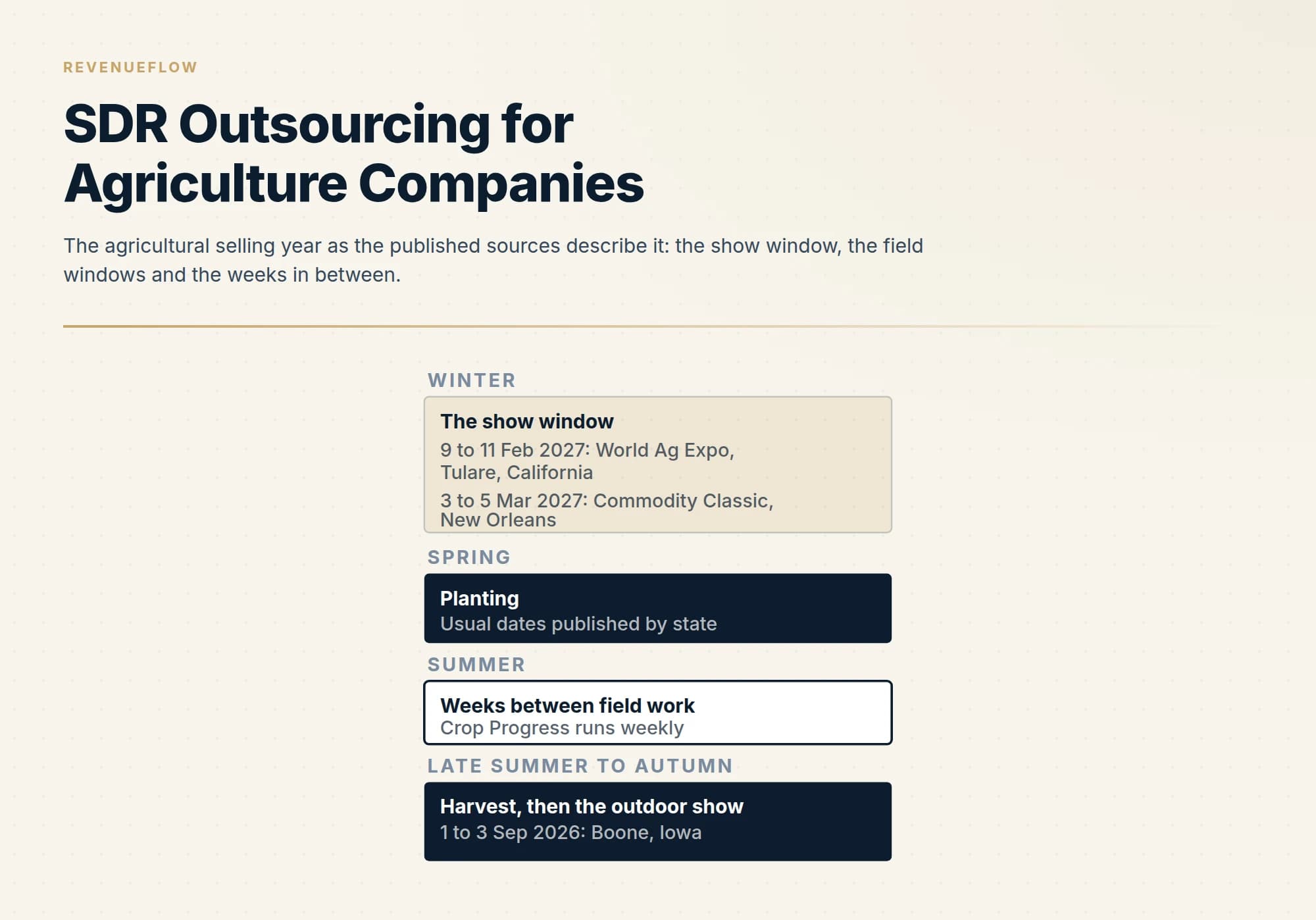
An outside sales development team can work for an agricultural seller when the accounts are not already covered by a cooperative, retailer or dealer, when a caller can qualify without answering an agronomy question, and when the list is worked in the published windows between planting and harvest.
Key takeaways
- Commodity Classic's published policy limits soliciting in an exhibit space to the exhibitor's own employees and bars solicitation of orders by anyone not registered to exhibit, so an outside team's show work is the weeks either side rather than the floor.
- The National Council of Farmer Cooperatives describes nearly 1,600 local farmer cooperatives that furnish farm supplies and provide credit, which makes a large share of the accounts on any list already covered by a channel partner.
- The agriculture department publishes weekly crop progress and a standing set of usual planting and harvesting dates by state, which is a free per-account calendar of when a buyer is in a field rather than at a desk.
- The engagement has to write down what a non-agronomist caller may establish and what waits for a technical person, because a meeting where the agronomic question is still open is a meeting your specialist has to take again.
Reviewed and updated September 21, 2026
Commodity Classic publishes a rule that quietly settles one half of the outsourcing question for anyone selling into agriculture. Its trade show access, solicitation and media policy, read on 21 September 2026, states: "Advertising and solicitation of orders by persons not registered to exhibit at the Commodity Classic is not permitted", and, further down, "Unauthorized/unregistered personnel conducting interviews or soliciting the sale of goods or services in the trade show will be removed from the exhibit area." (Commodity Classic, Solicitation and Media Access Policy) The place where a large share of this industry's relationships are actually renewed is a place your outside sales development team cannot work on your behalf unless they are your registered booth staff.
This page is for a company selling business to business into agriculture, which covers inputs, equipment, animal health, agtech software, financing and services, and which is deciding whether to pay an outside team to open doors. It is not written for a company trying to sell to farms for the first time; how the channel is structured and how the crop calendar drives a direct motion is set out in B2B sales for agtech startups, and that argument is linked here rather than repeated.
The results for this phrase are the vertical-free outsourced-SDR page: vendor round-ups, price directories, one generated location page, and a single agency result that names agriculture. One of the ten is about this industry at all. What follows is what the industry's own pages say, which is where the answer actually is.
The generic part of the decision, meaning the four models, what a seat costs against what a meeting costs, and how ramp behaves, is in SDR outsourcing and outsourced SDR pricing. Below is the part that only applies here.
Somebody already covers that farm
The first thing to establish is that the accounts on your list are not uncovered. Agriculture buys through intermediaries, and two kinds of them already have a relationship with the grower your setter is about to call.
The farmer-owned cooperative is one. The National Council of Farmer Cooperatives, read on 21 September 2026, describes its members as regional and national cooperatives "which in turn consist of nearly 1,600 local farmer cooperatives across the country", and describes what they do in a sentence that explains why they are hard to go around: "Farmer cooperatives handle, process and market almost every type of agricultural commodity; furnish farm supplies; and provide credit and related financial services, including export financing." (NCFC, About) A co-op is a customer, a channel and a lender at once.
The agricultural retailer is the other, and the Agricultural Retailers Association's own professional-development listing shows what its members' staff are trained on: its webinar page, read the same day, names "Adjuvant education for agronomists, Nurse Tank Safety Advisory, ResponsibleAg benefits & tools, FIFRA 101: Intro to the complex landscape of pesticide Laws". (Agricultural Retailers Association) An agronomist who has sat through FIFRA training is the person your setter has to get past, or work with, and that agronomist is not neutral about who supplies the farm.
For an outsourcing decision this matters before the list is built, not after. A setter calling an account your co-op partner already serves is competing with your own route to market, and the commission question that creates is the same one a manufacturer creates by calling around a distributor. The realistic list is what remains once the covered accounts are marked, and if that list is small, the programme is small. Say the number out loud before signing anything.
The year decides who is reachable
The second constraint is that the customer disappears for months at a time, and the disappearance is predictable and public.
The United States Department of Agriculture's National Agricultural Statistics Service publishes both the weekly Crop Progress report during the season and a standing set of usual planting and harvesting dates by crop and state (USDA NASS, National Crop Progress). That is a free, official, per-state calendar of when your buyers are in a field rather than at a desk, and no outbound programme selling into agriculture has an excuse for not holding it against the list.
The other half of the year is published by the shows. World Ag Expo runs 9 to 11 February 2027 in Tulare, California, and its site describes itself as "the largest annual agricultural show of its kind", hosting "over 1,200 exhibitors" with "An estimated average of 100,000 individuals from over 70 countries" attending each year (World Ag Expo). Commodity Classic follows on 3 to 5 March 2027 in New Orleans (Commodity Classic). Farm Progress Show, which its site calls "The Nation's Largest Outdoor Farm Show", ran 1 to 3 September 2026 in Boone, Iowa, and its site reports from a post-show survey of the 2024 event that 95 percent of attendees were farm owners, operators and managers, from over 44 states (Farm Progress Show).
Put the two together and the shape of an agricultural outbound year is not a quarter, it is a set of windows. The weeks where a phone call is welcome are the weeks between field work, and the weeks around a show are the ones where a meeting already has a reason to exist.
The show floor is the rule an outsourced team runs into first
Most vendors selling sales development will offer to work your events. In this industry the events have published rules about who may do that, and those rules are written against exactly the arrangement an outsourced team creates.
The Commodity Classic policy quoted at the top says two separate things. One is about the booth: "No persons other than the exhibitor's employees may exhibit or solicit business in the assigned space." The other is about everybody else in the hall: solicitation of orders by people not registered to exhibit is not permitted, and unregistered personnel soliciting on the floor are removed. The show also requires a badge for access at all, and states that "Commodity Classic reserves the right to refuse admittance to anyone not meeting these standards."
Three consequences follow for the engagement document, and they are cheap to agree in advance and expensive to discover at the show.
- 1Booth work is employee work. The policy limits soliciting in the assigned space to the exhibitor's employees, so an outside team cannot staff your booth as a contractor and call it coverage.
- 2Working the hall is not an option. Solicitation of orders by anyone not registered to exhibit is not permitted anywhere on the floor, and the policy says unregistered personnel doing it are removed from the exhibit area.
- 3So the vendor's show job is the weeks around it. Booking meetings before the show and following up the conversations after it are the parts an outside team can do, and they are the parts worth paying for.
What the setter has to be able to say
The agronomy gate is the practical reason agricultural outbound fails on the second question rather than the first. Whatever you sell, the person on the other end has a field, a herd or a facility in mind, and the first thing they want to know is whether your product applies to it.
A setter who is not an agronomist can still do useful work, provided the scope is honest about what they can answer. They can establish acreage or head, crop or species, the current supplier and the route the farm buys through, whether the operation is a customer of a co-op or a retailer, and whether the person on the phone is the one who signs. They cannot recommend a rate, a tank mix, a ration or an application timing, and a programme that lets them try will cost you the account and, where a pesticide label is involved, more than the account.
That division has to be written down, because it is also what decides whether the meeting is worth anything. A booked call where the agronomic question is still open is a call your technical person has to take anyway.
| The setter establishes | Your technical person answers |
|---|---|
| Acreage, head or facility size | Whether the product fits that operation |
| Crop, species or operation type | Rate, timing, tank mix or ration |
| Current supplier and buying route | Anything a product label governs |
| Whether a co-op or retailer serves the account | What changing supplier would involve |
| Who signs, and when they are off the field | The trial or demonstration terms |
The rules a third-party caller and sender inherit
Two federal guides cover the outreach itself, and hiring somebody to do it does not move the responsibility.
The Federal Trade Commission's CAN-SPAM guide, read on 21 September 2026, states that "The law makes no exception for business-to-business email", and that "even if you hire another company to handle your email marketing, you can't contract away your legal responsibility to comply with the law", adding that "Both the company whose product is promoted in the message and the company that actually sends the message may be held legally responsible." (FTC, CAN-SPAM Act: A Compliance Guide for Business)
On calling, the Commission's Telemarketing Sales Rule guide lists among the calls not covered by the rule "business-to-business calls unless they involve retail sales of nondurable office or cleaning supplies, or solicit sales or charitable contributions from employees" (FTC, Complying with the Telemarketing Sales Rule). That exemption is narrower than it sounds in agriculture, because a farm is frequently a sole proprietorship whose business number is a mobile, and the federal rules on automated dialling and prerecorded voice at 47 CFR 64.1200 turn on whether the number called is a wireless one rather than on how your records label it (eCFR, 47 CFR 64.1200). None of this is legal advice, and a programme that dials farms should have read the current text of both before it starts.
Three openers, each built on a page read for this article
Three illustrative first messages follow, each one message to one buyer, sent once, with no bump and no thread reply. They name no real recipient, make no claim about results, and the companies speaking in them are invented.
Invented example, resting on the published show dates and asking for the thing the show is good for.
World Ag Expo runs 9 to 11 February in Tulare and your operation is in the catchment. We make a grain-handling retrofit that is easier to look at in person than to describe, and we hold a stand rather than walking the hall. Would a twenty-minute slot on the Tuesday morning be worth taking, or is a call in January better for you?
Invented example, resting on the published planting and harvesting dates rather than on a guess about the reader's schedule.
The usual planting dates the agriculture department publishes for your state put your window in the second half of April, which makes the next three weeks the only sensible time to talk about anything for this season. We supply a seed treatment applicator that your co-op already stocks. Is a short call before the end of the month useful, or should we speak in the autumn?
Invented example, written to the channel rather than around it, which is the message an outsourced setter should be sending more often than it does.
You supply about forty growers in the county and your agronomists already handle their programme decisions. We manufacture the application equipment behind one of the products you carry, and the conversation we want is with you rather than with them. Would a call with your agronomy lead in the next fortnight be worth arranging?
When this is the wrong play for an agricultural seller
Four cases. When the co-op or the retailer is your route to market and the growers on your list are theirs, an outsourced team calling those growers is a channel decision dressed as a marketing one, and it should be made as a channel decision or not at all. When the product cannot be qualified without an agronomic judgement, a non-technical caller will book meetings your specialist then has to repeat. When your addressable market is a few hundred operations in three states, a vendor sized for volume will widen the definition until the message stops being about agriculture. And when the season is against you, a fixed monthly fee running through planting and harvest buys activity rather than conversations.
There is a fifth, which is equipment sold through a dealer network. Dealers hold territories and customer relationships that a manufacturer does not casually reach past, and an outside caller who does not know which dealer covers which county will create a problem that costs more than the pipeline is worth.
Our own practice is one message per campaign, sent once, with qualification agreed in writing before anything sends, and a new campaign when there is a new reason to write rather than a second message under the first. If you would like to see a list built from a segment and a set of published field dates before committing to a programme, you can see what a first campaign looks like.
Show dates, association pages and regulatory guidance on this page were fetched and verified on 21 September 2026. Event dates move and rules change. Check the organiser's and the regulator's own pages before relying on them.
Frequently asked questions.
Frequently asked questions- Can an outsourced SDR team work a farm show for you?
- Not on the floor. Commodity Classic's access and solicitation policy says only the exhibitor's employees may solicit business in the assigned space, and that solicitation of orders by people not registered to exhibit is not permitted, with unregistered personnel removed from the exhibit area. What an outside team can do is book meetings in the weeks before and follow up the conversations afterwards.
- When should you call farms and agricultural accounts?
- Between the field windows, which are published. The agriculture department's statistics service issues weekly crop progress through the season and maintains usual planting and harvesting dates by crop and state, so a list can carry a per-account window rather than a guess. The winter show season is the other reachable stretch, because a meeting then already has a reason to exist.
- Does the cooperative or ag retailer channel stop you outsourcing outbound?
- It decides the size of the list rather than the answer. Cooperatives and agricultural retailers supply and often finance the farms on your list, so calling those accounts direct is a channel decision. Mark the covered accounts before the programme starts, count what is left, and if what is left is small then the programme is small.
- What can a non-agronomist setter ask an agricultural buyer?
- Acreage or head, crop or species, current supplier, the route the operation buys through, and who signs. What a setter cannot do is recommend a rate, a timing, a tank mix or a ration, because those are product-label and agronomic judgements. Writing that split into the engagement is what keeps a booked meeting worth attending.
About the author.

B2B cold email experts helping companies generate qualified leads through done-for-you outreach campaigns.
RevenueFlow Team
Explore more.
Ready to scale your outreach?
We build GTM engines that book real meetings. See the receipts.
Related articles.
SDR Outsourcing for Ecommerce Software Companies
Whether bought meetings can work for a company selling software to merchants: the app store as distribution, the billing model, the data rule and the agency.
Appointment Setting for Manufacturers: Who a Setter May Call
For the manufacturer hiring a setter: the ranked titles to hand over, the rep and distributor map that decides which accounts may be called, and the meeting types.
SDR Outsourcing for Fintech Companies: Assessability Test
For the fintech weighing an outside setter: the three assessability sentences, the promotion rules that bind every message, the sponsor test and which model fits.
LinkedIn Outreach for Utilities: Selling to the Sector
How a vendor selling to utilities uses LinkedIn next to a published sourcing process: the three ownership models, the registration gate and what a message may ask.
LinkedIn Outreach for Marketing Agencies
How a marketing agency wins its own clients on LinkedIn: the published agency search process, the platform rules aimed at how agencies work, and the expert buyer.
SDR Outsourcing for Commercial Insurance Agencies
What an outsourced sales development team may legally say for a commercial insurance agency, how it may be paid, and the expiration-date calendar it has to work.