B2B Sales for Agtech Startups: Channel, Calendar and Data
How an agtech startup sells: the grower, retailer and co-op map from the associations, USDA's crop calendar as the buying calendar, the ag data principles and the rules.
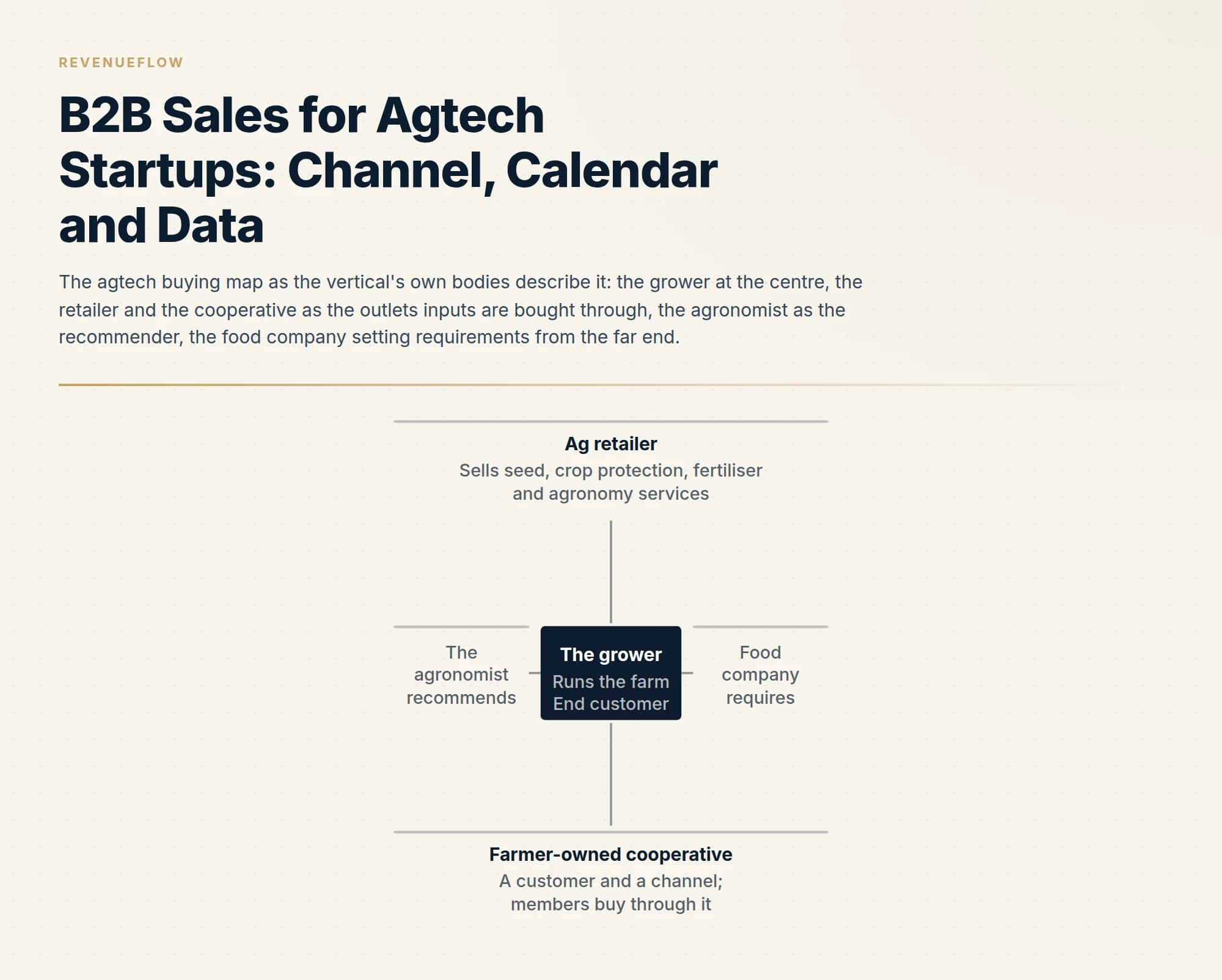
An agtech startup sells into a market the census counts at 1.9 million farms, inputs bought through retailers and cooperatives, and a year set by planting and harvest. The workable strategy picks a direct band of large growers or goes through the channel with the agronomist in the trial, times outreach to USDA's dates and answers the data questions first.
Key takeaways
- The 2022 Census of Agriculture counted 1,900,487 farms, down 6.9 percent from 2017, on 880.1 million acres, and only the 5,000 acres or larger size class grew in number.
- USDA's handbook puts Iowa corn planting most active from 25 April to 18 May and harvest most active from 5 October to 9 November, which are the windows a Corn Belt seller plans around.
- The Ag Data Transparent core principles, set in 2014 and updated in 2024, say farmers should own data from their operations, that collection needs explicit consent, and that providers should say whether data trains AI models.
- The FTC's CAN-SPAM guide makes no exception for business-to-business email, so a message to a co-op agronomy lead needs a postal address and an opt-out.
Reviewed and updated September 18, 2026
The buyer an agtech startup is selling to is getting scarcer and larger every census. The 2022 Census of Agriculture counted 1,900,487 farms in the United States, down 6.9 percent from 2017, on 880.1 million acres, with the average farm up to 463 acres from 441; only the largest size class, 5,000 acres or more, grew in number (USDA NASS, Farms and Farmland highlights, March 2024). USDA's census defines a farm as any place that produced and sold, or normally would have sold, $1,000 or more of agricultural products in the census year, so the count includes a long tail of operations no startup will ever sell to, and a countable head of large operations that every startup is chasing.
This page is for the agtech startup deciding how to sell: a company with a sensor, a biological, a farm management platform or an analytics product, and a founder or a first commercial hire doing the selling. It is not about selling to farms or agtech companies as an outside vendor; that reader is served by the site's cold email guide for agriculture and agtech. Here the reader is the startup, and the question is who to sell to, through whom, when, and under what rules, sourced from the vertical's own bodies.
Who actually buys, and who sits between you and them
Agriculture has more channel than most founders expect, and the channel has its own associations.
The grower is the end customer and, on the census definition, the operator of a farm. The Agricultural Retailers Association says it "unites its members and their interests to advocate and educate on their behalf, provide services to improve their businesses, and preserve their freedom to operate and innovate, ensuring a safe and plentiful food supply for all"; in practice the ag retailer is the business that sells seed, crop protection, fertiliser and often agronomy services to the grower, and it is the outlet through which a large share of on-farm inputs are bought (Agricultural Retailers Association, read 18 September 2026). The farmer-owned cooperative is the other outlet: the National Council of Farmer Cooperatives states that its mission "is to advance the business and policy interests of America's cooperatives and other farmer-owned enterprises," and a co-op is both a customer and a distribution channel, because its members buy through it (NCFC).
Two more people sit in the decision. The agronomist, employed by the retailer, the co-op or an independent consultancy, recommends what goes on the field, and a trial the agronomist did not see is a trial the grower discounts. And the food company at the other end of the chain sets requirements that reach back to the farm, which is why traceability products are sold to a buyer who never drives a tractor.
The startups that have done this describe the same map. Roadmap Agency's account of AdvancedAg, a family-owned biological technology business that grew across Western Canada without venture capital, opens with "Listen more than you talk in the first three years. Buyers open up when you show up to understand, not to pitch," and adds "Choose your channel carefully" and "Use research to learn, not just to prove. Knowing where your product works and where it does not is what builds credible sales conversations" (Roadmap Agency, five bootstrapping lessons from a family-owned agtech business, 24 June 2026). The agency page that ranks first on this keyword describes the same structure from the outside as "multi-stakeholder decision committees" and "seasonal buying cycles tied to planting and harvest" (Landbase, 12 January 2026, an agency's page, quoted as what the search results serve).
The crop calendar is the buying calendar
The farm's year is published, state by state, and a startup's selling year has to sit on top of it. USDA's Field Crops Usual Planting and Harvesting Dates handbook gives, for corn for grain in Iowa, usual planting from 19 April with the most active period 25 April to 18 May and an end of 26 May, and usual harvesting from 21 September with the most active period 5 October to 9 November and an end of 21 November; for Illinois the most active planting period is 21 April to 23 May and the most active harvest 23 September to 5 November. For soybeans in Iowa the most active planting is 8 May to 2 June and the most active harvest 28 September to 20 October (USDA NASS, Field Crops Usual Planting and Harvesting Dates, Agricultural Handbook 628, October 2010). The same handbook notes that more than 80 percent of the corn for grain acreage lies in the Corn Belt, with Iowa leading all states and Illinois second.
Read as a sales calendar for a startup selling to Corn Belt row-crop growers, that gives two windows in which the buyer is in the field and largely unreachable, from the third week of April to the end of May and from late September to late November, and a long stretch between harvest and planting when next season input decisions are made. A product that has to be on the planter at planting is sold in the winter, or it is sold next year. Specialty crops, livestock and other regions run on different dates, and the handbook covers the other field crops; what does not change is that the calendar is the grower's.
- 19 AprilUsual planting begins
Most active 25 April to 18 May; the grower is in the field
- 26 MayPlanting ends
The window for anything that goes on the planter has closed
- June to SeptemberThe growing season
The trial the agronomist did not see is the trial the grower discounts
- 21 SeptemberHarvest begins
Most active 5 October to 9 November
- 21 NovemberHarvest ends
The long window for next season input decisions opens
What the rules require of the sender
Two rule sets touch an agtech startup's outreach, and one of them is the vertical's own.
The Federal Trade Commission's compliance guide states that the CAN-SPAM Act "makes no exception for business-to-business email," that each separate email in violation is subject to penalties of up to $53,088, and that a commercial message must carry accurate header information, a non-deceptive subject line, identification as an advertisement, the sender's valid physical postal address and a clear way to opt out (FTC, CAN-SPAM Act: A Compliance Guide for Business, read 18 September 2026). A message to a co-op's agronomy manager or a retailer's location manager is commercial email under that definition. Many growers read email on a personal address, and the same rules apply to a message sent there.
The second rule set is not law but is what the industry holds providers to. The Ag Data Transparent core principles, first established in November 2014 by the American Farm Bureau Federation with commodity groups, farm organisations and technology providers, and updated in 2024, state "the fundamental belief that farmers should own information originating from their farming operations," that a provider's "collection, access and use of ag data should be granted only with the explicit consent of the farmer in digital or written contracts," that farmers should be able to retrieve their data in a usable format, that providers should name the integration partners, business partners, affiliates and trusted advisors who may see the data, and that providers "should explain whether ag data will be used in training machine learning or artificial intelligence models" (Ag Data Transparent, Core Principles, read 18 September 2026). The page groups them under headings that include ownership and control, collection, transparency, portability and the identity of data partners. For a startup whose product collects field, machine or financial data, those principles are a sales document: a grower's first objection is often about who else sees the data, and the answer has to be in the contract before it is in the pitch.
Farmers should own information originating from their farming operations.
Collection, access and use of ag data only with the explicit consent of the farmer in digital or written contracts.
Farmers should be able to retrieve their ag data in a usable format.
Integration partners, business partners, affiliates and trusted advisors who may see the data are named.
Providers should explain whether ag data will be used in training machine learning or artificial intelligence models.
The objections the vertical actually raises
The objections come from the people who have sold into this market and from the bodies that speak for the buyers.
The first is trust, and AdvancedAg's account is blunt about how long it takes: listen more than you talk "in the first three years." A startup with an eighteen month runway is being told that the market's clock is longer than its own, which is an argument for choosing a segment where a trial can prove out inside one season.
The second is the trial. The same account says to know "where your product works and where it does not," and the reason is structural: an agronomist recommends against a product that failed on one field more readily than for a product that succeeded on ten, because the recommendation carries the agronomist's name to the grower. A startup that resists a trial, or that runs a trial without the agronomist in it, is asking the channel to take a risk on its behalf.
The third is data. The Ag Data Transparent principles exist because farmers, commodity groups and technology providers wrote them together after the first wave of precision agriculture products, and the questions they answer, who owns the data, who sees it, whether the grower can take it away, and whether it trains a model, are the questions a startup's first commercial conversations will contain.
The fourth is money, and it is seasonal. Growers are paid when the crop is sold, and a subscription that bills monthly through a growing season asks to be paid before the harvest that funds it.
Channel reality for this play, and when direct selling is the wrong play
Direct selling from a startup to a grower works in a narrow band: a product the grower can adopt without the retailer or the co-op, a grower large enough to be worth a named-account effort, and a founder or rep who can be in the field during the trial. The census says that band exists and is growing at the top: the only farm size class that grew between 2017 and 2022 was 5,000 acres or more.
For everything else the channel decides. A product that goes on with the seed or the fertiliser is bought where the seed and fertiliser are bought, which the Agricultural Retailers Association's members and the cooperatives NCFC represents sell; the startup's sale is then to the retailer's or the co-op's agronomy and merchandising leadership, and the grower is reached through them. A product that a food company requires is sold to the food company's sourcing and sustainability teams and then rolled out to their growers.
Direct outbound is the wrong play in three cases. It is wrong for an input product in a territory where a retailer or a co-op already carries the category, because the grower will ask the retailer and the retailer was not told. It is wrong in the two field windows on the calendar above, when the buyer is on a planter or a combine. And it is wrong for a data product whose contract cannot yet answer the Ag Data Transparent questions, because the first reply will be the question the contract does not answer.
Three openers, each grounded in a page the buyer can check
Three sample first lines a startup could send, each tied to a fetched source. They make no claim about results, name no real person and carry no contact details.
To the agronomy lead at a farmer-owned cooperative, in December. USDA's usual planting dates put Iowa corn most active from 25 April to 18 May, so your members' input decisions for next season are being made now. We run a biological that goes on with the seed, we would like your agronomists in the trial design rather than reading about it afterwards, and the ask is a conversation before the plan is set. It is a legitimate reason to write because the dates are USDA's, the timing is the buyer's own calendar, and the message puts the agronomist in the trial.
To the sustainability lead at a food company. The Ag Data Transparent core principles say providers should name every partner who can see a grower's data and explain whether it trains a model. Our grower contract answers both in plain language, which is the first question your suppliers' growers will ask about a traceability programme; a short call to walk through it is the ask. The principles are quoted from the organisation's own page and the message answers the objection before it is raised.
To the operator of a large row-crop farm. The 2022 Census counted 1.9 million farms and found that only the largest size class, 5,000 acres or more, grew in number. Operations at that scale are the ones a field-level analytics product pays for, and we would like to run it on one field of yours through a season, with the data yours to keep, before either of us decides anything. The count and the size-class finding are the census's own and the ask is a one-season trial with the data terms stated.
To: Agronomy lead, a farmer-owned cooperative, in December
USDA's usual planting dates put Iowa corn most active from 25 April to 18 May, so your members' input decisions for next season are being made now. 1
We run a biological that goes on with the seed, we would like your agronomists in the trial design rather than reading about it afterwards, and the ask is a conversation before the plan is set. 2
Postal address and opt-out line in the footer. 3
- 1Dates from USDA's handbook, sent in the window between harvest and planting when input decisions are made.
- 2Names the channel and puts the agronomist in the trial, which is the objection the vertical raises first.
- 3The postal address and opt-out line the FTC's CAN-SPAM guide requires of every commercial email.
Where the generic startup advice still applies
The startup half is already on the site. Treating the first few hundred accounts as an experiment that decomposes by segment, substituting mechanism for case studies you do not yet have, and sending once per premise so a non-reply stays interpretable are in startup lead generation when the ICP is still a hypothesis; the one-message programme itself is in the outbound sales playbook; and the sequence for a company with one quarter to prove a channel is in go-to-market strategy. What an agtech startup adds is the segment the census makes countable, the calendar USDA publishes, the channel the retailers and cooperatives own, and the data terms the industry wrote for itself.
RevenueFlow runs email and LinkedIn, one message per campaign, against criteria agreed in writing before launch, and is paid on attended meetings that meet them. If the direct band of your market is the part you would rather have worked for you while your founders are in the field, you can see what a campaign would look like for your market.
The census highlights, the planting and harvesting handbook, the association pages, the Ag Data Transparent principles and the FTC guide were fetched on 18 September 2026 from the pages linked. Planting dates are USDA's state-level usual dates and vary by season and location. Nothing here is legal advice.
Sources: USDA NASS, Farms and Farmland (2022 Census highlights), USDA NASS, Field Crops Usual Planting and Harvesting Dates, Agricultural Retailers Association, National Council of Farmer Cooperatives, Ag Data Transparent, Core Principles, Roadmap Agency, bootstrapping lessons from an agtech business, Landbase, B2B lead generation for agtech, FTC, CAN-SPAM compliance guide
Frequently asked questions.
Frequently asked questions- Who does an agtech startup actually sell to?
- The grower is the end customer, but on-farm inputs are largely bought through agricultural retailers and farmer-owned cooperatives, whose associations describe themselves as the outlets for seed, crop protection, fertiliser and agronomy services. The agronomist recommends what goes on the field, and food companies set requirements that reach back to the farm. A startup picks a direct band of large growers or sells through the retailer, the co-op or the food company.
- When should an agtech startup do its outreach?
- Between harvest and planting, on the crop's own calendar. USDA's usual dates put Iowa corn planting most active from 25 April to 18 May and harvest most active from 5 October to 9 November, with soybeans on a similar rhythm, so the long window from late November to April is when next season's input decisions are made. A product that has to be on the planter is sold in the winter or it is sold next year.
- What do growers ask an agtech company about data?
- The questions the Ag Data Transparent core principles were written to answer: who owns the data, whether it is collected only with explicit consent, whether the farmer can retrieve it in a usable format, which integration partners and affiliates can see it, and whether it will be used to train machine learning models. The principles were established in 2014 by the American Farm Bureau Federation with commodity groups and technology providers and updated in 2024.
- When is direct selling the wrong play for an agtech startup?
- When the product goes on with seed, fertiliser or crop protection in a territory where a retailer or cooperative already carries the category, because the grower will ask the retailer; during the planting and harvest windows, when the buyer is in the field; and when a data product's contract cannot yet answer the ownership, consent and portability questions the industry's own principles set out.
About the author.

B2B cold email experts helping companies generate qualified leads through done-for-you outreach campaigns.
RevenueFlow Team
Explore more.
Ready to scale your outreach?
We build GTM engines that book real meetings. See the receipts.
Related articles.
Sales Strategy for Logistics Companies: Segment, Seat, Cycle
How a broker, forwarder, carrier or 3PL sets its sales strategy: Armstrong's segments and contract terms, the four provider seats shippers keep, and the rate cycle.
Sales Strategy for Manufacturing Companies: Direct or Reps
How a manufacturer decides whose salespeople carry its line: the published definition of a representative, MANA's agreement clauses and the split commission problem.
Lead Generation for Trucking Companies: Three Routes
How a motor carrier finds freight customers: the load board, the broker relationship and the shipper's annual bid, with the calendar and the rules on outreach.
B2B Sales for Hardware Companies: Sell Inside the Rules
B2B hardware sales differ from software: FCC authorization limits when a radio device may be offered, pilots cost a unit each, and distributors share compliance.
Outbound Sales for ERP Vendors: Follow the Support Clock
Outbound for ERP vendors and resellers works when lists follow published end-of-support dates, the first reader is the controller, and channel rules come first.
MEDDIC vs BANT: What Each Qualifies and When to Use Which
MEDDIC and BANT from the originators' own text: IBM's BANT form as a gate after the first call, PTC's six themes as an audit of a live deal, and when to run each.