Outbound Sales for ERP Vendors: Follow the Support Clock
Outbound for ERP vendors and resellers works when lists follow published end-of-support dates, the first reader is the controller, and channel rules come first.
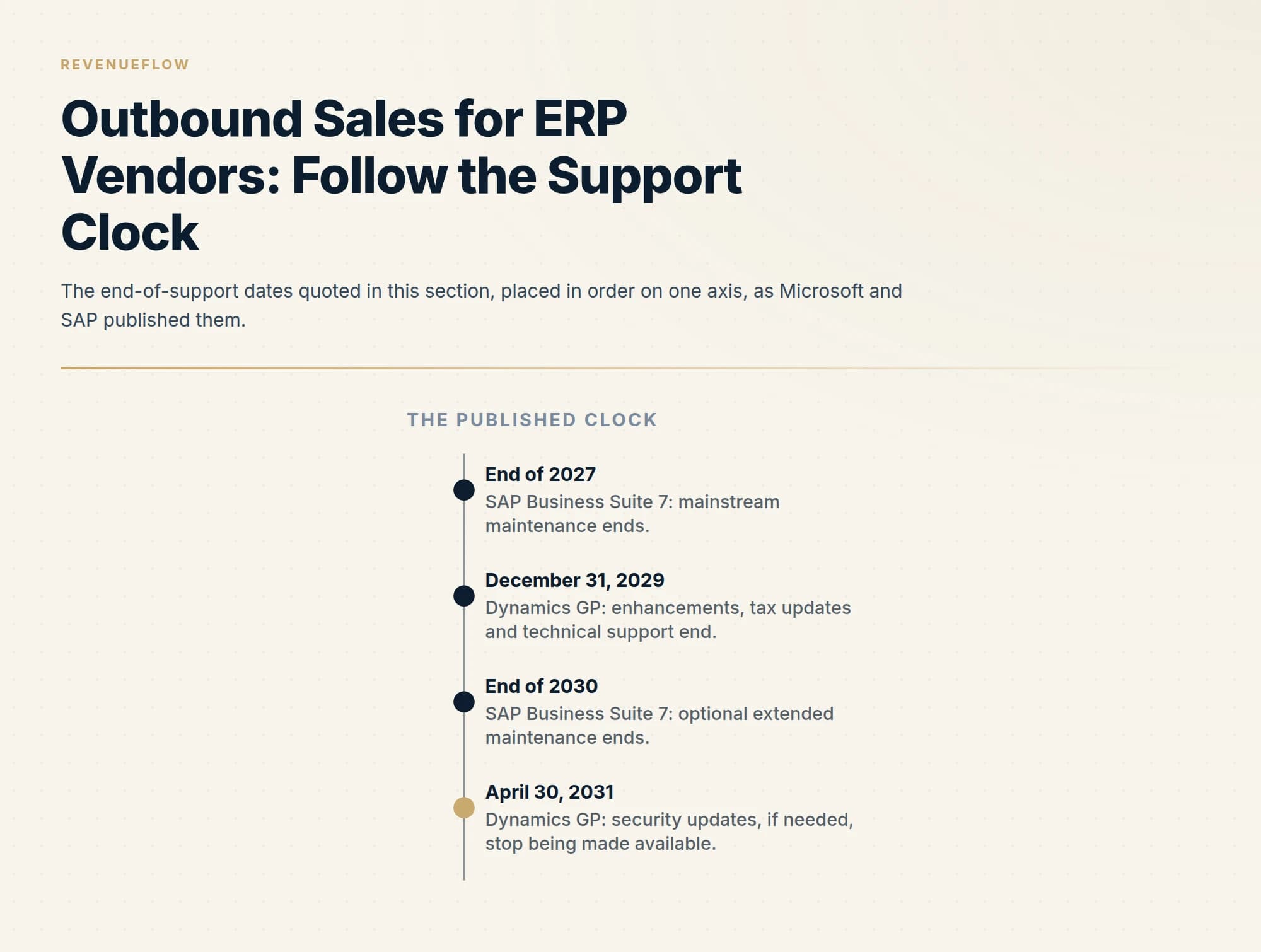
Outbound sales for ERP vendors works when the list follows the replacement clock publishers print themselves. Microsoft lists December 31, 2029 as the end of Dynamics GP support, and SAP set mainstream maintenance for Business Suite 7 to the end of 2027. Build lists on what companies run, write first to the controller, and settle partner channel rules before sending.
Key takeaways
- Microsoft's lifecycle page says Dynamics GP support ends on December 31, 2029, with security updates available until April 30, 2031.
- SAP's February 4, 2020 release set mainstream maintenance for Business Suite 7 to the end of 2027, with optional extended maintenance to the end of 2030.
- Published dates move, as Microsoft's revised Dynamics GP date shows, so every date in a message should be checked at the source before it is sent.
- A reseller carries the same software as rival partners, so its outbound has to sell the implementation: industry knowledge, migrations done and references.
Reviewed and updated September 18, 2026
A reseller of mid-market ERP software buys a list of two thousand controllers at distribution companies and writes to them about real-time inventory visibility. Forty open the email. None replies, because none of them is replacing a system this year. Three hundred miles away a distributor with ninety staff is running an accounting system whose publisher has announced the date on which support ends. Its controller has known the date for two years, has a folder of vendor names, and was not on the list.
This guide is for people who sell ERP software: publishers with a direct team, and the resellers and implementation partners who carry much of it to customers. A company replaces its ERP system rarely, so an outbound program for it has one job, which is to find the small share of the market that has a reason to move now. For a surprising number of accounts, the publisher of their current system has written that reason down and dated it.
The replacement clock is published
ERP buyers do not switch because a better product exists. They switch when staying becomes more expensive than moving, and the most common cause is the end of support for what they run. Publishers announce those dates years ahead, in public, on pages anyone can read.
Two examples show the pattern. Microsoft's lifecycle documentation for Dynamics GP says "we will end Dynamics GP support on December 31, 2029 (previously announced end date was September 30, 2029), for product enhancements, regulatory (tax) updates, and technical support", and adds "Security updates/patches, if needed, will be made available until April 30, 2031." SAP's press release of February 4, 2020 set the clock for its older suite: "SAP will provide mainstream maintenance for core applications of SAP Business Suite 7 software* until the end of 2027 followed by optional extended maintenance until the end of 2030". Customers who take neither option, the release says, "will automatically be transferred to the customer-specific maintenance model".
Three things about these dates matter to anyone building a list. They are specific to a product and a version, so the list has to be built on what a company runs rather than on what it is. They move: Microsoft's own sentence records that the Dynamics GP date was pushed back three months, and a message quoting a superseded date marks its sender as careless. And they are long. A controller with a 2029 deadline is not in a hurry in 2026, which means the outbound job is to be the known name when the project opens, not to force it open.
The tax calendar adds a second, smaller clock for the same accounts. Microsoft says Dynamics GP customers stay current by taking updates "typically released in June, October, and December each year", and that those updates carry tax changes. A customer who knows the year-end tax update will one day stop arriving has a finance reason, and a finance owner, for the project.
Two sellers, and what each is allowed to say
ERP is unusual in how much of it reaches customers through partners. Some publishers sell no other way. Acumatica's partner page is explicit: "Acumatica has no direct sales team; the product is sold exclusively through the global Value Added Reseller (VAR) network of partners."
That splits the reader of this guide in two, and the two should not run the same campaign.
- Can speak for the product and its roadmap
- Must respect the partner channel's accounts
- Often routes what it finds to a partner of record
- Sells its own implementation as much as the software
- Competes with other partners carrying the same product
- Wins on industry knowledge and references
A publisher's own team, where one exists, can speak for the product and its roadmap, but it must respect the partner channel's accounts and often routes what it finds to a partner of record. So it has to settle the channel rules before it builds a list: which accounts belong to a partner of record, whether outbound into a partner's installed base is allowed, and who gets the lead when a prospect replies. A reseller, often the only route to market, has the opposite problem. It competes with other partners carrying the same product, so the message cannot be about the software, and it wins on industry knowledge and references. It has to be about the implementation: the industry the reseller knows, the migrations it has done from the system the prospect runs, and the people who will do the work. The mechanics of writing to potential channel partners, rather than to end customers, are in cold email for reseller partnerships.
The committee is finance, operations and IT, in that order
An ERP system is the company's ledger before it is anything else, so the project usually belongs to finance. The controller lives in the system daily and feels its limits first. The chief financial officer owns the budget and the risk. Operations leaders care about inventory, orders and the warehouse. IT cares about integration, data migration and who supports it afterwards.
Lives in the system daily and feels its limits first. Usually the right first reader.
Owns the budget and the risk.
Care about inventory, orders and the warehouse.
Cares about integration, data migration and who supports it afterwards.
For outbound the controller is usually the right first reader, because the controller knows the support date, knows what the workarounds cost and will be asked to assemble the shortlist. A message to the chief executive about digital transformation reaches nobody who can act on it. How a committee of this kind behaves once a deal is open, and why security and procurement reviews deserve an early start, is the subject of our enterprise go-to-market guide. Distribution companies, which run more of their business inside an ERP than most, are covered from the message side in cold email for wholesale distribution.
What the rules require of the sender
ERP outbound is ordinary business email, and the ordinary rule applies. The FTC's CAN-SPAM compliance guide says "The law makes no exception for business-to-business email." It requires accurate header information, a subject line that reflects the content, a valid physical postal address and a clear way to opt out, and it says "You must honor a recipient's opt-out request within 10 business days." Recipients in other countries are covered by their own rules. None of this is legal advice.
There is a second constraint that is contractual rather than legal. Partner agreements commonly govern how a reseller may use a publisher's name and marks, and a message that implies it comes from the publisher is the fastest way to a difficult conversation with a channel manager. Say who you are in the first line.
Three openers built on published dates
Each is an example of the shape, sent once, with no follow-up underneath. None names a real person or claims a result.
To a Dynamics GP customer. Source: Microsoft's lifecycle policy page for Dynamics GP.
Microsoft now lists December 31, 2029 as the end of support for Dynamics GP, including tax updates. We are a reseller that has moved distributors of your size off GP. If a replacement project is on your list for the next two years, we can send the questions our clients wished they had asked first.
To an SAP Business Suite customer. Source: SAP's press release of February 4, 2020.
SAP's mainstream maintenance for Business Suite 7 runs to the end of 2027, with extended maintenance available to the end of 2030. If your team is weighing the extension against a move, we have a short comparison of what each path commits you to. Would that be useful to whoever owns the decision?
From a reseller, about itself. Source: the publisher's own partner page, such as Acumatica's.
We are one of the partners that sells and implements this product; the publisher has no direct sales team. Our work is in food distribution. If you are comparing partners as well as products, we can introduce two clients in your sector who will tell you how the project went.
When outbound is the wrong play for an ERP seller
There are four cases.
When you have no way to know what a company runs. Without the installed system, the published dates cannot be applied to a list, and the campaign falls back on titles, which is the two-thousand-controller email from the opening.
When the account has a partner of record. A publisher's team that writes into it, or a rival reseller that does so clumsily, spends goodwill the channel depends on. Settle the rules first.
When the deadline is years away and you need revenue this quarter. Outbound on a long clock builds familiarity. It does not pull a 2029 project into 2026, and a team funded for one quarter will cancel it before it reports.
When the buyer has issued an RFP. A formal selection has its own process and its own document. Answer the document, not the inbox.
The short version
Outbound sales for ERP vendors and resellers works when it follows the replacement clock that publishers themselves print. Build the list on what a company runs, check the current end-of-support date at the source because such dates move, and write first to the controller, who knows the date and will assemble the shortlist. A publisher's team settles its channel rules before it sends; a reseller sells its implementation, because the software is the same one its rivals carry. Follow the FTC's rules, say who you are in the first line, send once, and do not expect a long clock to produce a short sale.
If you would like to see a list built on installed systems and published support dates for your product, you can see what a first campaign looks like.
Support dates and partner program text were read from Microsoft, SAP and Acumatica on 18 September 2026, from stored snapshots; the SAP release is dated February 4, 2020. Publishers revise these dates: check the source before quoting one. Nothing in this article is legal advice.
Sources: Microsoft Learn, Understand the Lifecycle Policies for Dynamics GP, Microsoft Lifecycle, Dynamics GP, SAP News, SAP Extends SAP S/4HANA Maintenance Through 2040, Acumatica, The Acumatica Partner Program, FTC, CAN-SPAM Act: A Compliance Guide for Business
Frequently asked questions.
Frequently asked questions- How do ERP vendors generate leads with outbound?
- By building lists on what a company runs and when that system's support ends. Publishers print those dates: Microsoft lists December 31, 2029 for Dynamics GP support, and SAP set the end of 2027 for mainstream maintenance of Business Suite 7. Write once to the controller, who knows the date and will assemble the shortlist, well before the project opens.
- Who is the right person to contact when selling ERP software?
- Usually the controller first. An ERP system is the company's ledger, so the project tends to belong to finance, and the controller lives in the system daily and feels its limits first. The chief financial officer owns the budget and the risk, operations cares about inventory and orders, and IT cares about integration and data migration.
- How should an ERP reseller approach outbound differently from a publisher?
- A reseller sells the same software as rival partners, so its message has to be about the implementation: the industry it knows, the migrations it has done from the prospect's current system and the people who will do the work. A publisher's team must first settle which accounts belong to a partner of record and who receives any lead.
- When is outbound the wrong approach for an ERP seller?
- In four cases: you cannot tell what a company runs, so published dates cannot be applied; the account already has a partner of record; the deadline is years away and you need revenue this quarter, because a long clock does not produce a short sale; or the buyer has issued an RFP, which has its own process.
About the author.

B2B cold email experts helping companies generate qualified leads through done-for-you outreach campaigns.
RevenueFlow Team
Explore more.
Ready to scale your outreach?
We build GTM engines that book real meetings. See the receipts.
Related articles.
B2B Sales for Hardware Companies: Sell Inside the Rules
B2B hardware sales differ from software: FCC authorization limits when a radio device may be offered, pilots cost a unit each, and distributors share compliance.
LinkedIn Outreach for Automotive Companies: Who It Reaches
LinkedIn outreach into automotive, split by buyer: what it can open at manufacturers, parts suppliers and dealer groups, and the cases where it is the wrong channel.
LinkedIn Outreach for Ecommerce Companies: Who Is Reachable
LinkedIn outreach to ecommerce brands: why the storefront address reaches support, what Shopify's partner agreement says about contacting merchants, and who is reachable.
Outbound Sales for Web Development Companies: A Guide
Outbound for a web shop starts from the prospect's own public site: what it runs on, how it performs and whether a dated accessibility duty applies.
LinkedIn Outreach for Logistics Companies: Finding Shippers
LinkedIn outreach for brokers, forwarders and 3PLs: why the industry filter returns competitors, how to find shippers by function, and what goes in one checkable message.
Outbound Sales for Law Firms: What the Rules Allow
Outbound business development for law firms, read against ABA Model Rules 7.1 to 7.3: who a firm may approach, what a message must carry, and when it is the wrong play.