LinkedIn Outreach for Automotive Companies: Who It Reaches
LinkedIn outreach into automotive, split by buyer: what it can open at manufacturers, parts suppliers and dealer groups, and the cases where it is the wrong channel.
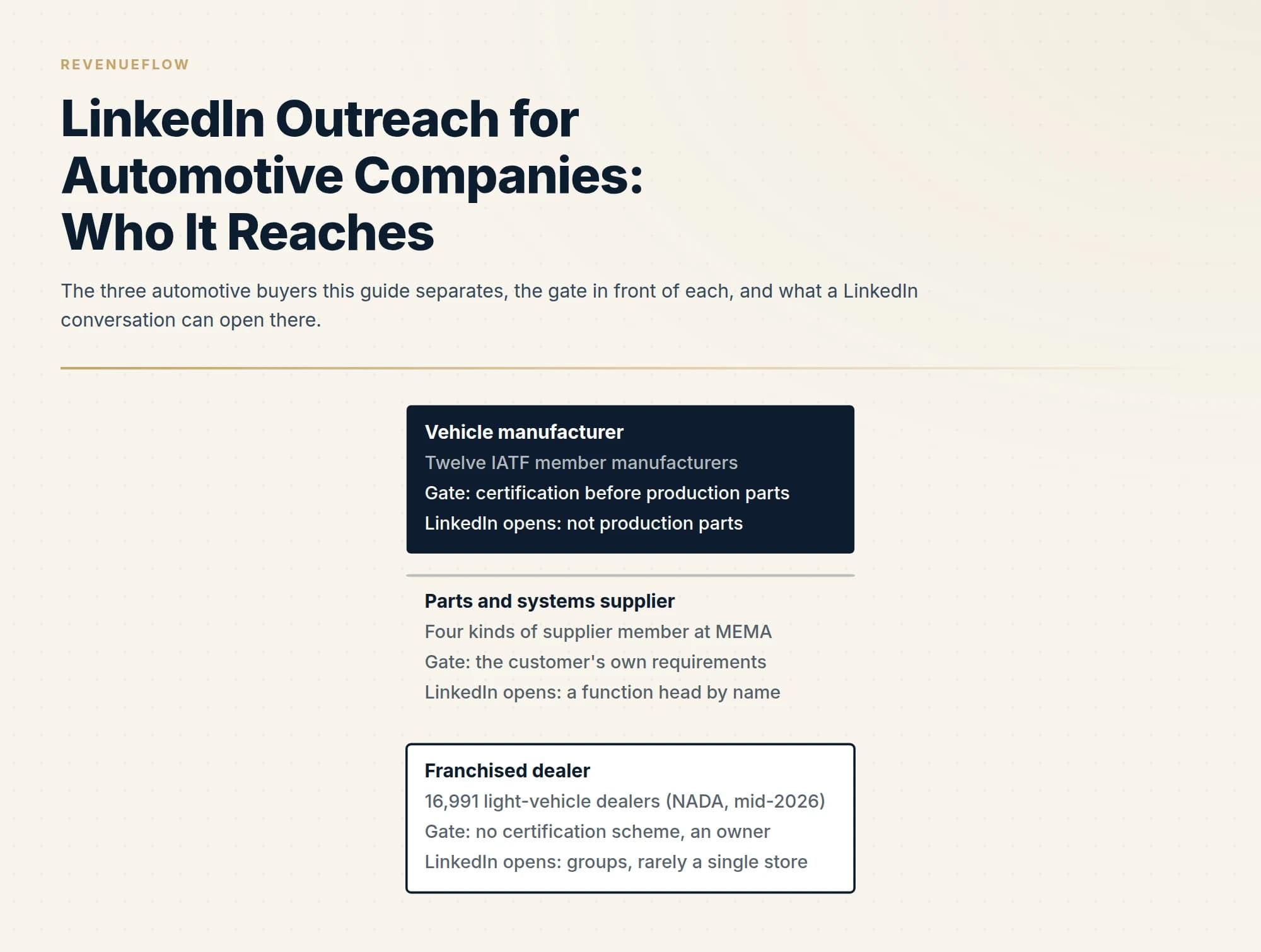
LinkedIn outreach works in automotive when it is aimed at named function heads at parts suppliers and at dealer groups with a corporate office. It cannot shorten the certification path for production parts at a vehicle manufacturer, and it is a poor fit for single dealerships. Use dated events from IATF and NADA pages as the reason to write.
Key takeaways
- Automotive is three buyers: twelve IATF member manufacturers, parts and systems suppliers as MEMA defines them, and 16,991 franchised light-vehicle dealers counted by NADA at mid-year 2026.
- A LinkedIn conversation cannot replace IATF 16949 certification for production parts, so vendors of software and services should write to the supplier function that owns the problem.
- MEMA's council list names the functions at a supplier: purchasing, finance, sales, human resources, legal, warranty and advanced technology, each with a named leader.
- LinkedIn's help pages say suspected automation can get an account restricted, so one human-sent message per person keeps this a small-list channel.
Reviewed and updated September 18, 2026
A company that sells quality software to parts makers builds a LinkedIn list of two hundred people with purchasing in their title at vehicle manufacturers. The connection requests go out, a few are accepted, and nothing happens. The list was aimed at the one group in the industry that cannot buy on a conversation, and it ignored the two groups that can.
This guide is for companies that sell to the automotive industry: software, services, equipment and data vendors who want to use LinkedIn to reach vehicle manufacturers, parts suppliers or dealer groups. It is about this trade, and it leaves the mechanics of the platform to other pages. For the rules of the platform itself, and what is safe to hand to an agency, read what is safe to outsource on LinkedIn. For what email into the same market looks like in numbers, read automotive cold email benchmarks.
Automotive is three buyers, and each has a different gate
The word automotive covers three kinds of company that buy in three different ways.
The first is the vehicle manufacturer. The International Automotive Task Force, the body behind the industry's quality standard, lists twelve vehicle manufacturers as members on its own site: BMW Group, BYD Group, Ford Motor Company, General Motors, IVECO Group, Jaguar Land Rover, Mercedes-Benz Group, Renault Group, Stellantis, Volkswagen, Volvo Group and Zhejiang Geely Holding Group. The IATF says it exists to agree quality system requirements for the manufacturers' "direct suppliers of production materials, product or service parts or finishing services". So a company that wants to sell production parts to one of these manufacturers meets a certification scheme before it meets a buyer.
The second is the parts and systems supplier. MEMA, the vehicle suppliers association, opens its About page with the words "We represent the largest manufacturing sector in the United States" and puts the supplier industry at more than 4.8 million jobs. Its membership page defines four kinds of supplier member: makers of components, modules, software and systems for original equipment; providers of product engineering, design, testing and prototyping services; providers of machinery, tools, dies and molds; and providers of major materials such as steel, aluminum and plastics. Suppliers answer to their customers' rules. The IATF publishes each manufacturer's customer specific requirements, and the same page carries a document of minimum quality system requirements for sub-tier suppliers, so the rules reach past the first tier.
The third is the franchised dealer. NADA's mid-year 2026 data report counts 16,991 franchised light-vehicle dealers in the United States, and adds that in the first half of 2026 "Dealerships wrote more than 136 million repair orders". A dealership has no certification scheme in front of it. It has an owner.
Decide which of the three you sell to before you open Sales Navigator. A list that mixes them produces a message that is vague to all three.
What LinkedIn can open at a manufacturer or a supplier
If you sell production parts, LinkedIn cannot shorten the path, because certification comes first. The IATF 16949 standard was created, in the IATF's words, to harmonize "the different assessment and certification systems worldwide in the supply chain for the automotive sector". A purchasing contact who likes your message still has to send you through that system, and the manufacturers' requirements documents are long and dated. A connection request does not change any of that.
If you sell something that is not a production part, such as software, consulting, staffing, logistics, test equipment or training, the certification gate is not yours to pass. It is your prospect's daily workload, and that makes it your subject. Here LinkedIn is a reasonable place to start a conversation, provided the message goes to the function that owns the problem.
MEMA's own council list is the best public map of those functions at a supplier. It runs an Automotive Executive Council for chief executives, chief operating officers, presidents and regional profit and loss leaders. It runs a Purchasing Executive Council, which in MEMA's words convenes "senior executives responsible for purchasing and supply chain strategy", a Finance Executive Council, a Sales Executive Council, a Human Resources Council, a Legal Issues Council for in-house counsel, a Warranty Management Council for warranty professionals, and an Advanced Technology Council whose meetings cover cybersecurity, CAFE regulation and vehicle connectivity. Each council is a function with a budget, a named leader and a set of peers. A vendor of warranty analytics writes to the warranty leader. A vendor of security tooling writes to the technology leader. Neither writes to purchasing first, because purchasing joins once a function head wants something.
We could not find a public count, from the platform or from any automotive association, of how many of these people use LinkedIn actively, and we will not invent a figure. Test it per segment instead: take ten target accounts, search the exact title in Sales Navigator, and count how many profiles show activity in the last ninety days. If the count is low for plant and quality roles and healthy for corporate functions, you have learned where the channel works for your list, from your own accounts, in an afternoon.
| You sell | Write to | Not first |
|---|---|---|
| Warranty analytics | The warranty leader | Purchasing |
| Security tooling | The technology leader | Purchasing |
| Production parts | Certification comes first | Any buyer on LinkedIn |
Dealer groups are a different channel question
NADA's own training shows how a dealership is organised. Its Academy is designed for dealer principals, prospective dealers and dealership managers, and its Professional Series trains department managers in four areas: sales, service, parts and office. That is the whole buying structure at a single store: a dealer principal and a handful of department managers.
Those department managers run a working day on the floor and in the service lane. Half a year of 136 million repair orders is a measure of how much of that day belongs to customers. We found no public measure of how often a service manager opens LinkedIn, so we make no claim about it. The practical reading is about company size. A dealer group with a corporate office has people whose job is to evaluate vendors, and that is the group worth testing on LinkedIn first. LinkedIn can open a conversation with groups and rarely with a single store. A single store has an owner who is easier to reach by email, through its dealer association, or on the show floor. Where each channel earns its place once the buyer is chosen is compared in lead generation channels.
A legitimate reason to write, from the trade's own sources
One message has to carry the campaign, so it needs a reason that belongs to the reader. Three illustrative openers follow, each built on a page we fetched on 18 September 2026. They are examples of shape. They name no real recipient and make no claim about results.
The first is for a quality leader at a supplier to Ford. The IATF's customer specific requirements page lists Ford's requirements for IATF 16949 and for the production part approval process as effective 15 June 2026.
Your customer's updated requirements for part approval took effect on 15 June. If your team is still reconciling submissions by hand, we built a checker for that exact document set and would be glad to show you how it reads a submission.
The second illustrative opener is for a fixed operations director at a dealer group, and it rests on the repair order count in the NADA mid-year data given above.
Franchised dealers wrote more than 136 million repair orders in the first half of this year. If your service lanes are near capacity, we have a scheduling approach built for groups with several stores, and we can walk you through it in fifteen minutes.
The third illustrative opener is for a vendor-facing role at a dealer group before the industry's main show. NADA's schedule page puts the opening of NADA Show 2027 on Wednesday, February 17, at the Orange County Convention Center.
You will have a full calendar at the show from 17 February. We would rather send you a two-page summary now so you can decide whether a meeting there is worth your time.
Each opener does three jobs. It gives a dated fact from the trade's own association, which the reader can check. It names a condition the reader either has or does not have. It ends with a small ask with a time box, and no claim about results.
To a fixed operations director at a dealer group (illustrative opener)
Franchised dealers wrote more than 136 million repair orders in the first half of this year. 1
If your service lanes are near capacity, we have a scheduling approach built for groups with several stores. 2
We can walk you through it in fifteen minutes. 3
- 1A dated fact from the trade's own association, which the reader can check.
- 2A condition the reader either has or does not have, aimed at groups and not at one store.
- 3A small ask with a time box, and no claim about results.
What the platform's rules take off the table
LinkedIn is a private platform with its own rules, and the account at risk is yours. Its help page on invitation restrictions says: "If you send an excessive number of invitations and we suspect the use of an automation tool, we may suspend or restrict your account." The same page recommends that members "only send invitations to people you know and trust". Its page on prohibited software says LinkedIn does not permit third party software that scrapes or automates activity on its website. We never recommend a tool that the User Agreement prohibits, and we do not describe one as safe.
Our own practice narrows it further. We send one message per campaign. On LinkedIn a second message lands in the same thread under the one the person chose not to answer, so we do not send it, and we do not come back later to someone who stayed silent there. That makes LinkedIn a small-list channel by design, which suits a market of twelve manufacturers and named supplier functions better than it suits 16,991 dealers.
If the campaign also uses email, the FTC's CAN-SPAM guide applies, and it is blunt about business recipients: "The law makes no exception for business-to-business email." The guide sets out what the sender must do, including honoring an opt-out request within 10 business days. Read the FTC's guide for the full list. This page is not legal advice.
The dates this industry publishes
Automotive gives an outbound team something rare: dated public events that change a prospect's workload. The IATF's requirements page is a calendar in disguise. General Motors' customer specific requirements are listed as effective 30 October 2025. Ford's are effective 15 June 2026. Stellantis has a requirements summary dated July 2026. For Jaguar Land Rover the page reads "The Jaguar Land Rover (JLR) Limited Customer Specific Requirements are under development", which means a new document is coming for every one of its suppliers. Each new document is a reason for a supplier's quality team to review its process, and a reason for a vendor who helps with that review to write.
On the retail side the anchor is the show. NADA Show 2027 opens on Wednesday, February 17, and its schedule includes franchise meetings between manufacturers and their dealers.
When LinkedIn is the wrong play in automotive
There are four cases, and they are common.
You sell production parts and you are not certified. The conversation ends at the certificate, whoever accepted your request. Spend the quarter on certification and on the manufacturer's published requirements.
Your buyer is a single dealership. An owner and a handful of department managers do not justify a channel built for corporate roles. Use email and the association calendar.
You need volume. One message per person, sent by a human from a real account, will not reach thousands of people in a month, and it should not try. Large lists belong in email, where a new campaign on a new reason is a genuine first touch. The broader industrial version of that motion is in manufacturing lead generation.
Your plan depends on software clicking send. The restriction wording given above is what happens to accounts that do that, and the account is the asset.
Where LinkedIn fits, it fits narrowly: named function heads at suppliers and at dealer groups, a reason taken from the trade's own calendar, one message, and a person sending it. If you would like to see that targeting applied to your own market by email first, you can see what a first campaign would look like.
Facts about the IATF, MEMA, NADA, LinkedIn and the FTC were read from their own pages on 18 September 2026, from stored snapshots. Requirement dates are as listed on the IATF page that day and will change. Nothing here is legal advice; check LinkedIn's current terms before relying on them.
Sources: IATF, About, IATF 16949:2016, About, IATF, Customer Specific Requirements, MEMA, About, MEMA, Original Equipment Suppliers membership, MEMA, Original Equipment Councils and Forums, NADA Data, NADA Academy, NADA Show schedule, LinkedIn Help, Types of restrictions for sending invitations, LinkedIn Help, Prohibited software and extensions, FTC, CAN-SPAM Act compliance guide
Frequently asked questions.
Frequently asked questions- Does LinkedIn outreach work for selling to automotive companies?
- It works for a narrow part of the market. Named function heads at parts suppliers and vendor-facing roles at dealer groups are reasonable targets, provided the message carries a reason taken from the trade's own calendar. It does not shorten the certification path for production parts at a vehicle manufacturer, and a single dealership is usually better reached by email or through its state association.
- Who should I message at an automotive supplier?
- Write to the function that owns the problem your product solves. MEMA's council list shows the functions suppliers organise around: purchasing and supply chain, finance, sales, human resources, legal, warranty management and advanced technology. A warranty analytics vendor writes to the warranty leader and a security vendor to the technology leader. Purchasing joins once a function head wants something.
- Can I automate LinkedIn outreach to automotive buyers?
- LinkedIn's help centre says it does not permit third party software that scrapes or automates activity on its website, and that an account suspected of using an automation tool to send invitations may be suspended or restricted. The account at risk is yours. We send one message per person, by hand, and treat LinkedIn as a small-list channel for that reason.
- What is a good reason to contact an automotive prospect on LinkedIn?
- A dated, public event that changes the reader's workload. The IATF lists each manufacturer's customer specific requirements with effective dates, such as Ford's on 15 June 2026, and NADA publishes its show schedule and its dealership data reports. A message built on one of those facts can be checked by the reader and explains why you are writing now.
About the author.

B2B cold email experts helping companies generate qualified leads through done-for-you outreach campaigns.
RevenueFlow Team
Explore more.
Ready to scale your outreach?
We build GTM engines that book real meetings. See the receipts.
Related articles.
LinkedIn Outreach for Ecommerce Companies: Who Is Reachable
LinkedIn outreach to ecommerce brands: why the storefront address reaches support, what Shopify's partner agreement says about contacting merchants, and who is reachable.
LinkedIn Outreach for Logistics Companies: Finding Shippers
LinkedIn outreach for brokers, forwarders and 3PLs: why the industry filter returns competitors, how to find shippers by function, and what goes in one checkable message.
Outbound Sales for Food and Beverage Companies: Who to Reach
Outbound sales for food and beverage brands: the four buyers behind a yes, the public show calendar, what a message may claim, and when outbound is the wrong play.
Outbound Sales for Web Development Companies: A Guide
Outbound for a web shop starts from the prospect's own public site: what it runs on, how it performs and whether a dated accessibility duty applies.
Outbound Sales for Law Firms: What the Rules Allow
Outbound business development for law firms, read against ABA Model Rules 7.1 to 7.3: who a firm may approach, what a message must carry, and when it is the wrong play.
Outbound Sales for Higher Education Vendors: Which Door to Use
Outbound for higher education vendors, built on universities' own purchasing policies: three doors, the ask that fits each one, and a dated accessibility review.