LinkedIn Outreach for Banks: A Regulated Message
How a bank's relationship managers use LinkedIn to reach business owners: what the FFIEC guidance, FINRA's notices and LinkedIn's own rules require, and where to stop.
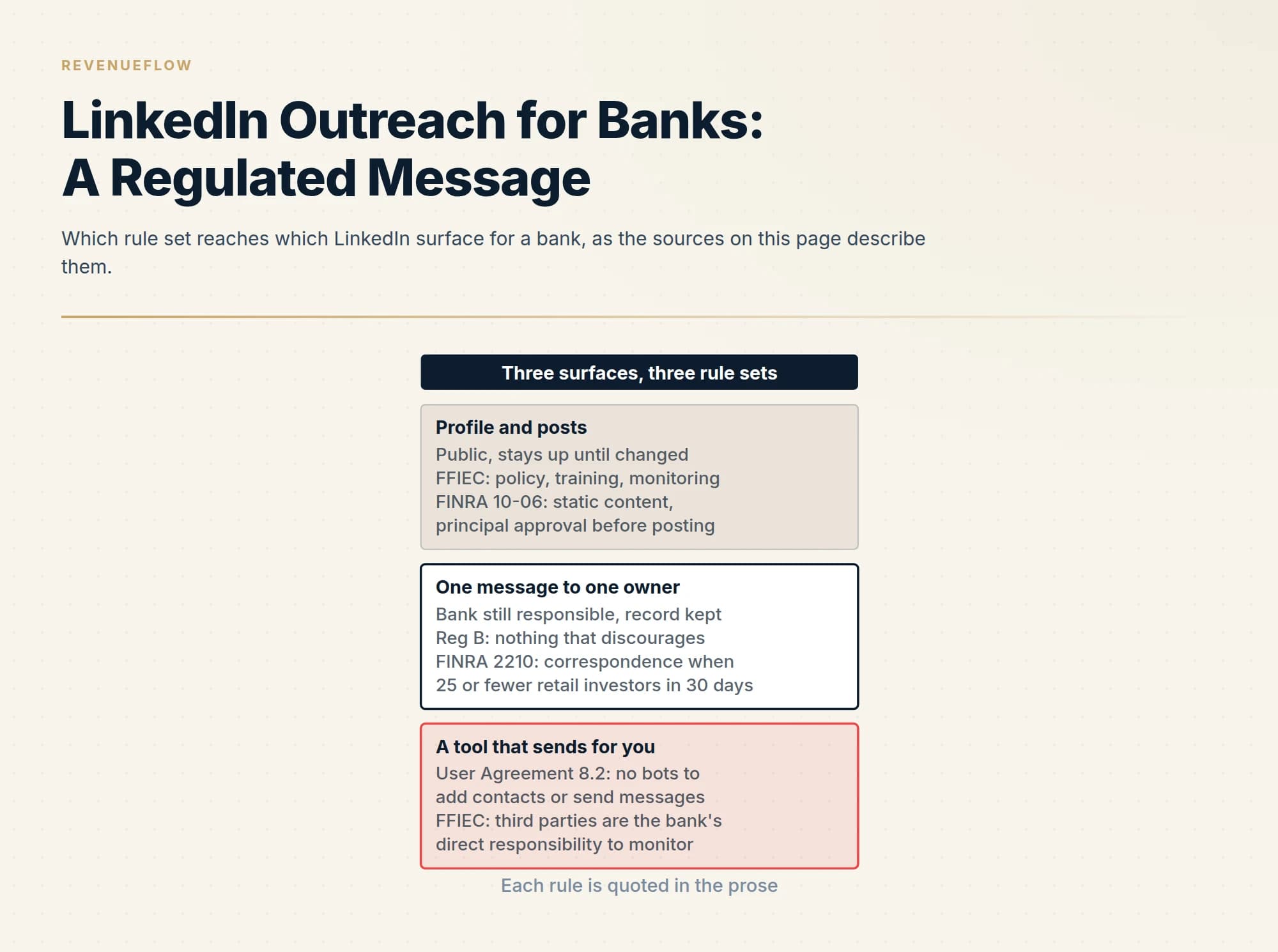
A banker's LinkedIn message is official use of social media under the FFIEC guidance, so the bank needs a policy, training and a record of it, and a registered person also has FINRA's static-versus-interactive rules. The workable motion is a centrally approved profile, one personal message with no product term, and a reply handled by a named banker.
Key takeaways
- The FFIEC guidance names LinkedIn as social media and treats employees' official use as the bank's communication, so policy, training and a retained record come before the first message.
- A relationship manager who is also a registered person has FINRA's rule too: static profile content needs principal approval before posting, and one message to one person is correspondence that is supervised and kept.
- The message a banker may still send in their own name states no rate, fee, approval or yield; it carries a public reason to talk and an offer of a conversation with a named person.
- Automation tools break LinkedIn's User Agreement and put a third party inside the bank's compliance perimeter, so outside help on this channel is research and drafting, never sending.
Reviewed and updated September 21, 2026
A commercial relationship manager at a bank finds the owner of a distributor whose new warehouse was in the local paper and writes four sentences on LinkedIn offering a conversation. The message is true, specific and polite. It is also, to the bank's regulators, a communication the bank is responsible for, on a channel the bank is expected to have a policy for, from an employee whose words the public may read as the bank's own. That is the fact this page is built around.
This guide is for people inside a bank: commercial and business banking relationship managers, treasury specialists and their compliance colleagues, using LinkedIn to reach business owners, finance leaders and the accountants and attorneys who refer them. Selling to banks is cold email for banking; the phone version of the job is bank cold calling scripts; how a regulated seller's own marketing is governed is B2B sales for financial services companies. What is specific to LinkedIn is below.
Why a banker's LinkedIn message is a regulated communication
The Federal Financial Institutions Examination Council published its Social Media: Consumer Compliance Risk Management Guidance in the Federal Register on 17 December 2013, and it names the platform: social media includes "sites that enable professional networking (e.g., LinkedIn)". It draws one line that matters for the channel choice: "messages sent via traditional email or text message, standing alone, do not constitute social media". A LinkedIn message is inside the definition; an email is governed by other rules (Federal Register, Social Media: Consumer Compliance Risk Management Guidance, read 21 September 2026).
Two sentences set the tone. "The Guidance does not impose any new requirements on financial institutions." And: "Financial institutions are expected to manage risks associated with all types of consumer and customer communications, no matter the medium." Nothing about LinkedIn is forbidden, and nothing is exempt. The CFPB carries the document on its guidance page, and the FDIC issued it as FIL-56-2013 (CFPB, FFIEC guidance on social media; FDIC, FIL-56-2013, both read 21 September 2026).
It is explicit about employees, which is what a relationship manager is: "employees' communications via social media may be viewed by the public as reflecting the financial institution's official policies". The remedy it names is policy and training: "training and guidance should be provided to employees regarding official use of social media". A banker messaging a business owner about the bank is official use.
What that pushes a bank to centralise
The guidance lists what a risk management programme for social media should contain, which explains why banks tend to hand LinkedIn to marketing. Among the components: "A risk management process for selecting and managing third-party relationships in connection with social media" and "An employee training program that incorporates the institution's policies and procedures for official, work-related use of social media".
Three of the rules it walks through reach a business banker's message directly, stated here as what each requires, with no legal advice attached. On lending, Regulation B "prohibits creditors from making any oral or written statement, in advertising or other marketing techniques, to applicants or prospective applicants that would discourage on a prohibited basis a reasonable person from making or pursuing an application", and the CFPB's page for section 1002.1 says it applies "to all credit - commercial as well as personal" (CFPB, 12 CFR 1002.1, read 21 September 2026). On deposits: "Whenever a depository institution advertises FDIC-insured products, regardless of delivery channel, the institution must include the official advertising statement of FDIC membership". On everything: "An act or practice can be unfair, deceptive, or abusive despite technical compliance with other laws", and what the institution communicates on social media should be "accurate, consistent with other information delivered through electronic media, and not misleading".
What that produces inside a bank is a split. Profile language, posts and any statement of a product's terms are written and approved centrally, because they are advertising in the guidance's sense. The one-to-one message is where the relationship manager still acts in their own name, and its safe shape makes no product claim: a specific reason to talk, drawn from something public about the business, and an offer of a conversation with a named person. It states no rate and no term, so it carries nothing a disclosure rule would need to accompany. Policy says who may send it, training says how, and a copy is kept.
Which bank rule reaches which message
The guidance walks through the consumer laws product by product, and for a business banker the useful reading is which of them a given message can touch. For deposits it restates the Truth in Savings Act: "Regulation DD and Part 707 require disclosures about fees, annual percentage yield (APY), interest rate, and other terms". For consumer credit it restates Regulation Z: "Any social media communication in which a creditor advertises credit products must comply with Regulation Z's advertising provisions". Commercial credit sits under Regulation B, deposits under the FDIC advertising statement, and everything under the prohibition on unfair, deceptive or abusive acts. A one-to-one message that names no product touches none of the disclosure rules and all of the accuracy rules, which is the point of writing it that way.
| Message about | Rule the guidance names | In a banker's one-to-one note |
|---|---|---|
| A business loan or line | Regulation B: no statement that would discourage an application on a prohibited basis | A reason to talk, no terms, no discouragement |
| A deposit or treasury account | Regulation DD disclosures; the Member FDIC advertising statement | Never named, so no disclosure is owed |
| A consumer product | Regulation Z advertising provisions and the consumer rules | Not this page; a different programme |
| Anything at all | Unfair, deceptive or abusive acts: accurate, consistent, not misleading | Every sentence checkable against a public fact |
The registered person's second rule book
A commercial banker is often also a registered person. Bank of America's posting for a senior relationship manager in middle market banking, read on 21 September 2026, requires the Securities Industry Essentials, Series 7 and Series 63 licences within 180 days of the start date (Bank of America careers, Sr. Relationship Manager, Middle Market Banking, New York). That banker's LinkedIn is also FINRA's business. Regulatory Notice 10-06, published on 25 January 2010, says of "Social networking sites, such as Facebook, Twitter and LinkedIn" that "a registered principal of the firm must approve all static content on a page of a social networking site established by the firm or a registered representative before it is posted", while interactive messages are supervised rather than pre-approved (FINRA Regulatory Notice 10-06, read 21 September 2026). Under FINRA Rule 2210 a message to "25 or fewer retail investors within any 30 calendar-day period" is correspondence and a message to more is a retail communication needing principal approval (FINRA Rule 2210, read 21 September 2026), and Regulatory Notice 11-39 makes retention follow the content of a message rather than the device it was sent from (FINRA Regulatory Notice 11-39, read 21 September 2026). The site's guide to LinkedIn lead generation for financial services firms, written for broker-dealers and advisers, carries that count and the archive question in full; for the bank's own relationship manager the practical reading is that the profile is approved once, each message goes to one person, and every message is kept.
Who a banker is writing to, and why the personal profile is the asset
The same Bank of America posting describes the job: the relationship manager "Acquires, deepens, and maintains profitable client relationships through sales, prospecting, and enhancing existing relationships", and it is "Highly desirable to have active networking contacts and Centers of Influence established in local markets". The two audiences are named there: the business itself, and the professionals who introduce it. Both are on LinkedIn under their own names, which is the whole reason the channel exists for a banker.
Everfi, which sells financial education programmes to banks, made the case for the individual profile from inside the vertical: "LinkedIn is most useful for business to business banking, and that means business owners are looking at individual bankers on your team." The same post warns against the shortcut: "don't use generic copy-paste messages. If you're adding someone, have a legitimate and personal reason to do so." (Everfi, 8 Tips for Banks to Get More Out of LinkedIn Marketing, dated 12 September 2025 in its page metadata, read 21 September 2026.) LinkedIn's own sales blog post of 26 April 2023 on three financial services firms opens with a wealth manager targeting individuals, the consumer side (LinkedIn Sales Blog, read 21 September 2026); Expandi's benchmarks page carries the vendor's own figures.
Put the posting and the Everfi sentence together and the LinkedIn motion for a banker is narrow and personal. The profile is approved once and earns trust for months. The connection request carries a reason. The message that follows is one message, sent once, to a named person, about something true of their business, handing the conversation to a call at the first reply. That is also how RevenueFlow runs LinkedIn for any client: one message per campaign, no bump behind it, and no second message under one that was ignored. The mechanics of the request and the note are in LinkedIn prospecting.
LinkedIn's own rules, and the tools that sell around them
Five of the ten pages that answer a search for this phrase, read on 21 September 2026, are tool or agency pages, four of them selling automation. LinkedIn's User Agreement, effective on 3 November 2025, says in section 8.2 that a member agrees not to "Use bots or other unauthorized automated methods to access the Services, add or download contacts, send or redirect messages, create, comment on, like, share, or re-share posts, or otherwise drive inauthentic engagement" (LinkedIn User Agreement). Its help page on prohibited software says such members "risk having their accounts restricted or shut down" (LinkedIn Help), and the Professional Community Policies add: "Use your true identity and share information that is real and authentic" (LinkedIn Professional Community Policies); all read 21 September 2026.
For a bank the two rule books point the same way. The FFIEC guidance says "Working with third parties to provide social media services can expose financial institutions to substantial reputation risk", and that monitoring "is the direct responsibility of the financial institution, as part of a sound compliance management system, even when such functions may be delegated to third parties". A tool that sends from a banker's account is a third party inside the bank's compliance perimeter, working in a way the platform forbids, on an account whose restriction would take the banker's professional identity with it. Outside help on this channel is research and drafting, not sending; the argument is in LinkedIn lead generation services.
When LinkedIn is the wrong play for a bank
It is the wrong play for retail products: a message to an individual about a deposit account, a mortgage or a card is consumer advertising under the laws the guidance walks through, and needs disclosures a short message cannot carry.
It is the wrong play for any message that states a term. A rate, a fee waiver, an approval, a yield: each is a claim Regulation B, the deposit-advertising rules or the prohibition on misleading statements reaches, and each belongs on an approved page, not in a banker's note.
It is the wrong play where no policy exists, because the guidance expects policies, training and records before official use. And it is the wrong play with automation, for the platform reason and the regulatory reason above, and for a registered person as a list activity, because a templated note to more than twenty-five retail investors in thirty days needs a principal's approval first.
Three openers, each on a fetched fact
Three illustrative openers follow, each built on a page read on 21 September 2026, each one message to one person, sent once, after the bank's policy owner has read the template. None names a real recipient, states a product term or claims a result, and the bank that speaks in each is invented.
The first is to the owner of a distributor, and it rests on Everfi's sentence that business owners are looking at individual bankers, so the message is about the business and signed by a person.
Your second warehouse was in the county paper last week, and a building that size usually raises a working-capital question before it raises a banking question. We bank four distributors in the county from the same office, and the person writing this would be the person you deal with. If a twenty-minute conversation about how the others financed the same step would be useful, name a morning. Nothing here is an offer or a decision on anything.
The second is to an accountant, and rests on the Bank of America posting naming Centers of Influence as a banker's second audience.
Your firm handles the year-end for three of the manufacturers we bank, and the owners speak well of the work. We are not writing to ask for introductions. We would like to know what your clients complain about in their banking, because that is what we are trying to fix on our side. Is a short call in the next month worth your time?
The third is from a registered person to a finance director, and it rests on FINRA Rule 2210's definition of correspondence: one message to one person, kept on record, with no claim in it.
Your treasurer's post about consolidating accounts after the acquisition described a problem we work on for companies of your size. This note is to one person, it makes no claim about any product or result, and a copy is kept by our compliance team as our rules require. If a conversation with our treasury specialist would help, we can arrange one at a time that suits you.
LinkedIn message to the owner of a regional distributor
Your second warehouse was in the county paper last week, and a building that size usually raises a working-capital question before it raises a banking question. 1
We bank four distributors in the county from the same office, and the person writing this would be the person you deal with. 2
If a twenty-minute conversation about how the others financed the same step would be useful, name a morning. Nothing here is an offer or a decision on anything. 3
- 1A public fact about the business, and what it usually means; no product is named.
- 2The individual banker is the asset, as Everfi's post says business owners look at individual bankers.
- 3A small ask and a plain statement that nothing is an offer or a credit decision, so no term and no discouragement.
What to agree in writing
The social media policy and the person who reads every template. The record keeping, whichever device the message is typed on. The rule that a message names no term. The audiences: the business and its centers of influence. One message per campaign, no bump, no automation. A bank that wants to see a researched list and a single approved message for its market before committing anything can start with a free campaign and count the conversations that begin.
Every regulator, platform, employer and publisher page above was read on its own site on 21 September 2026. Rules change and postings close. Nothing here is legal or compliance advice; the bank's own compliance function decides what it may send.
Frequently asked questions.
Frequently asked questions- Can a bank relationship manager message business owners on LinkedIn?
- Yes, under the bank's own policy. The FFIEC guidance published in December 2013 names LinkedIn as social media, says the guidance imposes no new requirements, and expects a bank to manage the risk of every customer communication, with training for employees' official use. So a banker may write to an owner once the bank has a policy, training and a way to keep the record, and the message itself makes no product claim.
- Does a banker's LinkedIn message need compliance approval first?
- It depends on who sends it and to how many people. For a registered person, FINRA Regulatory Notice 10-06 says static content such as the profile needs a registered principal's approval before posting, while interactive messages need supervision rather than prior approval, and Rule 2210 treats a message to 25 or fewer retail investors in 30 days as correspondence. A bank's own policy decides who reads templates before use.
- Can a bank use a LinkedIn automation tool for outreach?
- LinkedIn's User Agreement, effective 3 November 2025, says members agree not to use bots or other unauthorized automated methods to add contacts or send messages, and its help page says accounts using such tools risk restriction or shutdown. The FFIEC guidance also makes third parties working on social media the bank's direct responsibility to monitor. Research and drafting can be bought; sending should stay with the banker.
- When is LinkedIn the wrong channel for a bank?
- For retail products, because a message about a deposit account, mortgage or card is consumer advertising that needs disclosures a short message cannot carry; for any message that states a rate, fee or approval; where the bank has no social media policy, training or record keeping yet; with any automation; and for a registered person as a list activity, since a templated note to more than 25 retail investors in 30 days needs principal approval first.
About the author.

B2B cold email experts helping companies generate qualified leads through done-for-you outreach campaigns.
RevenueFlow Team
Explore more.
Ready to scale your outreach?
We build GTM engines that book real meetings. See the receipts.
Related articles.
SDR Outsourcing for Financial Services: The Third Party
What a bank, broker-dealer, adviser or agency's regulators say about an outside team that speaks for it, the licensed line, and which arrangement survives due diligence.
Appointment Setting for Business Brokers: The Seller Meeting
What a bought meeting with a business owner has to be for a brokerage: the three-part qualification, the confidentiality rules, the licence line and the owner's reasons.
LinkedIn Outreach for Utilities: Selling to the Sector
How a vendor selling to utilities uses LinkedIn next to a published sourcing process: the three ownership models, the registration gate and what a message may ask.
Cold Calling for PPC Agencies: What You Can See First
A paid media prospect is partly readable before the call and has already been told by the platform what to do when a stranger rings about its ads.
Cold Calling for Chemical Companies: Who Picks Up
A chemical cold call rarely arrives first. It reaches a formulator who has already been comparing suppliers on a screen, for one of three published reasons.
LinkedIn Outreach for Marketing Agencies
How a marketing agency wins its own clients on LinkedIn: the published agency search process, the platform rules aimed at how agencies work, and the expert buyer.