Cold Calling for PPC Agencies: What You Can See First
A paid media prospect is partly readable before the call and has already been told by the platform what to do when a stranger rings about its ads.
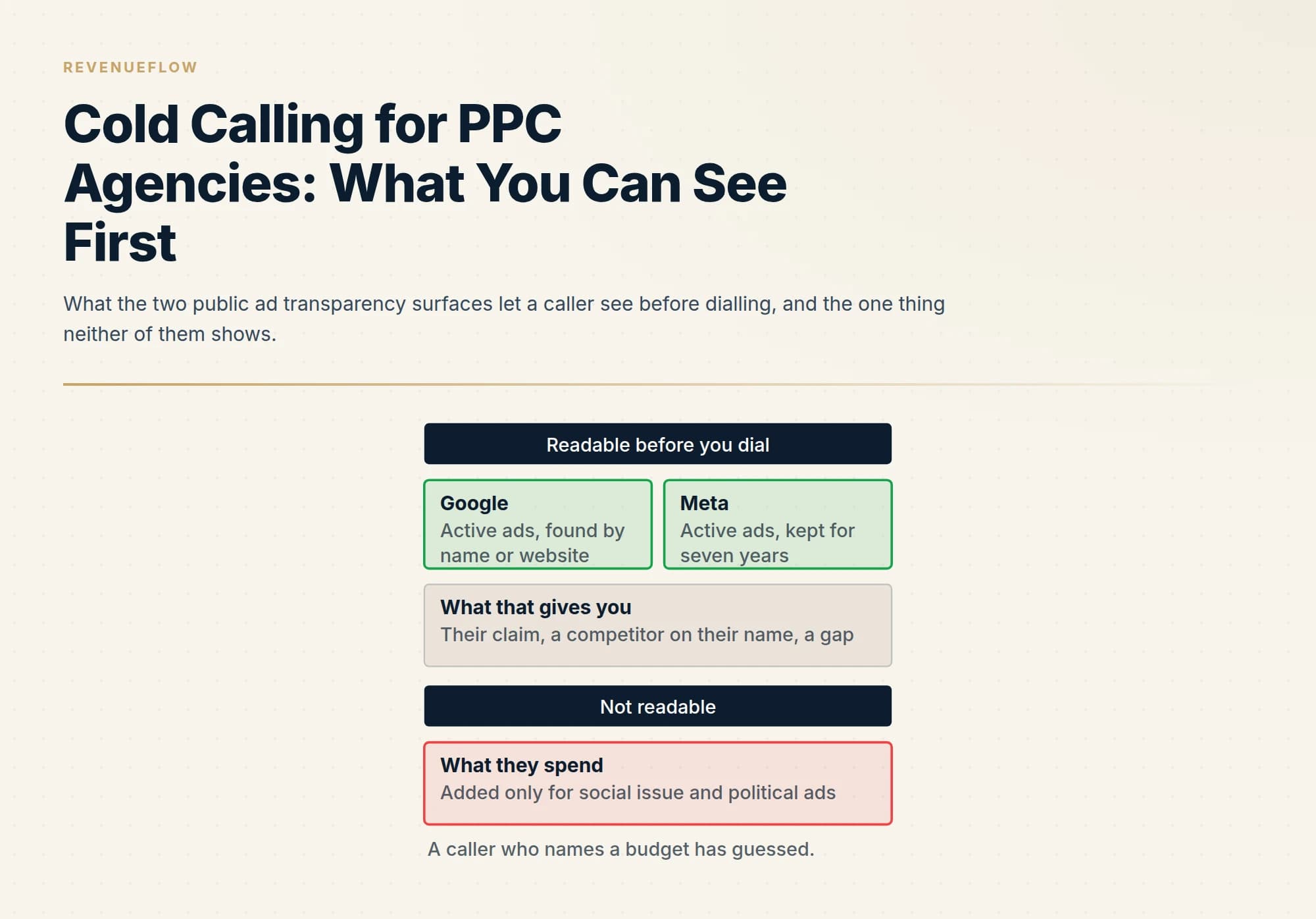
Both platforms publish what a business advertises, so a caller can open on something specific and checkable, but not on spend. Google tells advertisers that some callers pretend to be associated with it, and advises asking for an email and checking for a Partner. A legitimate agency volunteers both.
Key takeaways
- Google's Ads Transparency Centre finds active ads by advertiser name or website, and Meta's Ad Library holds all active ads across its products for seven years.
- Neither shows spend, except for ads about social issues, elections or politics, so a caller who names a budget has guessed.
- Google tells advertisers that businesses and hackers sometimes pretend to be associated with Google, and to ask a caller to send an email and check whether a third party is a Google Partner.
- One agency owner on a practitioner forum reported two clients from hundreds of calls, and said the usual answer was that the business was happy with its current advertiser.
Reviewed and updated September 21, 2026
Before a paid media agency picks up the phone, two things are already true about the business it is about to call. Some of what that business advertises is visible in a public library, searchable by its own domain name. And the platform it advertises on has already told it what to do when a stranger rings about its ads, which is to ask the caller to send an email and to check whether they are certified. Most calling advice for agencies ignores both.
This guide is for PPC and paid media agencies, freelancers and in-house teams selling media management to businesses. It covers what you can see before the call, what your prospect has already been warned about, who actually answers at a small business, what the industry's own practitioners report about this channel, and when the phone is the wrong tool. The general method and the federal rules for any business call are on what cold calling is and which rules apply and where the B2B exemption stops; neither is repeated here. Every source below was fetched on September 21, 2026.
You can see part of the account before you dial
Paid media is unusual among services in that the work is partly public. Both major platforms run transparency surfaces, and both are open to anyone.
Google's Ads Transparency Centre is the first. Its own description of the job it does is short: "Find the ads you've seen by searching by advertiser name or website." It offers to find active ads published through Google (Google Ads Transparency Centre, fetched September 21, 2026).
Meta's equivalent is broader in one respect and narrower in another. Meta describes the Ad Library as "a comprehensive, searchable database for ads transparency", says that "People can search for all active ads running across products from Meta", and notes that ads are stored there for 7 years. The important limit is what comes with them: for ads about social issues, elections or politics, Meta provides additional information "including spend, reach and funding entities" (Meta Transparency Centre, Ad Library tools, updated 24 August 2023, fetched September 21, 2026).
Read those two descriptions carefully and the honest boundary appears. You can see whether a business is running ads and what those ads say. You cannot see what it spends, unless the ads are political or about a social issue. Any caller who opens by telling a stranger what their budget is has guessed, and a prospect who checks will find that out.
What the surfaces do support is a better opening than a guess. Whether a competitor is advertising on the prospect's brand name, whether a set of creatives is stale, whether a campaign disappeared in the last quarter, whether the ad copy and the landing page tell the same story: those are readable, checkable and specific to the one business you are calling.
Your prospect has been warned about this exact call
This is the fact that separates a paid media call from every other agency call, and it is published by the platform itself.
Google's page for advertisers on suspicious contact says the problem plainly: "Sometimes businesses and hackers pretend to be associated with Google to try to trick people into providing more information than they should." Its instruction for a phone call is to ask the caller to send an email, and to check a third party's credentials: "If you're contacted by a third party, check if they are a Google Partner." It explains what that is: "Google Partners are agencies, marketing professionals and online experts who have been certified by Google to manage Google Ads accounts," and says that to reach that status "agencies must earn the Google Partner Badge, which signifies that the company is healthy, has happy customers, and demonstrates Google best practices." (Google Ads Help, suspicious emails or calls claiming to be from Google Ads, fetched September 21, 2026.)
Google publishes the same advice for business listings, and runs a troubleshooter for reporting third parties who violate its policies (Google Business Profile Help; Google Ads Help, third-party policy violations, both fetched September 21, 2026).
For a legitimate agency this is good news dressed as bad news. The prospect has a checklist, the checklist is short, and you can satisfy every item of it in the first thirty seconds. Say who you are and which company you work for, not that you are calling about their Google account. Never imply an affiliation with the platform. Offer the email before they ask for it, because Google has already told them to ask. And if you hold the badge, say so plainly, because Google's own page tells them to look for exactly that.
| What the prospect is told | What a legitimate caller does |
|---|---|
| Some callers pretend to be associated with Google | Name your own company in the first sentence and claim no affiliation at all. |
| Ask the caller to send an email | Offer it before they ask, from your own domain. |
| Check whether a third party is a Google Partner | If you hold the badge, say so. If you do not, say what you do hold. |
Who picks up, and what the practitioners report
The businesses a paid media agency calls are mostly small, and the person who answers is rarely a marketing manager. Our page on cold calling business owners describes who that actually is and why plain legibility beats gatekeeper technique with them.
The industry's own practitioners are candid about what follows, and their accounts are on the record. In an r/PPC thread on July 25, 2020, an agency owner described the approach he had settled on, which was to open the call by naming something the business was getting wrong in its online presence, always politely. His own list of examples was "(no google my business, irrelevant ads, having competitors bidding on their brand name etc.)". He reported the result without flattering himself, writing that he had got two "clients from cold calling out of the 100s of businesses" he had called. He also gave the objection in its paid media form, writing that when he reached the right person, "95% of the time they say they aren't interested or are happy with their current advertiser" (r/PPC, Cold Calling Ideas, July 25, 2020, fetched September 21, 2026). A reply in the same r/PPC thread put his own number in context, saying "You do know the low conversion rate of cold calling, 2% honestly aint bad" (r/PPC, Cold Calling Ideas, July 25, 2020).
Those are one practitioner's figures from one programme of a few hundred calls, not a benchmark, and they are quoted here because the agency stating them is the population.
The incumbent is the objection that matters, and it is different from the accountant's version of it. A business already running ads has an advertiser, and often a contract. What the transparency surfaces let you do is make the call about the work rather than about the relationship, which is the one opening that does not ask anyone to fire anybody in the first minute.
A second thread is worth reading for the tactical layer. In a r/PPC discussion on August 6, 2020, an agency owner posted his script and a commenter with a background in psychology suggested opening by asking whether now is a bad time, on the reasoning that an early no "establishes control" and produces a natural follow-up question (r/PPC, Best cold calling tactics, August 6, 2020, fetched September 21, 2026). The mechanics of that opener in general belong to the calling hub rather than to this page.
The channel question itself is live in this community. A poll posted on January 31, 2022 asked members, in effect, which approach has the best effort-to-result ratio when there is no reference to work from, and set cold calling against what the poster called very personalised emails, meaning messages that "points out bugs and things they could improve in a constructive way" (r/PPC, Google Ads client prospection poll, January 31, 2022, fetched September 21, 2026). That an agency owner framed the choice that way is the useful part; the poll's result is not something we can read from the page.
One opener, built on what is visible
A guide should show one opening and explain it rather than hand over a script collection. The caller and agency below are invented, and the call claims no results.
Call to the owner of a local service business
Morning, this is Priya from Redhollow Paid Media. We are an independent agency, not Google. Have I caught you at a bad moment? 1
We looked at your live ads in Google's public ad library before calling, and there is a competitor bidding on your own business name. 2
Is that deliberate, or is it news? Either way we will send the screenshot by email. 3
- 1Names the company and disclaims the affiliation in the first line, which is the first item on the checklist Google gives the prospect, then asks the permission question the practitioner thread recommends.
- 2A fact from a public surface the prospect can open themselves, about their own account, with no guess at their budget.
- 3One question answerable in a word, and the email offered unprompted, which is the second item on the checklist.
When the phone is the wrong play for a paid media agency
When your pipeline is referral fed and still full. Our page on lead generation for digital agencies makes the case that an agency with a working referral engine and finite delivery capacity is usually better served protecting both than adding an outbound channel. Two clients from several hundred calls is a real cost in hours as well as a real result.
When you cannot answer the credibility question. Lead generation for marketing agencies covers the proof problem for an expert buyer at length. On a call it arrives within a minute, and an agency without a comparable account to name will feel it.
When the account is too small to serve. The businesses easiest to reach by phone are often the ones whose media budget cannot carry a management fee. Qualify on what is visible before you dial rather than after the meeting.
When the message needs a screenshot. The openings the practitioners describe are often visual, and a phone call is the wrong container for a picture of a competitor's ad. Written outreach carries the evidence and a record of what was claimed, and our page comparing the two channels is how email and calling each fail.
RevenueFlow does not make cold calls for clients. We run email and LinkedIn, one message per campaign, and we state our position here so the advice can be read with it in view.
The short version
A paid media call starts before the dial, in two public libraries that show what a business is advertising and, outside political and social issue ads, never what it spends. It meets a prospect the platform has already coached, whose instructions are to ask you for an email and to check whether you are certified, so volunteer both and claim no affiliation. It reaches a small business where whoever answers is not the marketing manager, and it meets an incumbent advertiser roughly as often as the agency owners who have written about it say. Make the call about a specific thing you can see in their account, send the evidence, and qualify on the budget you can actually serve.
If you would rather reach the same list in writing, see what a first campaign looks like.
Frequently asked questions.
Frequently asked questions- What can a PPC agency see about a prospect before calling?
- Whether the business is running ads and what those ads say. Google's Ads Transparency Centre finds ads you have seen by searching advertiser name or website, and Meta's Ad Library lets anyone search all active ads across its products. What neither shows is what the business spends, unless the ads are about social issues, elections or politics.
- Why do businesses distrust calls about their Google Ads?
- Because Google tells them to. Its help page for advertisers says businesses and hackers sometimes pretend to be associated with Google, and advises asking a caller to send an email and checking whether a third party is a Google Partner. The prospect is following a published checklist, which a legitimate agency can satisfy in the first thirty seconds.
- What is a Google Partner and does it help on a call?
- Google describes Partners as agencies, marketing professionals and online experts certified by Google to manage Google Ads accounts, and says agencies must earn the Google Partner Badge, which Google says signifies a healthy company with happy customers that follows its best practices. If you hold it, say so, because the prospect has been told to look for it.
- How well does cold calling work for paid media agencies?
- The honest answer on the record comes from practitioners rather than from a benchmark. One agency owner posting in 2020 described getting two clients from hundreds of calls, and said that when he reached the right person the usual answer was that they were happy with their current advertiser. Another reply in the thread treated a low conversion rate as normal for the channel.
About the author.

B2B cold email experts helping companies generate qualified leads through done-for-you outreach campaigns.
RevenueFlow Team
Explore more.
Ready to scale your outreach?
We build GTM engines that book real meetings. See the receipts.
Related articles.
Cold Calling for Chemical Companies: Who Picks Up
A chemical cold call rarely arrives first. It reaches a formulator who has already been comparing suppliers on a screen, for one of three published reasons.
B2B Lead Lists for Aviation Companies: Build or Buy
Aviation is one of the few industries whose accounts are published by its regulator, which changes what is worth buying and what is worth downloading yourself.
B2B Lead Lists for Travel Agencies: Registers and Gaps
The travel trade is written down in state consumer protection registers, not industry directories, and an exemption inside one decides who is missing from your file.
Cold Calling for Manufacturers: The Desk and the Floor
Cold calling for a manufacturer calling plants and OEMs: who answers the main line, the buyer's desk against the floor, the show calendar, the channel map, the limits.
Cold Calling for Food and Beverage Companies: Three Doors
Cold calling for a food or beverage company: who picks up at a chain, a distributor and an independent grocer, where each publishes its door, and when the phone is wrong.
Cold Calling for Consulting Firms: The Partner's Hour
Cold calling for a consulting firm: who it dials and who picks up, why partner-led economics argue against the phone, the client's fiscal year, and when to skip it.