Is Cold Calling Against the Law? The B2B Exemption's Limits
Two federal regimes draw their lines in different places. One exempts most B2B calling. The other attaches to the number you dialled and ignores the question.
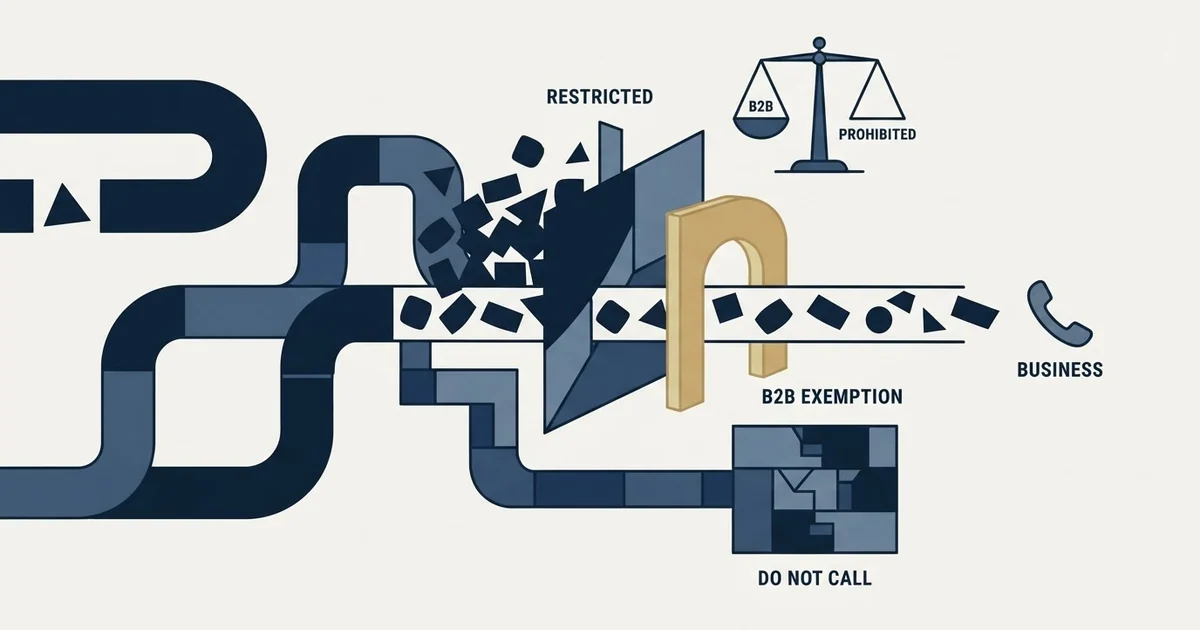
The FTC Telemarketing Sales Rule exempts most business-to-business calls, and its guidance says the Do Not Call Registry prohibition does not apply to them. The Telephone Consumer Protection Act is separate and restricts automated or prerecorded calls to mobile numbers without consent, whoever is being sold to.
Key takeaways
- The FTC guidance exempts business-to-business calls from the Telemarketing Sales Rule, with carve-outs for retail sales of nondurable office or cleaning supplies and solicitations aimed at employees.
- The exemption turns on who is buying, not which line was dialled: soliciting an employee at work for a personal purchase is not a business-to-business solicitation in the FTC description.
- The Telephone Consumer Protection Act restricts automated dialing and artificial or prerecorded voice calls to numbers assigned to cellular services without prior express consent, and written consent where the call is telemarketing.
- Mobile identification is therefore a data requirement before it is a legal one, and the dialer is a compliance decision rather than only a productivity one.
Reviewed and updated September 1, 2026
Somebody on a sales team reads that cold calling is regulated, finds a line saying business-to-business calls are exempt, and concludes the rules are somebody else's problem. That conclusion is half right, and the half that is wrong is the half that carries the penalties.
In the United States there are two separate federal regimes, written at different times for different reasons, and they draw their boundaries in completely different places. One of them does largely step back from business calling. The other does not care whether your call is business-to-business at all, because its restrictions attach to the number you dialled and the technology you dialled it with. Reading only the first is the mistake that turns a compliant-looking programme into an expensive one.
This is a plain-English reading of what the cited sources say, not legal advice. Nothing below substitutes for counsel who knows your jurisdiction and your call list.
Texas is the state asked about most often, and it is the general rule in one example: state telemarketing statutes are amended on their own timetable, so a national calling programme is bound by the strictest state on its list rather than by the federal average.
The rule that does exempt most B2B calling
The Telemarketing Sales Rule is the FTC's regime, and its exemptions are unusually explicit. The FTC's compliance guidance states that the Rule exempts "business-to-business calls unless they involve retail sales of nondurable office or cleaning supplies, or solicit sales or charitable contributions from employees" (Complying with the Telemarketing Sales Rule, FTC business guidance).
The same page is equally direct about the National Do Not Call Registry, stating that the prohibition on calling numbers on the Registry "does not apply to business-to-business calls". For a team selling software to operations directors, that is the single most useful sentence in the document, and it is why the Registry is not the compliance instrument people assume it is on the B2B side.
Two carve-outs sit inside the exemption and both are narrower than they look. Retail sales of nondurable office or cleaning supplies are pulled back under the Rule specifically, a carve-out that exists because of a particular pattern of abuse rather than because of any general principle. The second matters far more often.
The carve-out that catches ordinary B2B sellers
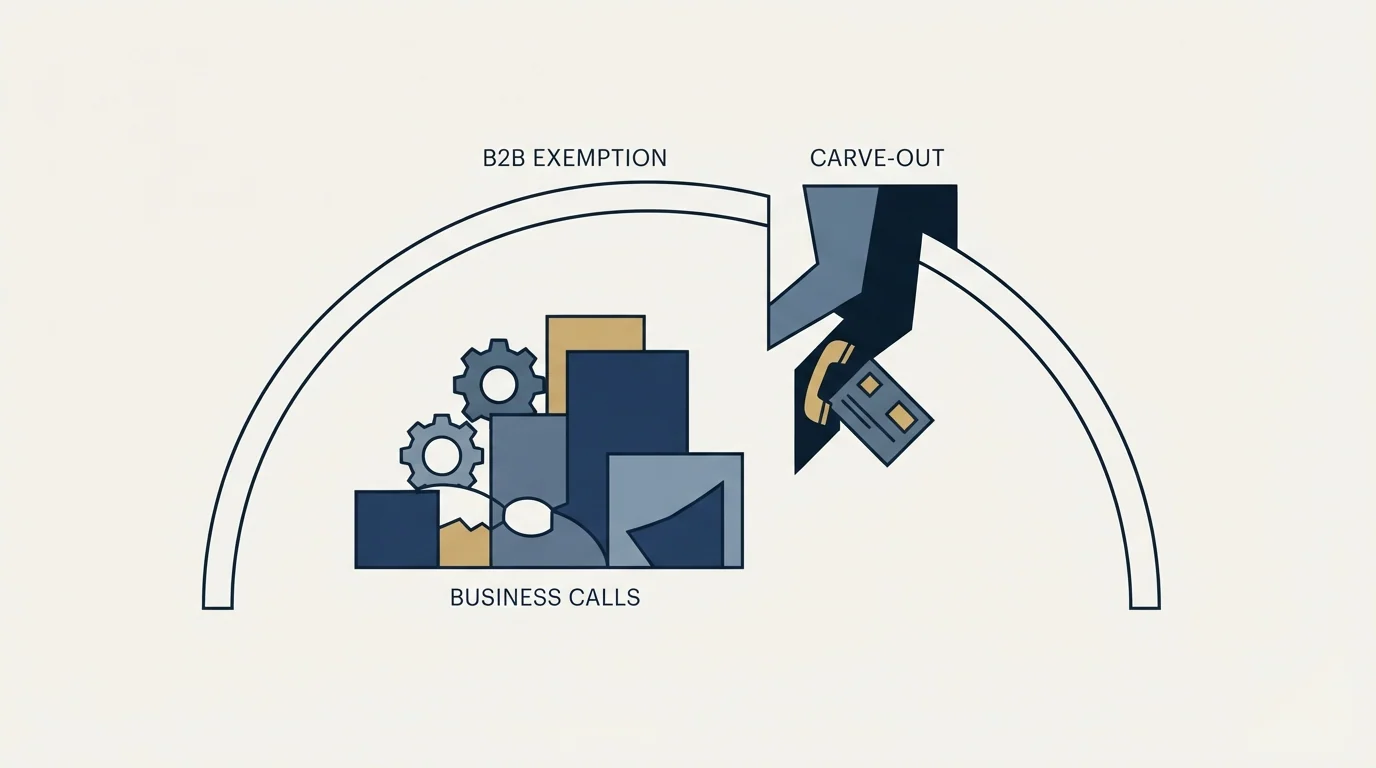
The FTC's guidance draws the line by who is being sold to, not by which line was dialled. Its wording is that calls soliciting consumers at their work, meaning "calls to business lines that solicit individual employees to buy products or services for their own use or make personal charitable contributions", are not business-to-business solicitations and are not exempt from the Rule.
That is a boundary about the buyer, and it is easy to cross without noticing. A pitch to a company for a product the company buys is a business-to-business solicitation. A pitch made to the same person, on the same office line, for something they would buy personally is not, whatever the list was called when it was built. Programmes that blur the two, or that work a list mixing company decision-makers with individuals at their workplace, are relying on an exemption that the FTC's own description does not extend to them.
Bank cold calling scripts explains why naming a specific decision and asking permission in the opening seconds matters more than generic openers.
- Selling a product or service the business itself buys
- Calls to numbers listed on the National Do Not Call Registry, which the guidance says the prohibition does not cover for B2B calls
- Ordinary vendor prospecting into a company
- Retail sales of nondurable office or cleaning supplies
- Soliciting an employee at work to buy for their own personal use
- Soliciting personal charitable contributions from employees
The statute that ignores the B2B question entirely
The Telephone Consumer Protection Act is a different instrument with a different logic, and it is where a business caller is most likely to be caught, because its central prohibition is not written around who the buyer is.
The statute makes it unlawful to make any call, other than for emergency purposes or with the prior express consent of the called party, using an automatic telephone dialing system or an artificial or prerecorded voice, to "any telephone number assigned to a paging service, cellular telephone service, specialized mobile radio service, or other radio common carrier service, or any service for which the called party is charged for the call" (47 U.S.C. 227). The FCC's implementing rule carries the same language, and adds that where the call includes or introduces an advertisement or constitutes telemarketing, what is required is the prior express written consent of the called party (47 CFR 64.1200).
Read that prohibition against a modern B2B list and the exposure becomes obvious. It attaches to the number, and a large share of direct-dial numbers on any current prospect list are mobile numbers. It attaches to the technology, so power dialers, automated voicemail drops and anything with a synthetic voice sit inside the restricted category rather than beside it. Nothing in that sentence asks whether the call was business-to-business.
- Yes: Whether what you sell is bought by the business or by the individual
- Yes: Which numbers on the list are mobile, held as a data field rather than an assumption
- Yes: Whether any dialing technology in use is automated, or any voice is prerecorded
- Yes: Whether your state adds requirements on top of the federal rules
- No: Assuming the B2B exemption in one regime carries into the other
- No: Treating the Do Not Call Registry as the whole of the compliance question
The three practical consequences
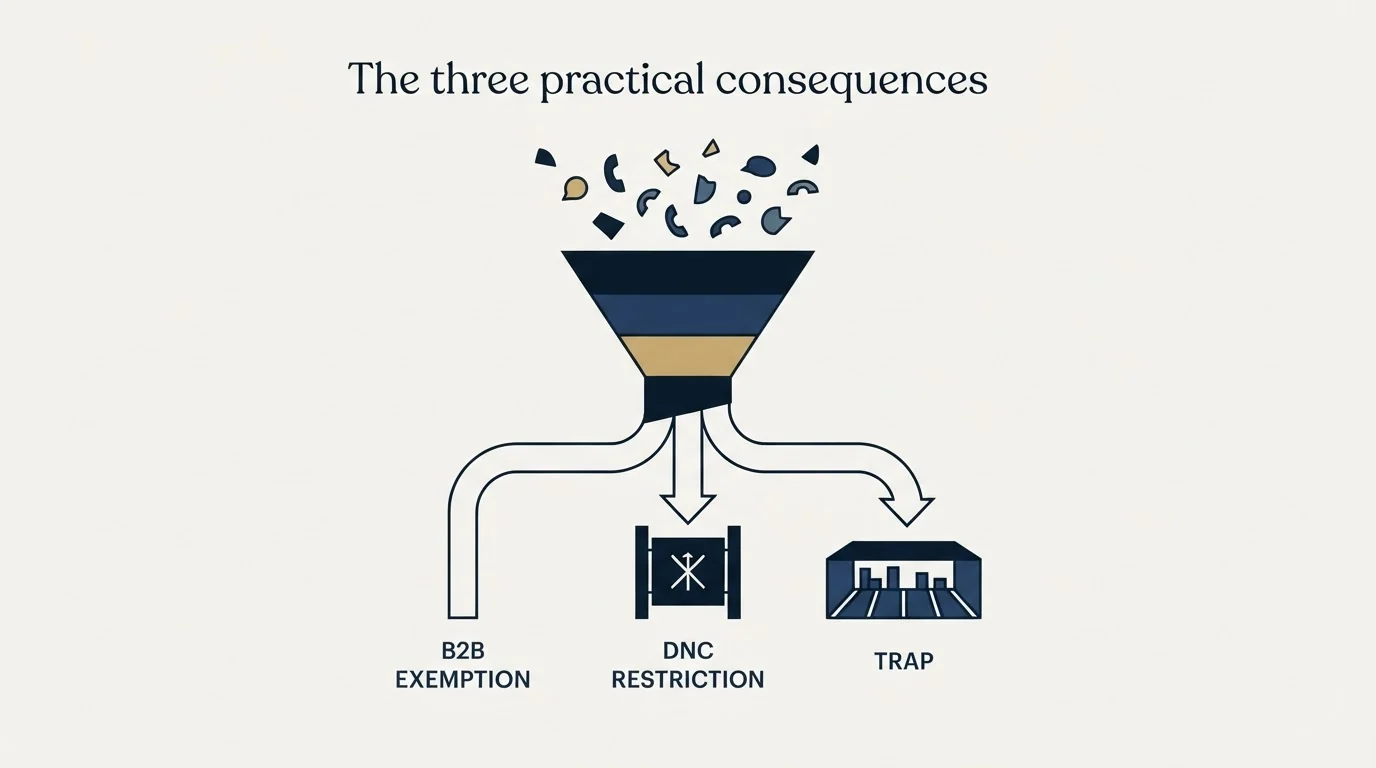
The first is that mobile numbers are a data problem before they are a legal one. If your list cannot tell you which direct dials are mobile, you cannot answer the question the statute actually asks, and no amount of scripting compensates for that.
The practical shape of that problem is worth stating, because it is usually discovered late. Contact data vendors label numbers inconsistently: some carry an explicit line-type field, some return a single direct-dial column that silently mixes desk lines and mobiles, and some infer the label from a source that predates a number being ported between carriers. Whichever you buy, the field is a claim rather than a fact, and it ages. A programme that intends to rely on line type has to decide who owns that field, how often it is refreshed, and what the rule is when the label is missing or stale. The conservative default, treating an unlabelled number as though it might be a mobile, is the one that costs connect rate and removes the exposure. Deciding this after the list is loaded means deciding it under pressure, which is how the aggressive default gets chosen by nobody in particular.
The second is that the dialer is a compliance decision, not just a productivity one. Teams evaluate dialers on connect rates and seat cost, and the technology choice sits directly inside the restricted category defined above. The way dialer modes are sold, and what a seat actually costs, is worth reading with that in mind rather than after.
The third is that the federal picture is a floor rather than the whole answer. States legislate on top of it, with their own registries, hour restrictions and registration requirements in some industries, and they do not agree with each other. The only safe version of this step is to check the rules where you are calling and where you are calling into, rather than to generalise from a federal exemption.
Thirteen states have been read at source against that question, and what each one keys on is set out in telemarketing laws by state.
Where written outbound sits in this
Email is governed by an entirely separate set of rules, and the mapping between the two is not intuitive. CAN-SPAM, GDPR and CASL draw their lines around consent, identification and opt-out mechanics rather than around dialing technology, which means a programme can be comfortably clear on one side and exposed on the other. The plain-English version for email covers those three regimes, and what the CAN-SPAM Act actually requires covers the US half in more detail.
The two channels also fail differently in ways that have nothing to do with law, and choosing between them on regulatory friction alone tends to produce the wrong answer. Comparing email and calling on how each one fails is the more useful frame, and the ceiling on a calling programme is usually arithmetic rather than legal: how many accounts a caller can actually cover tends to decide the outcome before any compliance question does.
Our own practice is a policy position rather than a legal conclusion. RevenueFlow runs email and LinkedIn and does not run phone outreach for clients, so this page describes calling regulation as it applies to teams who do. The written-channel doctrine we hold to is one message per campaign, with no bumps and no thread replies, and re-approaching an audience means a new campaign on a genuinely different premise rather than another touch in the same thread.
The short version
The Telemarketing Sales Rule does exempt most business-to-business calling, and the FTC's guidance says the Do Not Call Registry prohibition does not apply to B2B calls. The exemption stops where the buyer changes: soliciting an employee at work for something they would buy personally is not a business-to-business solicitation in the FTC's description, and retail sales of nondurable office or cleaning supplies are carved back in.
The Telephone Consumer Protection Act is a separate regime that does not turn on the B2B question. Its prohibition attaches to calls made with an automatic telephone dialing system or an artificial or prerecorded voice to numbers assigned to cellular and similar services, without prior express consent, and prior express written consent where the call is telemarketing. On a list full of mobile direct dials, that is the rule that binds.
Treat mobile identification as a data requirement, treat the dialer as a compliance decision, and check your state rules rather than generalising from the federal exemption. If the honest answer is that the calling programme is too much risk for the return, see what a first written campaign produces instead.
Statutory and regulatory wording above is quoted from the FTC, US Code and eCFR pages linked in the text, retrieved mid-2026. Rules change and state law varies. Verify current requirements with counsel before relying on any of this.
Frequently asked questions.
Frequently asked questions- Is B2B cold calling legal in the United States?
- The FTC compliance guidance exempts business-to-business calls from the Telemarketing Sales Rule, unless they involve retail sales of nondurable office or cleaning supplies or solicit sales or charitable contributions from employees. That exemption does not settle the Telephone Consumer Protection Act, which restricts how you may dial rather than who you may sell to.
- Does the Do Not Call Registry apply to business calls?
- The FTC guidance states that the prohibition on calling numbers on the Registry does not apply to business-to-business calls. That is narrower than it sounds, because it addresses the Registry specifically and leaves the separate restrictions on automated dialing and prerecorded voices untouched, which are the ones most likely to bind a modern list.
- Why do mobile numbers matter so much?
- The statute prohibits calls made with an automatic telephone dialing system or an artificial or prerecorded voice to numbers assigned to cellular and similar services, absent consent. It is written around the number and the technology, not around the buyer, so a large share of direct dials on a current prospect list falls inside it.
- Does RevenueFlow run cold calling for clients?
- No. We run email and LinkedIn rather than phone, so this page describes calling regulation as it applies to teams who do run it. Our own written-channel policy is one message per campaign, with no bumps or thread replies, and re-approaching an audience means a new campaign on a different premise.
About the author.

B2B cold email experts helping companies generate qualified leads through done-for-you outreach campaigns.
RevenueFlow Team
Explore more.
Ready to scale your outreach?
We build GTM engines that book real meetings. See the receipts.
Related articles.
Cold Calling for Chemical Companies: Who Picks Up
A chemical cold call rarely arrives first. It reaches a formulator who has already been comparing suppliers on a screen, for one of three published reasons.
Cold Calling for Manufacturers: The Desk and the Floor
Cold calling for a manufacturer calling plants and OEMs: who answers the main line, the buyer's desk against the floor, the show calendar, the channel map, the limits.
SDR Outsourcing for Agriculture Companies
Whether an outside sales development team can work for a company selling into agriculture: who already covers the account, which weeks exist, and the show rule.
LinkedIn Outreach for Banks: A Regulated Message
How a bank's relationship managers use LinkedIn to reach business owners: what the FFIEC guidance, FINRA's notices and LinkedIn's own rules require, and where to stop.
Cold Calling for PPC Agencies: What You Can See First
A paid media prospect is partly readable before the call and has already been told by the platform what to do when a stranger rings about its ads.
SDR Outsourcing for Financial Services: The Third Party
What a bank, broker-dealer, adviser or agency's regulators say about an outside team that speaks for it, the licensed line, and which arrangement survives due diligence.