Telemarketing Laws by State: 13 Statutes, Read
Thirteen states' own telemarketing statutes and agency pages, read first-hand: what each one keys on, and which of them reach a business to business call.
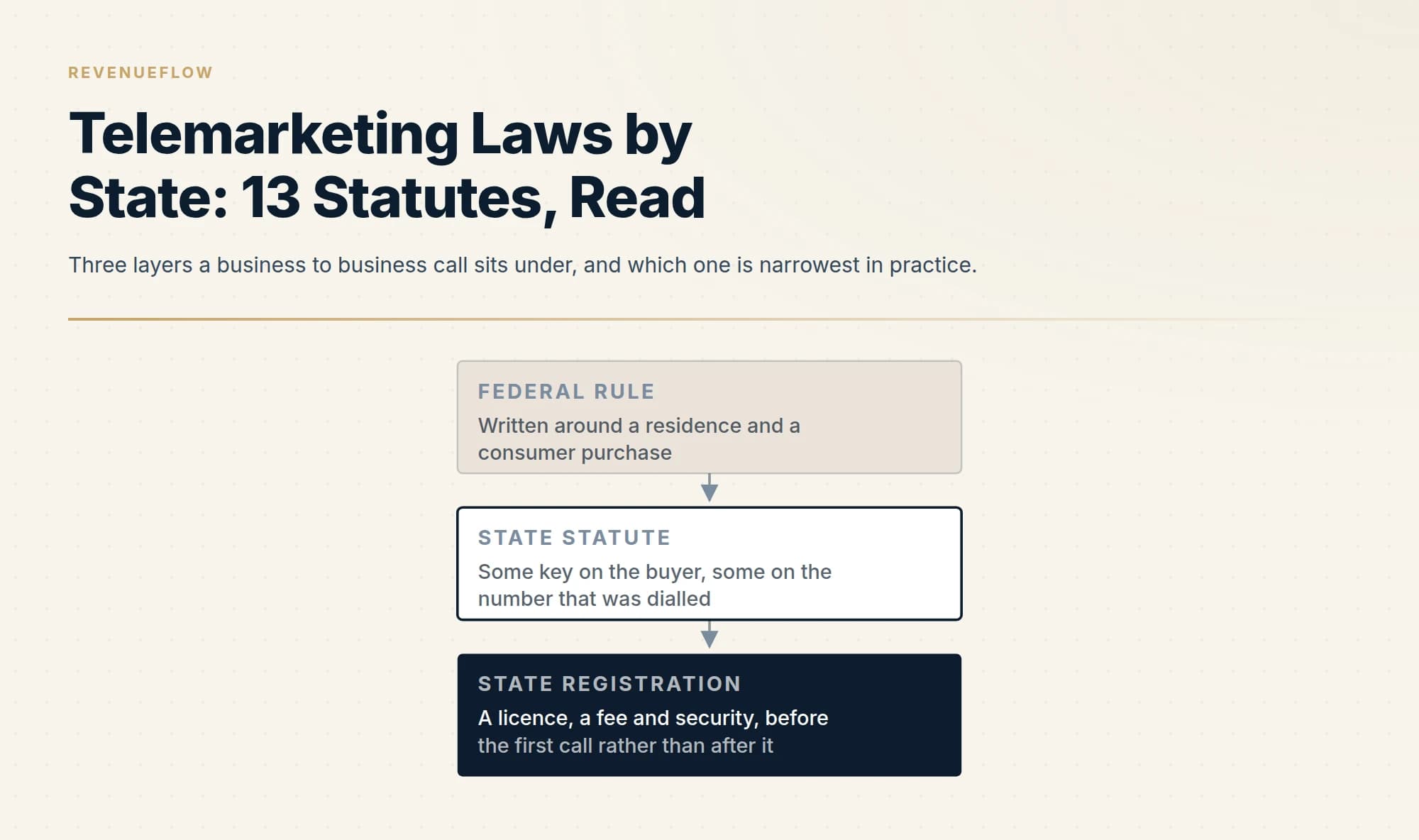
State telemarketing law is not one thing. Oregon excludes business to business contacts by name. Florida, Arizona, Missouri and Indiana key on a consumer or a residential subscriber. Virginia keys on the number dialled. California, Texas, Washington and Florida require registration or licensing, with business exemptions written narrowly.
Key takeaways
- The federal rules are written around a residence and a consumer purchase, so a federal business to business exemption says nothing about what a state statute does.
- Washington restricts calls to any person rather than any residence and closes an hour earlier than the federal window, at eight in the evening in the recipient's local time.
- The business to business exemptions in Washington and Texas cover purchases for resale or for a manufacturing process, which excludes most business software and services.
- Virginia defines a telephone solicitation by the number dialled, including any landline or wireless telephone with a Virginia area code, and applies the national registry at state level.
Reviewed and updated September 21, 2026
Washington is the clearest illustration of why the federal answer is not the answer. The federal Telemarketing Sales Rule restricts calls to a person's residence, and its own text says so: it is a violation "for a telemarketer to engage in outbound telephone calls to a person's residence at any time other than between 8:00 a.m. and 9:00 p.m. local time at the called person's location." Washington's statute is written differently. It says a commercial telephone solicitor "shall not place calls to any person which will be received before 8:00 a.m. or after 8:00 p.m. at the call recipient's local time." Any person, and an hour earlier.
This page reads thirteen states' own statutes and agency pages rather than a compliance vendor's summary of them, states what each one keys on, and says which of them reach a business to business call. Everything below was read on the source's own page on 21 September 2026. It is a plain English reading of what those pages say, not legal advice, and nothing here substitutes for counsel in the jurisdictions you call into.
The federal floor, in one paragraph
The federal layer is covered in full in when cold calling is against the law and is not restated here. The one sentence that matters for what follows is the Federal Trade Commission's own: "The prohibition on calls to numbers on the Registry does not apply to business-to-business calls or calls to consumers from or on behalf of charities." The Federal Communications Commission states the residential hours rule in the same shape: "Telemarketing calls to your home are prohibited before 8 a.m. and after 9 p.m."
Both of those are about a home. Neither says anything about a state statute, and states have written their own on top, on their own timetables, in their own language.
The states that key on the buyer
Four of the thirteen write their rules around who is buying, which is the federal shape, and a business to business seller sits largely outside them.
Florida's Telephone Solicitation statute, section 501.059 of the Florida Statutes, defines its central term this way: a "Telephonic sales call" is "a telephone call, text message, or voicemail transmission to a consumer for the purpose of soliciting a sale of any consumer goods or services". The licensing regime follows the same line. The Florida Department of Agriculture and Consumer Services, FDACS, states that "The Florida Telemarketing Act requires non-exempt businesses engaged in telemarketing and their salespeople to be licensed" before operating in Florida, and describes the law as requiring a licence of "businesses that solicit the sale of consumer goods or services".
Arizona, in ARS 44-1271, defines a seller by reference to calls that "provide or arrange to provide merchandise to consumers in exchange for payment", and defines a subscriber as "a person who subscribes to residential telephone service from a local exchange company". Missouri's no call provision, RSMo 407.1098, is explicitly residential: "No person or entity shall make or cause to be made any telephone solicitation to any residential subscriber in this state who has given notice to the attorney general". Indiana files its regime, Indiana Code Article 24-4.7, under a heading titled Telephone Solicitation of Consumers.
Oregon is the cleanest of all, because it names the exclusion outright. In ORS 646.561 its definition of telephone solicitation lists three kinds of call the term excludes, and the third is "Business to business contacts."
| State | What its own page keys on | Source, read 21 September 2026 |
|---|---|---|
| Oregon | Excludes business to business contacts by name | ORS 646.561, definitions |
| Florida | A call to a consumer about consumer goods | Florida Statutes 501.059 and the FDACS licensing page |
| Arizona | Merchandise to consumers, residential subscribers | ARS 44-1271, definitions |
| Missouri | Residential subscribers on the state list | RSMo 407.1098 |
| Indiana | An article titled solicitation of consumers | Indiana Code Article 24-4.7 |
The states that key on the number, or on registration
This is the group that catches an ordinary business to business programme, and it does so for two different reasons.
Virginia's Telephone Privacy Protection Act defines its scope by the line dialled rather than by the buyer. A telephone solicitation there is "any telephone call made or initiated to any natural person's residence in the Commonwealth, to any landline or wireless telephone with a Virginia area code, or to a landline or wireless telephone registered to any natural person who is a resident of the Commonwealth". A direct dial on a Virginia area code is inside that definition whoever answers it. And the statute then applies the federal registry at state level: "No telephone solicitor shall initiate, or cause to be initiated, a telephone solicitation to a telephone number on the National Do Not Call Registry". The federal guidance says that registry prohibition does not reach business to business calls. Virginia's own statute contains no such carve out in the section that states the prohibition.
Washington reaches business calls in a different way. Its hours provision, quoted at the top of this page, reaches any person rather than any residence, and it ends at eight in the evening rather than nine. Its business to business exemption is far narrower than the name suggests: the statute exempts "A business-to-business sale where: (A) The purchaser business intends to resell the property or goods purchased; or (B) The purchaser business intends to use the property or goods purchased in a recycling, reuse, remanufacturing or manufacturing process". A software subscription sold to an operations director is neither of those things.
Texas writes the same exemption in almost the same words. Its registration chapter states that "This chapter does not apply to a sale in which the purchaser is a business that intends to: (1) resell the item purchased; or (2) use the item purchased in a recycling, reuse, remanufacturing, or manufacturing process." Again, an ordinary business purchase for the buyer's own use is outside the exemption, which means the registration chapter is in play.
California is the registration case in its purest form. Its code requires that "Not less than 10 days before doing business in this state, a telephonic seller shall register with the department", and defines the trigger broadly: "A seller shall be deemed to do business in this state if the seller solicits prospective purchasers from locations in this state or solicits prospective purchasers who are located in this state." Calling into California from anywhere counts.
Florida is worth naming twice, because although its calling rules are consumer scoped, its licensing has a price attached. The state's own page lists an application fee of fifteen hundred dollars a year for the business, fifty dollars a year for each salesperson, and security of at least fifty thousand dollars in the form of a bond, a certificate of deposit or a letter of credit.
Four more states were read and gave less than their reputations suggest. Oklahoma's attorney general runs a registry it calls the Telemarketer Restriction Act Consumer Registry, which is consumer scoped by its own name. Louisiana's Public Service Commission runs its own do not call programme as a state registry separate from the federal one. Maryland's Stop the Spam Calls Act of 2023 is summarised by the legislature itself as "Prohibiting a person from making certain telephone solicitations to a certain called party in a certain manner by restricting the methods, times, and identifying information that the person making the call may utilize", enforced under the Maryland Consumer Protection Act. And Utah's chapter 13-25a served only its table of contents and an exemptions heading to this reading, so nothing is claimed about its operative text here: a page that did not render is not evidence that a rule is absent.
What this means for a calling programme
Four practical consequences follow, and none of them is a compliance verdict.
The first is that the question cannot be answered nationally. The thirteen states above already split three ways: some exclude business contacts by name, some key on the line dialled, and some require registration before the first call regardless of who is buying. A programme calling into all fifty is bound by the strictest rule that reaches its list rather than by any average.
The second is that a business to business exemption is a term of art and is often narrower than the phrase suggests. Washington and Texas both use the words business to business and both mean a purchase for resale or for a manufacturing process. Reading the phrase and stopping there is how a programme concludes it is exempt when it is not.
The third is that the line type in your data has a legal meaning in at least one of these states, and probably more. Where a statute keys on an area code or on a number registered to a natural person, whether a direct dial is a mobile registered to the individual is a fact about your data rather than about your script. Our cold calling tips page makes the operational version of that argument, and the dialler choice that sits beside it is in cold calling dialler pricing.
The fourth is that registration is a lead time problem rather than a paperwork problem. California asks for registration not less than ten days before doing business in the state. Florida asks for a licence, a per salesperson licence and security before operating. Neither of those can be arranged in the week a campaign is meant to start.
- Yes: You have read that state's own statute or agency page, not a summary of it
- Yes: You know whether its rule keys on the buyer, the number or the seller
- Yes: Any business to business exemption has been read to the end of the sentence
- Yes: The calling window used is the narrower of the federal and the state one
- Yes: Registration lead time is in the campaign plan rather than after it
- Depends: Counsel in that jurisdiction has seen the programme before it runs
- No: A federal exemption is being assumed to carry into state law
Which states this page covers, and which it does not
Thirteen states were read at source for this page: Arizona, California, Florida, Indiana, Louisiana, Maryland, Missouri, Oklahoma, Oregon, Texas, Utah, Virginia and Washington. Where a state is named above, the wording quoted is from the page linked or cited beside it, read on 21 September 2026.
The other thirty seven states are not covered here, and the absence of a state from this page is not evidence that it adds nothing. Several of them have passed their own telemarketing statutes since 2021 with their own consent standards, their own hours and their own registries. The only defensible way to handle a state that is not on this list is to read its statute or its attorney general's page before calling into it, which is the same advice when cold calling is against the law gives for the federal layer.
Statutes are also amended on their own timetables. Every sentence quoted above is dated because it has to be: the page you read in a year may not say the same thing, and a page that once said something is not evidence about what it says now.
The short version
The federal rules are written around a residence and a consumer purchase, and the business to business exemption inside them is real. State law is not one thing. Some states, Oregon most explicitly, exclude business contacts by name. Some, Florida, Arizona, Missouri and Indiana among them, key on a consumer or a residential subscriber, so an ordinary business call sits outside. Some, Virginia most clearly, key on the number that was dialled, which makes a direct dial on a state area code part of the question. And some, California, Texas, Washington and Florida, require registration or licensing before the first call, with business exemptions written to cover only purchases for resale or for a manufacturing process.
Read the statute for every state on your list, use the narrower of the two calling windows, treat line type as a data requirement, and put registration lead time in the plan. What cold calling actually is, and where it still works is the wider frame. If the honest answer is that the phone is more regulatory risk than the return justifies, see what a first written campaign produces instead.
Statutory and agency wording above was read on each source's own page on 21 September 2026, with dated snapshots kept as evidence. This is a reading of what those pages say and not legal advice. Rules change and state law varies. Verify current requirements with counsel before relying on any of it.
Frequently asked questions.
Frequently asked questions- Do state telemarketing laws apply to business to business calls?
- It depends entirely on the state. Oregon's definition of telephone solicitation excludes business to business contacts by name. Florida, Arizona, Missouri and Indiana write their rules around consumers or residential subscribers. Virginia defines the term by the number dialled rather than by the buyer, so a direct dial on a state area code is inside it.
- Which states require telemarketer registration?
- Among those read for this page, California requires a telephonic seller to register not less than ten days before doing business in the state, and Florida requires a licence for the business and for every salesperson plus security of at least fifty thousand dollars. Texas and Washington both run registration chapters whose business exemptions cover only resale and manufacturing purchases.
- Are state calling hours different from the federal ones?
- Yes in at least one of the states read here. The federal rule restricts calls to a person's residence outside eight in the morning to nine in the evening, local time at the called location. Washington's statute restricts a commercial telephone solicitor from calling any person before eight in the morning or after eight in the evening, which is an hour narrower.
- How should a B2B team handle states this page does not cover?
- Read that state's own statute or its attorney general's page before calling into it. The absence of a state from this page means it was not read, not that it adds nothing; several states have passed their own telemarketing statutes since 2021 with their own consent standards, hours and registries, and statutes are amended on their own timetables.
About the author.

B2B cold email experts helping companies generate qualified leads through done-for-you outreach campaigns.
RevenueFlow Team
Explore more.
Ready to scale your outreach?
We build GTM engines that book real meetings. See the receipts.
Related articles.
Cold Calling for PPC Agencies: What You Can See First
A paid media prospect is partly readable before the call and has already been told by the platform what to do when a stranger rings about its ads.
Cold Calling for Manufacturers: The Desk and the Floor
Cold calling for a manufacturer calling plants and OEMs: who answers the main line, the buyer's desk against the floor, the show calendar, the channel map, the limits.
Cold Calling for Food and Beverage Companies: Three Doors
Cold calling for a food or beverage company: who picks up at a chain, a distributor and an independent grocer, where each publishes its door, and when the phone is wrong.
Cold Calling for Consulting Firms: The Partner's Hour
Cold calling for a consulting firm: who it dials and who picks up, why partner-led economics argue against the phone, the client's fiscal year, and when to skip it.
Cold Calling for Chemical Companies: Who Picks Up
A chemical cold call rarely arrives first. It reaches a formulator who has already been comparing suppliers on a screen, for one of three published reasons.
The Permission-Based Opener: What Its Publishers Say and Measure
The permission-based cold call opener from the people who teach it, the critic who argues against it, and Gong's two dated measurements of which permission line works.