The Permission-Based Opener: What Its Publishers Say and Measure
The permission-based cold call opener from the people who teach it, the critic who argues against it, and Gong's two dated measurements of which permission line works.
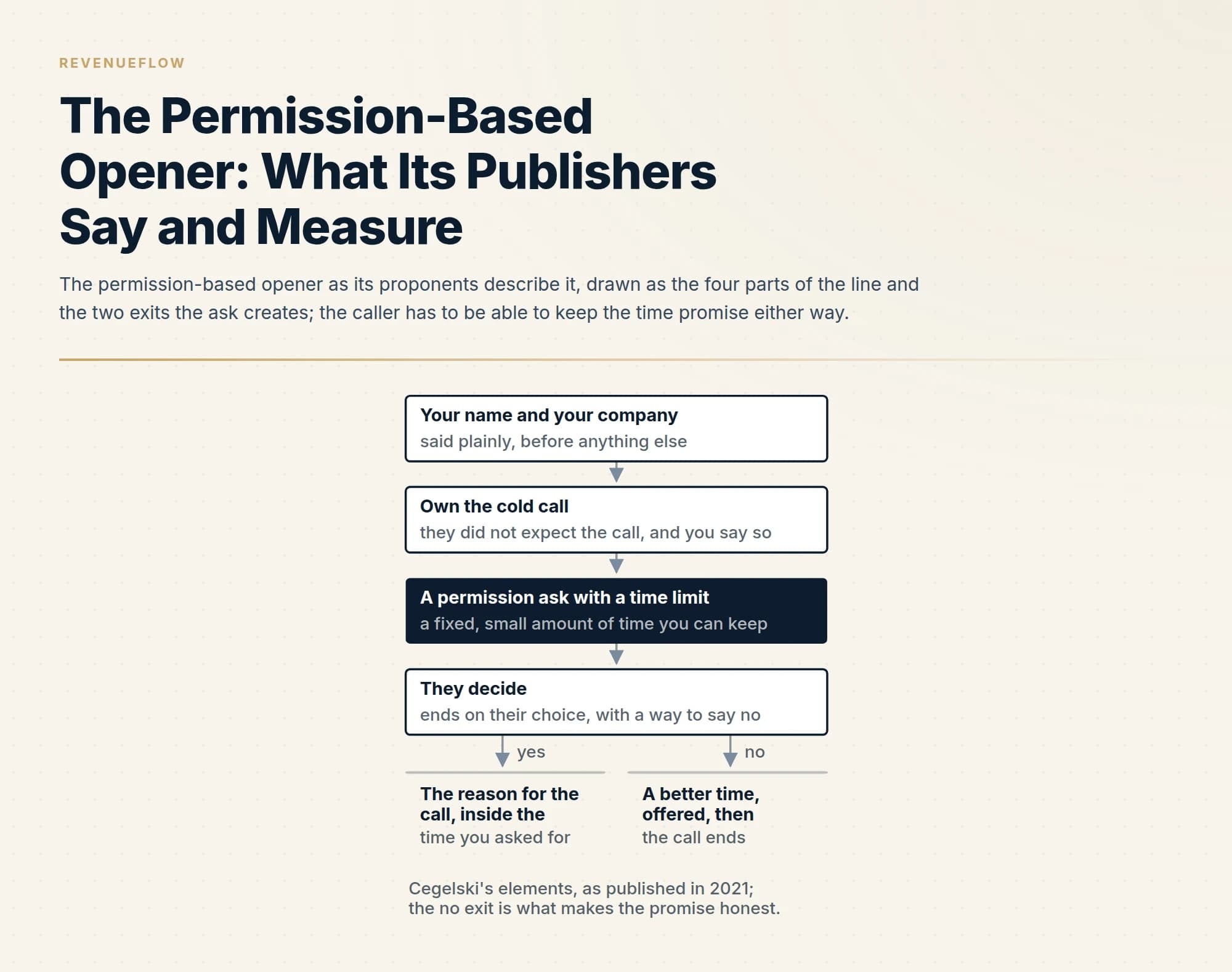
A permission-based opener names the caller and company, admits the call is cold, and asks for a small, fixed amount of time before the reason. Gong's 2018 and 2024 measurements separate the bad-time question, which performs worst, from the time-boxed ask, which owns the call and performs among the best. Critics say it sounds unsure; proponents lead with a reason.
Key takeaways
- Nick Cegelski's 2021 script and elements are the canonical version: name, company, an acknowledgment that this is a cold call, and a permission ask with a time limit.
- Gong's 2018 post on 90,380 calls and its 2024 post with 30MPC on more than 300 million calls both put the bad-time question at the bottom; the 2024 post puts the time-boxed permission ask among the best.
- Josh Braun's 2025 post carries both lists: against, it sounds unsure and hands over an easy out; for, it lowers resistance and shows respect for the prospect's time.
- The tailored permission opener, as 30MPC and Gong publish it, leads with context, owns the cold call, then asks for the time, which answers the two main objections directly.
Reviewed and updated September 19, 2026
A permission-based opener is the cold call opening that admits it is a cold call and asks for a fixed, small amount of time before saying why it was made. It is the most argued-over line in calling, and the argument is unusually well documented: the people who teach it have published their scripts and the elements behind them, the most prominent critic has published his objections and his own counter-list, and Gong has measured versions of it twice, six years apart, on two very different populations of calls. This page reads all of that at the source and sets it out.
One thing to say first. RevenueFlow runs written outbound, email and LinkedIn, and does not sell calling, so nothing here is a results claim of ours; the method is stated as its publishers state it, and the numbers are theirs. Eleven openers by situation, and a first-hand reading of Gong's 2018 study, are on cold call openers, where the permission line with a time box is opener two of eleven. This page is about that one line.
What the opener is, in its proponents' words
Nick Cegelski, then an enterprise account executive and a host of the 30 Minutes to President's Club podcast, gave the canonical version in a Daily Sales Tips episode transcript published on 26 June 2021 and fetched on 19 September 2026. The script: "Scott, this is Nick Cegelski with 30 Minutes to President's Club. I know you didn't expect me to call you this afternoon. Do you mind if I take one minute, I'll tell you I'm calling, and then you can let me know if it makes sense for us to speak?" Then the elements, in his words: "Here are the elements, the name of who you are, your name, the name of your company, acknowledgment that, yes, this is indeed a cold call and you didn't expect me to call you. And then a permission-based ask that has a time limit."
Every later description keeps those parts and renames them. The SDR Newsletter's guide to cold calling (published 28 May 2019, modified 5 March 2026, fetched on the same date) sorts every opener into two bins: "Permission-based openers ask for permission to pitch, while non-permission-based openers forego the permission." Hyperbound's guide (published 18 August 2025) says "A successful permission-based opener consists of three essential components:" and names them the confident introduction, the permission request and the value pitch. ZoomInfo's guide to openers gives the mechanism its proponents rely on: "The psychological mechanism is simple: when a prospect says yes, they shift from passive listener to active participant."
The time box varies by publisher and the variation is the point of it. Cegelski's second script asks for 28 seconds, Hyperbound's example asks for 27, the SDR Newsletter's for 15, and Cegelski's first version for one minute. Each is a promise about how long the interruption lasts, and the honest version is one the caller can keep.
The line that measures worst is also a permission line
The confusion in the published discussions comes from treating every permission ask as the same line. Gong's data separates them.
Gong's 2018 post on opening lines, published on 19 April 2018 and marked modified on 4 March 2026, covered "90,380 cold calls" and reported that the popular permission question of its day, asking whether the caller had caught the prospect at a bad time, booked meetings at a rate below the dataset's baseline. The full reading of that post, with its population, its baseline and the author's warning that opening lines have a shelf life, is on cold call openers and is not repeated here.
The second measurement is newer and larger. A Gong Labs post co-written with 30 Minutes to President's Club, published on 24 July 2024 and marked modified on 27 May 2026, fetched on 19 September 2026, states its population as "We analyzed 300M+ cold calls to answer the question: What's the best cold call opener?" It compares four openers. The bad-time question comes last: "This opener's success rate is the lowest of the" openers the post validated, at 2.15 percent, which the post describes as "just slightly higher than the average baseline." Asking how the prospect's day is going is reported at 7.6 percent. Then the time-boxed permission ask, which asks whether the prospect could give thirty seconds: "The permission-based opener has a strong 11.18% success rate because it owns that you're making a cold call and disarms the prospect with brutal honesty." And the post's winner, asking for recognition after leading with context, whether the prospect has heard the caller's company name, at "a whopping 11.24% success rate".
Read together, the two measurements say one thing clearly. The permission ask that performs worst asks whether to talk at all, and hands the prospect a reason to end the call without having heard one; the prospect decides before anything is on the table. The permission ask that performs well asks for a fixed amount of time and states, inside the same breath, that the caller knows it is a cold call. Both are permission-based openers; the difference is what the prospect is being asked to grant. Neither post states how many calls used each line, and the post co-written with 30MPC does not define its success rate on the page as fetched, so the figures are one vendor's dated measurement over its customers' calls and are worth exactly that.
| The opening line | What it asks the prospect to grant | What the post concludes |
|---|---|---|
| "Did I catch you at a bad time?" | Whether to talk at all | The lowest of the four, just above baseline |
| "How's your day going?" | A pleasantry the prospect knows is a sales call | Better, and still behind the next two |
| "Could I get 30 seconds to tell you why I called?" | A fixed, small amount of time | Strong, because it owns the cold call |
| "Have you heard our name tossed around?" | Recognition, after leading with context | The winner by a fraction |
The case against, from its most-read critic
Josh Braun, a sales trainer whose post on the subject sits in the search results for this technique, published his objections on LinkedIn on 12 March 2025; the post was rendered and fetched on 19 September 2026. The post is fairer than its title, because it carries a list on each side.
Against: "It makes you sound unsure, like you're asking for permission to exist." "It gives them an easy out before they even know why you're calling." "It makes you sound like every other cold caller, which isn't a good thing." And the one that names the line Gong measured worst: it puts them on high alert, because most people know the bad-time question is just a sales move.
For, in the same post: "It lowers resistance by letting them feel in control." "It shows respect for their time, which can make them more open to listening." "It makes the call feel less pushy and more like a conversation." The post ends by asking readers which side they take.
There is a third voice worth hearing, from the receiving end. Chris Voss, the former hostage negotiator behind The Black Swan Group, published a short piece on 7 May 2018 (fetched 19 September 2026) recommending his own technique for exactly this moment, naming "cold-calling sales-people" who open by asking for a few minutes. His answer is the mirror: "Mirroring is simply repeating the last 3-5 words your counterpart has just said." A buyer trained that way answers a request for a few minutes by repeating it back as a question, and the caller has to say why. That is the strongest practical objection to a bare permission ask: it hands the prospect the conversation with nothing yet on the table.
- It sounds unsure, like asking permission to exist
- It gives an easy out before the reason is heard
- It sounds like every other cold caller
- A trained buyer mirrors the ask back and waits
- It lowers resistance by letting them feel in control
- It shows respect for their time
- It makes the call feel less pushy, more like a conversation
- A yes turns a passive listener into an active participant
What the proponents changed, and why
The people who teach the opener did not leave it where Cegelski's 2021 script put it. Armand Farrokh's post for 30 Minutes to President's Club, published on 26 January 2024 and fetched on 19 September 2026, restates the plain version and then names its flaw: "It's a decent start. But the customer can't tell if you're a telemarketer going through the phone book or if you're someone making a professional cold call." The fix is the tailored permission opener, in which the caller says why this person specifically is being called before asking for the time: "On top of addressing their initial concerns, Nick shares why he called Emma specifically." The post's own summary of the two openers it teaches is the clearest statement of what the ask is for: "Nick's opener earns the next 30 seconds with research. Mine earns it with a common thread. Both do exactly the same job: they tell the prospect you are not a rando, inside the first 7 seconds."
The Gong Labs post from the same year gives the tailored version three steps, lead with context, own the cold call, then get permission to pitch, and that ordering answers Braun's first two objections directly. A caller who has already said one true thing about the prospect is not asking permission to exist, and a prospect who has heard the reason before the ask no longer has an easy out from a call they know nothing about.
The example below is invented: the caller Tom Ashworth, the firm Marlow Payroll Audit, the prospect Dana and the filing change do not exist, and the line is here to show the parts rather than to be copied.
Cold call, first fifteen seconds, invented
Hi Dana, this is Tom Ashworth at Marlow Payroll Audit. 1
The reason for the call is the payroll filing change that landed this month, because it touches every firm running payroll across two states the way yours does. 2
This is a cold call, and you were not expecting it. 3
Can we have thirty seconds on it, and then you decide whether it is worth a proper conversation? 4
- 1Name and company first, as every published version of the opener has it.
- 2The context leads, before the ask, which is what the tailored version adds to the plain one.
- 3The cold call is owned in plain words rather than apologised for.
- 4A fixed amount of time and an explicit exit; the caller has to be able to finish inside it.
What has not changed since 2018 is the warning Gong attached to its first study, that opening lines have a shelf life. A line that was distinctive when few callers used it stops being distinctive once every list carries it, and the 2024 post's own account of the pleasantry opener says as much: nearly every salesperson uses it, so the prospect cannot distinguish the caller from everyone else. The tailored version resists that decay only as long as the tailoring is real, which is a property of the research behind the list rather than of the line.
Where this sits next to written outbound
A permission ask has no equivalent in a first email, because the message arrives whether or not permission was granted, and the reader's permission is exercised by reading past the first line or not. What transfers is the discipline underneath the tailored version: one true thing about the recipient before any ask, a plain statement of what the message is, and an ask small enough to answer in a word with a real way to decline. Our house version of that discipline is a single message per campaign, carrying one premise, sent once; a later approach is a new campaign on a new premise rather than a reminder, and on LinkedIn there is no second message at all. The reasoning, and what it costs, is set out where we take apart a published fifteen-touch cadence, the Agoge sequence.
The email templates that borrow the technique's name, asking a reader for permission before sending more, are a different object from the call opener, and this page does not cover them; the shape a written first touch should take is on how to write a cold email. Delivery, which decides whether any opener lands, is on sales tonality.
The short version
The permission-based opener, as its proponents publish it, is a name, a company, an admission that this is a cold call and a request for a fixed amount of time that ends on the prospect's choice. Gong has measured the family twice, in 2018 on 90,380 calls and in 2024 with 30MPC on more than 300 million, and both measurements separate the bad-time question, which asks whether to talk at all and performs worst, from the time-boxed ask, which owns the call and performs among the best. The published case against it, that it sounds unsure, hands over an easy out and sounds like everyone else, is answered by the tailored version, which leads with a reason before the ask; the case for it, that a yes changes how the prospect listens, is what its proponents are relying on. A trained buyer can mirror the ask straight back, so the reason had better be ready.
We do not run calls, so none of this is a claim about our own results. If the question is what a written first touch with the same discipline returns in your market, a first campaign is the cheapest way to find out.
Every quotation above is from the named page as fetched on 19 September 2026: the Daily Sales Tips transcript of Nick Cegelski's tip 889 (published 26 June 2021); the SDR Newsletter's cold calling guide (published 28 May 2019, modified 5 March 2026); Hyperbound's guide (published 18 August 2025); ZoomInfo's openers guide (undated on the page); Gong's 2018 opening-lines post (published 19 April 2018, modified 4 March 2026) and the Gong Labs and 30MPC post (published 24 July 2024, modified 27 May 2026); Josh Braun's LinkedIn post (12 March 2025); Armand Farrokh's 30MPC post (26 January 2024); Chris Voss's Black Swan Group piece (7 May 2018). Publishers revise these pages; confirm the current text before relying on it.
Frequently asked questions.
Frequently asked questions- What is a permission-based opener in cold calling?
- It is a cold call opening that names the caller and their company, acknowledges that the prospect was not expecting the call, and asks for a fixed, small amount of time, such as thirty seconds or one minute, before saying why the call was made, with the prospect free to decline. Nick Cegelski published the canonical script and its elements in 2021, and later guides keep the same parts under different names.
- Does asking if it is a bad time work on a cold call?
- Both of Gong's dated measurements put that question at the bottom. The 2018 post on 90,380 calls reported it below the dataset's baseline, and the 2024 post with 30MPC on more than 300 million calls reported it lowest of the four openers compared. The distinction that matters is that it asks whether to talk at all, while the time-boxed permission ask asks for a fixed amount of time and owns the cold call.
- Why do some sales trainers argue against permission-based openers?
- Josh Braun's 2025 post lists the objections: it makes the caller sound unsure, as if asking permission to exist; it gives the prospect an easy out before they know why the call was made; it puts them on alert because the bad-time question reads as a sales move; and it sounds like every other cold caller. The same post lists the case for it, and the tailored version answers the first two objections by leading with a reason.
- What is a tailored permission opener?
- It is the version 30 Minutes to President's Club and Gong Labs publish: the caller says why this specific person is being called, drawing on research such as a press release or a podcast appearance, then owns the cold call, then asks for the time. In the 2024 post co-written with Gong it is given three steps: lead with context, own the cold call, then get permission to pitch.
About the author.

B2B cold email experts helping companies generate qualified leads through done-for-you outreach campaigns.
RevenueFlow Team
Explore more.
Ready to scale your outreach?
We build GTM engines that book real meetings. See the receipts.
Related articles.
Cold Call Openers: Eleven Lines by Situation, and the Data
Eleven cold call openers sorted by what is true about the call, the four beats every opener has, and what Gong's 2018 opener study actually counted.
Cold Calling for SaaS Companies: What Changes on the Call
The two calls a software company makes, who picks up in crowded and uncrowded categories, how the first thirty seconds go, and why a SaaS list is a mobile-number list.
Cold Calling for Legal Tech Companies: Who Answers at a Firm
What changes when a legal tech company cold calls a law firm: which desks answer, why the billable hour hurts the pitch, the 2027 show dates, and what not to ask.
Cold Calling for Software Development Companies: Proof First
What changes when a custom software development shop cold calls: how buyers shortlist on proof, what a call should ask for, and the UK and US calling rules.
Command of the Sale: Force Management's Process Programme
Command of the Sale is Force Management's sales process and qualification programme, not its messaging one. What the vendor says it is, delivers and how it runs.
LinkedIn Outreach for Machine Shops
How a job shop or CNC machine shop uses LinkedIn to win OEM work: the four buyer titles, the RFQ gate, the ISO, AS9100 and ITAR facts, and LinkedIn's own rules.