Sales Tonality: The 38 Percent Figure and Its Author
Almost every guide to sales tonality opens with the same statistic. Its author published a scope note saying it does not apply, and the genre never carried it.

The 38 percent tonality figure comes from experiments on liking, run on people discussing their own feelings and attitudes. Mehrabian's own site states the equations do not apply outside that. What survives is narrower: where words and delivery disagree, delivery is believed, and the opening carries the judgement.
Key takeaways
- The seven, 38 and 55 percent split was measured on liking, with speakers talking about their own feelings and attitudes. Mehrabian's own site carries the sentence saying that unless a communicator is talking about feelings or attitudes, the equations are not applicable. No sales page carries that sentence forward.
- Two claims survive without a percentage. Where the words and the delivery disagree, a stranger believes the delivery. And the first few seconds answer a like-dislike question about whether this is a person or a queue, which decides whether the rest of the call happens at all.
- Delivery coaching has a ceiling as well as a floor. Above the point where a rep stops sounding like they are reading, more vocal styling makes a call resemble every other call the prospect took this month, and a recognised technique is a worse position than no technique.
- Delivery only operates on calls that connect, so it is the second and usually smaller of two multiplications. Number type, list decay and caller-ID labelling decide whether anyone hears the tone, and none of them is a coaching problem.
Reviewed and updated October 1, 2026
A manager listens back to four of a rep's calls on a Friday afternoon and writes one note: work on your tonality. The rep reads it on Monday, has no idea which second of which call it refers to, and spends the week trying to sound different in a way nobody has described. That note is the most common piece of delivery feedback in sales, and it is close to unactionable.
Almost every published guide on sales tonality opens the same way, with a number. Yesware's page on the subject introduces what it calls the Mehrabian model and states that the formula holds "55% of communication is achieved through nonverbal means (like body language); 38% through tone; and 7% through verbal". It then draws the conclusion the genre is built on, that "The fact that tone accounts for nearly 40% of communication is significant on its own". Variants of that split anchor most writing on the subject. It is worth knowing what the number was measured on, because its author published a scope limit alongside the equation, and the page quoted above reproduces the equation without it.
The figure, and the sentence its author attached to it
Albert Mehrabian's own website, the ordering page for his book Silent Messages, publishes the equation and the caveat together. The equation appears as "Total Liking = 7% Verbal Liking + 38% Vocal Liking + 55% Facial Liking". Directly underneath it he writes:
Please note that this and other equations regarding relative importance of verbal and nonverbal messages were derived from experiments dealing with communications of feelings and attitudes (i.e., like-dislike). Unless a communicator is talking about their feelings or attitudes, these equations are not applicable.
Two things in that passage decide how much weight the figure can carry on a sales call. The dependent variable is liking, not comprehension, persuasion or purchase. And the condition is a communicator talking about their own feelings or attitudes, which is not what a seller is doing when they explain why they called this account today.
A cold call does contain moments that fit the condition. A prospect deciding within four seconds whether the voice on the line is a person or a queue is making a like-dislike judgement of exactly the kind the experiments measured. What the equation cannot support is the claim it is usually recruited for, which is that 38 percent of whether the meeting gets booked is decided by vocal quality. The experiments were not about that and their author says so on the page that sells the book.
- The dependent variable is liking, on a like-dislike axis
- The speaker is talking about their own feelings or attitudes
- The interesting case is an inconsistent message, where words and voice disagree
- Stated limit: unless the communicator is talking about feelings or attitudes, the equations are not applicable
- The dependent variable is whether the call succeeds
- The speaker is explaining a business reason for calling
- The claim covers ordinary informational speech
- No scope limit is carried forward from the source
What survives the correction
Deleting an overstated statistic does not make delivery irrelevant, and pretending otherwise would be the opposite error. Two claims about tonality survive without needing a percentage behind them, and both are observable on your own recordings rather than borrowed from anybody's study.
The first is that an inconsistent message is the case where voice does most of its work. That is the situation the original experiments were built around and it is common on a cold call: a seller reads a line about how they will not take much of the prospect's time while sounding hurried, and the hurry is what gets believed. Where the words and the delivery disagree, the delivery is the part a stranger has no reason to discount.
The second is that voice carries the answer to a question the prospect asks silently in the first few seconds, which is whether this is a person who chose to call them or a queue working through a list. That judgement is a like-dislike judgement and it happens before any content has been transmitted. It is also the judgement that decides whether the rest of the script is ever reached, which is why the opening survives as the part of the call worth drilling.
Neither of those claims needs a number and neither can be improved by adding one.
The failure mode a percentage will never warn you about

There is a specific way that tonality coaching goes wrong, and it is more expensive than the misquoted figure. A vocal pattern learned as a technique, without the reasoning that produced it, is recognisable to anyone who has heard it before.
Our own write-up of the NEPQ questioning method sets this out as the risk that sits alongside its genuine contribution. That methodology puts explicit work into delivery, on pace, downward inflection and the pause after a question, and it is unusual among questioning frameworks for doing so. It also travels as clips, and tonality is the part that transfers worst through a clip. A seller who has learned the vocal pattern without the phases behind it produces a conversation that sounds studied, and a recognised technique is a worse position than no technique at all.
That is the practical ceiling on delivery coaching. There is a floor below which a rep sounds like they are reading, and clearing that floor is worth real effort. Above it, additional vocal styling makes a call sound more like the other calls the prospect has taken this month, which is the opposite of the effect it was adopted for.
Delivery is the second multiplication, and usually the smaller one
Before a team spends a quarter on how its reps sound, it is worth knowing how many people are hearing them. The arithmetic is worked through in our cold calling tips piece: meetings from a calling session are the product of two independent rates, how often somebody picks up and how often a pickup becomes a meeting, and published advice improves only the second one. In that piece's illustrative arithmetic, a rate starting near four percent has far more room in it than one starting near twenty, and the low rate is the one nobody is coaching.
Delivery lives entirely inside the second rate. It cannot move number type, list decay or how a carrier labels an outbound number, and those are the things deciding whether anyone is on the line to hear a tone at all.
The same ordering holds inside the conversation. Cold call appointment setting argues that the single largest difference between calls that continue and calls that end is a specific, checkable reason for calling that person, and that this is a property of the list rather than of delivery. A well-delivered call to somebody without the problem still fails. Vocal work is the polish on a decision that was made upstream.
Coaching delivery without producing theatre
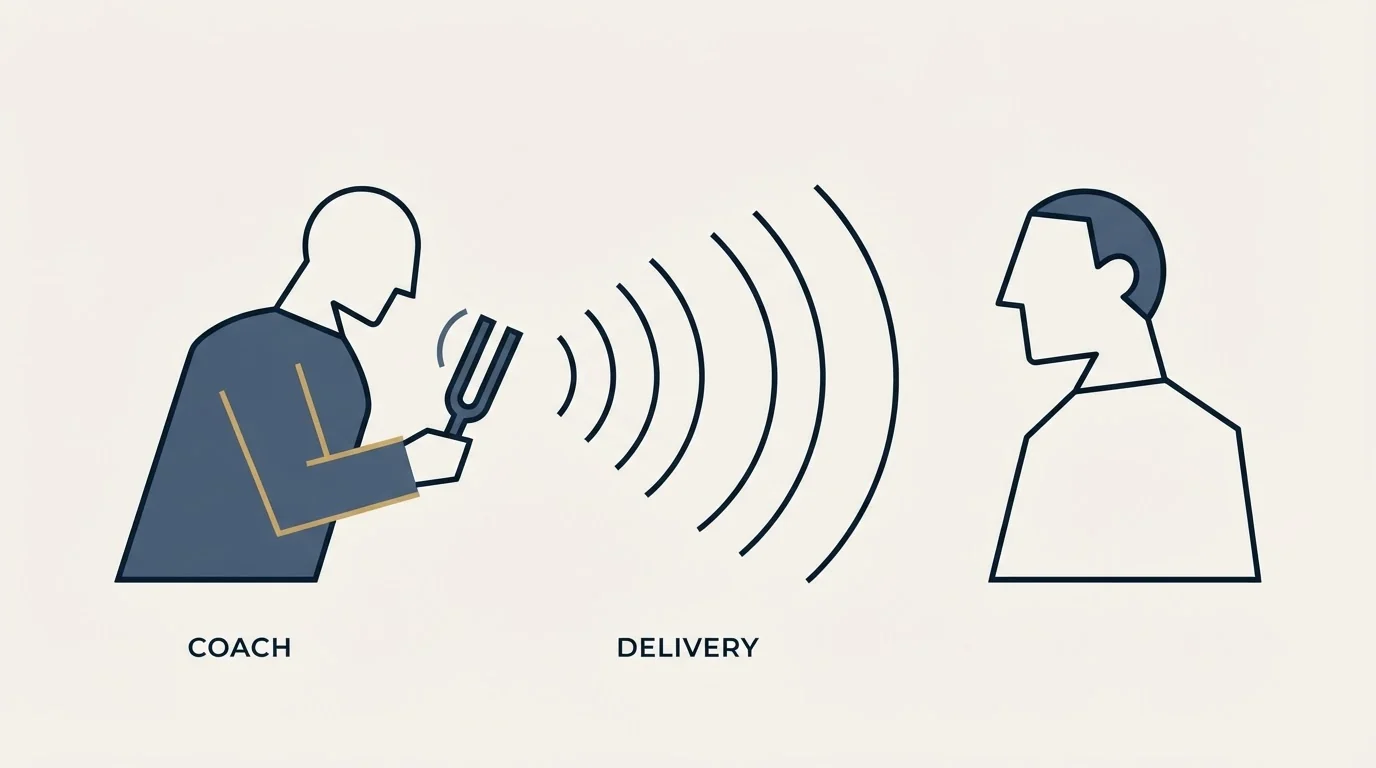
Delivery is coachable. What makes it coachable is the same thing that makes anything coachable, which is an artifact on the table. Our guide to sales rep coaching makes the general case, that a rep told to build more rapport hears an opinion while a rep shown the ninety seconds where they talked past a buying question hears a fact about their own call. Delivery notes are the class of feedback most likely to arrive as an opinion, so they need the artifact more than most.
Because a rep's coachable behaviours differ from outcomes several people control, structuring a sales performance improvement plan explains which layer of the process a plan should actually target.
Three constraints turn a tonality note into something a rep can act on.
Name the moment, not the quality. "Your tonality is off" describes a person. "In these four openings you speed up across the second sentence and the last three words are inaudible" describes a behaviour, in a place, that can be checked next week.
Coach one thing, and only from the opening. The first fifteen seconds are where a like-dislike judgement is actually being made, and they are the shortest segment to drill. Reviewing the first fifteen seconds of four calls shows a pattern. Reviewing one whole call shows an anecdote.
Have the rep listen before you comment. The gap between what a caller believes they said and what they said is usually large, and closing it costs nothing. Most delivery problems are audible to the person who made them within one playback, which makes the note a confirmation rather than a verdict.
- Step 1Pull four openings, not one call
The same fifteen seconds across four recordings, so a pattern is visible rather than a single instance
- Step 2The rep listens first
Most delivery problems are audible to the person who made them on one playback, which makes the note a confirmation
- Step 3Name the moment and the behaviour
Where in the opening it happens and what the voice does there, rather than an adjective about the rep
- Step 4Write one change, in a sentence
One instruction the rep can hold during a live call. A session that produces no sentence produced no coaching
- Step 5Check the same fifteen seconds next week
Four fresh openings against last week's sentence, before anything new is raised
The notes worth giving, and the ones that are decoration
Some delivery feedback describes something a listener could verify from a recording. The rest describes an impression, and an impression cannot be practised.
- Yes: It names a moment in the call that both people can find
- Yes: A second listener would agree it happened
- Yes: It describes what the voice did rather than how the rep seemed
- Yes: It is one change rather than a list
- No: Sound more confident
- No: Smile more while dialling
- Depends: Match the prospect's energy
The last item is deliberately unresolved. Mirroring a prospect's pace is a real and useful adjustment, and it is also the instruction most likely to produce a rep performing an impression of somebody else. It works when it is a response to what is actually happening on the line and fails when it becomes a technique applied on schedule, which is the same boundary the questioning-methodology risk sits on.
What the research behind mirroring actually measured, on whom, and where the technique misfires is read at the source in mirroring in sales.
One further note belongs in the lower half for a reason unrelated to delivery. When a caller sounds pushy, the cause is usually not the voice. Half of what arrives on a cold call carries no information at all, and arguing with a reflex means arguing against a position the person does not hold, which is what produces the tone buyers describe as pushy. Our piece on how cold call objections sort works through why that half is not answerable. A rep coached on warmth while still rebutting reflexes will sound warmer and land the same way.
Where we stand

RevenueFlow runs cold email and LinkedIn outbound for clients and does not sell calling, calling training or scripts, which is worth stating on a page about the phone because it means there is nothing here talking anybody into or out of the channel. Our documented practice on the written side is one message per campaign, with no bumps and no thread replies.
The transferable part of the argument is the same in both channels. A specific, checkable reason for the contact does more work than the styling wrapped around it, and it is decided before anything is sent or dialled.
The short version
The 38 percent figure that opens most sales tonality writing comes from experiments about liking, conducted on people talking about their own feelings and attitudes, and its author publishes the sentence saying the equations do not apply outside that. What survives the correction is narrower and still worth having: where words and delivery disagree, delivery is believed, and the first few seconds carry a like-dislike judgement that decides whether the rest of the call happens.
Above a floor of not sounding like a person reading, more vocal styling makes a call resemble every other call the prospect has taken. Coach delivery from four openings rather than one call, name the moment instead of the quality, and write one change the rep can hold live. Before any of that, check how many people are answering, because delivery only operates on the calls that connect.
If the constraint is the number of qualified conversations rather than how they sound, that is the half we run: see what a first campaign produces.
The Mehrabian equation and its scope note are quoted from Albert Mehrabian's own site at kaaj.com, fetched 22 August 2026, with a dated snapshot retained. The Yesware framing is quoted as a statement made on that page rather than as a verified finding.
Frequently asked questions.
Frequently asked questions- Is the 38 percent tonality statistic wrong?
- The figure is real and the use is out of scope. It comes from experiments about liking where the speaker discussed their own feelings and attitudes, and Mehrabian's own site states the equations are not applicable unless that condition holds. A seller explaining why they called an account is not talking about their feelings, so the number does not describe that call.
- Does tonality actually matter on a cold call?
- Yes, within limits nobody needs a percentage to state. Where the words and the voice disagree, a stranger believes the voice. And the first few seconds answer whether this is a person who chose to call or a queue working a list, which decides whether the script is ever reached. Both are observable on your own recordings.
- How do you coach a rep on tone without it being vague?
- Pull the same fifteen seconds from four calls rather than one whole call, have the rep listen before you comment, then name the moment and what the voice does there instead of naming a quality of the rep. Close with one change written in a sentence, and open next week by checking the same fifteen seconds against it.
- Should we buy tonality training for the team?
- Check the connect rate first. Delivery only affects calls where somebody answered, so it is the smaller of two multiplications, and a rate near four percent has more room in it than one near twenty. Where training is bought, the risk worth pricing is a vocal pattern learned as a technique, which buyers who have heard it before recognise.
About the author.

B2B cold email experts helping companies generate qualified leads through done-for-you outreach campaigns.
RevenueFlow Team
Explore more.
Ready to scale your outreach?
We build GTM engines that book real meetings. See the receipts.
Related articles.
Sales Productivity: Four Different Ratios Wear the Same Name
Sales productivity names four ratios that share no denominator, and improving one can move another the wrong way. The version you mean decides what happens next.
Sales Performance Improvement Plan Samples: What to Include
Three worked sales PIP samples, and the diagnosis that comes first. Most published plans set a target on an outcome the rep does not control alone.
Cold Calling Prospecting: Start From the Coverage Ceiling
One caller covers accounts in the low hundreds a week, not the low thousands. That ceiling decides whether calling is your coverage channel or a sample.
Cold Calling Sales Training: Diagnose Before You Buy It
Calling results come from the list, the offer and the execution. Training reaches the third, and the third is frequently not the one that broke.
SDR Metrics: Which Numbers the Rep Controls
A sales development scorecard mixes three kinds of number and only one is about the person being reviewed. Sorting them by who controls what turns it into a diagnosis.
Readymode Pricing: The Seat Is Dear for What Is Inside It
Readymode publishes $199 and $249 per licence per month, near the top of the dialer range. What the seat includes that others bill separately, and when that pays.