Mirroring in Sales: What the Research Measured, Where It Misfires
Mirroring in sales is two techniques: Voss's verbal mirror and the guides' matching of tone and posture, with the peer-reviewed research behind both read at the source.
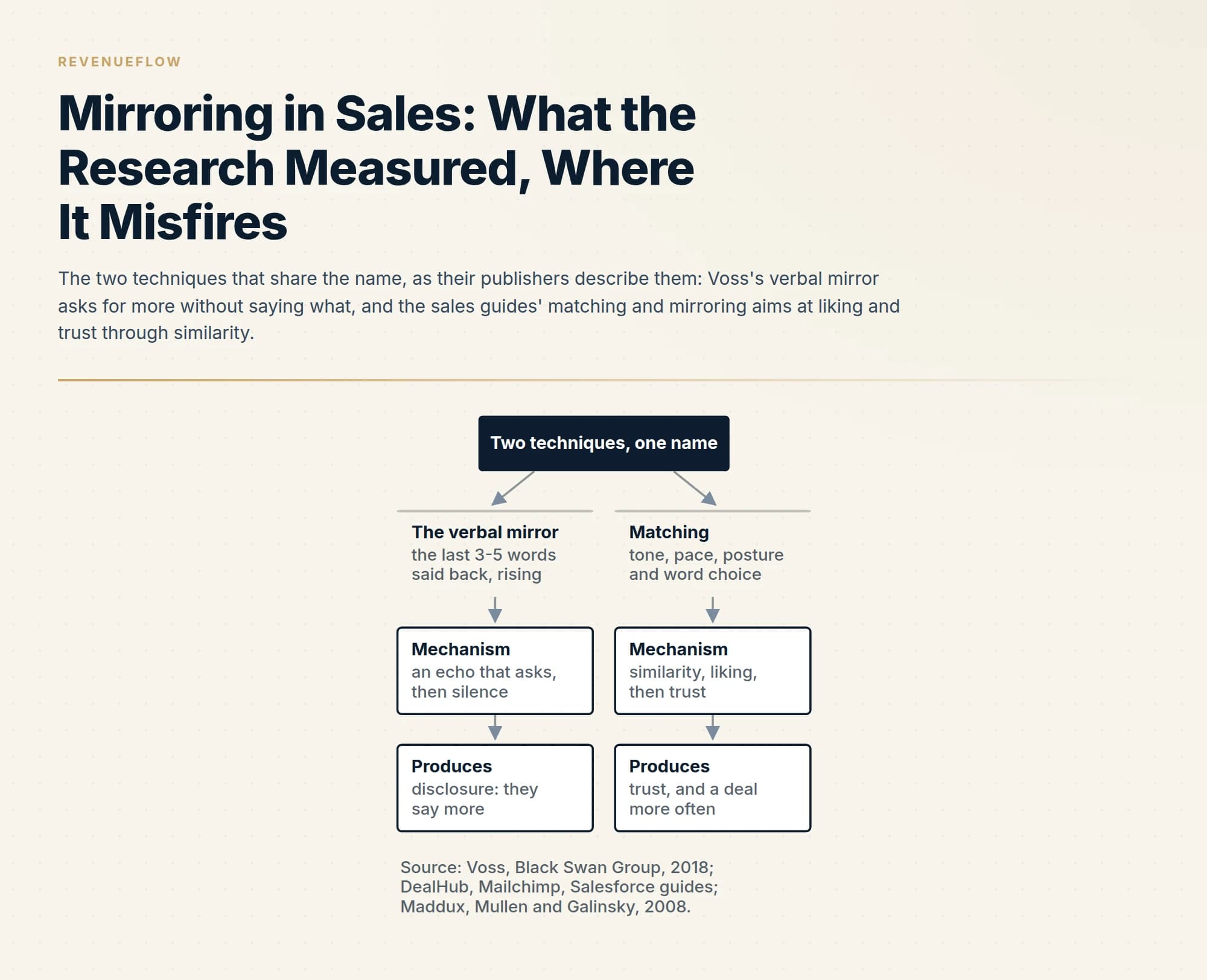
Mirroring in sales is two techniques. Chris Voss's verbal mirror repeats the last few words with a rising tone, then waits; matching and mirroring copies tone, pace, posture and vocabulary. The research behind the guides is two peer-reviewed studies on MBA students, where unnoticed mimicry produced better outcomes via trust. It misfires when noticed, and when nothing exists to mirror.
Key takeaways
- Chris Voss's own definition, published by The Black Swan Group in 2018, is repeating the last three to five words the counterpart said, with an upward inflection, then waiting for them to say more.
- Maddux, Mullen and Galinsky's 2008 study found that MBA students who mimicked their opponent's mannerisms secured better outcomes and reached deals more often, with trust as the mechanism and none of the mimicked noticing.
- Swaab, Maddux and Sinaceur's 2011 study found that mimicking a counterpart's language in the first ten minutes of a chat negotiation raised individual gain, and mimicking in the last ten did not beat the control.
- The technique misfires when it is noticed, when its classroom results are quoted as buyer closing rates, when a trained listener mirrors the seller's ask back, and in a first cold message, which has nothing to mirror.
Reviewed and updated September 19, 2026
Two different techniques travel under the name mirroring in sales, and the guides that rank for the term run them together. One is verbal and specific: repeat the last few words the other person said, with a rising tone, and wait. The other is behavioural and diffuse: match the prospect's posture, pace, volume and vocabulary so that they feel a familiarity they cannot place. The first has an author who publishes it; the second has a body of experimental research that the guides cite without naming. This page separates the two, reads the research at the source, and says where each one misfires.
One thing first. RevenueFlow runs written outbound, email and LinkedIn, and does not sell calling, so nothing here is a claim about our own results. Mirroring is a technique for the booked conversation, which is the half of the work we do not do; where delivery on that call is concerned, sales tonality reads the most-quoted figure about it back to its author, and this page does the same job for the research behind mirroring.
The verbal mirror, as its author publishes it
Chris Voss, the former FBI hostage negotiator behind The Black Swan Group, published the technique's definition on the company's site on 7 May 2018 (fetched 19 September 2026): "Mirroring is simply repeating the last 3-5 words your counterpart has just said." The delivery matters: the piece says the mirror is spoken with an upward inflection, like an actual question, and that with practice a negotiator will mirror a selected few words from within a sentence, sometimes only one.
The piece's own example is aimed at a caller, and it is worth quoting because it is the buyer's side of a cold call. The caller asks whether the listener has a few minutes to talk; the mirror repeats the words back as a question, and the caller has to say why. Voss recommends practising the skill on "open-ended, undefined agenda calls", on the principle that "High-stakes results call for low-stakes practice." The mechanism claimed is disclosure: a client who mirrors every position the other side takes, the piece says, knows it will "trigger a response that clearly tells him if their position is soft or firm", and it gives the mirror's user "the upper hand while providing the counterpart the illusion of control."
So the verbal mirror is a question disguised as an echo. It asks the other person to say more without telling them what to say, and it costs the user nothing but the discipline of not filling the silence.
Matching and mirroring, as the sales guides describe it
The second technique is what the sales guides in the results mean by the word. DealHub's glossary entry (published 17 August 2023, modified 9 April 2026, fetched 19 September 2026) defines it as "a psychology-based strategy sales reps use to build rapport with their prospects. It involves matching the prospect's tone of voice and speech patterns to create a sense of familiarity that appeals to their subconscious." Mailchimp's guide (fetched the same day, undated on the page) states the principle it rests on: "It is based on one essential principle: that people like people who are similar to them." Carew's page on the subject (published 22 July 2025) pairs it with pacing, and Salesforce's guide (published 18 June 2024) extends it to word choice, with a caution: "However, there's a fine line between effective mirroring and mimicry."
What the guides have in common is the mechanism they assume: similarity produces liking, and liking produces trust, and trust produces a deal. What they have in common too is the citation: each mentions research, and none names the paper. The next section does.
What the research measured, and on whom
The study behind most of the guides' claims is Chameleons bake bigger pies and take bigger pieces, by William Maddux, Elizabeth Mullen and Adam Galinsky, published in the Journal of Experimental Social Psychology in 2008 and hosted as an author's copy on Maddux's own university page (fetched 19 September 2026). It ran two experiments, and its abstract states the first result: "Negotiators who mimicked the mannerisms of their opponents both secured better individual outcomes", and, of the pairs as a whole, "Thus, mimickers created more value and then claimed most of that additional value for themselves, though not at the expense of their opponents."
The population is the part the guides leave out. Study 1's participants were 104 MBA students enrolled in a negotiations course, running an employment negotiation exercise with eight issues; Study 2's were 62 full-time MBA students in a negotiations class, running an exercise about the sale of a gas station in which a deal on price alone was impossible. In Study 2, the paper reports, mimicry increased the likelihood of reaching a deal and "interpersonal trust mediated the relationship between mimicry and deal-making." The mimickers were not trained. They were handed a message five minutes before the exercise telling them to copy their partner's mannerisms, and the message carried its own warning, in the researchers' words: it is very important that you "mimic subtly enough that the other person does not notice what you are doing", because otherwise the technique completely backfires.
The second study is closer to written outbound, because the mirroring is in text. Early words that work, by Roderick Swaab, Maddux and Marwan Sinaceur, published in the same journal in 2011 and hosted on the same page, tested linguistic mimicry in online chat negotiations. Its abstract: "We hypothesized that in online, virtual formats, negotiators receive better outcomes when mimicking their counterpart's language; furthermore, we predicted that this strategy would be more effective when occurring early in the negotiation rather than at the end". Experiment 1's participants were 66 MBA students at a business school in Thailand, negotiating over a synchronous chat program so they could not see or hear each other. The study compared mimicry early and late and had no separate condition for the middle of the conversation; those who mimicked their counterpart's language in the first ten minutes "obtained higher individual gain compared to those mimicking during the last 10 min, as well as compared to control participants." Experiment 2 "replicated this effect in the United States (with Dutch and American negotiators) and also showed that trust mediated the effect of virtual linguistic mimicry on individual negotiation outcomes."
| Study | Who, doing what | What it found |
|---|---|---|
| Maddux, Mullen and Galinsky, 2008 | 104 MBA students in an employment negotiation; 62 MBA students in a gas station sale exercise | Mimickers secured better individual outcomes and created more value; mimicry raised the chance of a deal, with trust as the mechanism; none of the mimicked noticed |
| Swaab, Maddux and Sinaceur, 2011 | 66 MBA students in Thailand negotiating by chat; a replication with Dutch and American negotiators | Mimicking the counterpart's language in the first ten minutes beat mimicking in the last ten and beat no mimicry; trust carried the effect |
Two details from the 2008 paper travel further than its headline. First, "none of the participants who were mimicked noticed that their opponents were copying their behaviors", which is the condition under which the effect was measured, not a guarantee that it holds when someone does notice. Second, the paper reports an earlier finding, from a 2003 study it cites, that waitresses instructed to repeat orders back verbatim "received bigger tips than those who were instructed not to mimic". That is the verbal mirror, measured in a restaurant, and it is the nearest thing in the literature to Voss's technique.
Where it misfires
When it is noticed. Every source agrees, and the researchers built it into their instructions. Mailchimp's guide: "Sales mirroring is only effective when used subtly", because making it obvious can come across wrong. Salesforce's guide draws the line between mirroring and parroting. The 2008 paper measured the effect only among people who never noticed. A prospect who catches a seller adjusting their posture to match has been handed a reason to distrust everything that follows, and there is no published result on the far side of that line.
When the population is assumed to be buyers. Every participant in both studies was an MBA student in a classroom exercise with points to maximise, negotiating against a classmate. Nothing in the papers describes a sales call, a buyer with a budget, or a relationship that continues after the exercise. The effects are real for what they measured; a guide that turns them into a figure about closing rates has added a population the papers do not contain.
When the mirror is used on you. Voss's example is a cold caller asking for a few minutes, and the listener mirroring the request back. A seller who opens with a bare ask, and meets a buyer who has read the same piece, hears their own words returned as a question with nothing on the table. That is an argument for leading with a reason before any ask, which is the same conclusion the people who teach the permission-based opener reached from the other side.
When there is nothing to mirror. Both techniques need something the other person has already said. The 2011 study's mimicry was of the counterpart's language in a live chat; the 2008 study's was of mannerisms across a table. A first cold message has neither. There is no prior message to echo and no posture to match, and a message that imitates the recipient's public writing to manufacture familiarity is the noticed case in written form.
- Yes: There is a live conversation, by voice or by chat, with something to mirror
- Yes: The mirroring is subtle enough that the other person does not notice
- Yes: It is done early in the conversation rather than saved for the end
- Yes: The verbal mirror is followed by silence, so the other person fills it
- No: A closing rate from the studies is quoted as if buyers were the population
- No: A first cold message imitates the recipient's public writing to seem familiar
Where our own practice differs
We do not run calls, so the behavioural technique is not ours to run. The one part of this page that reaches our own work is the last misfire. A first message from us carries one true observation about the recipient's business and one ask, and it is sent once; it does not imitate the recipient to seem familiar, and a later approach is a separate campaign on a separate premise rather than a reminder. The reasoning, and what it costs, is set out where we take apart a published fifteen-touch cadence, the Agoge sequence. Once a reply exists there is something to mirror, and the correspondence that follows can use the verbal mirror honestly, because the other person has now said something.
The booked call is where the rest of this page applies, and the structure that call needs, with the questions that change the answer, is on the discovery call. Rehearsing delivery, including the discipline of not filling a silence, is what sales rep coaching is for.
The short version
Mirroring in sales is two techniques. Voss's verbal mirror repeats the last few words with a rising tone and waits, and its claimed product is disclosure. Matching and mirroring, as the sales guides describe it, copies tone, pace, posture and vocabulary, and its claimed product is trust through similarity. The research the guides lean on is two peer-reviewed studies on MBA students in classroom negotiations: mimicking mannerisms produced better outcomes and more deals, with trust as the mechanism, among people who never noticed; mimicking language in a chat helped early in the conversation and not late. It misfires when it is noticed, when its numbers are applied to buyers, when a trained listener mirrors the seller's own ask back, and when there is nothing yet to mirror, which is the case for every first cold message.
If the question is what a first message with one true observation and one ask returns in your market, before any mirroring is possible, a first campaign is the cheapest way to find out.
Every quotation above is from the named source as fetched on 19 September 2026: Chris Voss's piece on The Black Swan Group's site (published 7 May 2018); DealHub's glossary entry (published 17 August 2023, modified 9 April 2026); Mailchimp's guide (undated on the page); Salesforce's guide (published 18 June 2024); Carew's page (published 22 July 2025); and the author's copies of Maddux, Mullen and Galinsky (Journal of Experimental Social Psychology, 2008) and Swaab, Maddux and Sinaceur (same journal, 2011) hosted on William Maddux's university page. Publishers revise these pages; confirm the current text before relying on it.
Frequently asked questions.
Frequently asked questions- What is mirroring in sales?
- Two things share the name. The verbal mirror, as Chris Voss publishes it, is repeating the last three to five words the other person said, with a rising tone, and waiting for them to expand. Matching and mirroring, as the sales guides describe it, is subtly copying a prospect's tone of voice, pace, posture and word choice so they feel a familiarity that produces liking and trust. The two work by different mechanisms.
- Does mirroring actually work, according to research?
- In the two peer-reviewed studies the guides lean on, yes, for what they measured. MBA students told to mimic a classmate's mannerisms in a negotiation exercise secured better outcomes and reached deals more often, with trust as the mechanism; students who mimicked a counterpart's language early in a chat negotiation gained more than those who did it late. None of the mimicked participants noticed, and no buyer took part.
- When does mirroring backfire in a sales conversation?
- When it is noticed. The researchers' own instruction to participants said to mimic subtly enough that the other person does not notice, because otherwise the technique completely backfires, and the guides say the same in their own words. It also misfires when a trained listener mirrors the seller's own ask back as a question, and when there is nothing yet to mirror, which is the case for every first cold message.
- Can you use mirroring in a cold email?
- Only after a reply exists. Both techniques need something the other person has already said: the 2011 study mimicked a counterpart's language in a live chat, and Voss's mirror repeats words just spoken. A first cold message has no prior message to echo, and imitating the recipient's public writing to manufacture familiarity is the noticed case in written form. Once they reply, the correspondence can mirror honestly.
About the author.

B2B cold email experts helping companies generate qualified leads through done-for-you outreach campaigns.
RevenueFlow Team
Explore more.
Ready to scale your outreach?
We build GTM engines that book real meetings. See the receipts.
Related articles.
Command of the Sale: Force Management's Process Programme
Command of the Sale is Force Management's sales process and qualification programme, not its messaging one. What the vendor says it is, delivers and how it runs.
LinkedIn Outreach for Machine Shops
How a job shop or CNC machine shop uses LinkedIn to win OEM work: the four buyer titles, the RFQ gate, the ISO, AS9100 and ITAR facts, and LinkedIn's own rules.
Gap Selling vs SPIN Selling: What Each Method Diagnoses
Gap Selling and SPIN Selling from their authors' own pages: four question types that develop a stated need, against a measured gap between two states.
MEDDIC vs BANT: What Each Qualifies and When to Use Which
MEDDIC and BANT from the originators' own text: IBM's BANT form as a gate after the first call, PTC's six themes as an audit of a live deal, and when to run each.
The Columbo Close: One More Thing, and Where It Works
The Columbo close is the question asked from the door once the buyer thinks the selling is over. Its two readings, the buyer it suits, and where it fails.
Sales Strategy for Logistics Companies: Segment, Seat, Cycle
How a broker, forwarder, carrier or 3PL sets its sales strategy: Armstrong's segments and contract terms, the four provider seats shippers keep, and the rate cycle.