The Columbo Close: One More Thing, and Where It Works
The Columbo close is the question asked from the door once the buyer thinks the selling is over. Its two readings, the buyer it suits, and where it fails.
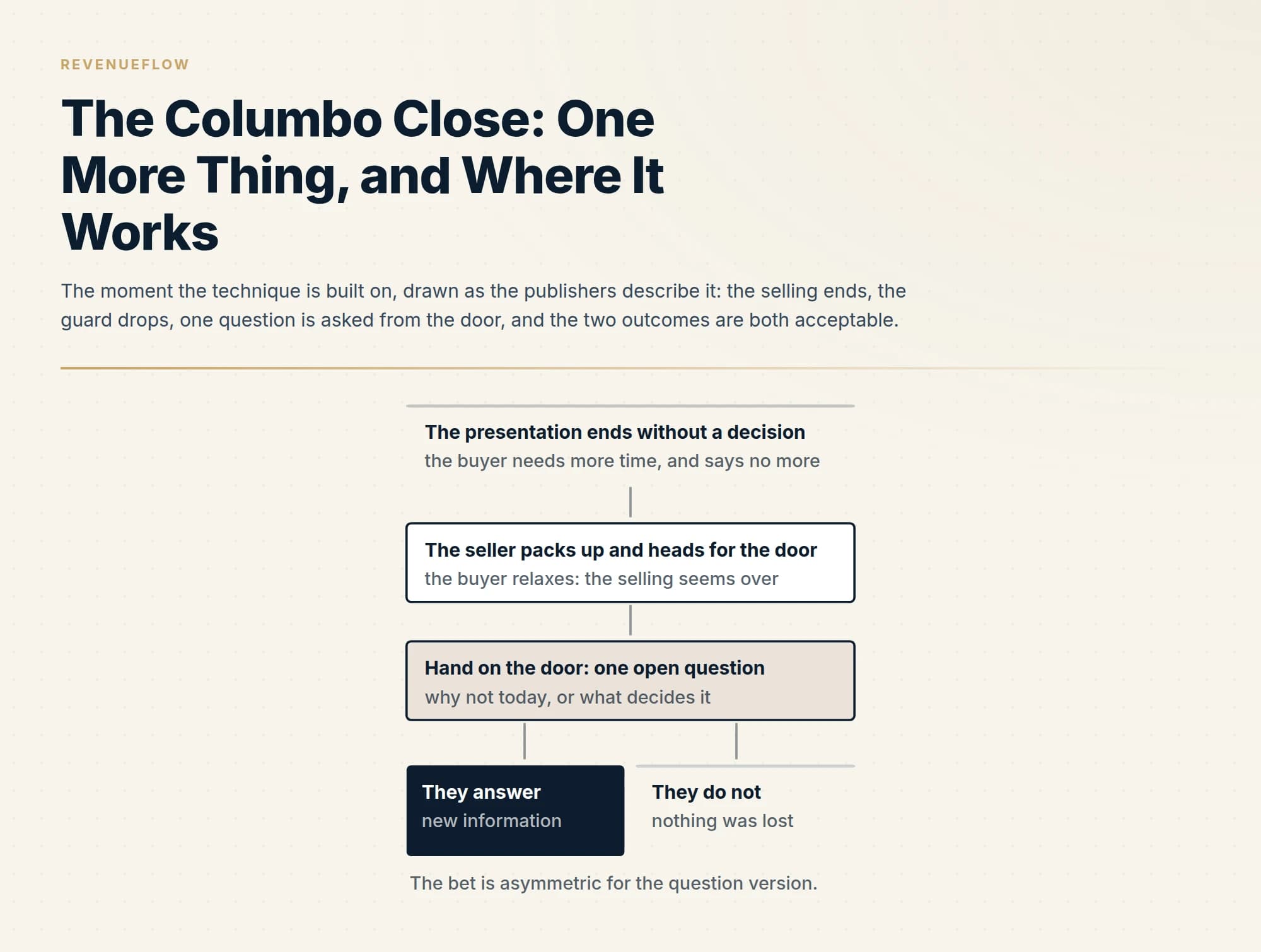
The Columbo close is the one more thing asked from the door after a meeting has ended without a decision, named for the television detective's habit. Publishers give it two readings: an open question that catches a relaxed buyer and draws out the real reason, and a held-back highlight that keeps a leaving buyer in the room.
Key takeaways
- Every publisher places the technique at the same moment: the buyer believes the selling is over, relaxes, and a question asked with the seller's hand on the door gets the answer a seated question was parried on.
- Two readings exist: the question, taught by Developing B2B Sales, Sales Playbook B2B and DBusiness as the doorknob close, and the reveal, taught by Close and repeated by PPAI, which withholds the best material until the buyer stands up.
- It suits a buyer in a live conversation who has declined or is leaving without saying why; it is spent by re-entering the room to re-sell, which DBusiness warns against, by using it twice, and by asking it of a stranger.
- It has no written version: a postscript that begins with one more thing is a longer email and a second message is a bump, and this site sends one message per campaign; the door returns in the meetings the message books.
Reviewed and updated September 19, 2026
The presentation has ended without a decision. The buyer has said they need more time, the seller has thanked them and packed up, and both people have relaxed, because the selling is over. The Columbo close is the question asked from the door at that moment. Named for a television detective's habit of turning back with one more thing, it is the only technique in the closing canon that depends on the buyer believing the conversation has already finished.
This page is about that one technique: the two readings the sales publishers give it, the mechanism both readings rely on, the buyer it suits, where it backfires, and why it has no written equivalent in an outbound programme that sends one message per campaign. The rest of the canon is catalogued once on this site, in sales closing techniques, and nothing there is restated here.
Where the name comes from
The publishers who teach the technique all begin with the character. DBusiness, in a piece published 27 June 2011 on the death of the actor who played him, describes Lt. Frank Columbo as a rumpled detective who "never seemed to know which way was up" until he solved the crime, usually by tricking the perpetrator into talking too much. Close's guide to closing techniques, published 23 April 2024 and modified 24 July 2026, records what became of the catchphrase, just one more thing, which it says "has become a mantra for many talented sales professionals." It describes the move itself: "After a suspect thought Columbo was done with them, he would put them on the spot while walking away by turning around and asking for" one more thing.
The technique travels under two other names. DBusiness calls it the Doorknob Close, noting that "The Doorknob Close, also known as the" Reverse Close, and Voss Graham's Developing B2B Sales blog, undated and read on 19 September 2026, says the same: "A close relative to this technique is actually called the" Door Knob Close. Whatever it is called, every source describes the same physical moment: the seller's hand on the door.
The two readings the publishers give it
Read the five sources together and the technique splits into two versions that share a moment and differ in what is said.
The first is a question. Developing B2B Sales describes the setup: "In sales the Columbo technique is used most effectively when the prospect believes you are leaving the office." Then the mechanism: "They relax and drop their guard relative to what information they are willing to share." The seller, hand on the handle, asks permission for one last question, and the author's two examples are "Before I leave there is one question I have for you, may I ask it now?" and the bolder "Before I leave would you mind telling me the real reason you are not interested in XXXX?" DBusiness gives the same question in its own words: "Now that the presentation is over, may I just ask . . . why didn't you buy from me today?" Sales Playbook B2B, published 27 April 2020, frames it as preparation: when everything has been discussed "but no confirmed sale or next action has been agreed have a meaningful question ready to ask them before you leave." with examples such as "Just one more thing, what would you say is the main factor when making your final decision?" and "just one more thing, how did we compare to your current supplier?"
The second reading is a reveal. Close's version is not a question but a held-back highlight: "Once you think the customer is ready to leave, this last-ditch sales strategy can make them stick around." Its sample line is "Before we finish this call, I just want to share one quick case study from a business that's very similar to yours." and its instruction is to "hit them with the most enticing part of your" pitch "once they've indicated they don't want to listen much longer." PPAI, a promotional-products trade body, repeats that version on 30 May 2024, quoting Close's Amy Copadis: "According to Copadis, this approach works best when you haven't revealed the best part of your solution and you have a feeling the prospect is on their way out."
The question
Developing B2B Sales, Sales Playbook B2B, DBusiness
- Asked after the buyer has said no or ended the meeting without a reason
- One open question: why not today, what decides it, how did we compare
- Wants new information; a reopened conversation is the bonus
- Works because the guard is down once the selling seems over
The reveal
Close, and PPAI quoting Close
- Said when the buyer is leaving before the best part has been shown
- One held-back highlight: a case study from a similar company
- Wants the buyer to stay; called a last-ditch strategy by its own source
- Works only if something genuinely better was still unsaid
Why the door matters
Both readings rest on the same mechanism, and DBusiness states it most precisely: "The timing of this question makes it much more effective than if it's asked earlier in the presentation because the prospect, thinking the presentation is over, begins to relax." And: "The Doorknob Close is powerful because it catches the prospect in an unguarded moment." The seller is no longer selling, so the buyer is no longer defending, and a question that would have been parried ten minutes earlier gets a straight answer.
Developing B2B Sales locates the whole technique in the seller's willingness to actually leave: "I believe the key to the success of the Columbo technique is your willingness to appear to have finished your efforts, pack up and heading for the door to leave." A question asked from a seat is a follow-up question; the same question asked with a coat on is a different event, because the buyer has nothing left to protect. The author is also honest about the asymmetry of the bet: "The worst case is they wouldn't answer (which is the current situation.) and the best case is they answer the question which allows you to reenter the sales process."
That asymmetry is what separates the question version from the reveal version. A question at the door costs nothing if it fails, because the meeting was already over. A reveal at the door has a cost built into it: it tells the buyer that the seller sat on the best material until the buyer tried to leave, and a professional buyer reads that as a tactic rather than a gift.
The buyer it suits
The technique was written for one situation: a buyer who has declined, or is ending the meeting, without saying why. Sales Playbook B2B's examples are all open questions aimed at that gap, and its author says what the answer is for: "These are all open-ended questions which will allow you to potential uncover hidden feelings and also could reopen the conversation and extend the meeting." The answer does not have to be the one the seller wants: "They may say they will never leave their current provider, but by uncovering the reason you can better prepare to revisit that prospect at a later date", and the same pattern across other prospects is worth more than any single reopened meeting.
Two things follow about who this works on. The buyer has to be in a live conversation, in a room or on a call, with a visible end to it, because the whole mechanism is the moment the end arrives. And the buyer has to have withheld something, a reason or a preference, that a direct question during the meeting failed to draw out. A buyer who has told you plainly why they are not buying has nothing left for the door to catch. In that sense the technique is less a close than a last act of discovery, and the honest version of it belongs to the same discipline as running the discovery call so that reasons come out early, when they are cheap.
DBusiness names the outcome to expect and the outcome not to force. The question "almost always results in new information, which the seller can then use as an opportunity to reopen the discussion." Then the warning, which is the most useful sentence in any of the sources: "Warning: Do not be a pest." followed by "Do not reward an honest answer by re-entering the room, taking your coat off, and asking for another cup of coffee." and "The Doorknob close is an extra opportunity to close, but don't try to force the prospect into immediately reversing his decision."
Where it backfires
The failure cases are the mirror of the conditions, and the publishers name them themselves.
The pest. A buyer who gives an honest answer at the door and is then re-sold on the spot learns that candour is punished, and the information that was the whole point of the question is the last they will offer. The DBusiness warning is a rule, not a courtesy.
The reveal that reads as a trick. The Close version depends on the moment "When you haven't shown the main highlight yet" and the buyer is leaving. A professional buyer who is shown the best case study only as they stand up has been told, in effect, that the seller was rationing it; the technique's own source calls it last-ditch, and a last-ditch reveal to a buyer who has been sold to before invites the question of what else was held back. The question version avoids that cost, because a question withholds nothing.
Asking it twice. The mechanism is surprise, and DBusiness says so: "No seller ever plans to use the Doorknob Close, but it can be very useful because it contains the element of surprise." A buyer who has seen it once will hear the second one more thing as the routine it has become, and the guard that was down goes back up.
The stranger. Every source places the technique at the end of a presentation or a call with a buyer who has been in a conversation. Asked of somebody who has not, it stops being a Columbo close and becomes an unearned question from a person the buyer has no reason to answer.
- Yes: A live conversation with a visible end: a meeting or a call, not a message
- Yes: The buyer has declined or is leaving without saying why
- Yes: One open question prepared in advance, not improvised at the handle
- Yes: Willingness to actually leave if the answer is no answer
- No: Re-entering the room and re-selling on the strength of an honest answer
- No: Holding back the best material so there is something to reveal at the door
- No: Using it on the same buyer twice
Why it has no written version in outbound
Everything above happens in a room. Cold outreach happens in an inbox, and the door does not exist there: a message has no moment at which the reader believes the selling is over and relaxes, because a reader controls when a message ends by closing it. What the written imitation of the technique produces is well known to anybody who receives cold email: the postscript that begins with one more thing, or the second message a few days later that opens with it. Neither has the mechanism the publishers describe. The first is a longer email; the second is a bump.
This site runs cold email and LinkedIn outbound and books meetings, and it sends one message per campaign, with no bumps and no thread replies. A message that arrives underneath one the reader chose not to answer is delivered to the population most likely to mark it as spam, and the reputation cost lands on the sending domain across everything else it sends. The argument, with its cost stated, is in why we stopped using follow-ups. A question from the door that has become a second email is exactly the object that policy excludes, however good the question.
Where the technique does have a place is the conversation the message started. Once somebody has replied, a thread exists, meetings happen, and the meetings end; the door is real again. The client's own people take the conversation from the booked meeting on, and what counts as a booked meeting is agreed in writing before a campaign launches, with budget, timing and authority never billing conditions. A buyer who ends that first meeting without saying why is the buyer the publishers wrote the technique for, and the question from the door is the seller's to ask.
The short version
The Columbo close is the question asked from the door after the selling appears to be over, named for a television detective's habit of turning back with just one more thing. The publishers give it two readings: an open question that catches a buyer with their guard down and draws out the reason they did not buy, and a held-back highlight that keeps a leaving buyer in the room. The question costs nothing when it fails; the reveal tells a professional buyer the best material was rationed.
It suits a buyer in a live conversation who has declined or is leaving without saying why, and it is spent the moment the seller re-enters the room to re-sell, uses it twice, or asks it of a stranger. It has no written version: a postscript is a longer email and a second message is a bump, and this site sends one message per campaign. The door comes back in the meetings the message books. If the constraint is how many of those meetings exist, we plan the first campaign for free.
Descriptions, sample wordings, conditions and warnings are quoted from Close (published 23 April 2024, modified 24 July 2026), PPAI (published 30 May 2024, quoting Close's Amy Copadis), Developing B2B Sales by Voss Graham (undated), Sales Playbook B2B (published 27 April 2020, modified 7 February 2021) and DBusiness (published 27 June 2011, modified 15 February 2019), all fetched first-hand on 19 September 2026. These publishers revise their pages, so check the current wording before relying on it.
Sources: Close: 16 best closing techniques, PPAI: the Columbo close and 5 other techniques, Developing B2B Sales: the Columbo technique, Sales Playbook B2B: closing techniques explained, DBusiness: the Doorknob Close
Frequently asked questions.
Frequently asked questions- What is the Columbo close?
- A closing technique named for the television detective Lt. Frank Columbo and his habit of turning back at the door with just one more thing. In sales it is the question, or in one version the held-back highlight, delivered after the buyer believes the meeting is over. DBusiness calls it the Doorknob Close and the Reverse Close; Developing B2B Sales calls the Door Knob Close its close relative.
- How does the Columbo close work?
- On timing. The seller thanks the buyer, packs up and heads for the door, and the buyer, thinking the presentation is over, relaxes and drops their guard. One open question asked from the door, such as why the buyer did not buy today, then draws out information the same question would not have drawn out earlier. DBusiness says the question almost always produces new information and warns the seller not to re-enter the room and re-sell on it.
- When does the Columbo close backfire?
- When the seller becomes a pest by re-selling on the strength of an honest answer, when the reveal version tells a professional buyer that the best case study was rationed until they tried to leave, when it is used on the same buyer twice and the surprise is gone, and when it is asked of a stranger who was never in a conversation. Every publisher's version assumes a live meeting or call with a real ending.
- Can the Columbo close be used in a cold email?
- No. The mechanism is a live ending the buyer believes in, and a message has none, because the reader ends it by closing it. A postscript opening with one more thing is a longer email, and a second message opening with it is a bump. This site sends one message per campaign with no bumps and no thread replies; the technique belongs to the meetings a message books, where the door is real again.
About the author.

B2B cold email experts helping companies generate qualified leads through done-for-you outreach campaigns.
RevenueFlow Team
Explore more.
Ready to scale your outreach?
We build GTM engines that book real meetings. See the receipts.
Related articles.
The Direct Close: Asking Plainly for the Business
The direct close asks for the business with nothing wrapped around the question. The condition the publishers attach, the buyer it suits, where it backfires.
The Urgency Close: Real Deadlines and Manufactured Ones
The urgency close from the publishers who teach it, the test that separates a real deadline from a manufactured one, the structure, and why we never invent one.
The Summary Close: Restating What Was Agreed Before the Ask
The summary close restates the buyer's needs, the agreed answer to each and then asks. What the publishers say, the structure, a worked example, and where it fails.
Objection Handling Frameworks: LAER, AAA and Others Compared
The named objection-handling frameworks with their publishers quoted: Carew's LAER, RAIN Group's four steps, HubSpot's five, Gong's three and both AAAs.
B2B Sales for Financial Services Companies: Regulated Seller
For the bank, agency, broker-dealer or adviser selling to businesses: the buying group, the credit and renewal windows, and the rules that bind the seller's own message.
Command of the Sale: Force Management's Process Programme
Command of the Sale is Force Management's sales process and qualification programme, not its messaging one. What the vendor says it is, delivers and how it runs.