SDR Outsourcing for Business Brokers: The Fee Timing
Whether a success-fee brokerage should rent sales development at all: the fee timing, the texts that limit what an outside person may say about value, and who signs.
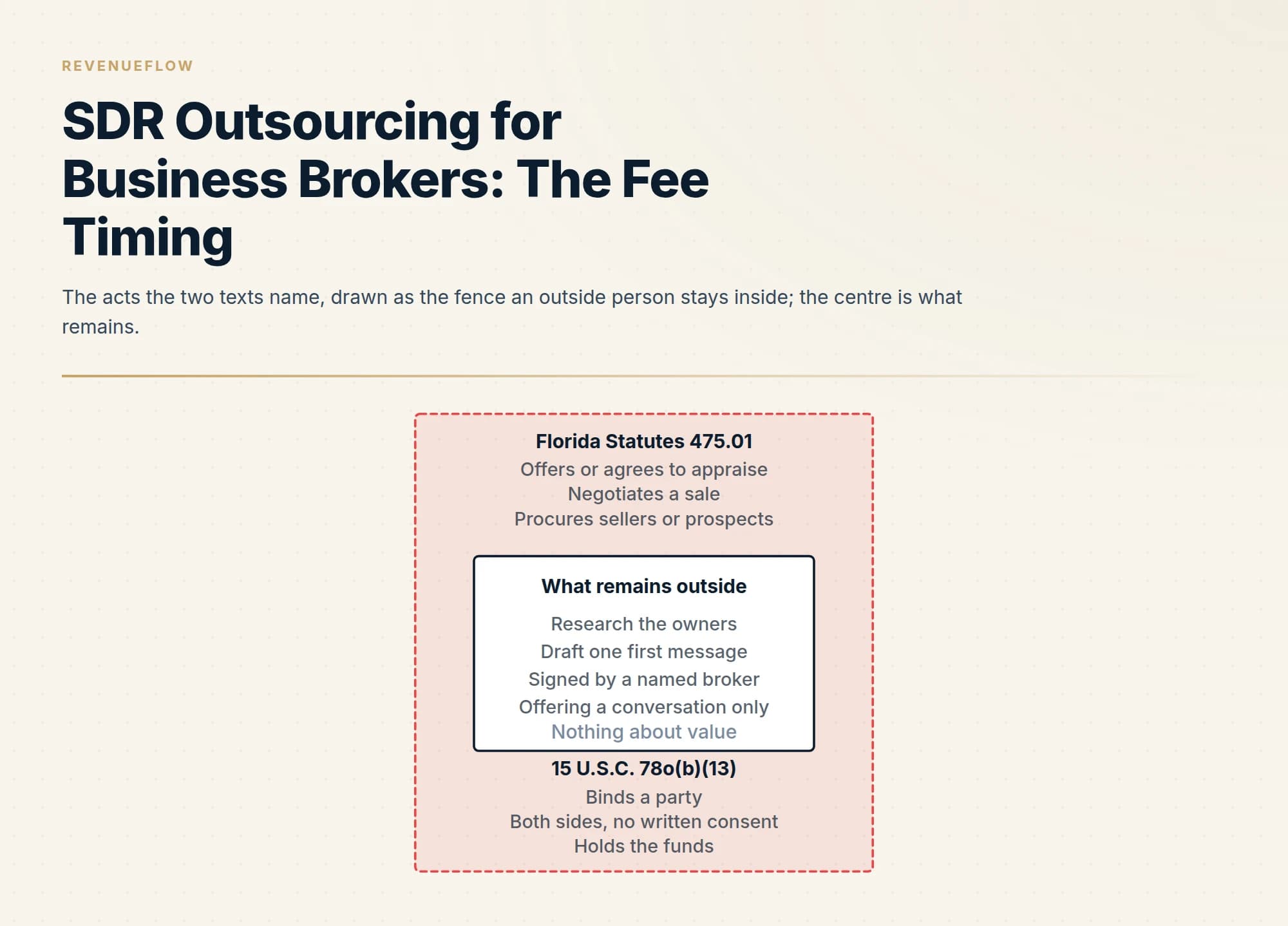
A business brokerage is paid at closing and a vendor at the meeting, the lead or the month, so most arrangements fund an early cost from a late fee. Florida's statute and the federal M&A broker exemption name acts an outside person may not perform, so what travels is research and a first message signed by a named broker.
Key takeaways
- The fee event in this trade is rare and late: 300 surveyed advisors reported 203 completed transactions in the first quarter of 2026, and the practice is paid only at closing, while every outside arrangement is paid earlier.
- Florida's Chapter 475 counts offering to appraise or negotiate the sale of a business enterprise as brokerage, and the federal M&A broker exemption reaches any person associated with a broker, so an outside person says nothing about value and binds nobody.
- Owners sell once and fear the word getting out, so the first message is signed by the named, licensed broker who will hold the valuation conversation; the outside team researches and drafts but never sends.
- Per-meeting and per-lead arrangements pay for the thing a licensed person must do; a seat or a research-and-writing arrangement is priced for what actually travels.
Reviewed and updated September 21, 2026
A two-partner business brokerage rents an outsourced sales development seat in March. The rep is diligent, works the county's owners by email and phone, and in May an owner asks what a business like theirs would go for. The rep says three to four times earnings, because that is what the rep has heard the partners say. Nothing closes until the following spring, when the brokerage's fee arrives and the seat has cost fourteen months. The vendor was paid on time every month. The brokerage paid for a valuation opinion it never authorised, given by a person it never licensed.
This guide is for the business brokerage and the lower-middle-market advisory firm working on a success fee, deciding whether an outside team should do part of its sales development at all, and if so which part. It does not repeat the four arrangements on sale, which are in SDR outsourcing and outsourced SDR pricing, and it is not about the meeting itself, what qualifies one and how a setter handles confidentiality, which is a separate question. A private equity fund's deal team weighing the same decision from the buy side has SDR outsourcing for private equity firms; selling services to funds is cold email for private equity. What is specific here: the fee timing that makes three of the four arrangements a bad fit, the licence and exemption text that decide what an outside person may say, and the owner trust that decides who signs the message.
A success-fee practice is paid last, and a vendor is paid first
The International Business Brokers Association, "the largest international non-profit association operating exclusively for people and firms engaged in Business Brokerage", formed in 1984, awards the Certified Business Intermediary designation to members who meet its education and experience standards (IBBA, About, read 21 September 2026). Its quarterly Market Pulse survey with M&A Source for the first quarter of 2026 "was conducted April 1-16, 2026 and was completed by 300 business brokers and M&A advisors", and "Respondents completed 203 transactions this quarter" (IBBA and M&A Source, Market Pulse Q1 2026, via PR Newswire, 30 June 2026, read 21 September 2026). Three hundred advisors, two hundred and three closings in a quarter: the fee event in this trade is rare per practitioner, and it arrives at the end of a process that starts with a first conversation.
BizBuySell's Insight Report for the second quarter of 2026 counts the market's other end: "A total of 2,117 businesses changed hands in Q2 2026, down 10% both quarter-over-quarter and year-over-year", with the median sale price at $349,250 (BizBuySell Insight Report, Q2 2026, read 21 September 2026). A brokerage's revenue is a percentage of numbers like that, paid at closing, months after an owner signs an engagement and the business is marketed to approved buyers. An outsourced seat, a per-meeting fee or a per-lead fee is paid monthly, at the meeting, or at the lead. The mismatch is the first fact about outsourcing in this trade: whatever arrangement is bought, the practice funds it from a fee that may be a year away and may never come.
An owner agrees to talk about value. A per-meeting vendor is paid here.
Books, owner dependence, a method. Months, by the trade's own account of owner readiness.
The owner signs with the brokerage. A seat has been paid every month to here.
Blind profile, buyer screening, offers.
The success fee. The only point at which the practice is paid.
What an outside person may say about value
Two texts decide it, and neither is about sales development. The first is state licensing. Florida's Chapter 475 defines a broker as a person who, for compensation, "appraises, auctions, sells, exchanges, buys, rents, or offers, attempts or agrees to appraise, auction, or negotiate the sale, exchange, purchase, or rental of business enterprises or business opportunities", and extends the definition to a person "who directs or assists in the procuring of prospects or in the negotiation or closing of any transaction" (Florida Statutes, section 475.01, read 21 September 2026). Offering to appraise a business enterprise is on that list. The rep in the opening paragraph, in Florida, did something the statute defines as brokerage; in another state the definition may be narrower or absent, and the brokerage's own counsel reads its own statute.
The second text is federal. The Securities Exchange Act carries a registration exemption for merger and acquisition brokers at 15 U.S.C. 78o(b)(13), added by Public Law 117-328 on 29 December 2022 according to the section's amendment notes. It defines the term M&A broker to include the people around the broker: the term "means a broker, and any person associated with a broker, engaged in the business of effecting securities transactions solely in connection with the transfer of ownership of an eligible privately held company". The statute, as Cornell LII carries it, defines an eligible company as one whose earnings before interest, taxes, depreciation and amortization "are less than $25,000,000" or whose gross revenues "are less than $250,000,000" in the prior fiscal year. The exemption is lost if the broker "Binds a party to a transfer of ownership of an eligible privately held company", if it "Represents both the buyer and the seller in the same transaction without providing clear written disclosure as to the parties the broker represents and obtaining written consent from both parties to the joint representation", or if it "receives, holds, transmits, or has custody of the funds or securities to be exchanged by the parties to the transaction" (15 U.S.C. 78o, Cornell Legal Information Institute, read 21 September 2026). That is the text; whether a given sale is a securities transaction at all, and whether the exemption applies to a given practice, is a question for counsel.
What the two texts share is a list of acts, and the list is the instruction for any outside person. Procuring prospects and negotiating are brokerage in Florida. Binding a party, representing both sides without written consent, and touching funds cost the exemption federally, and the federal definition reaches "any person associated with a broker". So the outside person, if there is one, does none of those things, says nothing about what a business is worth, and says nothing that could be read as an offer to appraise or negotiate. What remains is research and a first written approach, signed by a licensed, named broker, offering a conversation.
The owner's trust decides who signs
IBBA's seller Q&A page says the owner is doing this once: "The typical business owner will only sell a business once." It lists confidentiality first among the reasons an owner uses a broker, who will "contact only owner approved buyers through a blind profile", and it tells the owner what a good valuation is not: "A business owner should never accept a computer-generated valuation or a one-size-fits-all approach when selling the business." (IBBA, Common Business Buyer and Business Seller Questions, read 21 September 2026.) BizBuySell's seller guide says why the owner is careful: "If word that the business is being sold gets out to your creditors, customers, competitors, or employees, it could trigger a negative reaction, weakening your business momentum and therefore its value." (BizBuySell, Selling Your Business Confidentially, read 21 September 2026.)
Brokers quoted in BizBuySell's Q2 2026 report describe the owners who do reach out. Joe Howell of East Coast Business Brokers: "I have been busy with phone calls from aging and burned-out owners ready to sell. Not ideal without any exit planning". Vipin Singh of Murphy Business Sales: "Preparation, clean financials, and minimized owner dependence are now absolute prerequisites to securing a successful close". The report's own reading is that "many owners recognize that an eventual exit is coming, but far fewer have completed the preparation needed to capitalize on today's market conditions."
For the outsourcing decision that settles who signs. An owner who will sell once, who is told never to trust a generic valuation, and who fears the word getting out, is not going to open up to a rented rep with a foreign email signature. The first message goes out in the name of the broker who will hold the valuation conversation, from the brokerage's own domain, and every reply lands with that person. The outside team can find the owner and draft the sentence; it cannot be the sender. That is also how RevenueFlow works for any client: the campaign is in the client's name, one message per campaign, no bump behind it, and the qualification standard is agreed in writing before launch.
Which arrangement fits a success-fee practice
Set the fee timing against the four arrangements. A per-meeting fee is paid at stage one of the five above, for a conversation whose value, if any, arrives at stage five a year later; the vendor's incentive is to book owners who were only curious, and in this trade a curious owner who hears the word sale from a stranger is a lost owner. Taskblink, the one vendor page in the ten pages that answer a search for this phrase which is written for business brokers, sells exactly that unit, "At least 3 booked sales calls in 30 days, or it's free", reaching owners "by text, email, and phone" (Taskblink, Appointment Setting for Business Brokers, read 21 September 2026); that is the vendor's own offer, recorded as such. A per-lead fee is paid earlier still, for a name. A dedicated seat is paid monthly and learns the trade, but the person in it may not say what a business is worth, so the seat's ceiling is the research and the draft. A research-and-writing arrangement is priced for what actually travels.
The practice that buys a seat is therefore buying a researcher and a writer whose output is signed by a partner, and the honest comparison is that seat's monthly cost against a partner's hours spent finding owners, which is the arithmetic in outsourced SDR vs in-house. A practice that buys meetings is buying the one thing its regulators, its trade body and its owners all say should come from a licensed, named person.
The rules the practice keeps whoever sends
Email carries one federal rule for the sender. The Federal Trade Commission's CAN-SPAM guide says "The law makes no exception for business-to-business email", and, on outsourcing, that "even if you hire another company to handle your email marketing, you can't contract away your legal responsibility to comply with the law" (FTC, CAN-SPAM Act: A Compliance Guide for Business, read 21 September 2026). Vendors that text owners' mobile phones work under the Federal Communications Commission's consent rules, which "require a caller to obtain your oral or written consent before making an autodialed or prerecorded call or text to your wireless number" (FCC, Stop Unwanted Robocalls and Texts, read 21 September 2026). How a vendor obtains consent, and how it dials, goes in writing before the first contact. None of this is legal advice; the practice's counsel decides what applies.
When outsourcing is the wrong play for a brokerage
It is the wrong play when the practice cannot fund a monthly cost from a fee that arrives at closing, which describes a two-partner practice in a year without one. It is the wrong play as a way to buy meetings, because the meeting in this trade is a valuation conversation and the person who holds it must be licensed and named. It is the wrong play where the state defines procuring sellers or offering to appraise as brokerage and the vendor's people are neither licensed nor supervised as the statute requires. It is the wrong play with any vendor whose reps will discuss value, or who reach owners by methods the practice cannot see. And it is the wrong play when no partner has time to take every reply the same day, because the reply is the owner deciding whether to trust one person.
It fits a practice with more owners in its territory than its partners can research, a partner willing to sign and answer every message, and a vendor content to do research and drafting and nothing more.
Three openers, each on a fetched fact
Three illustrative openers follow, each built on a page read on 21 September 2026, each one message to one owner, sent once, signed by a named broker, saying nothing about value. None names a real recipient or claims a result, and the brokerage that speaks in each is invented.
The first rests on BizBuySell's Q2 2026 heading that demand continues to outpace the supply of quality businesses.
Buyers for businesses like yours are not the scarce thing this year; prepared sellers are. We are a two-partner brokerage in the county, and the partner signing this would be the one you deal with. If it would ever be useful to know what preparation a sale takes, before anyone talks about numbers, we would give you an hour of it in confidence.
The second rests on Vipin Singh's line, in the same report, that preparation, clean financials and minimized owner dependence are now prerequisites to a close.
The brokers surveyed this year say the same three things decide whether a business closes: preparation, clean books and how much of the business depends on the owner. Your company has been under one owner for twenty years by the state record. We would like a confidential conversation about the third of those, with nothing to sign and no buyer in the room.
The third rests on the federal exemption's condition that a broker represents both sides only with written disclosure and consent.
When we work with an owner, we represent the owner and nobody else in that sale, and we put that in writing before the first meeting. If you have ever wondered who a broker actually works for, the partner signing this would answer that in a short call, in confidence, and leave value for another day.
What to agree in writing
- Yes: The outside person never states, estimates or offers to estimate what a business is worth
- Yes: Every message is signed by a named, licensed broker and sent from the practice's domain
- Yes: The outside person never binds a party, never represents both sides, never touches funds
- Yes: The state licence position is settled by counsel before anyone procures a prospect
- Yes: Pay per meeting and pay per lead are off the table; research and drafting are what is bought
- Yes: The vendor's consent and dialling practice, if it calls or texts, is stated in the contract
- Yes: One message per campaign, no bump, and every reply to the signing partner the same day
A brokerage that wants to see a researched owner list and a single first message, signed by its own partner, before committing to any arrangement can start with a free campaign and count the confidential conversations that begin.
The IBBA, PR Newswire, BizBuySell, Florida Legislature, Cornell LII, Taskblink, FTC and FCC pages were read on their own sites on 21 September 2026. Statutes and exemptions are quoted as text, not interpreted; whether any of them applies to a given practice or sale is a question for its own counsel.
Frequently asked questions.
Frequently asked questions- Can an outsourced SDR tell a business owner what their company is worth?
- Not on a brokerage's behalf. Florida's Chapter 475 defines a broker to include a person who, for compensation, offers, attempts or agrees to appraise or negotiate the sale of business enterprises, and IBBA tells owners never to accept a computer-generated or one-size-fits-all valuation. Other states differ, but the safe contract has the outside person say nothing about value and leave every valuation conversation to a licensed, named broker.
- Does the federal M&A broker exemption cover an outsourced sales team?
- The exemption at 15 U.S.C. 78o(b)(13) defines an M&A broker as a broker and any person associated with a broker, and it is lost if the broker binds a party to a transfer, represents both sides without written disclosure and consent, or holds the funds. Whether a given sale is a securities transaction and whether the exemption applies is a question for counsel; the practical rule is that an outside person does none of the listed acts.
- Which SDR outsourcing model fits a business brokerage?
- The one priced for what an outside person may actually do. A per-meeting fee is paid at the first conversation for value that arrives at closing a year later, if at all, and rewards booking curious owners; a per-lead fee is paid earlier still. A dedicated seat or a research-and-writing arrangement buys the owner research and a first message the partner signs, which is the part of the job that travels.
- Who should sign the first message to a business owner?
- The broker who will hold the valuation conversation. IBBA's page says the typical owner sells a business once, and BizBuySell's seller guide says word of a sale reaching creditors, customers, competitors or employees can weaken the business's value. An owner in that position opens up to a named, licensed person from the brokerage's own domain, not to a rented rep, so the outside team drafts and the partner sends.
About the author.

B2B cold email experts helping companies generate qualified leads through done-for-you outreach campaigns.
RevenueFlow Team
Explore more.
Ready to scale your outreach?
We build GTM engines that book real meetings. See the receipts.
Related articles.
Appointment Setting for Business Brokers: The Seller Meeting
What a bought meeting with a business owner has to be for a brokerage: the three-part qualification, the confidentiality rules, the licence line and the owner's reasons.
SDR Outsourcing for Logistics Companies: The Brokerage Line
What an outside sales development team may do in a freight company's name, the calling and email rules it inherits, and which arrangement survives a bid-shaped market.
SDR Outsourcing for Financial Services: The Third Party
What a bank, broker-dealer, adviser or agency's regulators say about an outside team that speaks for it, the licensed line, and which arrangement survives due diligence.
LinkedIn Outreach for Banks: A Regulated Message
How a bank's relationship managers use LinkedIn to reach business owners: what the FFIEC guidance, FINRA's notices and LinkedIn's own rules require, and where to stop.
Cold Calling for PPC Agencies: What You Can See First
A paid media prospect is partly readable before the call and has already been told by the platform what to do when a stranger rings about its ads.
Cold Calling for Chemical Companies: Who Picks Up
A chemical cold call rarely arrives first. It reaches a formulator who has already been comparing suppliers on a screen, for one of three published reasons.