SDR Outsourcing: The Four Models and What Each Costs
Dedicated team, fractional SDR, offshore staffing or outcome-based agency. What you control in each, how ramp works, and what happens when the person leaves.
SDR outsourcing comes in four shapes: a dedicated agency team, a fractional or part-time SDR, offshore staffing, and an outcome-based agency selling meetings rather than people. They differ in what you control, how ramp works, and what happens when an individual leaves.
Key takeaways
- A dedicated team gives the most control over messaging and the most visibility, at the highest cost per unit of output.
- Fractional SDRs suit low or uncertain volume, though vendors differ in whether they sell the shape at all: SalesRoads' pricing page prices dedicated SDRs from $11,950 per four weeks, with no fractional tier.
- Offshore staffing lowers cost per seat and raises variance, and the deciding factor is usually whether your buyers will engage on a call rather than the seat rate.
- Buying outcomes rather than people removes ramp and attrition risk from your side entirely, and makes the meeting definition the thing you manage instead.
Reviewed and updated September 21, 2026
A request for "an outsourced SDR" comes back with four quotes, and all four use the same phrase to describe four genuinely different arrangements: an agency pod assigned to your account, a share of one experienced rep's week, a seat filled offshore at a lower rate, and a vendor who will not tell you who is doing the work because what you are buying is meetings rather than people.
The choice between them is a staffing decision before it is a purchasing one. Who employs the person, where they sit, and whether the deliverable is time or an outcome determines what you can direct day to day, how long you wait for anything, what happens the week the individual quits, and how far the output swings from month to month.
How this decision plays out depends on the seat you sit in. We keep persona-specific outbound guides for founders, SaaS founders, VPs of sales, SDR managers, RevOps leads, agency owners, consultants, recruiters, professional-services firms, and heads of marketing.
The dedicated agency team
The agency employs the reps and assigns you a pod, usually a rep plus a strategist plus some data and operations support behind them. SalesHive describes exactly this shape: one flat monthly fee covering the SDR team, a strategist, the AI platform, data and tools, with the price varying by team model, channel mix, and daily touch volume of 150, 250 or 500 plus.
What you control is targeting, messaging approval and priorities, mediated through the strategist. What you almost never control is hiring. Ask early whether you can reject an assigned rep and whether that costs you anything, because the answer varies and it never appears on a pricing page.
Ramp has two halves and only one of them is on the agency's clock. The rep already knows how to prospect. Learning your product, your market's objections and which titles actually own the decision takes weeks regardless of experience, and an agency that promises a warm start is usually drawing on a list built for somebody else.
The continuity promise is the main thing you are paying the agency premium for, and it is real: when a rep leaves, they backfill. What you rarely get is a credit for the re-ramp. Ask what happens to committed activity levels during a backfill, and whether the replacement's first weeks bill at the full rate. Quality variance is a function of the individual plus the pod around them, and the strategist layer is what compresses it. A team sold with no strategist is one person's good or bad month, priced as a service.
The fractional SDR
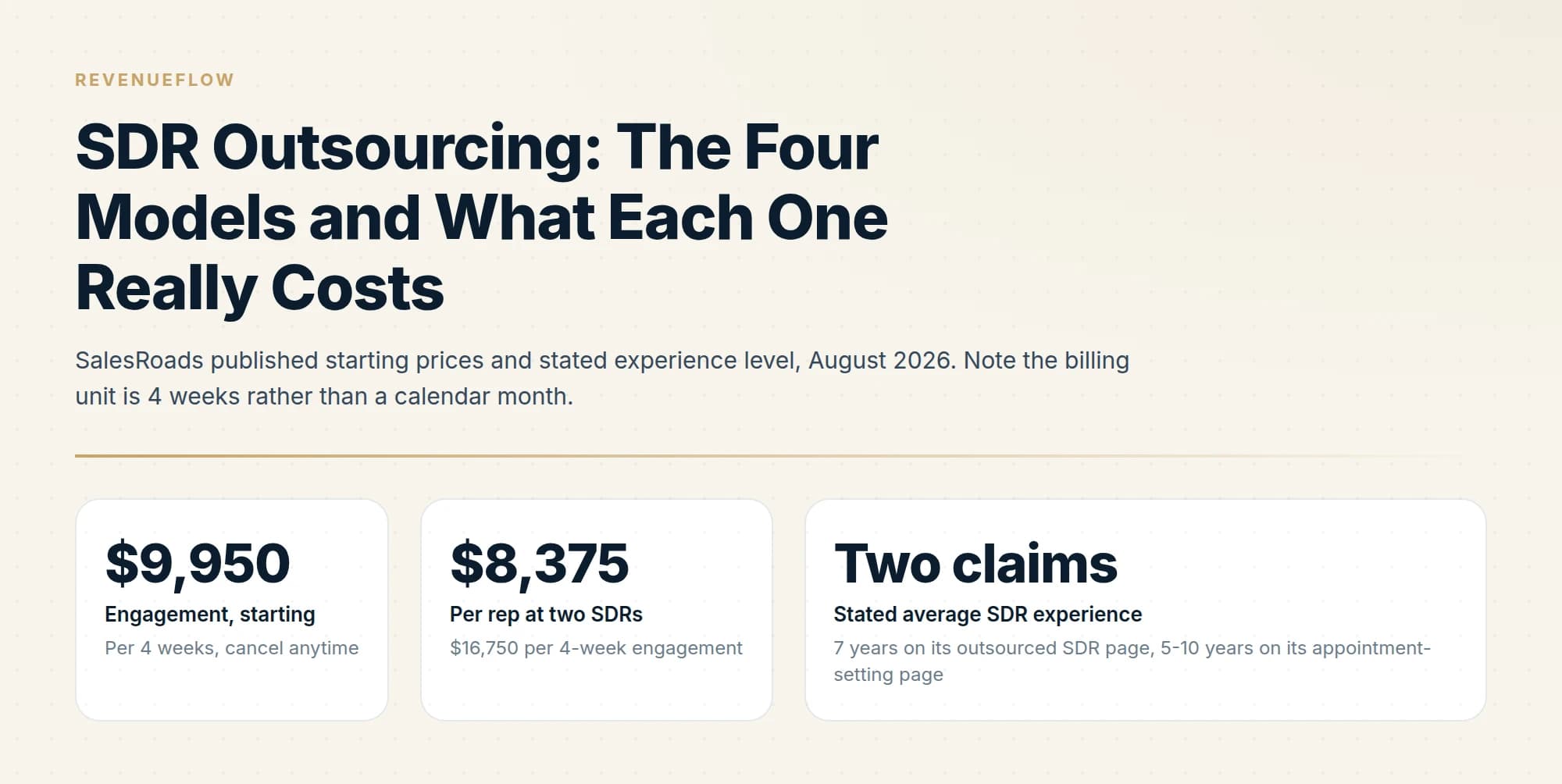
You buy a share of one experienced person's week. Vendors differ in whether they sell this shape at all: SalesRoads is a useful illustration of how unsettled this shape is. Its pricing page prices dedicated SDRs from $11,950 per 4 weeks with no fractional tier, while its appointment-setting page still shows a Fractional SDR package at $6,950 per 4 weeks. Its stated SDR experience splits the same way: its pricing page states an average of 14 years of sales experience, while its appointment-setting page states 5-10 years.
Per 4 weeks, cancel anytime
$16,750 per 4-week engagement
14 years on its pricing page, 5-10 years on its appointment-setting page
The thing that catches people out is that ramp is priced per person, not per hour. Someone working half a week on your account still needs the whole product education, the whole objection library and the whole market context. A fractional arrangement therefore buys proportionally less output while paying close to the full ramp cost, so the payback period is longer than the headline discount suggests.
In exchange you usually get more direct access to the individual than a pod model gives you, and at this level of experience that access is worth something. Attention is the trade. Your account competes with the rep's other accounts, and it competes hardest in the week you most need it, because from your side a hot week on somebody else's account looks identical to a slow week on yours.
When the person leaves, you restart. There is no bench inside a one-person arrangement, so the replacement is a new hire from your point of view even when it is a reassignment from the vendor's. Fractional fits a narrow ICP with a low volume ceiling and a complicated product, where one senior person who actually understands what you sell beats three who do not.
Offshore staffing

The seat is filled outside your market at a materially lower rate. SalesHive prices team location explicitly, US-based or offshore, alongside channel mix and daily volume, which tells you location is a priced variable rather than an implementation detail the vendor absorbs.
Channel is where the difference actually shows up. Research, list building, enrichment and email work travel well. Live phone into your home market is where accent, idiom and local context surface, and where this model either works or visibly does not. Judge it by listening to recordings from the specific team you would be assigned, not by the vendor's showcase reel.
Timezone cuts both ways and buyers usually only consider one direction. A team several hours ahead of you has the list built and overnight replies triaged before your day starts, which is a real advantage on email-led programmes. A team behind you cannot dial your prospects during their business hours without running night shifts, and night shifts are the single largest driver of attrition in offshore calling teams, which loops straight back into your continuity problem.
Management load does not disappear, it moves. Somebody has to run the daily standup, review recorded calls and correct drift before it becomes a habit. Either the vendor supplies an onshore team lead or you supply the management yourself, and if nobody is named in the proposal, the answer is you. Variance is highest in this model and it tracks almost entirely with whether that named manager exists and whether there is a real QA process on recordings.
- You direct priorities and messaging, not hiring
- Agency absorbs recruiting, you absorb product ramp
- Backfill is contractual, re-ramp is usually uncredited
- Variance follows the individual, damped by the strategist
- You often direct the work more directly, and manage more of it
- Ramp is longer where market context matters, shorter on research work
- Attrition risk is the question to ask about, in writing
- Variance is highest and tracks the onshore manager and QA process
- You direct criteria, copy and exclusions, never headcount
- Ramp sits on the vendor's balance sheet
- Turnover is invisible to you, which is the correct outcome
- Variance appears as meeting quality, governed by the written definition
Outcome-based: buying meetings instead of people
Teams arrive at this page with no dedicated SDR team and senior people covering the whole cycle, which changes what is being bought: the question is not how to add a layer cheaply but which of the four models below can run without an internal SDR function to sit alongside.
The vendor staffs the work however they like and you pay per meeting. Every staffing question above disappears behind the deliverable, which is the appeal and also the thing to be clear-eyed about.
You control criteria, copy approval, suppression lists and exclusions. You do not control headcount, hours or channel mix except by agreement, and you should not want to, because you transferred those decisions along with the delivery risk. Ramp is still real in calendar time, but you are not paying salaries through it.
When somebody on the vendor's side leaves, you may never find out. Under this model that is correct: continuity of output is what you bought, and continuity of personnel is their means of delivering it.
Quality variance shows up as meeting quality rather than as activity levels, which is why the entire negotiation in this model is about the written definition of a qualified meeting. That definition is the only control surface you have, and it does a lot of work. We set out what belongs in one, and the specific ways a loose one gets exploited, in pay-per-appointment B2B.
How ramp actually behaves

Every people-based model has the same shape, and it is routinely sold as though it does not.
- Weeks 1 to 2Assignment and onboarding
Rep assigned, product education, ICP and objection handling, suppression list loaded. Sending infrastructure prepared.
- Weeks 3 to 4First sends at low volume
Deliberately small while domains warm. High volume here buys nothing and risks the sending infrastructure.
- Weeks 5 to 8Volume ramps and replies arrive
Early meetings appear. Targeting and messaging adjust based on what replies actually say.
- Weeks 9 to 12Steady state
The first period where output is a fair measure of the arrangement rather than of the setup.
The practical consequence is that a three-month engagement is one ramp and roughly one month of evidence. If your evaluation window is short, the outcome-based model is structurally safer, because the ramp is financed by somebody else.
Questions that reveal which model you are actually buying
Vendor pages describe all four in similar language, so ask about the mechanics instead of the label.
- Yes: Who employs the person doing the work, and in which country do they sit
- Yes: Is this person exclusive to us, and if not, how many accounts do they carry
- Yes: Who manages them day to day, and is that person onshore
- Yes: What happens in week one of a backfill, and does it bill at the full rate
- Depends: Do we get to interview or reject the assigned rep
- Depends: Who owns the sending domains when the engagement ends
The domain question belongs on this list even though it sounds like an infrastructure detail. If the vendor bought and warmed the sending domains, leaving means leaving the warmed infrastructure your results were built on and starting cold somewhere else. That is a switching cost, and switching cost is a staffing consideration in disguise.
Choosing by constraint

Pick the model that removes your actual bottleneck.
If your constraint is management capacity, the dedicated agency team is the honest choice, because the strategist layer is the thing you are paying for. If your constraint is budget and your motion is email-led, offshore is where the rate difference is real and the quality risk is manageable. If your constraint is a complicated product that takes months to explain, fractional buys you seniority you could not hire at that price. If your constraint is that you cannot carry any delivery risk this quarter, buy meetings and spend your effort on the definition instead.
A vendor selling to government buyers has one more constraint, the conduct rules an outside setter inherits, which SDR outsourcing for public sector vendors works through before choosing a shape.
Two adjacent options are worth knowing about before you commit to any of them. The build-versus-buy arithmetic, including the fully loaded cost of an in-house hire and the ramp you pay for either way, is in outsourced SDR versus in-house. And a portion of the work in every model above is now automatable regardless of who does the rest: SDR tasks you can automate covers what genuinely moves, and AI SDR covers where the software category currently stops.
Pricing units are a separate axis from staffing shape, and the two get conflated constantly. Any of these four models can be sold per seat, per meeting or on a hybrid, and the unit determines who eats a bad quarter. That comparison, including how to normalise a four-week billing period against a monthly one, is in outsourced SDR pricing.
The short version
Four arrangements hide behind the same phrase. A dedicated agency pod sells you continuity and a strategist, and charges for the re-ramp you did not budget for. A fractional SDR sells seniority at a lower fixed cost, with the catch that ramp is priced per person rather than per hour, so partial output carries close to full setup. Offshore sells rate, and the quality question is entirely about channel, timezone and whether a named onshore manager exists. Outcome-based sells meetings and makes every staffing question somebody else's, which moves your whole risk onto one written definition. Choose against your real constraint, then check the billing unit separately.
RevenueFlow sits in the fourth category and is paid on attended meetings that meet criteria agreed in writing before launch. You can see what a campaign would look like for your market.
Vendor pricing and stated terms verified against the vendors' own pages in mid-2026. All are subject to change; confirm current terms directly before contracting.
Sources: SalesRoads appointment setting, SalesRoads pricing, SalesHive pricing
Frequently asked questions.
Frequently asked questions- What are the SDR outsourcing models?
- A dedicated agency SDR team working only your account, a fractional SDR splitting time across clients, offshore staffing where you effectively rent seats, and an outcome-based agency that sells booked meetings rather than people. The choice determines control, ramp and what happens on attrition.
- What is a fractional SDR?
- A part-time or shared sales development resource, typically split across several clients. It suits low or uncertain volume where a full seat cannot be justified. Vendors differ in whether they sell it as a distinct tier: SalesRoads' pricing page prices dedicated SDRs from $11,950 per four weeks rather than offering a separate fractional rate.
- Is offshore SDR outsourcing worth it?
- It lowers cost per seat and raises variance in both quality and consistency. The deciding question is usually whether your buyers will engage with the outreach as delivered, which depends on the market and the channel rather than on the seat rate. Test before committing to volume.
- What happens when an outsourced SDR leaves?
- It depends on the model. With staffing arrangements the ramp restarts and you absorb the gap, much as with an internal hire. With outcome-based engagements the vendor absorbs it, because you are buying meetings rather than a named person, which is the main structural advantage of that model.
About the author.

B2B cold email experts helping companies generate qualified leads through done-for-you outreach campaigns.
RevenueFlow Team
Explore more.
Ready to scale your outreach?
We build GTM engines that book real meetings. See the receipts.
Related articles.
SDR Outsourcing Companies: What Each One Publishes
Three of eleven SDR outsourcing companies publish a price per head. None publishes a price per meeting. What each puts on its own pricing page, and why the unit matters.
Outsourced SDR Pricing by Seat, Meeting or Qualified Meeting
Three pricing units, three different distributions of risk. How to normalise quotes onto one number, and why per-qualified-meeting is not per-meeting.
Prospecting Methods: Six Ways In, and What Each One Demands
Six prospecting methods, grouped by economics rather than preference: what each one needs before it works, where it stops scaling, and how to choose.
No Show Email Template: What to Send After a No Show
A no-show accepted the meeting, so writing to them is correspondence rather than a bump. The checks to run first, what to send, and the policy behind it.
Fractional VP of Sales: Four Arrangements, One Title
Interim executive, shared leader, consultant and managed pod are sold under one title. Which one you are buying, and the conditions that decide it.
Prospect Meaning in Sales: A Name Is Not a Prospect
A prospect is a name that passed a fit check, not a name that replied. What lead, prospect and opportunity each assert, and what the boundary decides.