Pay-Per-Appointment B2B: Meeting Definition Over Price
Pay-per-appointment moves delivery risk to the vendor and concentrates everything you still carry onto one written definition. How that definition gets exploited.
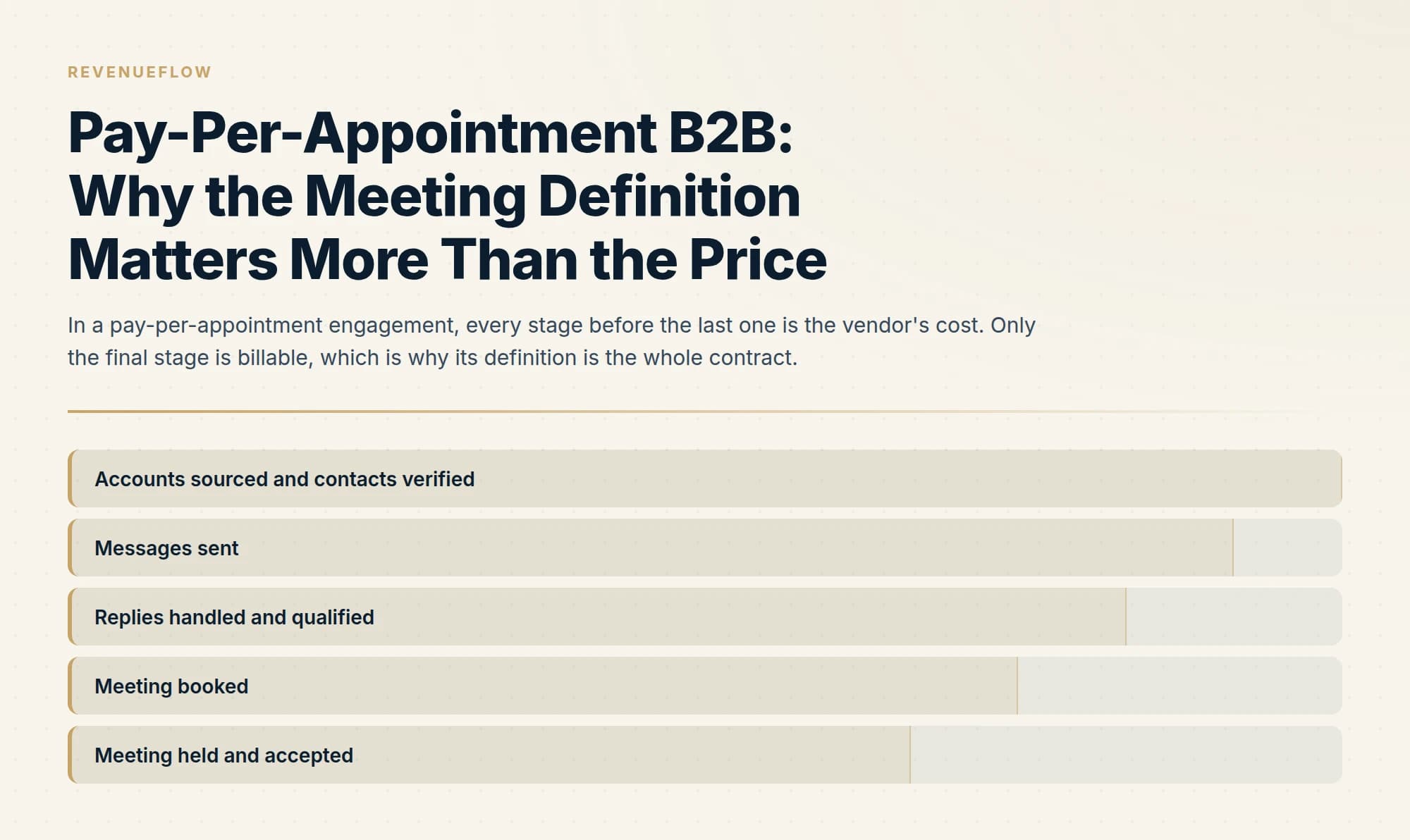
Pay-per-appointment pricing charges for each booked meeting rather than for effort, which moves delivery risk to the vendor. Because the vendor is paid per booking, the written definition of a qualifying appointment becomes the entire commercial contract and deserves more attention than the rate.
Key takeaways
- Paying per appointment transfers delivery risk to the vendor and concentrates all remaining risk onto the definition of an appointment.
- The common exploits are wrong seniority, wrong company size, a conversation agreed as a favour, no-shows counted as delivered, and the same account booked twice.
- Budget, timing and authority must not be billing conditions, because requiring them limits the vendor to prospects already in a buying cycle.
- A definition is enforceable only with a stated dispute window, rejection reasons that map to the criteria, and a named reviewer on your side.
Reviewed and updated September 2, 2026
A pay-per-appointment quote arrives with a rate per meeting on it, and almost every buyer spends the negotiation on that rate. The rate is the least consequential number in the document. Whatever it ends up being, the invoice is that rate multiplied by a count, and the count is produced by a definition that is usually one sentence long and was written by the vendor.
Get the definition right and the rate mostly takes care of itself. Get it wrong and the rate you negotiated becomes irrelevant, because you are being billed accurately for meetings you would not have bought.
What the model actually transfers
Asked plainly, how pay per meeting pricing works is a question about where payment stops: the invoice is triggered by an attended meeting that meets the written standard, and it is not conditional on that meeting becoming a customer, because conversion depends on a sales process the provider does not run.
The pay per meeting model is this arrangement described from the invoice end, and everything below applies to it unchanged, because the model is only as good as the sentence defining which meetings count.
Under a retainer, you buy effort. The vendor is paid whether or not anything lands, and the contract's job is to describe how much work happens. Under pay-per-appointment, the vendor fronts the entire cost of the programme and receives nothing until a meeting exists: list building, sending infrastructure, domains and warm-up, copywriting, reply handling, scheduling, and the chasing that turns a "sure, send times" into a slot on a calendar.
That same outcome-billing logic shows up in data supply, where FullEnrich charges only for found and verified data and a failed lookup costs the buyer nothing.
That is a genuine transfer of delivery risk, and it is the reason the model is attractive. It also has two immediate consequences that shape everything else in the agreement.
Vendor cost. Nothing is billable here.
Vendor cost, including domains, warm-up and deliverability.
Vendor cost, and most of the actual labour.
Billable only if the agreement triggers on booking rather than attendance.
The event you are actually buying.
The first consequence is that the vendor's economics depend on the count, so their incentive points at the count. That is plain arithmetic rather than a character flaw, and every commercial model puts an incentive somewhere.
The second is that the only thing standing between that incentive and your sellers' calendars is the written definition. In a retainer, a loose spec costs you some wasted activity. Here, a loose spec is a billing instruction. The definition is simultaneously the product specification, the acceptance test and the invoice line.
Five ways a loose definition gets used
Buyers who say an agency promised qualified leads that never materialize are usually describing this exact clause, because a meeting billed at booking and lost at the calendar invite is delivered on paper and absent in the room.
None of these require bad faith. A vague clause creates pressure, and pressure finds the seam.
Buyers describe the failure as receiving fake meetings with no buying intent, and the five drift patterns above are how it happens without anybody acting in bad faith: the favour meeting in particular satisfies a loose clause exactly as written, which is why the clause and not the rate is where the negotiation belongs.
Seniority drift. The clause says "decision maker" or "relevant stakeholder" and names no titles. What arrives is a coordinator, an analyst, or someone whose job touches the area without owning any part of it. They agreed to a call, they attended, and the clause is satisfied as written. The fix is either an agreed title list or an explicit responsibility test, something like "has responsibility for or influence over the relevant area", which is checkable by someone who was not on the call.
Company-size drift. "Mid-market" and "enterprise" are adjectives, and adjectives are not testable. Employee ranges, revenue bands, or a named list of qualifying attributes are. This one is easy to fix and is skipped constantly, because both sides feel they already agree about what mid-market means.
The favour meeting. Someone takes the call to be polite, or because the sender was persistent and pleasant, or because a mutual connection asked them to. Technically a conversation was agreed. What is missing is that they agreed to a business conversation about the specific topic. A definition should say so, and the calendar invite should describe the topic, which also gives you a paper trail. The tell is a run of bookings with no agenda in the invite and an attendee who opens with "so, remind me what this is about".
No-shows counted as delivered. If billing triggers on the booking, the vendor's job ends at the calendar invite and the no-show rate becomes entirely your problem. Attendance is the natural trigger because it is the moment you receive the thing you bought. Three answers are defensible: rebooked once at no charge, credited, or billed as delivered with the risk priced into the rate. Having no answer is what causes the argument, and it always surfaces during the first invoice rather than during the negotiation.
The same account, twice. Two contacts at one company inside a few weeks, or the same contact re-booked after a first meeting went nowhere. Both are second meetings dressed as first ones. A single clause handles it: billable once per account per period, unless the second meeting is with a genuinely different buying unit and was agreed in advance.
- Decision maker or relevant stakeholder
- Mid-market or enterprise company
- Prospect agrees to a meeting
- Meeting is booked
- One meeting equals one billable unit
- Named titles, or a written responsibility test for the relevant area
- Employee or revenue ranges, plus any required attributes
- Prospect agrees to a business conversation on a stated topic
- Meeting is held and the prospect participates
- One billable meeting per account per period unless separately agreed
What a defensible definition contains

The workable standard is short, and every line is something a person who was not in the room can verify afterwards.
- Yes: The company meets agreed criteria written as ranges rather than adjectives
- Yes: The attendee has responsibility for or influence over the relevant area
- Yes: The prospect agreed to a business conversation on a stated topic
- Yes: The prospect attended and participated
- Yes: The account was not on the suppression list supplied before launch
- No: The prospect confirmed a budget
- No: The prospect can sign without involving anyone else
- No: The prospect intends to buy within a stated window
- Depends: One billable meeting per account per period
The suppression line does quiet work. Existing customers, live opportunities, current vendors and partners have to be excluded by loading a list before launch, because catching them afterwards means the message already went out. If you supply that list late, a meeting with an existing customer is a dispute with no clean answer, and the honest reading is usually that it counts.
The three mechanics that make it enforceable
A definition with no enforcement machinery is a shared opinion. Three things turn it into a process.
A dispute window measured in business days. Pick a number, write it down, and state that silence means accepted. Without a clock, every invoice stays reopenable forever, which is worse for you than it sounds: a vendor who cannot forecast revenue prices that uncertainty into the rate. Short windows are fine. Three business days is enough time to notice that a meeting was wrong, and it is short enough that the reason is still fresh.
Rejection reasons that map to the criteria. A rejection cites the clause it fails. "Wrong seniority, the attendee does not own or influence this area" is a valid rejection. "The call went badly" is not, and neither is "they were not interested". This protects both sides. It shields the vendor from unfalsifiable criticism after a slow month, and it shields you from meetings that technically qualified and obviously should not have counted, because those are exactly the ones a written criterion catches.
A named reviewer. One person, named in the agreement, who flags outcomes in the shared channel. The route matters as much as the name. When rejections travel by email to whoever happens to be around, they arrive after the window and get argued rather than processed.
Why budget, timing and authority stay out of the billing

This is the most common amendment a buyer proposes, and it quietly breaks the model.
Requiring confirmed budget means the vendor can only bill for people already in a buying cycle. That population is a small fraction of your market, and it is not the fraction outbound is good at reaching. Outbound's actual job is the company that has the problem and has not started shopping. Filter to in-market only and you are paying outbound rates to compete inside evaluations that already have three vendors in them.
Timing conditions do the same thing with a different word. A prospect who says "not this year" in the first conversation is frequently a real opportunity next year, and the meeting is how you found out. Authority conditions are worse, because most B2B purchases involve several people and the first conversation is rarely with whoever eventually signs.
There is a version of this that works. Keep budget, timing and authority as qualifying questions the setter asks and reports back, so your team can prioritise the calendar and prepare properly. What you avoid is letting the answers decide whether the meeting is billable. The information is useful. As a billing condition it converts your outbound programme into an expensive way to find people who were already shopping.
Teams often propose adding two or three screening questions for cold email leads before a meeting is booked, and that is the right instinct in the wrong place: ask them and report the answers so the calendar can be prioritised, and keep them out of the criteria that decide whether the meeting is billable.
What a tighter definition does to the rate
It raises it, and that is correct. Every criterion you add moves work from the billable side of the vendor's ledger to the unbillable side, so their cost per accepted meeting goes up and the rate follows.
The negotiation that goes wrong is the one where a buyer pushes the rate down and leaves the definition loose. That trades a number you can see for a number you cannot audit, and the difference reappears as sales hours spent on meetings that should never have been booked. Fix the definition first, then discover what the rate is. If a vendor will not price against a tight definition, that is useful information delivered early and cheaply.
Published rates hide the same ambiguity elsewhere in the stack, since LeadMagic prints two per credit rates for one plan and each rests on a different billing clock.
For how the other commercial models handle the same risk, the appointment setting agency guide covers the retainer and hybrid structures, and outsourced SDR pricing sets out how to normalise quotes with different billing units onto one comparable number. What the major vendors actually publish, including which of them commit to an appointment count at all, is in appointment setting companies.
When the model is the wrong purchase

Pay-per-appointment needs three conditions, and the absence of any one of them is a reason to buy differently.
You need to be able to write down what a good meeting looks like. If your qualification is genuinely instinctive and lives in one senior seller's head, the model has no acceptance test and both sides will be unhappy by month two.
You need a market with room in it. A vendor working a universe of four hundred accounts against a per-meeting rate will burn through it quickly, because their incentive is the count and there is nowhere else to go. Narrow markets are usually better served by a retainer where you direct the pace.
And the meeting has to be the actual constraint. If meetings already happen and do not convert, buying more of them makes the same problem more expensive. That is a positioning or sales-execution issue, and no commercial model fixes it. The framework for deciding which purchase fits your bottleneck is in appointment setting versus lead generation.
The short version
Pay-per-appointment moves delivery risk onto the vendor, which is the point of it, and concentrates the entire agreement into one definition. A loose definition is exploited through seniority drift, size drift, favour meetings, no-shows billed as delivered, and the same account booked twice, none of which requires anyone to act in bad faith. A defensible definition uses ranges rather than adjectives, requires attendance and participation, and is enforced by three mechanics: a dispute window in business days with silence meaning accepted, rejections that cite the criterion they fail, and one named reviewer. Keep budget, timing and authority as questions the setter asks, never as conditions on the invoice.
Vendor claims about delivery quality are only as good as the pages that back them up, and a case where those pages vanished shows what that absence can mean.
RevenueFlow is paid on attended meetings that meet criteria agreed in writing before anything sends, which is the same structure described above. You can see what a campaign would look like for your market.
Frequently asked questions.
Frequently asked questions- How does pay per appointment pricing work?
- You pay an agreed amount for each meeting the vendor books that meets a written definition, rather than paying a retainer for effort. The vendor carries the cost of outreach and only earns on delivered meetings, which shifts delivery risk from you to them.
- What are the risks of paying per appointment?
- The vendor is paid to book, so a loose definition gets tested. The usual failures are meetings with the wrong seniority or company size, prospects who agreed as a courtesy, no-shows billed as delivered, and repeat bookings at one account. A tight written definition addresses all of them.
- Should budget be part of a qualified meeting definition?
- No. A first conversation is where budget gets discovered, so requiring it beforehand restricts the vendor to prospects already in a buying cycle, which is a small fraction of the market and not the part outbound reaches well. It converts outbound into an expensive way to find active shoppers.
- What happens if a prospect does not show up?
- Agree it in advance, because it is the most common dispute in this model. Rebooking, crediting or billing are all defensible positions. What is not defensible is leaving it unstated, since the vendor and the buyer will each assume the interpretation that favours them.
About the author.

Ben Carden is CRO at RevenueFlow, which builds and operates outbound revenue engines for B2B companies. Previously at Gartner Enterprise. Studied at London School of Economics.
Ben Carden · CRO
Connect on LinkedIn →Explore more.
Ready to scale your outreach?
We build GTM engines that book real meetings. See the receipts.
Related articles.
Last Outbound Agency Did Not Deliver: Locating the Failure
The leads were bad names a symptom and no stage. Four places an outbound engagement fails, the counts that separate them, and what to change in the next purchase.
Call Centre Appointment Setting: Fit and What to Pay For
A volume model suits a large market and a simple offer. The fit test, the incentive problem inside paying per booking, and the terms to settle before the first dial.
Lead Verification: What Each Check Actually Proves
Lead verification covers two different jobs. One asks whether a mailbox will accept mail, the other asks whether the person behind the row is real and lawful to contact.
ABM Metrics: Coverage Decides Every Other Number
Every published ABM metric is a ratio whose denominator somebody chose. Six numbers, the denominator each one needs, and the comparison that settles it.
5 ABM Campaign Examples and How Each One Is Built
Five worked account-based campaign examples, each built on the same five fields: account set, tier, plays in order, owner and handoff, and the exit condition.
Blue Zebra Appointment Setting: The Vendor's Pages Are Gone
Search results still describe a B2B appointment setting firm at this address. The pages themselves return 404 and the domain now serves something else entirely.