5 ABM Campaign Examples and How Each One Is Built
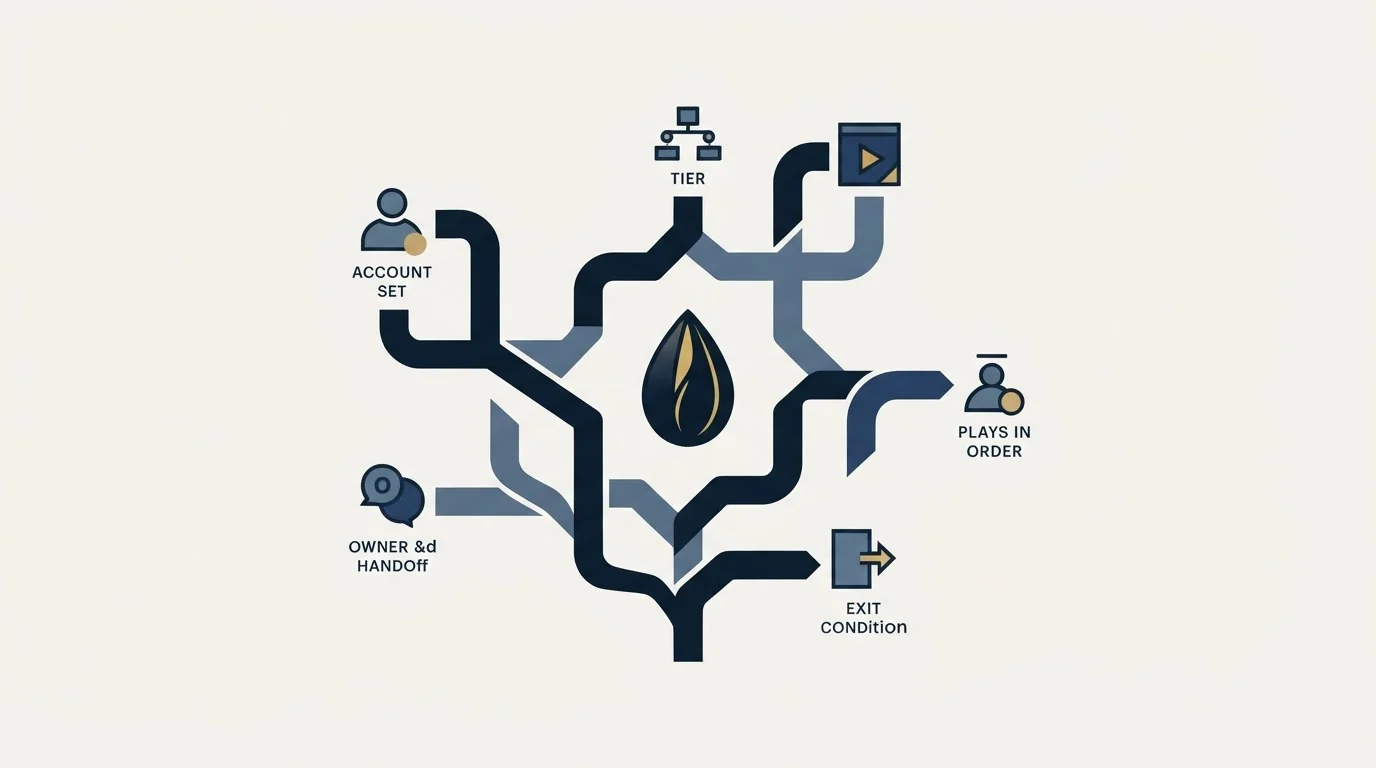
Five worked account-based campaign examples, each built on the same five fields: account set, tier, plays in order, owner and handoff, and the exit condition.
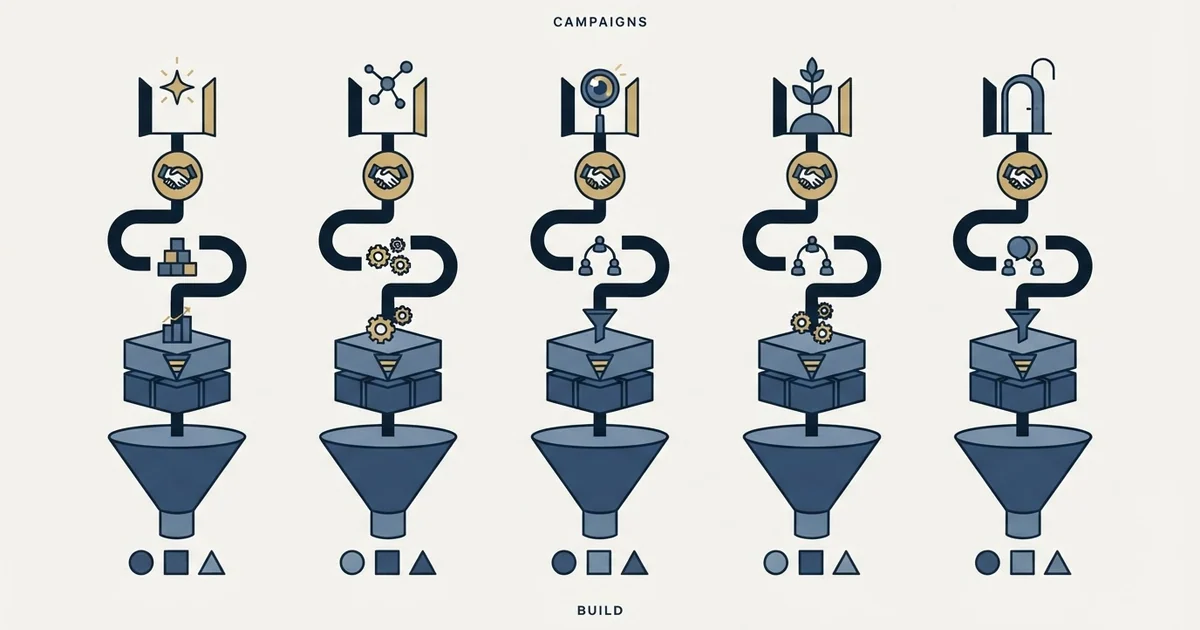
ABM email examples differ by tier. A one to one email carries a point of view written for a single account, a one to few email carries a shared premise plus one verified sentence, and a one to many email carries a premise true of every account. Each sits inside a campaign of five fields, from account set to exit.
Key takeaways
- An ABM email is one component of a campaign; the tier decides whether it carries a bespoke point of view, a shared premise with one verified sentence, or a single field of variation.
- Every ABM campaign needs five fields: the account set with its admission rule, the tier, the plays in order, the owner and the handoff, and the exit with a review date.
- Every account set needs a dating rule, because a trigger from four months ago describes a situation that has already resolved.
- An account belongs to exactly one live campaign, with the more recent trigger winning, or two premises reach one buyer in the same week.
Reviewed and updated September 21, 2026
Ask for an ABM campaign example and what usually arrives is an email. A well written email, aimed at a named stakeholder, with a personalised first line. That is a message, and a message is one component of a campaign in the same way a stage is one component of a pipeline.
A campaign is the whole apparatus: which accounts are in it and why, what tier they sit at, what happens on each channel and in what order, who owns the account when something moves, and the condition under which the campaign stops. Five worked examples follow, each built on the same five fields, and every company, figure and outcome in them is invented for this article rather than taken from any real programme.
That apparatus is what separates ABM campaigns from a set of well written emails aimed at the same list, and the five fields below are its parts.
If the practice itself is new, what ABM is and what it is not settles the definition first, and the account based marketing strategy covers the account selection and tiering decisions that sit upstream of everything here.
The five fields every ABM campaign needs
A campaign that is missing any one of these is not runnable by anybody except the person who invented it.
The same test applies to scheduled series, where drip examples fill in one template whose missing field is the permission basis behind a second and third message.
The account set, and how it was built. Not a segment description. The actual list, with the rule that admitted each account written down so somebody else can reproduce it next quarter.
The tier. How much human attention each account gets. Tier one means an account researched and addressed individually. Tier two means a cohort of accounts sharing one situation, addressed with one premise and light per account variation. Tier three means a large set addressed programmatically. The tier is a budget decision expressed as a research decision.
The plays, in order. What happens on which channel, to which roles, and what triggers the next move. This is where most campaign documents become a list of assets instead.
Each play still needs words that land, and seven pitch formats with the script written out separate the spoken openers from the paragraph a champion forwards.
The owner and the handoff. One name owns the account. A second name may own the reply. The moment the two change hands has to be written down, because it is the moment accounts get dropped.
The exit. What ends an account's participation, and the date the campaign itself is reviewed. Without both, an ABM campaign becomes a permanent condition of the account list.
ABM email examples, one per tier
An ABM email example only makes sense with its campaign attached, because the tier decides what the email may say. At one to one, it carries a point of view written for a single account. At one to few, a shared premise plus one verified sentence. At one to many, a premise true of every account by construction. One of each follows, all invented.
Tier one, from example one below. The contract lifecycle vendor writes to the general counsel of an acquiring manufacturer, naming the two entities being merged and the contract volume implied.
To: General counsel, [Acquirer] · Subject: [Acquirer] and [Target], two contract estates
When the purchase of [Target] completes, your team inherits its [number] supplier contracts on terms and templates that differ from yours. 1
We work on that integration problem for manufacturers after an acquisition, bringing both estates into one register before the first renewals fall due. 2
We wrote up what [Target]'s contracts imply for your next two quarters on a page built for [Acquirer]: [link]. Worth 20 minutes? 3
- 1The two hours of research, visible: both entities and the contract volume, true of this account alone.
- 2One sentence of what the vendor does, framed as that account's problem.
- 3The account specific landing page carries the long form, so the email stays short.
Tier two, from example two. One premise for sixty accounts, and one verified sentence per account naming the posting.
Subject: your first RevOps hire
[Company]'s posting for a [RevOps role], opened on [date], is the first RevOps role on your careers page. That hire will need one view of pipeline to start from, and we build that view for a first RevOps hire in their first week. Worth a look before they start?
Tier three, from example five. Eight hundred accounts, one field of variation, a deadline every one of them shares.
Subject: [regulation], [deadline]
Every [vertical] firm above [headcount] has to meet [requirement] under [regulation] by [deadline], [Company] included. We help security teams in [vertical] assemble that evidence ahead of the date. If it is on your list this quarter, would a 20-minute walkthrough help?
The difference between the three is where the research is visible. In the tier one email it is the whole first line; in tier two it is one sentence; in tier three it is a single field, and the premise does the rest.
Example one: the tier one executive campaign
Invented scenario. A company selling contract lifecycle software builds a set of twelve accounts, each a manufacturer that has announced an acquisition in the last two quarters. Every figure below is invented for the example.
Account set: twelve accounts, admitted by a public acquisition announcement dated within one hundred and eighty days.
Tier: one to one. Each account gets two hours of research and a named point of view about its specific integration problem.
Plays in order: a written account point of view sent to the general counsel, naming the two entities being merged and the contract volume implied. A parallel note to the operations lead framing the same problem as a throughput question. A physical package to the executive sponsor only after one of the two has replied. An account specific landing page carrying the point of view in long form, linked from both messages.
Owner and handoff: one account executive owns all twelve. Replies route to that person directly and never to a shared inbox.
Exit: an account leaves on a meeting, on an explicit no, or ninety days after the acquisition announcement, whichever comes first. The campaign is reviewed when all twelve have exited.
What makes this a campaign rather than a mailing is the ordering rule. The package is expensive and it is conditional on a reply, so the cost per account is bounded by a response rather than by the list size.
Example two: the tier two cohort campaign
Invented scenario. A revenue intelligence vendor targets sixty accounts that have posted a first RevOps role in the last sixty days.
Account set: sixty accounts, admitted by an open job posting for a named role, checked from the posting itself rather than from a signal vendor's score.
Tier: one to few. The accounts share one situation, so they share one premise, and the per account work is one verified sentence rather than a bespoke argument.
Plays in order: one email to the vice president of sales carrying the shared premise, with the account specific sentence naming the posting. A connection request to the same person on the same day, with no message attached. A separate campaign three weeks later to the head of marketing at the accounts that did not reply, built on a different premise rather than a reminder.
Owner and handoff: an SDR owns the list and works replies. The account executive is introduced only at the meeting.
Exit: on a meeting, on an opt out, or when the posting is filled, which is checkable and is the honest end of the premise.
The second wave is the part worth copying. It is a new campaign with a new audience and a new argument, not a follow up under the first message. Our own position on this is a hard rule: one message per campaign, no bumps and no thread replies, and a second approach earns its place on merit rather than on persistence.
Example three: the competitor renewal campaign
Invented scenario. A data enrichment vendor builds a set of forty accounts known to be using a competing product, timed against renewal windows the team has inferred from public case study publication dates. All figures invented.
Account set: forty accounts, admitted by a public reference to the competitor on the account's own site or in the competitor's published customer list.
Tier: one to few, with an account specific fact required before any account is contacted.
Plays in order: a single email to the data owner that concedes the incumbency in the first sentence and moves to the specific gap. A comparison page linked from that message and from nothing else. A short written teardown offered as the reply, produced only for accounts that answer.
Owner and handoff: the account executive owns the account throughout, because the conversation goes technical within one exchange.
Exit: on a meeting, on an explicit no, or when the inferred renewal window closes.
The discipline here is what does not happen. Nobody claims the competitor is bad, no invented switching statistic appears anywhere, and the teardown is produced on request rather than in advance, which caps the cost at the accounts that engaged.
Example four: the expansion campaign
Invented scenario. A workforce analytics vendor runs a campaign into twenty five existing customers where only one business unit has bought.
Account set: twenty five current customers with a single active business unit and at least two other units visible on the org chart.
Tier: one to one, using information the company already holds.
Plays in order: an internal briefing to the customer success manager first, because the play fails if the account team hears about it from the buyer. A note from the existing champion to the second unit's leader, requested rather than drafted for them. A separate seller led approach only where the champion declines or does not answer within two weeks.
Owner and handoff: customer success owns the account, the account executive owns the new unit, and the handoff moment is the introduction.
Exit: on a meeting with the second unit, on a decline from the champion followed by a decline from the seller led approach, or at sixty days.
This is the example that gets skipped, and it has the shortest path to revenue, because the identity problem and the credibility problem are already solved.
Example five: the tier three programmatic campaign
Invented scenario. A cybersecurity vendor addresses eight hundred accounts in one vertical at a research cost of roughly two minutes per account. Invented figures throughout.
Account set: eight hundred accounts in one regulated vertical above a stated headcount, with a compliance deadline in common.
Tier: one to many. The premise is true of every account by construction, and the per account fact is a single field rather than a paragraph.
Plays in order: one email to a single named role at each account, built on the deadline. Advertising to the same set, running for the campaign's duration, carrying the same premise rather than a brand message. Nothing else.
Owner and handoff: replies route to a pooled queue with a named owner per day and a stated response window.
Exit: on a reply, on an opt out, or at the compliance deadline, after which the premise is no longer true and the campaign is retired rather than reworded.
Plotted by account count, the five examples sort themselves: twelve and twenty five accounts at one to one, forty and sixty at one to few, eight hundred at one to many. The count follows from the research budget, which is why a tier one campaign stays in the tens.
What breaks these campaigns

Four failures recur, and none of them is a copy problem.
The trigger has decayed. A hiring signal from four months ago describes a situation that has already resolved. Every account set above carries a dating rule for exactly this reason.
Two campaigns are working one account. Two premises reaching one buyer in a week is invisible from inside either campaign. An account belongs to one live campaign, with the more recent trigger winning.
The handoff is undefined. The account moves from marketing to a seller, or from customer success to a seller, and nobody agreed which day that happens on. Accounts do not fail loudly at this point, they simply stop.
Nobody retires it. A campaign with no review date becomes the permanent state of the account list, and its results stop being readable because it has no boundary.
| What breaks | The field that prevents it |
|---|---|
| The trigger has decayed | Account set: a dating rule on the admission rule |
| Two campaigns work one account | Account set: one live campaign per account, the more recent trigger winning |
| The handoff is undefined | Owner and handoff: the day the account changes hands, written down |
| Nobody retires it | Exit and review: a stop condition and a review date |
The message layer inside all of this is a separate craft with its own failure modes, and where the programme sits beside the rest of a demand model is covered in B2B account based marketing. Where the per account research has to scale beyond what a person can write, ABM personalisation at scale covers what actually survives automation. And when a vendor's published campaign results are offered as evidence, how to read an ABM success story walks through what those pages disclose and what they leave out.
The short version
An ABM campaign is five fields: the account set with its admission rule, the tier, the plays in order, the owner and the handoff, and the exit with a review date. A document missing any of them is a description rather than something a second person can run.
Tier is the budget decision. One to one buys a point of view per account, one to few buys a shared premise with one verified sentence, one to many buys reach with a premise that is true by construction. Choose the tier from the account count and the value, then design the plays to fit it.
Give every account set a dating rule, because a trigger that has decayed produces a message about a situation that has resolved. Give every campaign a stop condition, and let an account belong to only one live campaign at a time.
Every example on this page is invented as an illustration. The transferable part is the structure and the ordering rule; the situation has to come from the accounts in front of you. Where the constraint is that too few of the right accounts are hearing anything at all, see what a first campaign produces against your market.
Frequently asked questions.
Frequently asked questions- What does a good ABM email look like?
- It depends on the tier. A one to one email opens on research true of that account alone, such as the two companies in an acquisition and what it does to their contracts. A one to few email shares one premise across a cohort and adds one verified sentence per account. A one to many email rests on a premise every account shares, such as a compliance deadline.
- What is the difference between an ABM campaign and an ABM email?
- An email is one component. A campaign carries the account set and the rule that admitted each account, the tier deciding how much research each account gets, the plays in order across channels and roles, the owner and the handoff moment, and the exit condition. Without those five, what you have is a message that a second person cannot run.
- How many accounts should a tier one ABM campaign have?
- Few enough that every account gets genuine individual research, which in practice means tens rather than hundreds. The count follows from the research budget rather than the other way round. If the per account work has quietly become one merge field, the campaign has become tier two and should be priced and judged as tier two instead.
- Should an ABM campaign use follow-up sequences?
- Our own practice is one message per campaign, with no bumps and no thread replies. That is more demanding than a cadence, because each message has to earn a reply on its own rather than relying on the next one to recover.
About the author.

Ben Carden is CRO at RevenueFlow, which builds and operates outbound revenue engines for B2B companies. Previously at Gartner Enterprise. Studied at London School of Economics.
Ben Carden · CRO
Connect on LinkedIn →Explore more.
Ready to scale your outreach?
We build GTM engines that book real meetings. See the receipts.
Related articles.
ABM Metrics: Coverage Decides Every Other Number
Every published ABM metric is a ratio whose denominator somebody chose. Six numbers, the denominator each one needs, and the comparison that settles it.
Two Agencies, One Target List: Who Owns Which Accounts
Two outbound suppliers on one market will contact the same companies unless the buyer splits it first. How to cut the list, run the exclusion feed and check the overlap.
Last Outbound Agency Did Not Deliver: Locating the Failure
The leads were bad names a symptom and no stage. Four places an outbound engagement fails, the counts that separate them, and what to change in the next purchase.
HR Lead Generation: The Renewal Clock and Who Signs
An HR buyer who agrees with every word still cannot act outside their own renewal window. Which triggers are observable, and who signs.
IT Lead Generation: The Buyer Runs Your Playbook
Technology buyers evaluate outbound for a living, and their purchases carry a security review nobody in your meeting owns. Which triggers are real.
When Outbound Stops Scaling: What Breaks First
Doubling the budget rarely doubles the meetings. The five constraints that bind in order, the signature each one leaves in the numbers, and what actually buys more.