ABM Personalization at Scale: Automated vs Manual
Retrieval automates well and judgement does not. The three tiers of personalization, what we automate in every build, and the failure modes worth designing against.
Automate contact resolution, grounded research retrieval, copy assembly against a human-written template, and the gates that run before sending. Keep the angle, the claims about your own results, the offer and the named-account tier manual. The test for any grounded detail is whether the next sentence changes without it.
Key takeaways
- Personalization has three tiers: field-level, which only has to be correct, grounded facts from a source that was actually read, and human judgement about the account.
- A grounded detail earns its place only if the following sentence would change were the detail different, which rules out most true but pointless observations.
- Check the rendered output rather than the source field, because empty greeting tokens and malformed company names both pass a source-level check.
- A sharp generic message outperforms a soft personalized one, and it costs less to produce, so the long tail of a list should get segment copy rather than weak personalization.
Reviewed and updated September 2, 2026
The most expensive personalization failure we see is not a broken merge field. It is a paragraph of correct, specific, verifiable detail about a company that gives the reader no reason to reply. The research was real, the sentence was accurate, and the email still went nowhere, because personalization was treated as the goal rather than as the setup for a point.
That distinction is the whole of personalization at scale. Some of the work is retrieval, and machines are now genuinely good at it. Some of the work is judgement about what to say, and that has not moved.
The term itself, its three settings and why it is not the same property as relevance are set out in sales personalization.
The three tiers, and what each one costs
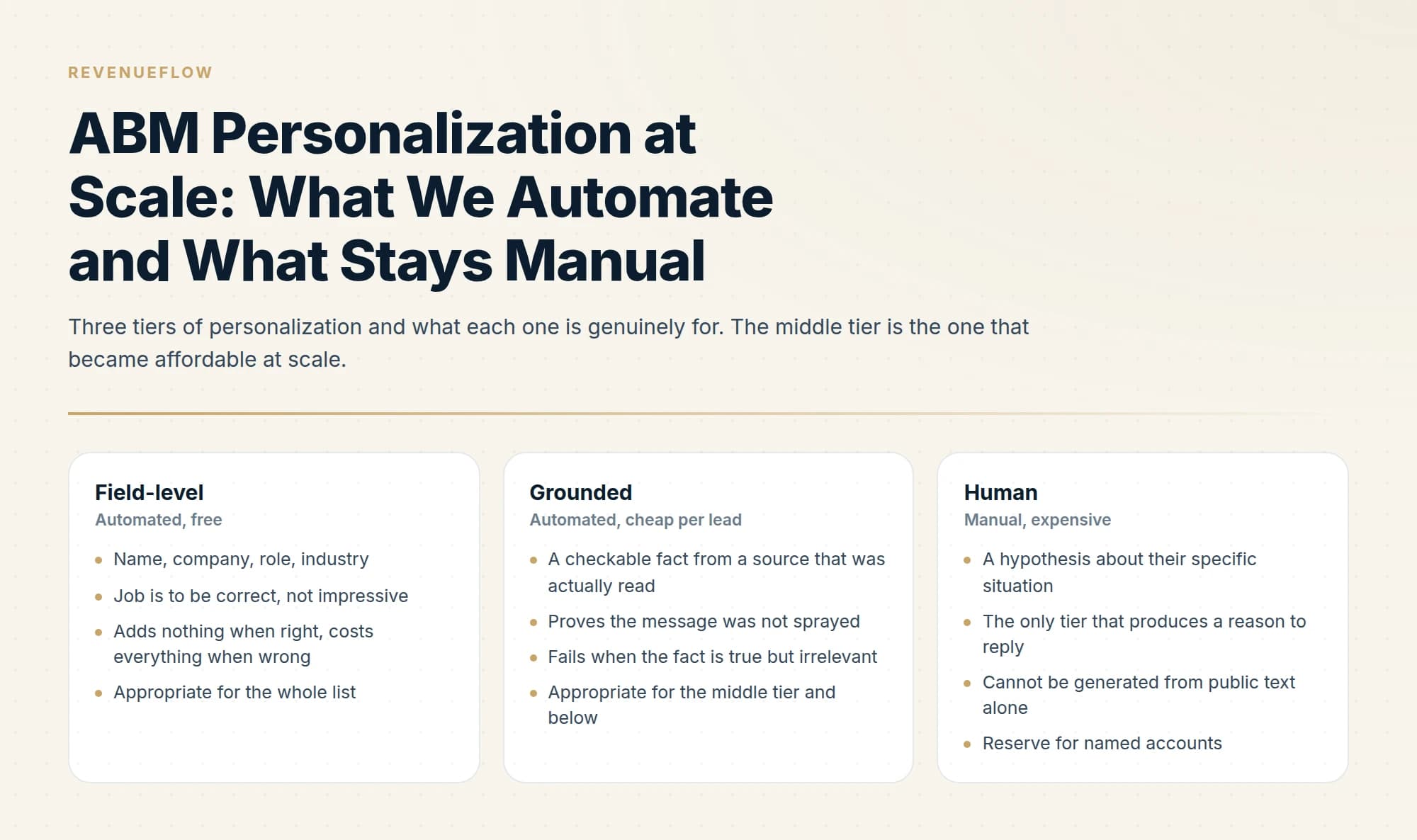
Personalization is a spectrum with three usable settings, and the mistake is applying one setting to an entire list.
Field-level. Name, company, role, industry, location. Cheap, automatic, and worth almost nothing on its own, because the reader knows a database produced it. Its actual job is to not be wrong.
Grounded. A specific, checkable fact about the company drawn from a source you actually read, most often their own website. What they sell, a service line, a location count, a recent launch, a job posting. This is the tier that changed, because retrieval and summarisation got reliable enough to do it at list scale.
Human. A point of view about their situation that required someone to think. A hypothesis about why a thing is hard for them specifically, an observation about their market, a reason your offer applies to them and not to their competitor.
- Name, company, role, industry
- Job is to be correct, not impressive
- Adds nothing when right, costs everything when wrong
- Appropriate for the whole list
- A checkable fact from a source that was actually read
- Proves the message was not sprayed
- Fails when the fact is true but irrelevant
- Appropriate for the middle tier and below
- A hypothesis about their specific situation
- The only tier that produces a reason to reply
- Cannot be generated from public text alone
- Reserve for named accounts
What we automate
Four things, in every account-based build we run.
Company and contact resolution. Finding the right people at the right companies, and verifying the addresses before anything sends. This is mechanical and unforgiving, and it is where most list quality actually lives.
Grounded research retrieval. Reading the company's own site and pulling out what they sell, in their words. The constraint we hold is that the model may only use text that was actually retrieved from a source. A model asked to describe a company from memory will produce something plausible and occasionally libellous.
Copy assembly against a template. Rendering the grounded fact into a message whose angle, offer and claims were written by a person and approved once, rather than generated per lead.
The gates. Automated checks that run before anything sends: verified addresses, no empty merge values, no unresolved template tokens, no company display value that would render as nonsense, and suppression against customers, live opportunities and anyone who has already said no.
Automated gates like these often live inside outbound tooling, and knowing what the lemlist API can automate helps decide where to build checks.
That last one is unglamorous and is where automation earns its place. A human reviewing 2,000 rendered emails will miss the eleven that are broken. A check that enumerates every field will not.
- Step 1Human writes the angle
The claim, the offer, the reason for writing and the banned phrases. Approved once, before any generation.
- Step 2Retrieve grounded evidence
Read the company's own pages. No fact enters the message that did not come from a retrieved source.
- Step 3Assemble against the template
The grounded detail slots into a structure a person wrote. Angle is fixed, evidence varies.
- Step 4Gate before send
Verified addresses, no empty tokens, no malformed company names, suppression applied. Failures are removed, not repaired in flight.
What stays manual, permanently

The angle. Why this segment should care, right now. Generated angles converge on the same three ideas because the training data converged on them first.
Any claim about us. Numbers, outcomes, client names, guarantees. A model asked to be persuasive will produce a specific-sounding number, and a specific-sounding number that is not true is the fastest way to lose a client. Every claim in a message we send is one a person can point at a source for.
The offer. What you are actually asking for and what they get. This is a commercial decision.
Named accounts. The top tier of an account list should be written by a person, because the whole justification for that tier is that the treatment is worth more than the automation costs. Automating the tier whose premise is bespoke attention removes its reason to exist.
Tiering decisions become concrete when the whole apparatus is written down, and five worked account-based campaigns set out the account set, tier, plays, owner and exit condition for each.
The failure modes worth designing against
Three of these account for most of what goes wrong, and all three are cheap to prevent and embarrassing to discover live.
The empty token. A greeting rendered from an empty first name produces "Hey ," in a stranger's inbox. Resolve greetings at build time rather than trusting a merge tag to have a value, and reject the row if it does not.
The garbage company name. Company fields arrive as legal entities, taglines, all-caps brand styling and truncated strings with an unclosed bracket. Interpolated into a sentence, those read as machine output no matter how good the rest is. Check the rendered value, not the source field.
The true but pointless fact. "I saw you have three offices in the Midwest" is accurate, retrievable, and gives the reader nothing. The test for a grounded detail is whether the following sentence would be different if the detail were different. If the message reads identically with the fact removed, remove it.
- Yes: The fact came from a source that was actually read
- Yes: The next sentence changes if the fact changes
- Yes: A person could verify it in under a minute
- Yes: The rendered value has been checked, not just the source field
- No: The line would read the same for any company in the segment
- No: It states a number or outcome about us that nobody can source
Quality control when nobody can read every message
At any real volume the review question becomes uncomfortable: nobody is reading 2,000 messages, so what exactly is being checked?
The answer that works is to check the space rather than the sample. A rendered message is one draw from a set of possible outputs, so reading fifty of them tells you about fifty draws and nothing reliable about the rest. Two habits follow.
Enumerate what is enumerable. If the copy has variable phrasing, generate every combination and read them, rather than sampling rendered rows. A clumsy pairing between two variable clauses appears in a fraction of sends and will not show up in any sample small enough to read, and enumeration finds it in seconds.
Check every value of every field that reaches copy. Company display names are the usual offender, because the distribution has a long tail of legal entities, all-caps styling, taglines and truncated strings. Sorting the distinct values by length and reading both ends of that list takes a few minutes and catches almost everything.
The residual risk is the row that is individually plausible and collectively wrong: a valid mailbox at the wrong company, a person who has changed jobs, a company name that is a real word. Those are caught by verification and by suppression rather than by reading, which is the argument for the gates running automatically rather than as a review step someone performs when there is time.
Volume changes the arithmetic, not the standard

At fifty accounts, a person can write fifty messages and should. At five thousand, grounded automation is the only way the messages get sent at all, and the question becomes how much quality you lose per row.
The answer depends almost entirely on how much of the message is fixed. A template where the angle, offer and claims are human-written and only the evidence varies loses very little. A template where the model is asked to decide what to say loses most of it, because the interesting judgement was the part delegated.
There is a hard limit worth knowing. We run one message per campaign, no follow-up sequences and no bumps. That constraint sharpens personalization rather than weakening it: the message has to work on its own, so a weak grounded detail has nowhere to hide behind three follow-ups.
The mechanics of building this at list scale are covered in our guides to personalization at scale in Clay and advanced email personalization. The tiering decision that determines which accounts get which treatment sits upstream, in building a target list you can actually work.
The compounding cost of a wrong detail
One asymmetry justifies most of the caution above. A correct personalized detail earns a small amount of attention. An incorrect one costs the account.
A prospect who reads a confident sentence about their business that is wrong learns something specific: that the sender did not check, and that anything else in the message is equally unchecked. That judgement is reasonable and it is not recoverable in a later message, because you will not get one.
The failure is worse in account-based work than in broad outbound, because the target list is finite and chosen. Burning a random address from a large pool costs you a fraction of a percentage point. Burning one of fifty named accounts costs two percent of the programme, and the account was selected precisely because it was worth having.
That is why the retrieval constraint is absolute rather than a preference. A detail that came from a retrieved page can be wrong if the page is out of date, which is a manageable risk. A detail a model produced from memory has no error rate you can reason about at all, and it will be delivered with exactly the same confidence.
Where the budget should actually go
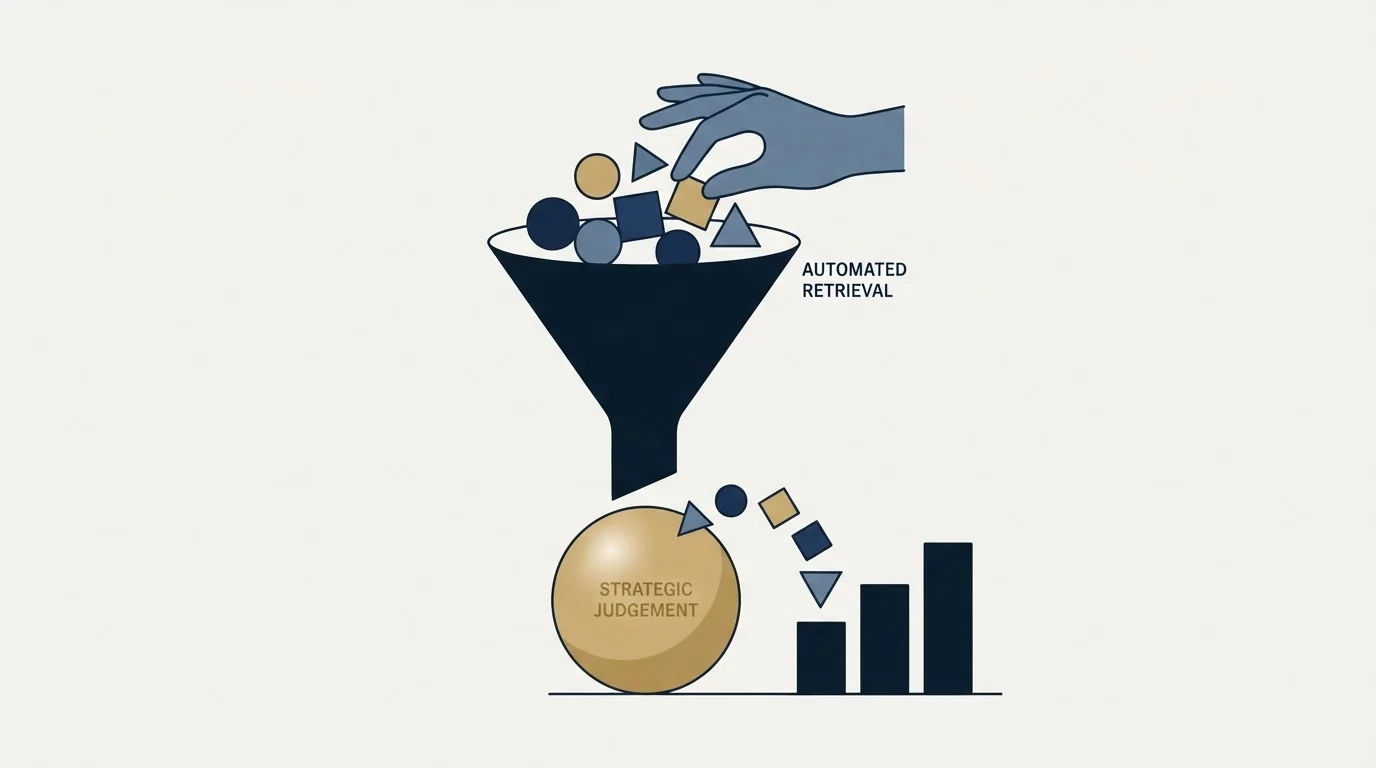
Given a fixed personalization budget across a tiered list, the allocation that works is uneven and deliberate.
The named tier gets human writing, because the deals justify it. The middle tier gets grounded automation with a human-written angle per cluster, which means the writing effort is spent once per cluster rather than once per account. The long tail gets a strong segment message with field-level accuracy and nothing more, because a weak attempt at personalization reads worse than an honest, well-argued segment email.
That last point is the one teams resist. A generic message that makes a sharp argument beats a personalized message that makes none, and the personalized one costs more to produce.
What each tier needs in the way of supporting assets is a separate question, covered in ABM content strategy for a 50-account list. If you are weighing whether to run this in house at all, the ABM agency buyer's guide covers where an outside team has genuine leverage and where it does not.
The short version
Automate retrieval, assembly and the gates. Keep the angle, the claims, the offer and the named accounts human. Test every grounded detail by asking whether the next sentence would change without it, and check the rendered output rather than the source field. Spend the personalization budget unevenly, because a sharp generic message outperforms a soft personalized one at every tier.
If you want to see what grounded per-account messaging looks like against your own target list, you can see what a campaign would look like for your market.
Frequently asked questions.
Frequently asked questions- Can AI personalize cold emails at scale?
- It can retrieve and assemble at scale, which is genuinely useful. It should not decide what to say. A workable split is a human writing the angle, offer and claims once, then automation grounding each message in facts retrieved from that company's own pages. Where the model chooses the argument, quality collapses toward the same three generic ideas.
- What is grounded personalization?
- Using a specific, checkable fact about a company that came from a source you actually retrieved, most often their own website, rather than from a model's memory. The constraint matters: a model asked to describe a company without retrieval produces something plausible and occasionally false, and a false detail in a first message is worse than no detail.
- How much personalization does a cold email need?
- Enough to prove the message was not sprayed and to set up a point worth reading. One grounded detail that changes the sentence after it is usually sufficient. Three paragraphs of accurate research with no argument attached will not get a reply, and it is the most expensive way to not get one.
- What are the most common personalization failures?
- An empty merge token rendering a greeting with no name, a company field carrying a legal entity or truncated string that reads as machine output, and a detail that is true but changes nothing in the message. The first two are prevented by checking rendered output before sending, and the third by a human reading the line.
About the author.

Ben Carden is CRO at RevenueFlow, which builds and operates outbound revenue engines for B2B companies. Previously at Gartner Enterprise. Studied at London School of Economics.
Ben Carden · CRO
Connect on LinkedIn →Explore more.
Ready to scale your outreach?
We build GTM engines that book real meetings. See the receipts.
Related articles.
BASHO Email: Four Sentences Built on One Insight
A BASHO email is four or five sentences built on one researched insight about a specific person. The format is documented, and it cannot be produced at volume.
Can Buyers Tell an Email Was Written by AI?
Buyers are not running a classifier on your cold email. What they react to is a message containing nothing only somebody who looked could have written.
Cold Email Frameworks: Which One Fits Your Offer
AIDA, PAS and Before-After-Bridge arrange the same four elements in different orders. What each one assumes about the reader, and what none of them fix.
What a Cold Email Is, and What Separates It From Spam
A cold email is a first business email to somebody with no prior relationship with you. What that one condition rules in, rules out, and demands technically.
The Cold Email Signature Is an Identity Claim
A recipient who is mildly interested and mildly suspicious checks that you exist before replying. The signature is where that check either resolves or does not.
Cold Email Marketing Service: Four Things, One Name
An agency, an infrastructure provider, a software onboarding tier and a freelancer all use the phrase. What each hands over, and the four questions that tell them apart.