Sales Personalization: What Earns the Line Its Place
Sales personalization is the practice of shaping an outbound message around a specific, checkable fact about the recipient's company or role, so the argument applies to them rather than to their segment. It runs at three settings, field-level, grounded and judged, and only the judged setting, written by a person, supplies a reason to reply.
Key takeaways
- Sales personalization is a property of the message: a correct merge field changes nothing about whether the message deserves an answer.
- Useful company information is a fact the company published about itself that changes what the message argues, such as what it sells, a role it is hiring for or a service line it launched.
- Personalization and relevance are different properties; if the next sentence would read the same with the personalized fact changed, the fact comes out.
- Woodpecker's benchmarks page shows the first-name merge tag in four of the ten subject lines used by the most companies on its platform, which is why field-level detail earns nothing.
Sales personalization is the practice of shaping an outbound message around a specific, checkable fact about the recipient's company or role, so that the argument the message makes applies to them rather than to their segment. It is a property of the message, not of the tooling: a merge field carrying a first name is personalization in the literal sense and changes nothing about whether the message deserves an answer.
The word covers two different activities that get one name. One is retrieval, which is finding a true fact about a company. The other is judgement, which is deciding what that fact means for the reader and what to say because of it. The two get conflated, and an argument about personalization is usually an argument about which of them somebody means.
What sales personalization covers
Sales personalization covers three settings of the same idea: field-level detail a database fills in, grounded facts retrieved from a source somebody read, and judged views about the reader's situation that a person has to write. They cost different amounts and buy different things, and only the third supplies a reason to reply.
Field-level. Name, company, job title, industry, city. It is produced by a database and the reader knows it. Its only job is to be correct, because a wrong one is expensive and a right one earns nothing.
Grounded. A specific fact about the company drawn from a source somebody actually read: what they sell, how many locations they run, a role they are hiring for, a service line they launched. This is the setting that changed, because retrieval got cheap enough to run over a whole list rather than over a shortlist.
Judged. A view about the reader's situation that required a person to think. Why this is hard for them specifically, what their market is doing to them, why the offer applies here and not to the company next door. Nothing produces this from public text alone.
Field-level detail is also the default. Woodpecker's cold email benchmarks page lists the ten subject lines used by the most companies on its platform over its last 90 days, merge tags and all, and the first-name tag shows up in four of them. One of the ten is a first-name tag followed by "i find your company inspiring", a sentence that fits every company it could be sent to. That is personalization in the literal sense, and it argues nothing.
Most published definitions stop at the first two and treat the third as a matter of effort. It is not. The third is the part that decides whether the message argues anything, and it is also the part that does not get cheaper when the tooling improves.
Company information for sales personalization
Company information is the grounded setting in practice: facts about the account that somebody can read on a source the account itself published. The useful ones share one property, which is that each changes what the message argues. What the company sells decides which problem the offer addresses. How many locations it runs changes the arithmetic of a multi-site offer. A role it is hiring for says which function is under pressure this quarter. A service line it launched says where the next budget is going.
The sources worth reading are the ones the company controls: its own site, its careers page, its press releases and its product pages. A value taken from a data provider's field is a claim about the company made by somebody else, and it is worth checking against the company's own page before it reaches a sentence.
Two filters decide whether a fact goes in. The first is the test in the next section: the next sentence changes if the fact changes. The second is decay. A standing attribute, such as what the company sells, stays true for a long time. An event, such as a hiring post or a launch, has a window, and a message that cites an event after the window has closed reads as a stale scrape.
| The fact | Read it on | What it changes |
|---|---|---|
| What the company sells | Its own site and product pages | Which problem the offer addresses standing |
| How many locations it runs | Its own site | The arithmetic of a multi-site offer standing |
| A role it is hiring for | Its careers page | Which function is under pressure this quarter event |
| A service line it launched | Its press releases | Where the next budget is going event |
Why it matters: personalization is not the same as relevance
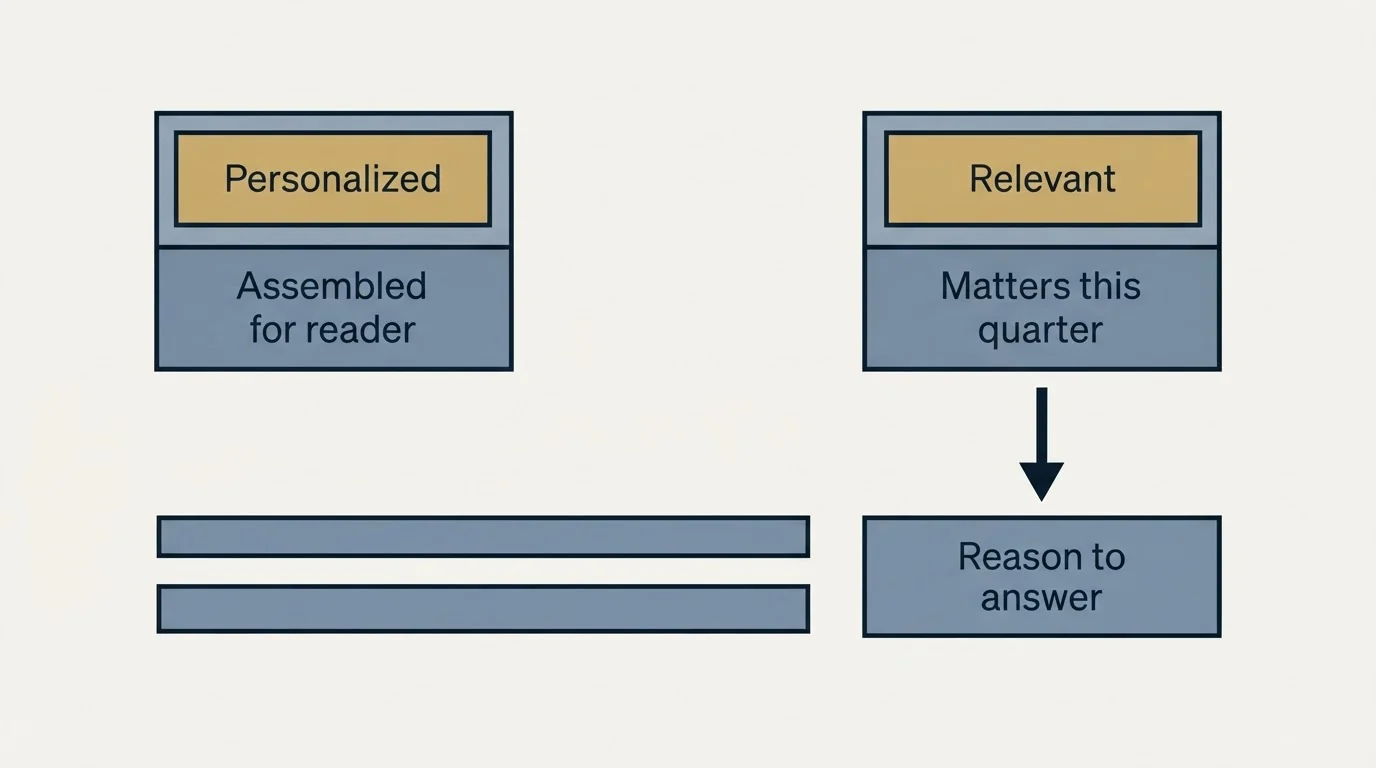
The failure worth naming is a message full of accurate, specific, verifiable detail about a company that gives the reader no reason to answer. The research was real and the sentence was true, and the email still went nowhere.
That happens because personalization and relevance are different properties. Personalization is about whether the message was assembled for this reader. Relevance is about whether what it says matters to them this quarter. A message can be heavily personalized and completely irrelevant, and the reader experiences that as effort spent on them for no purpose, which reads worse than an honest segment email.
The working test is short. Would the next sentence be different if the personalized fact were different? If the message reads identically with the detail removed, the detail is decoration and it should come out. A fact that changes nothing about the argument is a cost with no return, and at list scale it is a cost paid several thousand times.
There is an asymmetry underneath all of this that justifies the caution. A correct personalized detail earns a small amount of attention. An incorrect one ends the account, because a reader who finds one confident wrong sentence about their own business now has a reason to assume the rest is equally unchecked, and there is no second message in which to fix it. That is why a line worth keeping is one the reader could verify in under a minute, from a source their own company published.
How it is used in outbound

In an outbound programme, personalization is a build decision made once per segment rather than a writing decision made once per email. That is the difference between the term as a sales trainer uses it and the term as an operator uses it.
The angle, the offer and every claim about the sender are written by a person and approved before anything is generated. What varies per row is the evidence, retrieved from a source that was actually read, slotted into a structure somebody wrote. Where the model is asked to decide what to say rather than which fact to use, the judgement that made the message worth sending was the part delegated, and the output converges on the same three ideas across every row.
Three operational habits carry the load.
Check the rendered value, not the source field. Company names arrive as legal entities, all-caps brand styling, taglines and truncated strings. A field that looks fine in a table reads as machine output once it is interpolated into a sentence.
Rendered from the source fields, before anyone read the sentence
Hi , saw that Northwind Trading Limited is opening a new office. 1
Congratulations to NORTHWIND on the launch. 2
Teams at Northwind | Quality You Can Trust tell us the same thing. 3
- 1An empty first name renders as a comma with nothing in front of it, and a legal entity name reads as machine output.
- 2All-caps brand styling copied from a logo field.
- 3A tagline carried inside the company name field.
Resolve greetings at build time and reject the row that cannot be resolved. A greeting rendered from an empty first name arrives in a stranger's inbox as a comma with nothing in front of it.
Enumerate rather than sample. Reading fifty rendered messages tells you about fifty draws. If the copy carries variable phrasing, generate every combination and read them all, which takes seconds and finds the clumsy pairing that appears in a small fraction of sends.
Our own practice narrows the shape further, and it sharpens the standard rather than relaxing it. We run one message per campaign, with no bumps and no thread replies, so the message has to work on its own. A weak grounded detail has nowhere to hide behind three follow-ups.
Where the budget should go
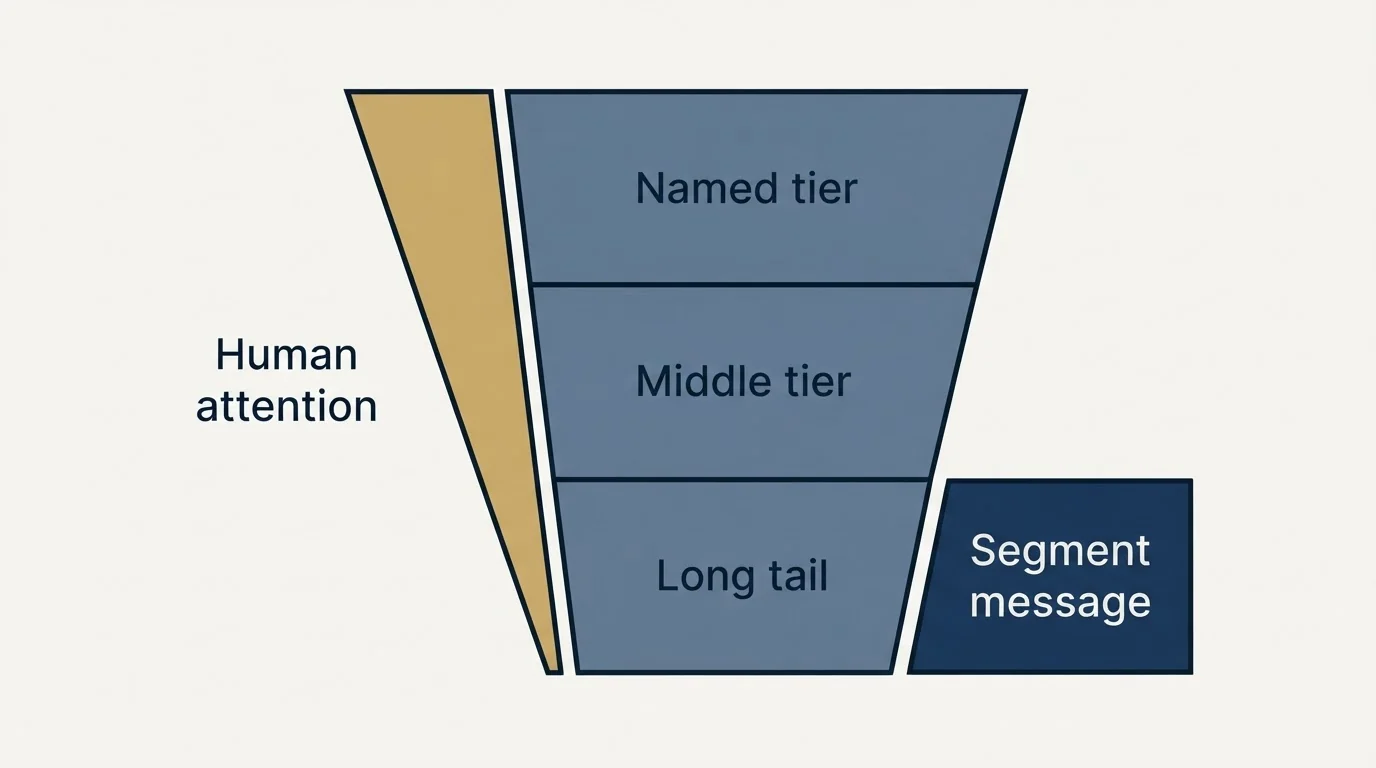
Given a fixed amount of human attention across a list, the allocation that works is deliberately uneven.
The named tier gets a person writing, because the deals justify it and because automating the tier whose entire premise is bespoke attention removes its reason to exist. The middle tier gets grounded retrieval against a human-written angle per cluster, so the writing effort is spent once per cluster rather than once per account. The long tail gets a sharp segment message with field-level accuracy and nothing more.
That last allocation is the one teams resist, and it is the one the test above supports. A generic message that makes a specific argument beats a personalized message that makes none, and the personalized one is more expensive to produce.
The volume question changes the arithmetic without moving the standard. At fifty accounts a person can write fifty messages and should. At five thousand, grounded retrieval is the only way the messages exist at all, and the quality lost per row depends almost entirely on how much of the message was fixed before generation started.
Related terms
ABM personalization at scale is the operating guide for this entry: what to automate, what stays manual permanently, and the quality control that works when nobody can read every message. Cold email personalization benchmarks carries the measured rates by personalization depth.
For the mechanics at list scale, personalization at scale in Clay and advanced email personalization are the build instructions. Signal-based outbound covers the case where the personalized fact is an event with a decay window rather than a standing attribute, which is where relevance and timing become the same question.
On the receiving side, buyer engagement is what the reader actually did in response, and it is the only honest measure of whether any of this worked. Lead qualification is what a reply has to demonstrate before it earns a person's time.
If the constraint is that the list is built and the messages are not going out at volume, that is the half we run, on criteria agreed in writing before anything sends. See what a first campaign produces against your market.
Frequently asked questions.
Frequently asked questions- What is sales personalization?
- Sales personalization is shaping an outbound message around a specific, checkable fact about the recipient's company or role, so the argument applies to them and to more than their segment. It runs at three settings: field-level detail from a database, grounded facts retrieved from a source somebody read, and judged views about the reader's situation that a person writes.
- What company information is useful for sales personalization?
- Facts the company published about itself that change what the message argues: what it sells, how many locations it runs, a role it is hiring for, a service line it launched. Read them on the company's own site, careers page or press releases. A standing attribute stays true for a long time; an event has a window, and citing it late reads as a stale scrape.
- What is the difference between personalization and relevance in sales?
- Personalization is about whether the message was assembled for this reader. Relevance is about whether what it says matters to them right now. A message can be heavily personalized and completely irrelevant, which reads as effort spent on the reader for no purpose. The test that separates them is whether the next sentence would change if the personalized fact changed.
- How much personalization can be automated?
- Retrieval automates well and judgement does not. Finding a checkable fact about a company from a source that was actually read is cheap per row once the pipeline exists. Deciding what that fact means for the reader, what to offer and what to claim is the part a person still writes, and delegating it is what makes generated messages converge on the same few ideas.