Buyer Engagement: What the Other Side Actually Did
Buyer engagement is the measurable activity the buying side produces in response to a seller: replies, questions, meeting attendance, documents read and colleagues added to a conversation. It is defined by whose behaviour is counted. Seller activity rises whether a deal is alive or dead, while buyer engagement can return zero, which is what makes it readable.
Key takeaways
- Buyer engagement counts only what the buyer chose to do, so forty two seller touches on an account contribute nothing to it.
- Weight each signal by what it cost the buyer: a colleague introduced outranks a question, a question outranks a reply, and an open counts as close to none.
- Measure it per account in four passes: list the buyer's dated actions, weight them, count the people and seats behind them, and date the last one.
- Engagement establishes that attention is being paid and does not establish intent, since a formal evaluation of three vendors produces heavy engagement with all three.
A pipeline review opens with an engagement dashboard. Forty two touches on the account this quarter, three sequences completed, the whole playbook executed. Every number on the screen describes something the seller did. Not one of them describes anything the buyer did, and the deal has not moved in nine weeks.
Buyer engagement is the measurable activity the buying side produces in response to a seller: replies, meeting attendance, questions asked, documents read, people added to a conversation. It is defined by whose behaviour is being counted, and the answer is the buyer rather than the seller.
That sounds like a small distinction. It is the entire content of the term, and it is the reason the phrase exists separately from sales engagement, which names the seller's side of the same exchange.
What counts, and what only looks like it counts
The useful test is whether the buyer had to choose to do the thing.
A reply is engagement. A question is stronger engagement, because it costs the buyer more and reveals what they are actually weighing. A second name appearing on a thread is stronger still, because somebody inside the account decided this was worth a colleague's attention, which is a claim about internal support rather than about interest.
An open is the weakest signal in the set and should be treated as close to none. The live entry on open rate sets out why the measurement itself has become unreliable, and even a genuine open establishes only that a message was rendered.
Attendance at a meeting the seller proposed sits in the middle. Somebody accepted an invitation, which is real, and somebody may also have accepted it to be polite, which is also real.
The strongest signals in the set are the ones that cost the buyer internal capital: introducing a colleague, scheduling a session with a person who was not previously involved, or asking for something that will have to be explained upward. Those are the actions that separate an account that is evaluating from an account that is being pleasant.
| What the buyer did | What it cost them | What it establishes |
|---|---|---|
| Opened a message | Nothing they chose | That a message was rendered. Treat as close to none |
| Attended a meeting you proposed | An accepted invitation | Something real, and possibly politeness |
| Replied | A choice to answer | Engagement |
| Asked a question | More than a reply | What they are actually weighing |
| Added a second name to the thread | A colleague's attention | A claim about internal support |
| Introduced a colleague, or asked for something that has to be explained upward | Internal capital | An account that is evaluating, as opposed to being pleasant |
Seller activity
Things your team did
- Emails sent
- Calls attempted
- Sequences completed
- Meetings proposed
- Content shared with the account
cannot fail Rises when the team is busy, whatever the buyer thinks
Buyer engagement
Things the buyer chose to do
- Replies written
- Questions asked
- Meetings attended
- Colleagues added to the conversation
- Requests that will have to be explained internally
can go to zero Rises only when somebody on the other side spent something
Why it matters: activity metrics cannot fail
The reason to separate the two columns is that only one of them can deliver bad news.
A seller-activity dashboard reports a healthy number in every state of the world, because the team can always send more. It goes up when the deal is progressing and it goes up when the deal is dead and the rep is compensating. A manager reading it cannot distinguish those two cases, which makes it a report on effort rather than on the pipeline.
Buyer engagement can go to zero, and that is precisely what makes it worth measuring. An account that replied twice in March and has produced nothing since is telling you something the activity count cannot. The absence is the signal.
The second reason is that engagement is the earliest place a stalled deal becomes visible. A deal that will not close usually stops producing buyer signals well before it stops producing seller optimism, because the rep is still working it and the CRM stage has not been changed. Reading the buyer column is the practice meetings land and nothing closes works through for the stretch after the first conversation.
The third reason is that engagement is a property of a group rather than of a person. One enthusiastic contact who cannot release money is not the same as three quiet people who can, and treating a single responsive individual as an engaged account is one of the most reliable ways to forecast a deal that never closes. The roles involved and the asymmetry between them are set out in buying committee, and the seat that has to be reached at some point is described in economic buyer.
How to measure buyer engagement on one account
Buyer engagement is measured one account at a time, from the buyer's actions only, in four passes: list every dated action somebody on the buying side chose to take, weight each by what it cost them, count how many people and which seats produced them, and write down the date of the last one. The output is a short reading a manager can challenge, with the component signals still visible.
Take the account this page opened with. The example is illustrative, and the detail added here is invented to show the passes.
- List the buyer's actions, with dates. The dashboard shows forty two touches over a twelve week quarter, all of them the seller's. The buyer column holds three entries: a reply in week one, a reply with a question in week two, and a meeting attended in week three.
- Weight them by cost. Two replies and an accepted invitation. One question, which is the strongest item on the list. Nothing that spent internal capital.
- Count the people and the seats. All three actions came from one contact. Nobody was added to the thread, and nobody who can release money has produced a signal.
- Date the last one. Week three. The nine weeks since are empty.
The reading that comes out: one responsive person, no group, no economic seat, and a last buyer action nine weeks old. On the dashboard this account looks like the busiest one in the pipeline. Read from the buyer column it is single threaded and quiet, and what that earns is a direct question to the contact about what changed, asked before another forecast call carries the deal forward. The stage in the CRM has not moved because the seller has not moved it, which is a fact about the seller.
Prospect engagement is the same question asked earlier
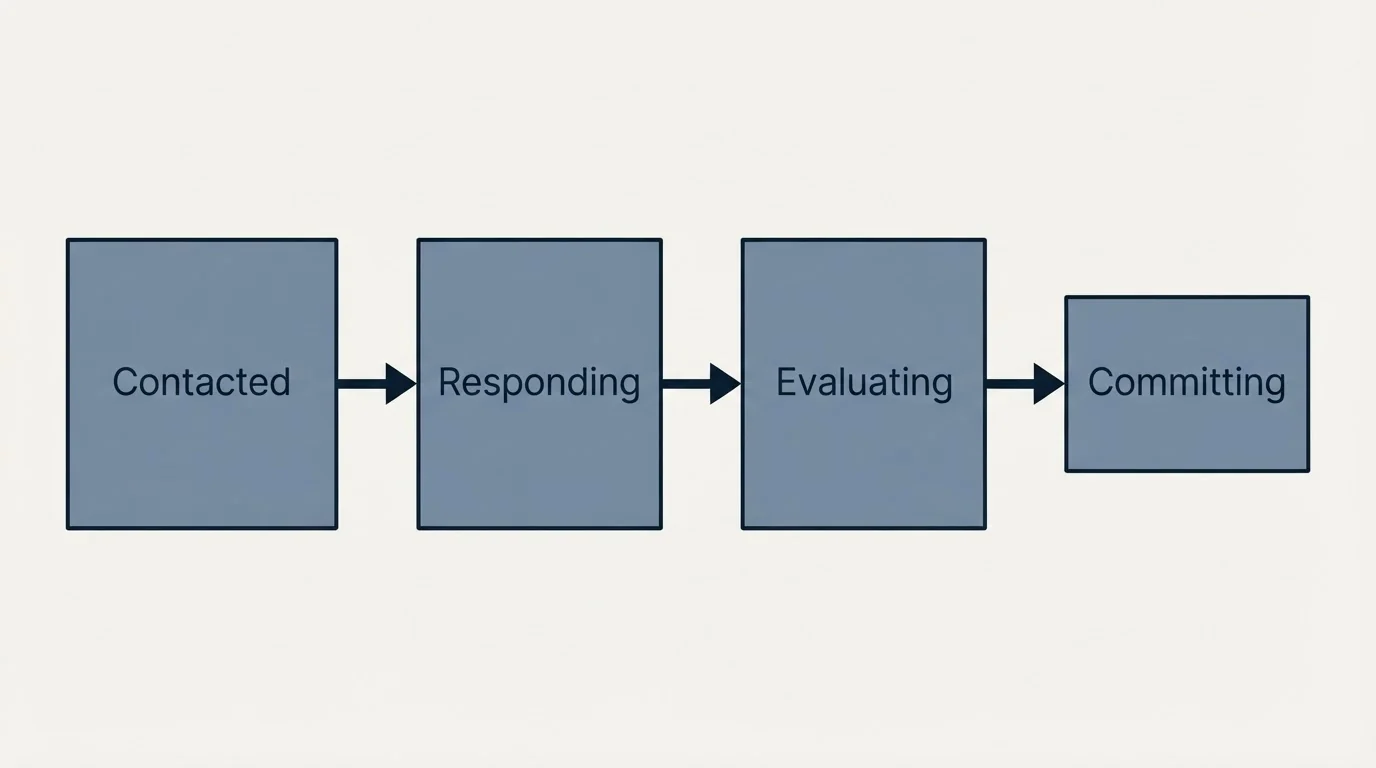
Prospect engagement is the term used for the same measurement before an opportunity exists, when the person on the other side is a target rather than a buyer in an evaluation. The two phrases describe one discipline at two stages, and the distinction worth keeping is what each stage can establish.
At the prospect stage the population is people who were contacted rather than people who are evaluating, so the signals are thinner and the denominator is much larger. A reply is the primary unit. Silence from the population is the ordinary outcome rather than a fault.
At the buyer stage the population is a named group inside an account that has agreed to spend time, so the signals get richer and the count gets small. One question from the right person carries more information than a hundred prospect-stage replies.
The failure this distinction prevents is running a prospect-stage engagement score inside a live deal. A score built to rank thousands of cold contacts by responsiveness will treat a buying committee's careful silence during an internal review as disengagement, because silence is what that model was trained to punish. The two stages need two readings.
Where the textbook definition misleads
An engagement score is a compression, and it hides which signal fired. A single number combining opens, clicks, replies and attendance treats the weakest input as commensurable with the strongest one. Two accounts on the same score can be in completely different states, and the score cannot say which. The same objection applies to any single-number ranking, which is the argument the lead scoring entry makes at the top of the funnel.
High engagement is not intent, and it is often the opposite. A buyer running a formal evaluation of three vendors will engage heavily with all three. So will a buyer collecting information to renegotiate with an incumbent. Engagement establishes that attention is being paid, which is genuinely useful and much narrower than it sounds. What it does not establish is that a purchase is going to happen, which is the same boundary intent data has to be read against.
Silence has more than one meaning. A quiet account may be gone, and it may be in a procurement stage where nobody is allowed to talk to you. Treating an engagement drop as a lost deal is as wrong as ignoring it. What the drop earns is a question, not a conclusion.
It is measured on what your systems can see. The decision runs partly through conversations inside the account, on channels you have no access to. An engagement reading is a sample of the visible surface, and the invisible part is larger. That gap is the same one the multi-touch attribution entry describes for the journey as a whole.
How it is used in outbound
For a cold outbound programme, buyer engagement is the first honest read available on whether an audience was chosen correctly.
The chain is short. A campaign reaches a list. Some share of that list replies. Of those, some agree to a conversation, and of those, some bring somebody else. Each step is a buyer action, and the shape of the drop-off says something specific about the work upstream of it.
A programme producing replies but no meetings usually has a relevance problem: the premise landed well enough to answer and not well enough to book. A programme producing meetings that never widen has a targeting problem: the people who agreed to talk cannot involve anyone else, which means the seat being contacted was wrong.
Our own doctrine makes the reading cleaner than it usually is. We send one message per campaign, built on one premise, and any later approach is a separate campaign with its own reason to exist. Nothing is bumped, and no thread is replied into. So a reply is attributable to a single message and a single premise rather than to the cumulative weight of a five step cadence, and the engagement signal answers a question about the premise instead of a question about persistence. The cost of that discipline is fewer total replies. The benefit is that the ones that arrive mean something. What a cadence is and which variables define one is set out in sales cadence, and the wider category of tooling built to record all of this is covered in sales engagement platforms.
The practical instruction for a team is to record buyer actions as a separate class from seller actions in whatever system holds the account, and never to blend them into one activity feed. Once they are blended, the only question anybody can answer is how busy the team has been, and the buyer experience the account is actually having is invisible, which is the thing buyer experience argues gets decided before the first conversation.
Related terms
Buyer engagement is read against the buying committee rather than against an individual, and the seat whose engagement matters most is the economic buyer. A person producing engagement on your behalf inside the account is a sales champion. The signal it is most often confused with is intent data, which reports third-party behaviour rather than behaviour directed at you, and the number that compresses it is lead scoring. Where the account has crossed into a live deal, the object being measured is a sales qualified opportunity, and the weakest input people still count is open rate.
The short version
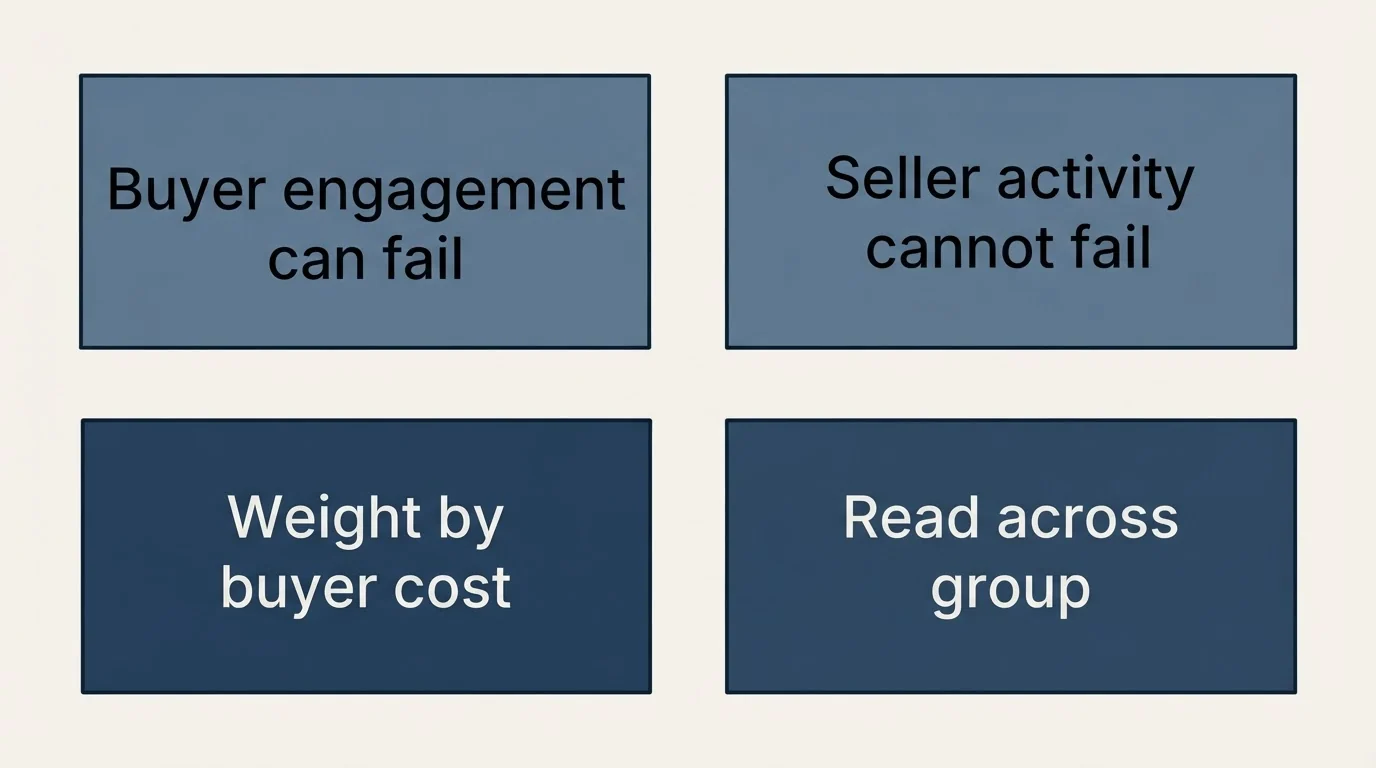
Buyer engagement counts what the buying side did, which is the half of the exchange that can return zero and therefore the half worth reporting. Seller activity cannot fail and tells a manager nothing about a deal. Weight the signals by what they cost the buyer, read them across the group rather than on one responsive contact, and keep the prospect engagement reading separate from the buyer-stage one, because a model built to rank cold contacts will misread a committee that has gone quiet for a reason.
RevenueFlow runs cold email and LinkedIn outreach for B2B teams, one message per campaign, and reports what the other side did rather than what we sent. If you would rather that were somebody else's job, see how the campaigns work.
Frequently asked questions.
Frequently asked questions- What is buyer engagement?
- Buyer engagement is the measurable activity the buying side produces in response to a seller: replies, meeting attendance, questions asked, documents read and people added to a conversation. It is defined by whose behaviour is being counted, and the answer is the buyer. Emails sent, calls attempted and sequences completed are seller activity, which is a different column.
- How do you measure buyer engagement?
- One account at a time, from the buyer's actions only. List every dated action somebody on the buying side chose to take, weight each by what it cost them, count how many people and which seats produced them, and note the date of the last one. Keep the component signals visible, because a single score hides which signal fired and who produced it.
- What is the difference between buyer engagement and sales engagement?
- They name opposite sides of the same exchange. Sales engagement is the seller's activity, the emails, calls, sequences and meetings proposed. Buyer engagement is what the buying side chose to do in response. Most dashboards labelled engagement are reporting the first and calling it the second, which is why they stay green on deals that stopped moving months earlier.
- Does high buyer engagement mean a deal will close?
- No. A buyer running a formal evaluation engages heavily with every vendor in it, and so does a buyer gathering material to renegotiate with an incumbent. Engagement establishes that attention is being paid, which is narrower and more useful than it sounds. What predicts a close is which people engaged and whether anyone with budget authority is among them.