Buyer Experience: The Part Outbound Decides First
Most buyer-experience work goes into the demo and the proposal. The chapter that runs first is a message the buyer never asked for, and three properties decide it.

Buyer experience is the sum of what a buying organisation encounters while deciding whether to spend money with you, from the first thing they see to the signature. For anyone who did not arrive on their own, it starts with outbound, and three properties decide that first chapter.
Key takeaways
- Buyer experience starts at first contact, often a message the buyer never asked for, long before the demo or the proposal.
- Three properties decide a first message: whether its premise is true of the recipient, whether it arrives once, and whether declining is easy.
- A buying committee decides mostly without you, so every document should survive being forwarded to a sceptic with no context.
- A post-sale satisfaction score samples only the buyers who bought; where deals stop and what losses say are better readings.
Reviewed and updated October 1, 2026
A revenue team decides to improve the buyer experience. The demo gets a new opening, the proposal template gets redesigned, response-time targets go up on a wall, and a survey goes out to everyone who signed. Six months later the win rate has not moved, and nobody can point at the change that was supposed to move it.
The work went into the wrong chapter. By the time a buyer is in a demo they have already had an experience of your company, and much of what they concluded from it was settled before anyone on your side knew their name. Buyer experience is decided at first contact, in a message the buyer did not ask for, and improving the parts you can see while ignoring the part that runs first is how the effort produces nothing.
What is buyer experience?
Buyer experience is the sum of what a buying organisation encounters while deciding whether to spend money with you. It runs from the first thing they see through to the moment somebody signs, and it includes every interaction that was not designed as an interaction: an email they did not want, a form that asked for a phone number, a follow-up that arrived under a message they had already ignored.
Two things make it awkward to manage. The first is that the buyer is not one person. A committee experiences you separately, and the person who eventually signs may have formed their view of you entirely from what a colleague forwarded. Who sits on a buying committee and where the vetoes come from is the structure underneath that, and why the economic buyer cannot be identified from the org chart is the reason the committee's shape is not knowable in advance.
The second is that a large part of the experience happens without you. Research, peer conversations, a competitor's page, a review site, a colleague's opinion from a previous job. The controllable surface is smaller than it feels, which is an argument for spending the effort where the surface is genuinely yours rather than spreading it evenly.
Split by phase, the part before a buyer is interested is almost entirely yours: the first message and what your public pages say when they look you up. The deciding phase is shared with peers, review sites and how quickly your team answers, and the commitment, from proposal through security review to terms, is mostly yours again.
The chapter that runs first
Outbound is the opening of the buyer experience for anyone who did not arrive on their own, and it is the chapter routinely excluded from the discussion, because it is measured on reply rate rather than on experience.
That exclusion is the mistake. A cold message is a real interaction with a real person who did not ask for it, and it produces a durable impression whether or not it produces a reply. The population that forms an opinion of you from outbound is far larger than the population that ever books a meeting, and the impression that population carries is the ambient reputation your later marketing has to work against.
There are three properties of a first message that decide what impression it leaves, and none of them is copy quality.
Whether the premise is true of them. A message asserting something about the recipient's situation that is not true reads as automated regardless of how the sentence is written. The reader is not evaluating the prose, they are evaluating whether the sender knows who they are. This is a targeting property rather than a writing one, and it is why a segment written precisely enough to build a list from does more for buyer experience than a copy rewrite.
Whether it arrives once. A second message landing under one the recipient chose not to answer converts a neutral interaction into an annoying one. The recipient already had the information required to reply and did not, so the second message carries no new premise and reads as pressure. This is the single largest buyer-experience decision in outbound and it is usually made by default, because the sequence was configured before anyone asked what a non-reply means.
Whether declining costs them anything. An unsubscribe that works, immediately and without a form, is a buyer-experience feature. It also protects the sending infrastructure, which is why the two interests point the same way here rather than trading off.
Why the follow-up sequence is a buyer-experience defect

The standard outbound advice is a sequence: an opening message, then three to six more over a few weeks, each landing under the last. Presented as persistence, it is usually described as a numbers decision.
We do not run it, and the reason is a buyer-experience reason before it is a deliverability one. A reminder reaches exactly the population that saw the first message and decided not to answer. It is therefore targeted, precisely, at the people most likely to experience it as an intrusion, and it asks them to reconsider a decision they already made without giving them a new reason to. Reading a non-reply as an answer is the position that treats the recipient as a person who decided something.
Our own practice is one message per campaign, with no bumps and no thread replies. That costs us reach, and what we gave up and why sets out the trade honestly rather than as a best practice.
The general principle underneath it transfers past outbound: any mechanism that increases contact frequency without increasing the relevance of the contact is a buyer-experience cost dressed as diligence.
A buyer meets you at four moments, in order. The unrequested contact is decided by the three properties above. Their own research is decided by whether your public pages answer the question a stranger actually has, including what it costs. The first conversation is decided by whether the meeting is about their situation and by what was agreed before it was booked. The committee's circulation is decided by whether what you sent survives being forwarded.
The forwarding test
The most useful and least used test of a B2B buyer experience is whether your material works when you are not there.
A committee decision happens mostly in your absence. The person you spoke to summarises you to four colleagues who have never met you, using whatever you gave them, in a meeting you are not in. Everything that depended on your explanation is lost at that boundary, and what survives is whatever a document can carry on its own.
That reframes several things that are usually treated as polish. A proposal that requires a walkthrough is a proposal that fails the moment it is forwarded. Pricing that only exists in a conversation cannot be defended by your champion to a finance colleague who asks what it costs. A claim without a source attached becomes an assertion the moment your voice is removed from it.
The practical version is short: assume every document you send will be read once, silently, by somebody sceptical who has no context and no way to ask you a question. Most B2B sales material fails that test and almost nobody runs it.
Measuring it without a satisfaction survey

The instinct is to survey. The problem with a post-sale satisfaction score is structural rather than methodological: it samples only the people who bought. The buyers whose experience of you was worst are precisely the ones who are not in the sample, and a score built from the survivors will look healthy in exactly the situations where the experience is driving people away.
Measuring what the other side did avoids that sampling problem, and buyer engagement counts only the buying side's behaviour rather than the seller's activity.
It also explains why a buyer can go through a rich brand experience and still not be recognised as a high-intent buyer downstream. That experience happens in places your systems cannot see: research on other sites, peer conversations, and a colleague's inbox after a forward. What does reach your systems is often logged as seller activity, so a stage defined by what the rep did records nothing about what the buyer did. Counting the buying side's behaviour directly is what closes that gap.
Four things are more informative and all of them are already in your systems.
Where deals stop, by stage, over time. A cluster that forms at one boundary is an experience defect at that boundary rather than a competitive loss. How pipeline stages have to be written before that reading is possible matters here, because a stage defined by seller activity cannot show you where the buyer stopped.
Time to a real answer, not time to a first response. An acknowledgement inside an hour followed by the answer in four days is a slow response with a fast autoresponder on it.
Complaint and unsubscribe rate on outbound. This is the only routine, unsolicited feedback you get from the population that did not buy, and it is usually read as a deliverability metric and filed with infrastructure. It is a buyer-experience metric that happens to also predict inbox placement.
What losses say when you ask. Not a win-loss programme with a vendor attached, just the question asked directly and the answer recorded verbatim rather than summarised, which is the same discipline that makes a customer-centric process actually customer-centric rather than a renaming exercise.
| Measure | What it shows |
|---|---|
| Where deals stop, by stage, over time | A cluster at one boundary is an experience defect at that boundary |
| Time to a real answer | Whether a fast first response is only an autoresponder |
| Complaints and unsubscribes on outbound | The only routine feedback from people who did not buy |
| What losses say when asked | The buyer's own words, recorded verbatim |
Where it breaks
It gets owned by whoever is closest to the signature. Assigning buyer experience to the sales team makes the chapter before contact somebody else's problem, and that chapter is the one with the largest population in it.
It becomes a design project. Interface and document polish are real and they are downstream of whether the interaction should have happened in that form at all. A beautifully designed fourth reminder is still a fourth reminder.
Speed gets optimised instead of relevance. Faster contact with the wrong premise arrives at the wrong conclusion sooner. The order that works is relevance first, then speed, because speed multiplies whatever the message already was.
Nobody writes down what a good experience would look like. Without that, every review defaults to comparing this quarter to last quarter's feeling. Four or five sentences describing what a buyer should be able to do without asking you is enough, and it is checkable.
The short version
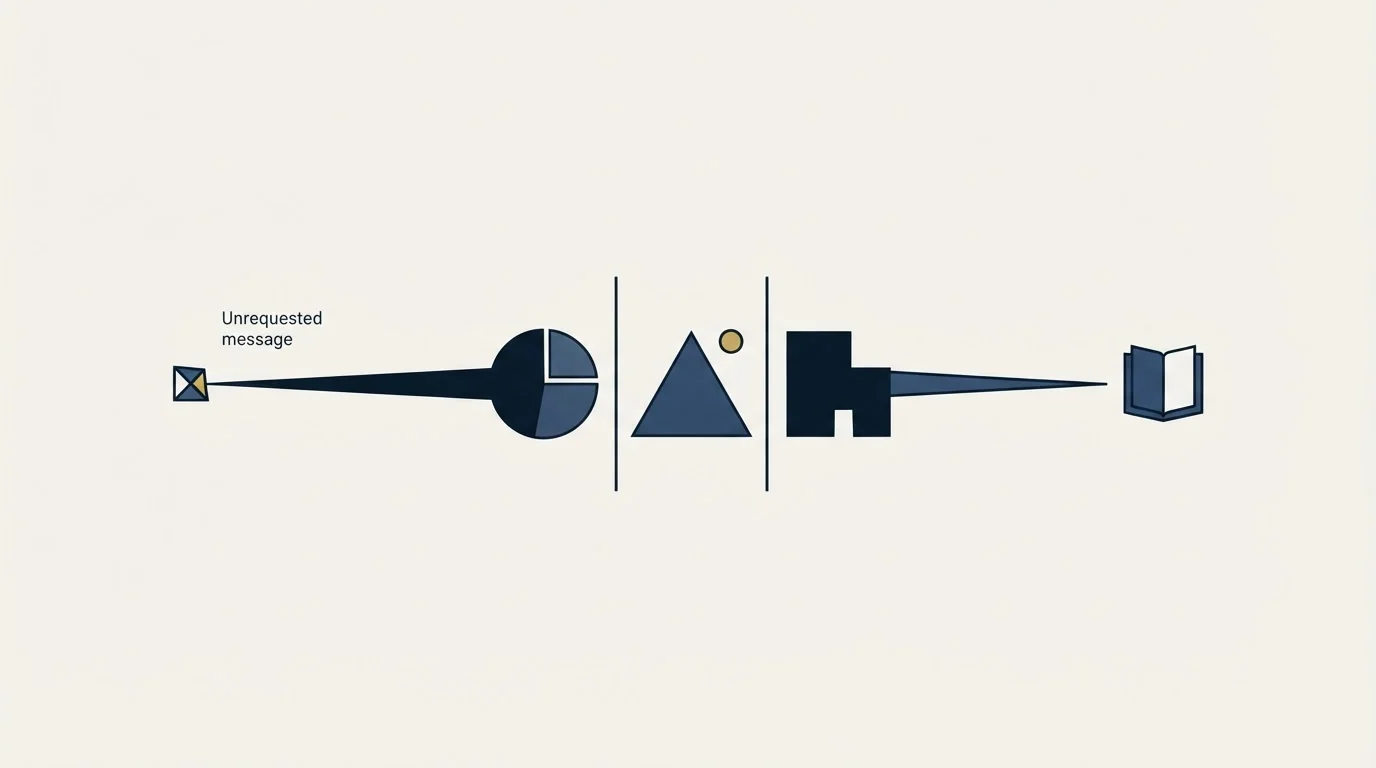
Buyer experience is the whole of what a buying organisation encounters while deciding to spend money, and the chapter that runs first is outbound to people who never asked. Three properties decide that chapter: whether the premise is true of the recipient, whether the message arrives once, and whether declining is easy. A follow-up sequence fails the second on purpose, which is why we do not run one. Test everything you send against being forwarded to a sceptic with no context, measure where deals stop and what the people who did not buy tell you rather than surveying the ones who did, and write down what a good experience would look like so a review has something to check against.
If the first chapter is the one that needs work, we will build the campaign and you can read what comes back.
Frequently asked questions.
Frequently asked questions- What is buyer experience in B2B?
- It is everything a buying organisation encounters while deciding whether to spend money with you, from the first thing they see through to the signature. It includes interactions nobody designed as interactions, such as an unwanted email or a form asking for a phone number, and it is experienced separately by each member of the buying committee.
- Why does outbound matter for buyer experience?
- Because it is the first chapter for anyone who did not come to you on their own. Every recipient forms an impression, whether or not they reply, and that population is far larger than the one that books a meeting. Whether the premise is true of them, whether it arrives once and whether declining is easy decide that impression.
- Why might a high-intent buyer go unrecognised downstream?
- Most of a buyer's experience happens where your systems cannot see it: research on other sites, peer conversations and a colleague's inbox after a forward. What your systems do capture is often logged as seller activity, so stages defined by what the rep did miss what the buyer did. Counting the buying side's behaviour directly closes that gap.
- How do you measure buyer experience without a survey?
- Use readings already in your systems: where deals stop by stage over time, the time to a real answer rather than a first acknowledgement, complaint and unsubscribe rates on outbound, and what lost buyers say when asked, recorded in their own words. A post-sale survey only samples the buyers who bought, so it misses the worst experiences.
About the author.

B2B cold email experts helping companies generate qualified leads through done-for-you outreach campaigns.
RevenueFlow Team
Explore more.
Ready to scale your outreach?
We build GTM engines that book real meetings. See the receipts.
Related articles.
SDR Outsourcing for Business Brokers: The Fee Timing
Whether a success-fee brokerage should rent sales development at all: the fee timing, the texts that limit what an outside person may say about value, and who signs.
SDR Outsourcing for Logistics Companies: The Brokerage Line
What an outside sales development team may do in a freight company's name, the calling and email rules it inherits, and which arrangement survives a bid-shaped market.
Appointment Setting for Business Brokers: The Seller Meeting
What a bought meeting with a business owner has to be for a brokerage: the three-part qualification, the confidentiality rules, the licence line and the owner's reasons.
SDR Outsourcing for Financial Services: The Third Party
What a bank, broker-dealer, adviser or agency's regulators say about an outside team that speaks for it, the licensed line, and which arrangement survives due diligence.
Sales Prospecting for Health Systems: The Public Record
Where health systems are written down in public: the Medicare cost report, the facility list a non-profit system files, and the two gates that follow qualification.
Cold Calling for PPC Agencies: What You Can See First
A paid media prospect is partly readable before the call and has already been told by the platform what to do when a stranger rings about its ads.