Sales Prospecting for Health Systems: The Public Record
Where health systems are written down in public: the Medicare cost report, the facility list a non-profit system files, and the two gates that follow qualification.
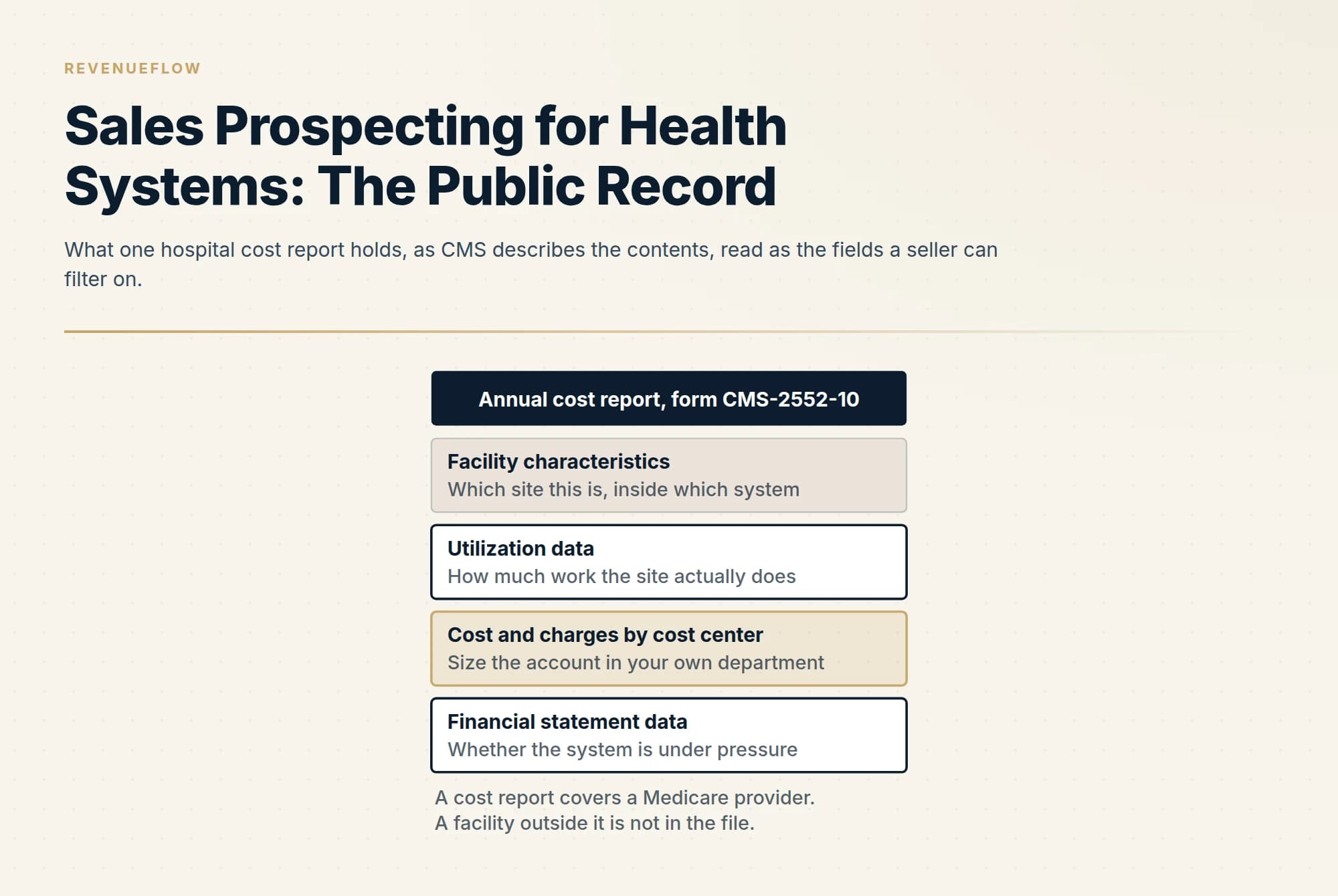
A health system is a group of facilities, and the federal record describes the group. A non-profit system lists its hospital facilities on Schedule H of its Form 990. Each Medicare certified facility files an annual cost report carrying utilization and cost by cost center. Neither names the buyer, and two gates follow.
Key takeaways
- CMS states that Medicare certified institutional providers must file an annual cost report, carrying facility characteristics, utilization, cost and charges by cost center and financial statement data.
- IRS instructions require a hospital organisation to list its hospital facilities on Schedule H, which gives a seller the roster of sites inside one system.
- Group purchasing is a second qualifying question beside product fit, because an account may buy through an agreement you are not party to.
- Vendor credentialing requirements can differ between two sites of the same system, so winning the system does not mean equal access everywhere.
Reviewed and updated September 21, 2026
A founder with a clinical workflow product spends a quarter building a list of hospitals from a contact database: name, city, bed count, a director of nursing. Every account looks alike. Meanwhile each of those hospitals had filed an annual financial report with the federal government, and the non-profit systems among them had published, line by line, which facilities they own and what they spend on their communities. None of it was in the list.
This guide is for companies selling into hospitals and health systems: devices, health IT, services, facilities, staffing. It covers one layer the rest of our healthcare family leaves out, which is where a health system is written down in public, what each record lets a rep infer, and which of those records publish a dated event you can write about. The committee, the evidence bar and the cycle are on healthcare lead generation and medical device lead generation, and this guide does not repeat them. If your accounts are physician practices, ambulatory centres or post-acute providers rather than hospitals, the registries are different and healthcare sales prospecting is the page you want. The generic method is on sales prospecting. Every source below was fetched on September 21, 2026.
The account is bigger than the building
The first mistake is treating a hospital as the account. Jonathan Fullerton of Gen5, writing from twenty years of selling into this market, describes what is actually on the other side: "Health system consolidation has led to sprawling entities comprised of multiple hospitals, physician practices, outpatient centers, labs and clinics." He adds that those entities are governed at two levels at once, the system and the individual hospital, with committees layered over both. His blunt version of the consequence is the line worth keeping: "The decision maker is not the decision maker." (Gen5, no date on the page, fetched September 21, 2026.)
For a prospecting team that is a structural instruction, not a warning. Your unit of work is the system, and the hospital you found is one site inside it. Two questions follow, and both have public answers. Which facilities does this system own? And what does each of them look like financially?
The cost report: every Medicare-certified facility files one
The record most sellers never open is the Medicare cost report. CMS states the obligation plainly: "Medicare-certified institutional providers are required to submit an annual cost report to a Medicare Administrative Contractor (MAC)." It then says what is in it: "The cost report contains provider information such as facility characteristics, utilization data, cost and charges by cost center (in total and for Medicare), Medicare settlement data, and financial statement data." The files are held in the Healthcare Provider Cost Reporting Information System, and the hospital form is CMS-2552-10. The page dates its own latest drop, showing new cost report data updated 6/30/2026 and released 7/14/2026. (CMS Cost Reports, fetched September 21, 2026.)
Read that field list as a prospecting schema. Cost and charges by cost center means the account's spending is broken out by department, so a seller whose product lives in one department can size the account in that department rather than by bed count. Utilization data says how much work each facility does. Financial statement data says whether the system is under pressure. And the whole thing arrives on an annual cycle whose release date CMS publishes, which means the list can be rebuilt on a known schedule rather than whenever someone remembers.
Two cautions belong beside it. CMS attaches its own disclaimer to the data, saying that derived conclusions and analysis are not to be considered attributable to CMS or HCRIS, so any number a rep quotes is the rep's reading. And a cost report describes a Medicare-certified provider, so a facility outside that programme is not in the file.
The facility list a non-profit system publishes about itself
A non-profit health system files a Form 990, and a hospital organisation files Schedule H with it. The IRS instructions say what that schedule makes public. A hospital organisation "must list its hospital facilities", and the instructions define which ones: facilities that "were required to be licensed, registered, or similarly recognized as a hospital under state law" at any time during the tax year. The same instructions record that "the Affordable Care Act requires hospital organizations to conduct community health needs assessments", and that section 501(r) applies those requirements to each hospital facility separately. (IRS Instructions for Schedule H, Form 990, fetched September 21, 2026.)
That first sentence is the answer to the question the cost report raises. A non-profit system tells the federal government, on the record, which hospitals it operates. Put the two together and you have the shape of the account: the roster from Schedule H, the size and spending of each site from the cost report.
The community health needs assessment is the second use, and it is the one most sellers miss. Each hospital facility has to conduct one, and the assessment is a document about that facility's own stated priorities. A seller whose product touches one of those priorities is not guessing about fit; the organisation has written down what it says it is trying to fix, and dated it.
| Record | Question it answers |
|---|---|
| Schedule H, Form 990 | Which hospital facilities does this non-profit system operate, and what has each one said its community priorities are? |
| Medicare cost report | How large is this facility, what does it spend by cost center, and is the money getting tighter? |
| Medicare enrollment and certification | Is this provider certified, and therefore in the cost report file at all? |
What the records do not tell you, and who does
None of these records names a buyer. They name an organisation, its sites, its money and its stated priorities. The person still has to come from the system's own pages, and the committee that decides is described on our healthcare lead generation page and, for anything installed in a clinical area, on medical device lead generation. What a first approach into this market can reasonably ask for, given all that, is set out on SDR outbound into healthcare.
Two other things a list cannot see are worth planning for before anyone writes.
The contracting layer. A great many purchases in this market run through a group purchasing organisation. The Healthcare Supply Chain Association, whose members are the GPOs, describes what one is: an entity that helps healthcare providers realise savings "by aggregating purchasing volume and using that leverage to negotiate discounts with manufacturers, distributors and other vendors" (Healthcare Supply Chain Association, fetched September 21, 2026). For a seller that is a second qualifying question beside product fit: is there a contract vehicle, and are you on it? An account that buys through a GPO you have no agreement with is a longer road than an account of the same size that does not.
The access layer. If your sale involves anyone physically entering a facility, vendor credentialing gates it. GHX, which runs one of the credentialing systems, wrote in a guide dated August 29, 2023 that requirements "can vary broadly from healthcare facility to facility, even within the same health system, and can frequently change based on shifting policies and procedures" (GHX, fetched September 21, 2026). Read together with the facility roster from Schedule H, that sentence says something practical: winning the system does not mean access to every site on the same terms.
Three reasons to write, each from a record
We send one message per campaign and nothing underneath it, so the reason has to carry the weight on its own. The systems are unnamed, the senders are invented, and none of these claims a result.
Invented example. Subject: your community health needs assessment. Your assessment for the hospital in this county names the priority we build for, and it is dated this year. We work with systems of your size on exactly that problem. If it would help, we can send the two-page version of how other teams approached it.
The source is the facility's own published assessment, which Schedule H requires. The reader wrote it, so nothing here is a guess about their priorities.
The second is worth taking apart, because every line of it is doing a job.
To: the operations lead at a multi-site system
Your latest cost report puts a number on what the department we work in costs to run at your two largest sites. 1
We think a share of that is addressable, and we would rather be wrong in front of you than in a deck. 2
Who owns that budget? 3
- 1The fact is the reader's own annual filing, broken out by cost center, so it is checkable and it is about them.
- 2A claim the sender can be wrong about, with no figure attached to the sender's own results.
- 3One question, answerable in a name, which is the most a first message should ask of a stranger inside a sprawling organisation.
Invented example. Subject: before we ask for a meeting. We are not on your group purchasing agreement yet, and we would rather find that out now than after a pilot. Is there a route for a vendor in our category, or is this a year where that is closed?
The source is the contracting fact the association describes. It is a disqualifying question asked early, which is the fastest thing a seller can do in a market with this cycle length.
When this way of prospecting is the wrong play
When your accounts are not hospitals. Physician practices, ambulatory centres and post-acute providers are enumerated by different records entirely, and are covered on our healthcare sales prospecting page. Do not build a hospital list and write to a practice.
When the system is investor owned. Schedule H accompanies a Form 990, which an investor owned system does not file, so its facility roster has to come from the company's own disclosures instead. The cost report route still works; the community benefit route does not.
When the evidence is not ready. The evidence bar in this market chooses the list rather than the other way round, an argument medical device lead generation makes at length. A perfectly built list of large systems is of no use to a product that cannot yet clear a committee at one of them.
When there are twenty accounts. A regional segment may be a couple of dozen systems. That is named research and introductions, and a campaign adds very little to it.
What we could not fetch, and why it matters
Two sources a seller would want did not serve this box. The CMS provider data catalogue at data.cms.gov returned an access denied page on both a plain and a headless fetch, and the American Hospital Association's data site returned the same, so nothing here rests on either. The point generalises: when a record will not open for you, write around it rather than describing it from memory, and say which one it was.
The short version
A health system is a group of facilities, and the federal record describes the group. Schedule H lists which hospitals a non-profit system operates and what each has said its community priorities are. The Medicare cost report gives each facility's size, its spending by cost center and its financial position, on an annual cycle CMS dates. Neither names the buyer, and neither clears the two gates that sit after qualification, which are the contracting vehicle and the credentialing process. Start with the roster, size the site in your own department, and write about something the organisation published itself.
If you would like that account map built and a first campaign run against it, see what a first campaign looks like.
Frequently asked questions.
Frequently asked questions- Where can I find a list of hospitals owned by one health system?
- A non-profit system files Schedule H with its Form 990, and the IRS instructions require the organisation to list its hospital facilities, meaning those required to be licensed or registered as a hospital under state law. That gives the roster of sites. An investor owned system files no Form 990, so its roster has to come from the company's own disclosures instead.
- What is in a Medicare cost report, and can I use it for prospecting?
- CMS says the report carries facility characteristics, utilization data, cost and charges by cost center, Medicare settlement data and financial statement data, filed annually by Medicare certified institutional providers. For a seller that means you can size an account inside your own department rather than by bed count. CMS notes that conclusions drawn from the data are not attributable to CMS.
- Does a health system's group purchasing agreement affect a cold approach?
- It affects whether the sale can happen at all. The Healthcare Supply Chain Association describes a group purchasing organisation as aggregating purchasing volume to negotiate discounts with manufacturers and distributors. If an account buys through an agreement you are not on, that is a longer road than an account of the same size that does not, so it is worth asking early.
- How is prospecting health systems different from prospecting physician practices?
- The records are different. Practices, ambulatory centres and post acute providers are enumerated through provider registries, which our healthcare sales prospecting page covers. Hospitals and health systems are described by the cost report and, for non-profits, by the hospital facility list on Schedule H. Building one list and writing to the other wastes the campaign.
About the author.

B2B cold email experts helping companies generate qualified leads through done-for-you outreach campaigns.
RevenueFlow Team
Explore more.
Ready to scale your outreach?
We build GTM engines that book real meetings. See the receipts.
Related articles.
Sales Prospecting for Consulting Firms: Find the Event
Prospecting for a consulting firm: where triggers are published by practice, who inside the firm reads them, why alumni and referrals come first, when to skip it.
B2B Lead Lists for Travel Agencies: Registers and Gaps
The travel trade is written down in state consumer protection registers, not industry directories, and an exemption inside one decides who is missing from your file.
Sales Prospecting for Utilities: Read the Filings First
Prospecting utilities from the proceedings that announce their spend: rate cases, resource plans and procurement decisions, who owns each, and the supplier gate.
Cold Calling for PPC Agencies: What You Can See First
A paid media prospect is partly readable before the call and has already been told by the platform what to do when a stranger rings about its ads.
Sales Prospecting for SEO Agencies: Four Public Signals
How an SEO agency builds its own prospect list from signals Google documents: the index check, position, core update dates and site moves, under the warning owners read.
LinkedIn Lead Generation for Financial Services Firms
A LinkedIn message from a regulated firm is a communication the rulebook already defines, and the definition turns on how many people receive it within thirty days.