LinkedIn Lead Generation for Financial Services Firms
A LinkedIn message from a regulated firm is a communication the rulebook already defines, and the definition turns on how many people receive it within thirty days.
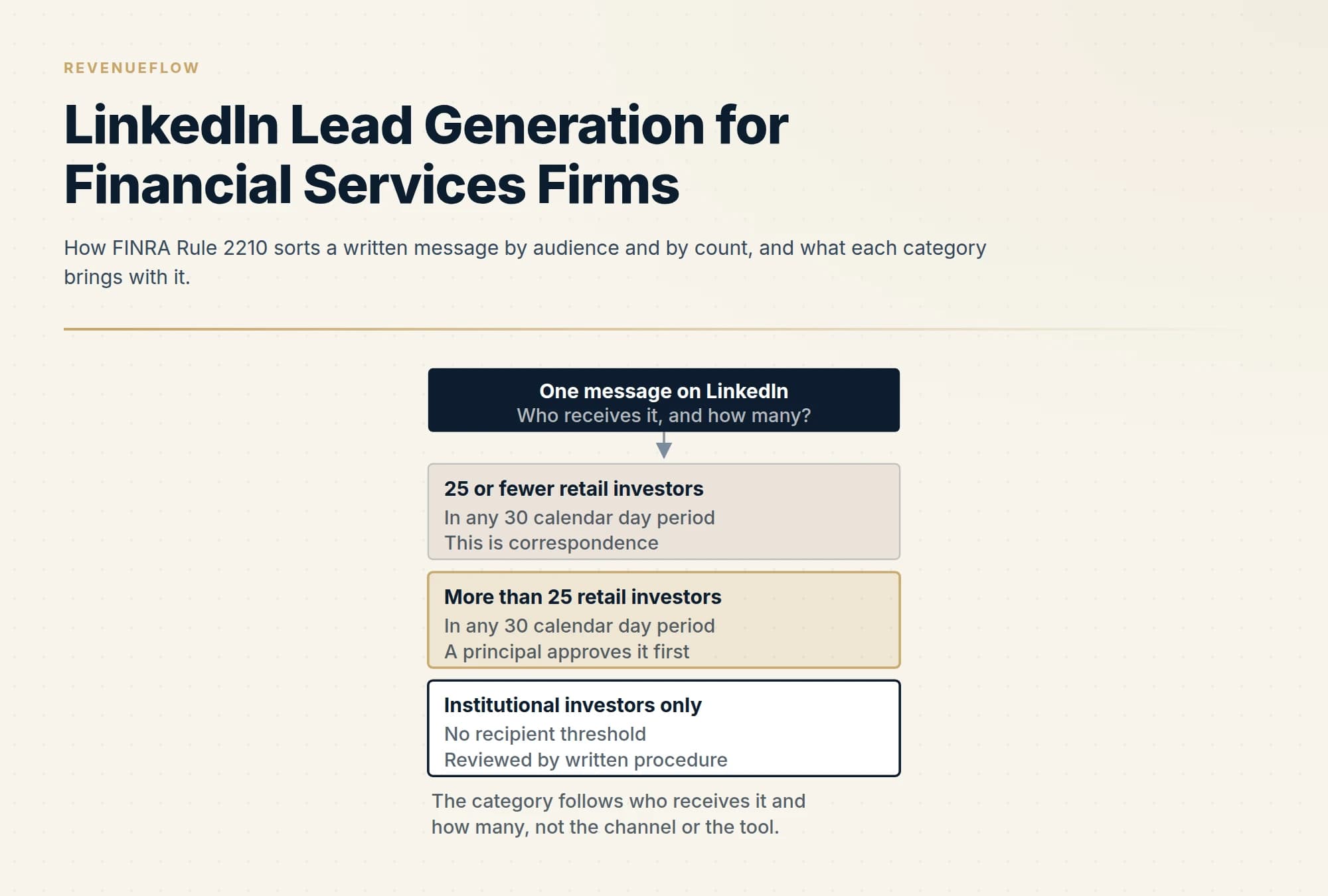
For a FINRA member firm, a LinkedIn message reaching twenty five or fewer retail investors in thirty days is correspondence, and more than twenty five makes it a retail communication requiring principal approval. Retention follows content rather than device. Advisers face the marketing rule instead. Design volume first.
Key takeaways
- FINRA Rule 2210 defines correspondence as a written communication made available to 25 or fewer retail investors in any 30 calendar day period, and more than 25 as a retail communication.
- The rule requires an appropriately qualified registered principal to approve each retail communication before the earlier of its use or filing with the Advertising Regulation Department.
- FINRA notes that whether a communication must be retained depends on its content and not on the device or technology used to send it.
- LinkedIn's User Agreement forbids scripts and robots used to scrape the service and forbids bypassing its use limits, which rules out the automation that makes volume cheap.
Reviewed and updated September 21, 2026
A marketing lead at a broker-dealer builds a LinkedIn programme the way every guide describes it: a connection note, a message behind it, a few hundred people a month. Nine weeks later compliance asks for the approval record and the archive. There is no approval record, because nobody realised that at that volume the message had changed category under the firm's own rulebook, and no archive, because the messages were sent from a rep's personal account.
This guide is for financial services firms, and the agencies working for them, that want LinkedIn to produce conversations: broker-dealers, registered investment advisers, lenders and B2B finance companies. It is about what is different here, which is that a message you send on LinkedIn is a communication your regulator has already defined, and its definition depends on how many people you send it to. The general method of outsourcing this channel is on our LinkedIn lead generation services page, and the mechanics of prospecting on the platform are on LinkedIn prospecting. Neither is repeated here. Nothing below is legal advice; it is what the rules say, with the regulator's own page linked, and your compliance function decides what it means for you.
Your outreach volume decides which rule applies
Most channel guides treat volume as an efficiency question. In this vertical it is a definitional one.
FINRA Rule 2210 sorts every written communication a member firm makes into categories, and it draws the line by headcount and calendar. "Correspondence" is defined as "any written (including electronic) communication that is distributed or made available to 25 or fewer retail investors within any 30 calendar-day period." A "Retail communication" is one "distributed or made available to more than 25 retail investors within any 30 calendar-day period." An "Institutional communication" is one made available only to institutional investors, and the rule defines who counts as one; that definition turns on the audience alone and sets no recipient threshold. (FINRA Rule 2210, fetched September 21, 2026.)
Read that as a design constraint on a campaign. The same LinkedIn message, written once, is one thing at twenty-five recipients in a month and a different thing at twenty-six, and the difference is not cosmetic. Rule 2210 requires that "An appropriately qualified registered principal of the member must approve each retail communication before the earlier of its use or filing with FINRA's Advertising Regulation Department". For institutional communications the rule instead requires the firm to establish written procedures for principal review that are appropriate to its business, size, structure and customers, and where those procedures do not require review of everything before first use, they must provide for education and training, documentation of it, and surveillance and follow-up.
So the first question for a LinkedIn programme in this vertical is not which tool to use. It is who you are writing to and how many of them there are in a rolling thirty days.
The archive is not optional, and it does not care whose phone it is
The second constraint is retention, and it is the one a personal LinkedIn account quietly breaks.
FINRA's Regulatory Notice 17-18, on social media and digital communications, records that its earlier notices remind firms of their obligation to retain records of digital communications relating to their business as such, as required by Rule 17a-4(b)(4) under the Securities Exchange Act of 1934. It then states the principle that decides every argument about devices: "determining whether a communication must be retained depends on its content and not upon the type of device or technology used to transmit the communication." The same notice says firms must train their people on the difference between business and non-business communications. (FINRA Regulatory Notice 17-18, fetched September 21, 2026.)
For a LinkedIn programme that has one practical consequence. A rep's own profile is where the conversation will happen, because nobody replies to a company page, and the content of those messages is what decides whether they are records. Firms that run this channel successfully decide in advance which accounts are in scope, route them through an archiving arrangement, and write to that constraint rather than discovering it in a review.
An older notice in the same family, Regulatory Notice 10-06, is worth reading alongside it for the distinction it draws between static content a firm posts and interactive content it takes part in, which is the distinction that sits underneath the whole social media rulebook (FINRA Regulatory Notice 10-06, fetched September 21, 2026).
If you are an adviser rather than a broker-dealer
Registered investment advisers sit under a different instrument, and the boundary matters because many firms in this market are both.
The SEC's marketing rule governs an adviser's advertisements, and the Commission's own frequently asked questions show how tightly it constrains one common instinct, which is to put numbers in front of a prospect. The staff describe the position this way: the rule "prohibits an adviser from displaying performance results in an advertisement, unless certain requirements are satisfied", and, other than for private fund performance information, an advertisement "must include performance results for prescribed time periods ending on a date that is no less recent than the most recent calendar year-end". (SEC, Marketing Compliance Frequently Asked Questions, fetched September 21, 2026.)
Translate that into a first LinkedIn message and the instruction is short. Whatever makes your firm worth a reply, it is not a return figure dropped into a direct message. The openers further down are built that way on purpose.
| If your firm is | The page to read is | What it asks of a message |
|---|---|---|
| A FINRA member firm | Rule 2210 and the social media notices | Category by audience and count, principal approval, retention by content |
| A registered investment adviser | The SEC marketing rule and its FAQ | Constraints on showing performance in an advertisement |
| Neither, for example a B2B lender | The ordinary rules for commercial outreach | Truthful content, and the platform's own terms |
What the platform itself forbids
LinkedIn's own terms close off the shortcut most volume tools sell. The User Agreement's list of things a member agrees not to do includes to "Develop, support or use software, devices, scripts, robots or any other means or processes (such as crawlers, browser plugins and add-ons or any other technology) to scrape or copy the Services, including profiles and other data from the Services", and separately to "Override any security feature or bypass or circumvent any access controls or use limits of the Services". (LinkedIn User Agreement, fetched September 21, 2026.)
A regulated firm has a sharper reason than most to take that seriously. An account restriction in the middle of a programme is an operational problem for anyone; for a firm that has just told its regulator how it supervises and retains a channel, it is a supervision problem too. Volume limits and auto-send belong to the hub pages linked at the top, and our own position is one message per campaign with nothing sent underneath it.
Who is actually there, and who is not
The titles worth approaching on LinkedIn in this market are the ones whose work is externally facing: a CFO, a treasurer, a controller, a head of finance at a company you would lend to or serve. They maintain profiles because their careers require it.
The people whose work is not externally facing are a different matter, and a programme that assumes otherwise wastes its month. Two groups in particular are thin on the platform in any usable sense: staff inside regulated firms whose communications are supervised and who therefore do not hold open conversations there, and retail customers, who are not the audience of a B2B programme at all and whose presence in a list is what moves a message into the retail category described above.
Three openers, each grounded in something published
Each of these is one message, sent once. The firms and senders are invented, no recipient is a real person, and none of them makes a claim about results, because of the constraint in the marketing rule section above.
Built on the reader's own filing. The first opener names something the recipient's own company published about its structure, says which part of that this sender works on, and offers a document rather than a meeting. It is taken apart below.
Direct message to a finance lead at a commercial account
Your annual filing puts the treasury function under one person and your footprint across four states. 1
We work with finance teams at that shape on the reconciliation side. 2
If it is a live problem this year we can send how two similar teams structured it. If not, no follow up. 3
- 1A fact the recipient's own company published, so the message is checkable and is not about the sender.
- 2No figure and no performance claim, which is what the marketing rule section above requires of an adviser and what good practice suggests for everyone else.
- 3One ask, answerable in a line, and an explicit end to the contact. How many people this goes to in thirty days is what decides its category under Rule 2210.
Built on a regulator's published change. The second opener names a proposal the agencies have put out for comment, says that the vendor questions it raises are the ones the sender's clients are already fielding, and offers to send what is being asked. The source is the regulator's own release, and the offer is a document rather than a call.
Built on a published appointment. The third congratulates a new controller, observes that a first quarter in that seat usually means an inventory of who does what, and asks whether a short conversation is worth having once the dust settles. The source is the company's own announcement.
Each one is short enough to be read in a message pane, carries no figure about the sender, and asks a question the reader can answer in a line. For a FINRA member firm, the number of people any one of them goes to in thirty days is what decides which approval path it takes.
When LinkedIn is the wrong play for a financial services firm
When the audience is retail. This whole page is about business outreach. A programme aimed at individual investors is a different activity under different rules, and nothing here applies to it.
When the firm cannot supervise the channel. If a rep's account cannot be brought into the archiving arrangement, the honest answer is not to run the programme from that account. Written outreach from firm-controlled addresses is easier to supervise and leaves a cleaner record, which is a real argument in this vertical rather than a stylistic preference. Our pages on cold email for banking and cold email for wealth management cover that channel for these buyers.
When the offer is a number. If the only thing distinguishing the firm is performance, the marketing rule and the approval path are going to shape every message, and the channel is a poor fit for a proposition that cannot be stated without a figure.
When the buyer is a handful of institutions. If your market is thirty banks, this is named research and warm introductions, and a campaign adds very little.
The short version
LinkedIn in financial services is not a different channel so much as a regulated one. Under FINRA Rule 2210 the same message is correspondence at twenty-five retail recipients in thirty days and a retail communication at twenty-six, which brings principal approval with it. Retention follows the content of a message, not the device it was sent from, so the account that sends it has to be in scope before the programme starts. Advisers have the marketing rule's constraints on showing performance. And the platform's own terms rule out the automation that makes volume cheap. Design the list and the volume first, and the messages after.
If you would rather have the list built and a compliant-by-design first campaign prepared for your own review, see what a first campaign looks like.
Frequently asked questions.
Frequently asked questions- Does FINRA Rule 2210 apply to LinkedIn messages?
- The rule sorts written communications, and it says written includes electronic. The category depends on the audience and the count: 25 or fewer retail investors in a 30 day period is correspondence, more than 25 is a retail communication, and a communication reaching only institutional investors is an institutional communication. Your compliance function decides how that applies to your programme.
- Can a representative run LinkedIn outreach from a personal profile?
- Only if the firm can supervise and retain it. FINRA records the obligation to retain digital communications relating to the firm's business as such, and states that whether something must be retained depends on its content rather than on the device it was sent from. In practice that means deciding which accounts are in scope and routing them through an archiving arrangement before the programme starts.
- What does the SEC marketing rule mean for an adviser posting on LinkedIn?
- The rule constrains showing performance in an advertisement. The Commission's own frequently asked questions describe a prohibition on displaying performance results unless certain requirements are met, including performance for prescribed time periods no less recent than the most recent calendar year end. The practical effect is that a first message should not carry a return figure.
- Which buyers are worth approaching on LinkedIn in financial services?
- Finance leaders at the companies you serve or lend to, owners and operators at commercial accounts, and partners who publish under their own name. Two groups belong nowhere near the list: retail investors, whose presence changes which rule applies, and supervised staff inside regulated firms who cannot hold an open conversation on the platform.
About the author.

B2B cold email experts helping companies generate qualified leads through done-for-you outreach campaigns.
RevenueFlow Team
Explore more.
Ready to scale your outreach?
We build GTM engines that book real meetings. See the receipts.
Related articles.
B2B Lead Lists for Aviation Companies: Build or Buy
Aviation is one of the few industries whose accounts are published by its regulator, which changes what is worth buying and what is worth downloading yourself.
B2B Lead Lists for Travel Agencies: Registers and Gaps
The travel trade is written down in state consumer protection registers, not industry directories, and an exemption inside one decides who is missing from your file.
LinkedIn Lead Generation for Commercial Insurance Agencies
LinkedIn lead generation for a commercial insurance agency: where the buyers are sourced, what a licensed producer may say in a note, and the three rules that reach it.
Cold Calling for Chemical Companies: Who Picks Up
A chemical cold call rarely arrives first. It reaches a formulator who has already been comparing suppliers on a screen, for one of three published reasons.
Cold Calling for PPC Agencies: What You Can See First
A paid media prospect is partly readable before the call and has already been told by the platform what to do when a stranger rings about its ads.
Sales Prospecting for Health Systems: The Public Record
Where health systems are written down in public: the Medicare cost report, the facility list a non-profit system files, and the two gates that follow qualification.