B2B Lead Lists for Aviation Companies: Build or Buy
Aviation is one of the few industries whose accounts are published by its regulator, which changes what is worth buying and what is worth downloading yourself.
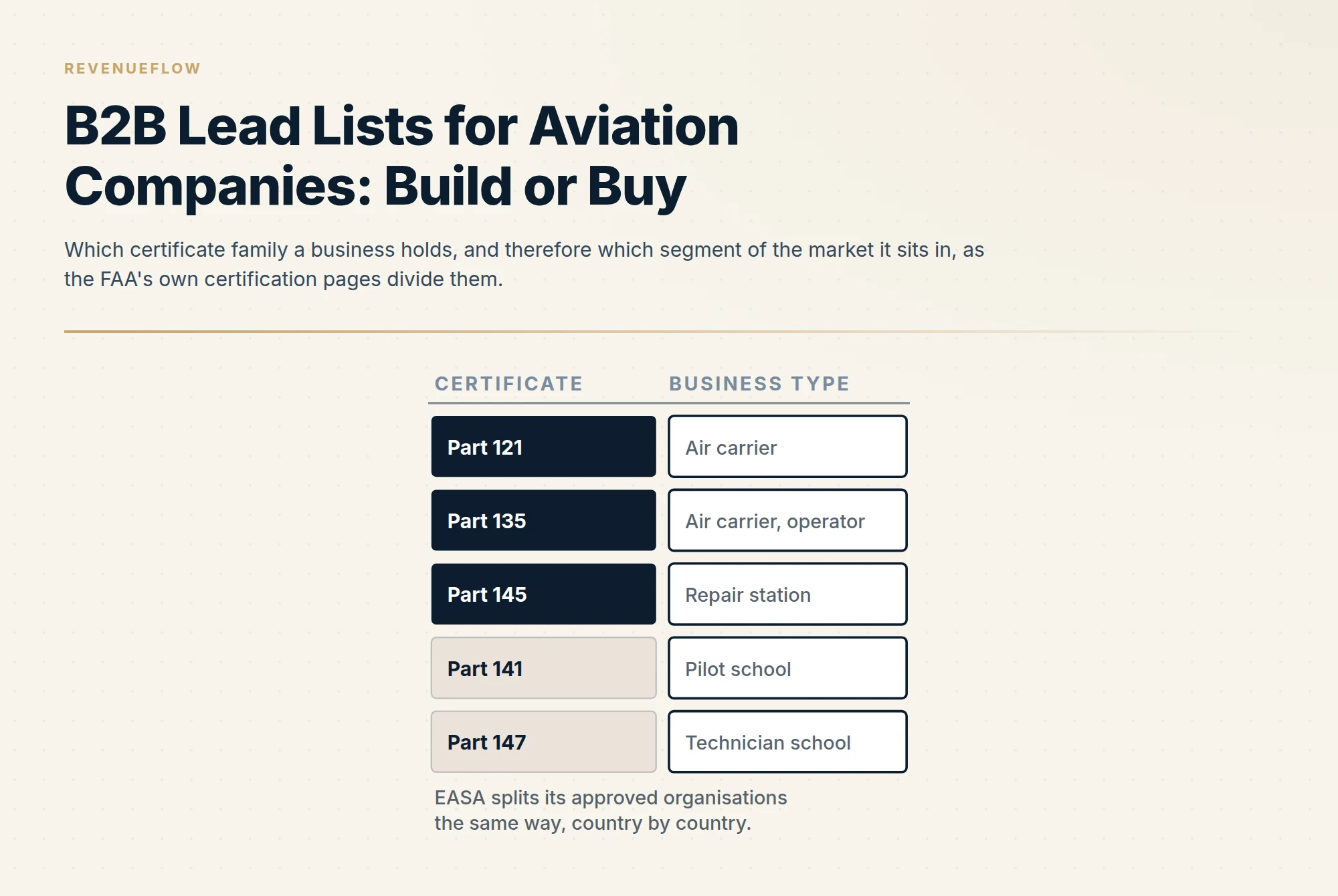
The FAA publishes an aircraft registration database refreshed nightly and delivered as comma separated files, and sorts businesses by certificate family. EASA publishes approved organisation lists by country. None of them holds a named buyer, and an owner can ask for certain details to be withheld.
Key takeaways
- The FAA states that the data in its releasable aircraft download is refreshed daily at 11:30 pm central time and delivered as comma separated values.
- Certificate family is the segment: Part 121 carriers, Part 135 charter and on demand operators, Part 145 repair stations, Part 141 and Part 147 schools.
- A published procedure lets private aircraft owners ask for personally identifiable information to be withheld from a publicly available FAA website, so a registry built list has a predictable hole.
- Permissible fields in the download may be blank and, in the FAA's own words, should not be considered in error, so a blank is not a data quality problem to fill in by guesswork.
Reviewed and updated September 21, 2026
Search for an aviation lead list and the first page of results is an aisle of vendors, each offering an aviation email file with a verification rate in the title. One of them pitches the file by its SIC code. What none of them mentions is that the American regulator publishes, and refreshes every night, a file naming the aircraft, their owners, the charter operators and the maintenance shops, for nothing.
This guide is for anyone building or buying a list of aviation businesses: a supplier selling into airlines, charter operators, maintenance shops and fixed base operators, or a service firm whose market is that industry. It covers what an aviation row should contain, which public file holds which field, where those files are silent, what a vendor is actually selling you, and how to check a file before anyone sends to it. What a lead list is in general, and what a bought one contains, is on our lead list glossary entry and on CMO email list; neither is repeated here. Every source below was fetched on September 21, 2026.
Aviation is enumerable, and that is unusual
The reason a list for this vertical can be built rather than bought is that almost everything in aviation is certificated, and certificates are public.
The FAA publishes a downloadable aircraft registration database. Its own page describes the delivery and the discipline behind it. The download arrives as a set of named files, including an Aircraft Registration Master file, an Aircraft Dealer Applicant file, a Deregistered Aircraft file, an Engine Reference file and a Reserve N-Number file. "The data in the download is refreshed daily at 11:30 pm central time." It comes as comma separated values, chosen because of the "multitude and availability of tools that can open, read, and manipulate the data". (FAA, Releasable Aircraft Database Download, fetched September 21, 2026.)
Businesses, not just aircraft, are enumerated too. The FAA separates certification into families, and the family a company holds is the segment it belongs to: Part 121 air carrier certification, Part 125, Part 135 air carrier and operator certification, Part 141 pilot schools, Part 145 repair station certification and Part 147 maintenance technician schools (FAA, 14 CFR Part 135 Air Carrier and Operator Certification, fetched September 21, 2026). The FAA's repair stations page carries a Find a Repair Station route alongside the application form and the bilateral agreements that let a shop work on foreign-registered aircraft; the page dates itself, last updated Tuesday, July 23, 2024 (FAA, Repair Stations, fetched September 21, 2026). Facilities can be looked up through the FAA's AVInfo Find a Facility Dashboard (FAA, AVInfo, fetched September 21, 2026).
Outside the United States the same logic holds under a different authority. EASA publishes approved organisation lists and splits them the way a seller would want them split: Part-145 organisations by country, including separate lists for Brazil, Canada and the USA, foreign Part 145 and Part 147 organisations, Part-CAMO and Part-CAO organisations, design organisation approvals and production organisation approvals (EASA, Aircraft and products, fetched September 21, 2026).
The fields that matter, and the one that is missing
A general purpose contact file gives you a company, an industry label and an address. An aviation row built from the registry gives you something better, because the fields are operational.
The registration file tells you what a business flies, which is the single most useful qualifier in this market. Fleet type, fleet size and age separate an operator that needs what you sell from one that does not, and the deregistered file tells you what has left a fleet. Certificate type places the account in a segment. Base location puts it on a map. And because the registry refreshes nightly, a change in any of those is a dated event rather than a stale field.
What the registry does not give you is a person. There is no job title in it, no direct line and no work email address. Every list built this way needs a second pass to find the individual, and that pass is the expensive one. This is the honest reason the vendor aisle exists: the vendors are selling the second pass, not the first.
| Field | Invented example | Where it comes from |
|---|---|---|
| Operator | Cloudbank Air | Certificate holder records |
| Certificate family | Part 135 | FAA certification pages |
| Fleet | Six aircraft, two types | Aircraft Registration Master file |
| Base | One field, one state | Registration record |
| Maintenance | Work sent to a Part 145 shop | Repair station lookup |
| The buyer | Not in any of them | The operator's own site |
The row above is invented, including the operator name, and is shown to make the shape of the record visible rather than to describe a real business.
The hole the rule puts in the file
Every list built from a public registry has a shape determined by what the rule lets the registry publish, and in American aviation the rule has a deliberate gap in it.
The FAA's Aircraft Inquiry page states it plainly. Under a procedure the agency has established in accordance with 49 U.S.C. 44114(b), the page says, it is one "by which private aircraft owners can request certain personally identifiable information, such as names and addresses, be withheld from broad dissemination or display on a publicly available FAA website." The same page records that the data is "Updated Each Federal Working Day At Midnight". (FAA Registry, Aircraft Inquiry, fetched September 21, 2026.)
Two things follow for anyone building a list. An owner who has used that procedure is not absent from the industry; they are absent from your file, and a list that treats the registry as a census will quietly undercount exactly the owners most likely to want privacy. And the download's own documentation warns against a related misreading: the file is composed of Required and Permissible data, where permissible fields "may be blank and should not be considered in error". A blank field is not a data quality problem to be filled in by guesswork.
What the vendors in this market are selling
The search results for this phrase are almost entirely files for sale, and several of them state a row count or a verification rate in the page title. None of those pages was fetched for this article, so none of those numbers is repeated here, and the same discipline is the right one for a buyer.
Three questions separate a file worth buying from one worth avoiding, and all three are answerable before money changes hands. Where did the rows come from, and if the answer is a public registry, what did the vendor add to it? When was the contact layer last checked, as a date rather than as a percentage? And will the vendor show you a sample of the exact segment you are buying, not a sample of their best segment? A seller who built the account layer from the registry themselves is in a strong position to ask the third question, because they already know what the accounts look like.
If the answer is the public registry, ask what was added to it. You can download that part yourself, refreshed nightly.
Ask for a date. A verification rate with no date attached describes a process, not this file.
A charter sample proves nothing about the repair station rows. Ask for the segment you intend to send to.
The trade media in this market sell something different again, which is access to their own readership rather than a file. That is a legitimate product and a different purchase; it is advertising, and it should be compared against advertising rather than against a list.
Check the file before anyone sends to it
Whatever route produced the rows, the verification step is the same one every list needs, and our page on email list cleaning covers it in full. Two aviation-specific additions are worth making.
Reconcile the account layer against the registry you can refresh yourself. If a vendor's row says an operator flies a type it no longer holds, the nightly file will say so, and that single check tells you a great deal about the age of the rest of the file. And separate the segments before sending, because a charter operator, a repair station and a flight school have almost nothing in common as buyers even though a single industry label covers all three.
When a bought aviation list is the wrong purchase
When the segment is small enough to enumerate. If your market is Part 145 shops with a particular rating in three states, that is a short list you can build and keep current for nothing. Buying it adds cost and removes the refresh.
When what you need is the person, not the company. No registry holds a buyer. If the account layer is easy and the contact layer is the whole job, say so when you scope the purchase and buy against that, rather than paying for company data you could have downloaded.
When the product is regulated at the other end. Parts, tooling and anything export controlled bring obligations that a list cannot see and that this page does not cover. Take that to counsel rather than to a data vendor.
When the offer is untested. A large file makes a weak message worse faster. Our page on cold email for aerospace covers the writing side for this family of buyers, and aerospace cold email benchmarks is the reference point for what the channel does here.
The short version
Aviation is one of the few industries whose accounts are published by their regulator. The FAA's registration database is refreshed nightly and delivered as a comma separated file; the certificate families sort operators, repair stations and schools into segments; EASA publishes the equivalent organisation lists country by country. What none of them holds is a named buyer, and what the American file deliberately omits is any owner who asked for their details to be withheld under the published procedure. Build the account layer yourself, buy only the layer you cannot build, and check the whole thing before a single message goes out.
If you would rather have that list built and a first campaign run against it, see what a first campaign looks like.
Frequently asked questions.
Frequently asked questions- Can I build an aviation lead list without buying one?
- The account layer, yes. The FAA publishes a downloadable registration database refreshed nightly, sorts operators and maintenance organisations by certificate family, and offers facility lookups. EASA publishes approved organisation lists by country. What no registry holds is a named person with a title and a work address, which is the layer a vendor is actually selling.
- Why do two aviation lists of the same segment disagree?
- Three reasons, and all are structural. An owner may have used the published procedure to have personally identifiable information withheld from a public FAA site. Permissible fields in the download are supplemental and may simply be blank. And the contact layer comes from somewhere else entirely, so two vendors adding different people to the same registry rows produce different files.
- What should I ask an aviation list vendor before buying?
- Where the rows came from, and if it was a public registry, what was added to it. When the contact layer was last checked, as a date rather than a percentage. And whether they will sample the exact segment you intend to send to, because a charter sample tells you nothing about the repair station rows in the same file.
- Which FAA file identifies maintenance businesses?
- Repair stations are certificated under 14 CFR Part 145, and the FAA's repair stations page carries a find a repair station route alongside the application form and the bilateral agreements that let a shop work on foreign registered aircraft. Facilities can also be looked up through the agency's find a facility dashboard.
About the author.

B2B cold email experts helping companies generate qualified leads through done-for-you outreach campaigns.
RevenueFlow Team
Explore more.
Ready to scale your outreach?
We build GTM engines that book real meetings. See the receipts.
Related articles.
B2B Lead Lists for Travel Agencies: Registers and Gaps
The travel trade is written down in state consumer protection registers, not industry directories, and an exemption inside one decides who is missing from your file.
Cold Calling for PPC Agencies: What You Can See First
A paid media prospect is partly readable before the call and has already been told by the platform what to do when a stranger rings about its ads.
LinkedIn Lead Generation for Financial Services Firms
A LinkedIn message from a regulated firm is a communication the rulebook already defines, and the definition turns on how many people receive it within thirty days.
Cold Calling for Chemical Companies: Who Picks Up
A chemical cold call rarely arrives first. It reaches a formulator who has already been comparing suppliers on a screen, for one of three published reasons.
Sales Prospecting for Health Systems: The Public Record
Where health systems are written down in public: the Medicare cost report, the facility list a non-profit system files, and the two gates that follow qualification.
Outbound Sales for Food and Beverage Companies: Who to Reach
Outbound sales for food and beverage brands: the four buyers behind a yes, the public show calendar, what a message may claim, and when outbound is the wrong play.