Cold Calling for Chemical Companies: Who Picks Up
A chemical cold call rarely arrives first. It reaches a formulator who has already been comparing suppliers on a screen, for one of three published reasons.
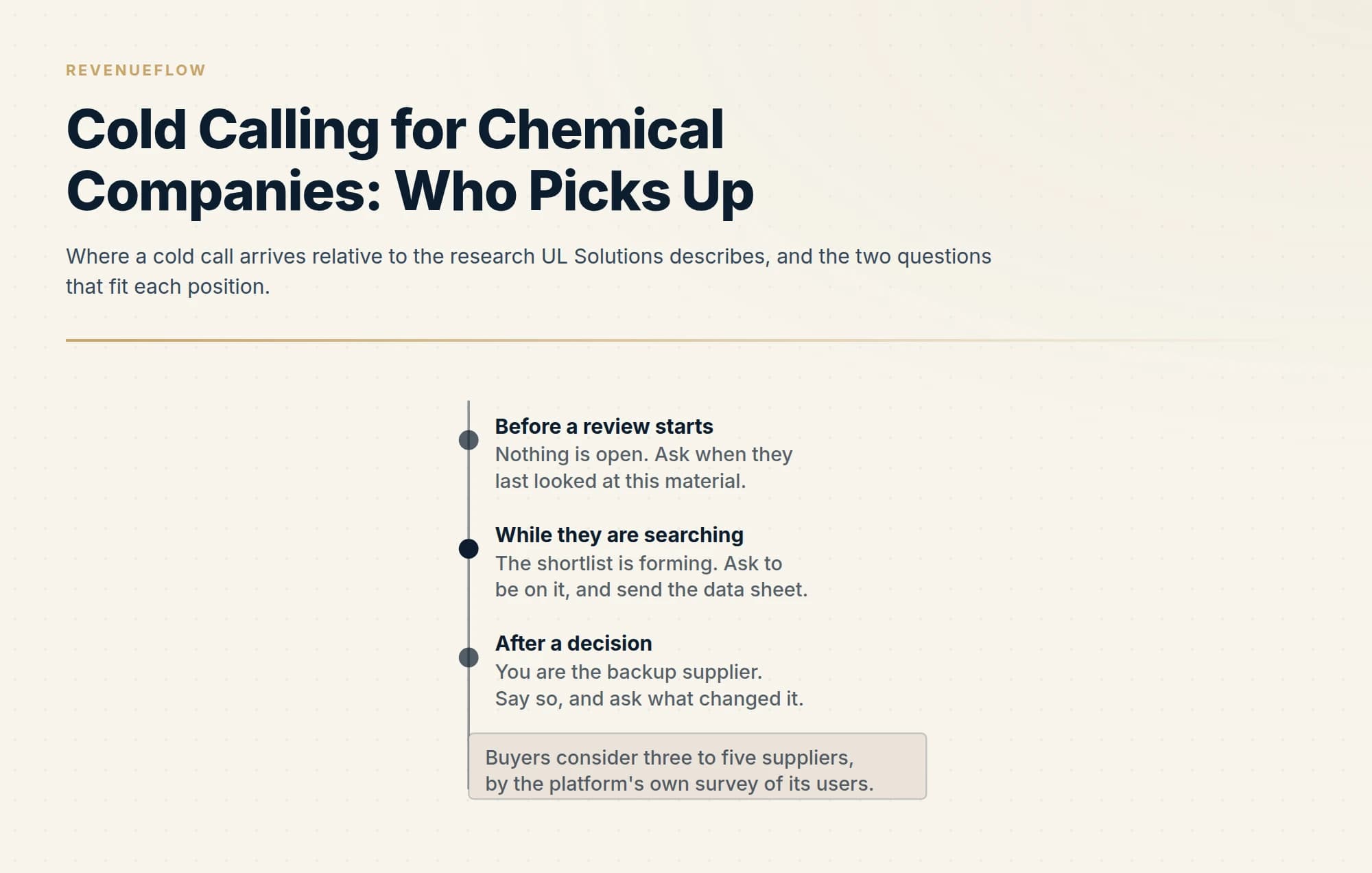
A chemical call reaches product formulators, research staff and engineers who research online and typically consider three to five suppliers. Increasing regulations, rising material costs and changing technology are the published reasons they look at alternatives. The first ask is a data sheet, then a sample.
Key takeaways
- A materials platform reports from its own survey of its users that the majority consider three to five suppliers before deciding, so the call is competing for a place on a shortlist.
- The three trends it names as prompting a search for alternatives are increasing regulations, rising material costs and changing technology.
- Field sellers in this industry say appointments are the goal of the call, that questions beat a presentation, and that the way to learn a prospect's preferred channel is to ask.
- The first useful thing a caller can send is technical documentation and then a sample, because a formulator cannot evaluate a material from a conversation.
Reviewed and updated September 21, 2026
In February 2019 a chemical rep posted a question to a sales forum that describes the state of selling in this industry better than any survey. "my company is extremely old fashioned, like they still use paper for everything and don't believe in appointments", he wrote, and then the detail that makes it real: "When I watch my elderly sales manager walk in with a bag of chemicals and 2 novel sized books filled with product I know there's ways to make a sales call more efficient". (r/sales, February 4, 2019, fetched September 21, 2026.)
This guide is for chemical manufacturers, formulators and distributors whose sales teams call new accounts: plants, purchasing departments and product development groups. It covers who actually picks up in this industry, what that person has already done before your call, the published reasons they become willing to look at a new supplier, what the first call should actually ask for, and where the phone stops working. The general method and the federal rules for any business call are on what cold calling is and which rules apply and where the B2B exemption stops. Every source below was fetched on September 21, 2026.
Your call lands in the middle of a search that has already started
The most important thing to understand about a chemical cold call is that it is rarely first contact with the problem. It is contact with a person who has been looking at alternatives on a screen.
UL Solutions, which runs a materials search platform used by product developers, describes the people a materials supplier is selling to as "product formulators, R&D professionals and engineers", and says the difficulty has grown because those people "have more options than ever when making purchases". On research behaviour it reports its own finding: from a survey of professionals who use its Prospector site for material research, "the majority consider three to five suppliers prior to making a purchase decision", a result it says held across industries and departments. It also names where that research happens, listing general search engines, supplier websites and industry search engines as the top resources used for most or every project. (UL Solutions, no publication date on the page, fetched September 21, 2026. The figure is UL's own survey of its own platform's users and is quoted as such.)
That reframes the call. You are not introducing a category. You are trying to be one of the three to five names on a shortlist that is being assembled, or already has been, somewhere you cannot see. The two useful questions on a first call follow directly: is a formulation being reviewed, and who is doing the reviewing.
Three published reasons a formulator will take the call
A cold call needs a reason that belongs to the other person, and in this industry the reasons are documented. UL Solutions lists the top trends that prompt R&D professionals and engineers to research alternative products, and there are three of them: "Increasing regulations", "Rising material costs" and "Changing technology".
Each of those is a research task before it is a purchase. A regulation that reaches an ingredient forces a reformulation whether or not anyone wanted one. A cost movement in a feedstock sends a purchasing manager looking for a second source. A change in what a customer's own product has to do sends the formulation back to the bench. A caller who can name which of the three is live at that account has a reason to be on the phone that the person on the other end recognises.
A caller who cannot name one is asking a stranger to create the project.
One illustrative opener, built on the first of the three trends, shows what that sounds like. The caller, the company and the account below are invented, and the call claims no results.
Call to a purchasing contact at a formulating business
Morning, this is Ines at Halderbrook Chemicals. Is now a bad moment? 1
We are calling formulators who use this class of ingredient, because the rule that covers it is being revisited and that usually sends people looking at alternatives. 2
Two things: is anything in that formulation under review at your end, and who would see the data sheet if we sent one? 3
- 1The permission question, which is what the field sellers in the thread describe as the alternative to arriving with a presentation.
- 2The reason is the first of the three trends the materials platform names, and it belongs to the reader rather than to the seller.
- 3Two questions, each answerable in a sentence, and the ask is a document rather than an hour of someone's day.
| Trend | What it does to the account | The question it suggests |
|---|---|---|
| Increasing regulations | Forces a reformulation nobody asked for | Is anything in the formulation under review for a rule change? |
| Rising material costs | Sends purchasing looking for a second source | Are you carrying a single source on anything you would rather not? |
| Changing technology | Sends the product back to the bench | Is anything being reformulated for a new requirement? |
Who picks up, and what the field says about reaching them
The route itself is short, and it divides by function. Reception routes rather than blocks. Purchasing owns price and second sourcing, so a technical question reaching it is passed on. Formulation or research owns whether the material can be used at all, which is the question your data sheet answers. The real first ask, at either door, is a document and then a sample.
The vertical's own reps are candid about the mechanics, and the thread quoted at the top is where they say so.
One field seller's summary of what works is that the objective is a meeting rather than a pitch: "Generally, appointments are king." His instruction for that meeting is to arrive with questions rather than a presentation, because "You want to know as much as possible", specifically about what the account uses now, how it uses it, and whether anything about it is a problem.
A second reply pushed back on the idea that any one channel is correct. "Old School is coming back in fashion", he wrote, on the grounds that buyers are saturated with data and advertising, and then gave the practical instruction: "Discover each prospect's favorite method, just by asking." On the walk-in, which is still normal in this industry, he described his own discipline plainly, that he presents a card at reception and asks for an appointment, and that "I never walk in and arrogantly assume they will stop what they are doing and sit through a sales pitch". On persistence he was specific: "Use EVERY tool at your disposal and be persistent. 8 to 10 attempts or until they tell you to stop." (r/sales, February 4, 2019, fetched September 21, 2026.)
Two things are worth taking from that and one is worth leaving. The channel question is answerable by asking it, which costs one sentence on a first call. The receptionist is a router rather than an obstacle, and the ask that gets past her is a specific person and a specific subject. What we would not carry over is the persistence count: our own position is one message per campaign with nothing sent underneath it, and an eight to ten attempt cadence is that seller's practice rather than ours, quoted here because it is what the industry's own reps describe.
Not everyone in the thread's wider community enjoys the work. In a separate r/sales discussion, a rep who spent two years at a chemical importer and distributor wrote that he left, "Ultimately, I got out of it due to my hatred of cold calling buyers", and moved to a technical sales role with no cold calling at all. Another described the industry as "old, established, and good old boys club". (r/sales, August 16, 2019, fetched September 21, 2026.)
The first ask is a document, not a meeting
This is where the vertical diverges most sharply from software selling. A formulator cannot evaluate a material from a conversation. What moves the process is the technical documentation and then a sample, and both are things a caller can send the same day without asking anyone to clear an hour.
That is also the honest reading of what the field sellers describe. The bag of chemicals and the two books in the opening quotation are a primitive version of the right instinct: the seller arrives carrying the thing that can be assessed. The efficient version of the same instinct is to leave the books behind and send the data sheet, because the person who has to read it is not in reception.
It is worth being precise about one thing a caller should not do with documentation. The information that travels with a chemical into a workplace, the labels and the safety data sheets, is governed by a federal standard about hazard communication, whose own summary of itself is that it is the standard "that gave workers the right to know, now gives them the right to understand" (OSHA, Hazard Communication, fetched September 21, 2026). That standard is about information reaching the people who handle the material. It is not a rule about what a sales call may say, and this page does not pretend otherwise. The practical point for a caller is simpler: the documents exist, the buyer expects them, and promising one you cannot send the same week is an avoidable way to lose a new account.
When the phone is the wrong play for a chemical seller
When there is no live reason. UL's three trends are the test. If nothing has changed at the account, a call asks a busy person to start a project for your benefit, and the honest answer is to wait for a reason or to make one through published information rather than through persistence.
When the territory is national and the accounts are plants. One rep in the threads was based in Houston and called customers across North America. That is a real pattern, and it is also the pattern where a phone-first motion spends a person per attempt across a geography nobody can cover. Written outreach carries the reach and leaves a record of exactly what was claimed, which a technical buyer may later want to check. Our page on how email and calling each fail compares the two.
When the buyer's process is a portal. Larger manufacturers run supplier registration and qualification systems, and a call does not bypass one. The call's job there is to find out whether you are registered and who owns the category, which is a different and much shorter conversation.
When the caller cannot answer a technical question. In a market where the evaluator is a formulator, an unprepared caller does lasting damage to the company's name, and the account remembers. Our page on cold calling as a lead generation channel covers the cost side of staffing this properly.
RevenueFlow does not make cold calls for clients. We run email and LinkedIn, one message per campaign, and we say so here because calling advice from a firm that sells another channel should come with its position stated.
The short version
A chemical cold call almost never arrives at the start of the story. It reaches someone who researches on the web, considers a handful of suppliers, and starts looking because a regulation changed, a cost moved or a product had to do something new. The reps in this industry say the goal of the call is a meeting and the tool for it is questions, that the way to learn a prospect's preferred channel is to ask, and that reception is a router rather than a wall. The first useful thing you can send is a data sheet, and the second is a sample. Name the reason, ask who is reviewing, and put the document in their hands.
If you would rather open those conversations in writing, see what a first campaign looks like.
Frequently asked questions.
Frequently asked questions- Who answers a cold call at a chemical company?
- Reception routes rather than blocks, and the two functions behind it are purchasing, which owns price and second sourcing, and formulation or research, which owns whether the material can be used at all. A materials industry source describes the people being sold to as product formulators, research professionals and engineers, which is the group the call is trying to reach.
- What gives a chemical seller a reason to call?
- Three published trends prompt formulators to research alternatives: increasing regulations, rising material costs and changing technology. Each is a research task before it is a purchase, and naming which one is live at the account gives the call a reason that belongs to the person answering rather than to the seller.
- Is cold calling still normal in chemical sales?
- Field practice in this industry still includes walk ins and phone calls, and reps discuss both openly. One described a firm that still used paper and did not believe in appointments. Another left the work over what he called his hatred of cold calling buyers. Both accounts are dated 2019 and are quoted as practice rather than as advice.
- Should a chemical seller ask for a meeting or send a sample?
- Both, in that order of preference and the reverse order of effort. A formulator cannot evaluate a material from a conversation, so the documentation and then the sample are what move the process. Sending the data sheet the same day costs nothing and does not ask anyone to clear an hour, which makes it the easier first yes.
About the author.

B2B cold email experts helping companies generate qualified leads through done-for-you outreach campaigns.
RevenueFlow Team
Explore more.
Ready to scale your outreach?
We build GTM engines that book real meetings. See the receipts.
Related articles.
Cold Calling for PPC Agencies: What You Can See First
A paid media prospect is partly readable before the call and has already been told by the platform what to do when a stranger rings about its ads.
B2B Lead Lists for Aviation Companies: Build or Buy
Aviation is one of the few industries whose accounts are published by its regulator, which changes what is worth buying and what is worth downloading yourself.
B2B Lead Lists for Travel Agencies: Registers and Gaps
The travel trade is written down in state consumer protection registers, not industry directories, and an exemption inside one decides who is missing from your file.
Cold Calling for Manufacturers: The Desk and the Floor
Cold calling for a manufacturer calling plants and OEMs: who answers the main line, the buyer's desk against the floor, the show calendar, the channel map, the limits.
Cold Calling for Food and Beverage Companies: Three Doors
Cold calling for a food or beverage company: who picks up at a chain, a distributor and an independent grocer, where each publishes its door, and when the phone is wrong.
Cold Calling for Consulting Firms: The Partner's Hour
Cold calling for a consulting firm: who it dials and who picks up, why partner-led economics argue against the phone, the client's fiscal year, and when to skip it.