Cold Calling for Manufacturers: The Desk and the Floor
Cold calling for a manufacturer calling plants and OEMs: who answers the main line, the buyer's desk against the floor, the show calendar, the channel map, the limits.
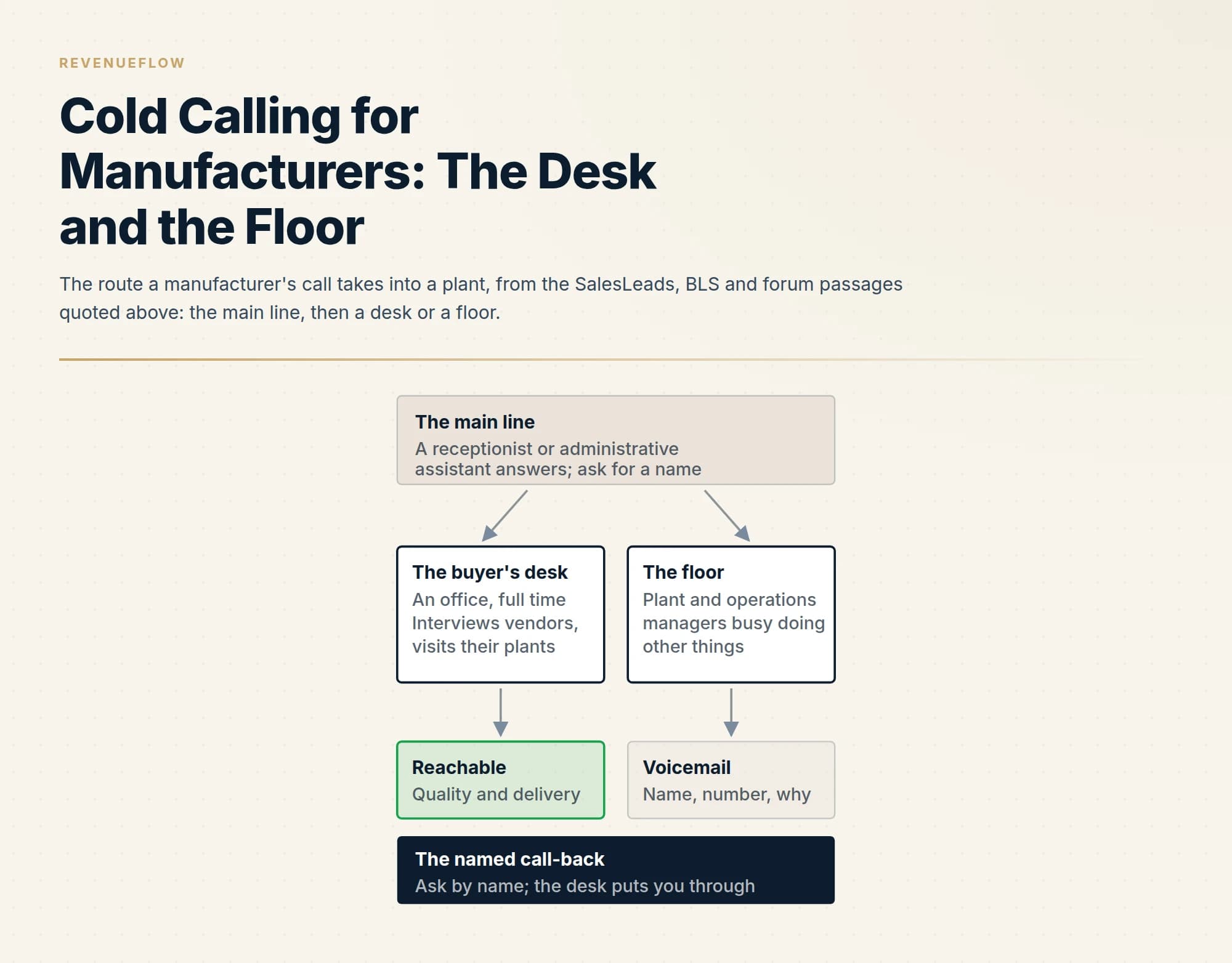
A manufacturer calling a plant reaches a receptionist first, then one of two people: a buyer at a desk who keeps office hours and interviews vendors, or a production lead on the floor, busy doing other things. The buyer's day and the show calendar are the clocks, the channel map comes before the list, and the call qualifies, never pitches.
Key takeaways
- The BLS says purchasing managers, buyers and purchasing agents usually work in an office setting, evaluate suppliers on price, quality and speed of delivery, and attend trade shows to make contacts with suppliers.
- SalesLeads' industrial calling guide says many industrial businesses have receptionists and administrative assistants who answer phones, and that plant and operations managers are often busy doing other things.
- The sales forum thread that anchors this page, from an injection moulder's applications engineer, reports one client from cold calling in four years and a person reached on roughly one call in thirty.
- FABTECH lists 21 to 23 October 2026 in Las Vegas; IMTS records over 90,000 attendees at its 2026 show and a save-the-date for 2028, so the fortnight before a show is when buyers are thinking about suppliers.
Reviewed and updated September 21, 2026
An applications engineer at an injection moulding company, handed the sales job when the company changed, asked the sales forum the question every manufacturer's shop-floor seller eventually asks. "Over the past 4 years we got ONE client from cold calling. The rest found us through marketing or referrals." The replies did not argue with the number. They argued about what the call was for.
This page is cold calling for the manufacturer: the job shop, the contract manufacturer, the component or equipment maker whose own people phone buyers and engineers at other plants and OEMs. It is written for the people inside the manufacturer, not for vendors selling into plants; a vendor reaching plant managers is the manufacturing lead generation guide's reader. It covers who picks up when a manufacturer calls a plant, when a plant answers, the channel question a call can collide with, what the call may say, what the trade says against it, and when the phone is the wrong play. The method of a cold call and its rules live in the hubs; whether to pay an outside team to make these calls is appointment setting for manufacturers. Every outside page below was fetched on 21 September 2026 and is dated where it publishes a date.
What a search for this returns
Four of the ten pages name manufacturing. The sales forum thread above, from 19 June 2014, is the one first-hand account and it is the manufacturer's own. SalesLeads, an industrial project data vendor, lists six things to avoid when cold calling industrial companies, written for the seller into a plant. Factur, an agency that works only with manufacturers, sells the calling as a service. A LinkedIn post on calling in industrial manufacturing could not be fetched. The other six are generic cold-calling guides and vendor lists. The thread and the SalesLeads piece between them describe who answers; nothing in the ten describes when a plant can be reached or what the channel does to a call.
Who picks up at a plant
The main line reaches a person whose job is to answer it. SalesLeads puts it plainly for the industrial caller: "Many industrial businesses have gatekeepers like receptionists and administrative assistants who answer phones", and the people the caller wants are elsewhere: "plant managers, operations managers, and construction managers are often busy doing other things" (SalesLeads, 27 August 2018). The buyer, by contrast, sits at a desk. The Bureau of Labor Statistics describes purchasing managers, buyers and purchasing agents as people who "usually work in an office setting. Most work full time. Travel may be required", and lists among their duties to "Evaluate suppliers on the basis of the price, quality, and speed of delivery of their products and services" and to "Interview vendors and visit suppliers' plants and distribution centers to examine and learn about products, services, and prices" (BLS, purchasing managers, buyers, and purchasing agents, as fetched).
That is the map. A manufacturer calling a plant has two people to reach and they are in different places: the buyer, in an office with a phone, whose job includes interviewing vendors; and the engineer or production lead, on the floor, whose job does not. The thread's most practical reply describes the call that finds them: a pre-qualification call to the receptionist, in the reply's own words, "Is there a Head of Production there I could send it to? Great could I just get their name?", and then a named ask on the next call, because "when you call back they put you through" (the thread).
When a plant answers
Two clocks run at a plant and neither is the caller's. The buyer keeps office hours, per the BLS description above, so the desk is reachable through the working day. The floor is not, and SalesLeads' advice for the unanswered call is the only honest one: "If no one answers your cold call, leave a voicemail message with your name, number, and reason for calling". A plant's own maintenance shutdowns and changeovers are its calendar, and the only source for them is the plant; a caller who does not know them learns them from the receptionist on the first call, which is another reason to make that call a question rather than a pitch.
The trade calendar is public. FABTECH lists its 2026 edition for 21 to 23 October at the Las Vegas Convention Center, with expo hours from nine in the morning each day (FABTECH, as fetched). IMTS's site records that "IMTS 2026 brought together over 90,000 attendees" in September and points to a save-the-date for IMTS 2028 (IMTS, as fetched). The BLS lists attending "meetings, trade shows, and conferences to learn about new industry trends and make contacts with suppliers" among a buyer's duties, which is why the fortnight before a show is when a buyer is already thinking about suppliers.
The channel a call can collide with
Many manufacturers sell through distributors and independent representatives, and a call from the factory into an account a distributor owns is a channel problem before it is a sales problem. The National Association of Wholesaler-Distributors describes itself as "the national voice" of the wholesale distribution industry and says that "Founded in 1946, NAW represents industry trade associations and companies spanning every sector of distribution" (NAW, as fetched). The live pages linked above treat channel conflict as a targeting constraint: the manufacturing lead generation guide from the seller's side, and the appointment setting guide from the manufacturer's own, with the rep and distributor map drawn before any list is built. For the phone the rule is the same and shorter: the map is drawn first, and the call goes only to the open segment.
What the call may say
The rules on a business-to-business call, the federal exemption with its two carve-outs and the separate statute on autodialers and mobile numbers, are quoted in what cold calling is and which rules apply, and this page adds no legal reading of them. What is specific to a plant is small. The main line is a business line and the receptionist is an employee, so the call is the business-to-business call the hub describes; a call that solicits the receptionist personally is the carve-out. And a manufacturer's own product claims, about tolerances, certifications and lead times, are claims the buyer will test against a sample and a spec, which is why the thread's reply says to lead with questions and the BLS duties say the buyer will visit the plant.
What the trade says against it
The thread is the objection, in the manufacturer's own words. The poster's number, one client in four years, sits beside the reach rate, one person in thirty calls: "Recently I am getting a person to speak to maybe 1 our every 30 calls", from a list the poster describes as searching for "companies that might have need for injection mold plastics". The first reply agrees with the premise, "I would say cold calling is incredibly difficult within this sort of industry", tells the poster to "Invest more in your marketing", and adds the one calling instruction that survives: "when first speaking with prospects, dont try and pitch them", because the aim of the first call is only to "figure out if it makes sense to talk". A third reply, from a former mechanical design engineer, names the mindset problem for an engineer selling, "Engineers do not think like sales people and vice versa. It is a completely different mind set", tells the poster to "Take some cold call classes", and offers the consolation that "Sales is non linear": in the reply's words, "if you make a hundred calls you will likely get some business", though not as a direct result of those calls.
SalesLeads, from the other side of the desk, reports the same walls as tactics: prioritise the list, mention a referrer where there is one, do not hang up on the unanswered call, and expect a gatekeeper.
One client in four years
The poster's own number; the rest found the company through marketing and referrals.
Reply: invest more in marketing, and on a call figure out if it makes sense to talk, never pitch.
One person in thirty calls
A list built by searching for companies that might have need for moulded plastics.
Reply: a gatekeeper issue or a data issue; make the pre-qualification call first and get a name.
An engineer on the phone
Engineers do not think like sales people, and vice versa.
Reply: take some cold call classes; sales is non linear, and a hundred calls get business that is not a direct result of those calls.
When the phone is the wrong play
Four cases. The product bought from a catalogue or to a specification through distribution, where the buyer never takes a meeting about it and the distributor owns the account. The shop whose marketing and referrals already bring the work, which is the thread's own situation and the first reply's advice. The account covered by a rep or distributor, where a factory call costs the relationship. And the shop at capacity, which cannot quote the work a buyer would send.
RevenueFlow runs email and LinkedIn for clients and does not cold-call, so the phone described here is the manufacturer's option and not our motion; how email and cold calling each fail compares the two. For a manufacturer the written channel carries what the buyer will test anyway, the certifications, the equipment list and the tolerances, to a desk that keeps office hours; we send one message per campaign, with no bumps. If building that list and first message is the part you would rather hand over, see what a first campaign would target.
Three openers, each on a fetched fact
Each opener below is one message, sent once, to one person; each rests on a page quoted above, names no real recipient and makes no claim about results. The shops and plants in them are invented for illustration.
The first is built on the BLS description of a buyer's duties and is for a purchasing agent at an OEM.
{{first_name}}, your role evaluates suppliers on price, quality and speed of delivery, so this is the one-line version of all three: we machine {{part_family}} to {{tolerance}} in {{material}}, with a {{lead_time}} standard lead time, and we would rather send a sample than a brochure. If a second source for {{part_family}} is on your list this quarter, which drawing should we quote?
The second is built on FABTECH's published dates and is for a fabrication buyer who will be in Las Vegas.
{{first_name}}, the fabrication show runs in Las Vegas from 21 to 23 October, and your company is on the attendee list. We are a {{size}} sheet-metal shop in {{state}} and our engineering manager will be on the floor on the Thursday with sample parts and certifications. If a twenty-minute look at what we run is useful before the show, name a day; if not, we will not follow up.
The third is built on the thread's pre-qualification call and is for the person who answered the plant's main line, by name.
{{first_name}}, this is a sales call from an injection moulding shop, and it is not urgent. We would like to send one page on the moulded parts going through your production line to whoever heads production. Could you tell us their name and whether a request should go to them or to purchasing, and whether any week this quarter is better than the rest?
The short version
A manufacturer calling a plant reaches a receptionist first and then one of two people in two places: a buyer at a desk who keeps office hours and whose job includes interviewing vendors, or a production lead on the floor who is busy doing other things. The buyer's day and the show calendar, FABTECH in October and IMTS on its own cycle, are the clocks. The channel map is drawn before the list, because a factory call into a distributor's account costs more than it wins. The trade's own voice puts the phone behind marketing and referrals and says the call is for qualifying, never pitching; a shop whose work already arrives that way, or whose product is bought to a spec through distribution, should leave the phone alone.
Frequently asked questions.
Frequently asked questions- Who answers when a manufacturer cold calls a plant?
- A receptionist or administrative assistant on the main line, according to an industrial data vendor's guide, and then one of two people in two places. The buyer sits in an office and, per the BLS, works full time evaluating suppliers and interviewing vendors. The plant or operations manager is on the floor and, in the same guide's words, often busy doing other things. The forum's practical advice is a pre-qualification call to get a name first.
- When is the best time to cold call a manufacturing plant?
- The buyer's desk keeps office hours, so it is reachable through the working day; the floor is not, and the honest advice for an unanswered call is a voicemail with a name, number and reason. The plant's own shutdowns are learned from the receptionist. The show calendar is public: FABTECH runs 21 to 23 October 2026 in Las Vegas and IMTS has a save-the-date for 2028, and buyers attend shows to make contacts with suppliers.
- Does cold calling work for a job shop or contract manufacturer?
- The one first-hand account in the search results says it works rarely: an injection moulder's engineer reported one client from cold calling in four years, with the rest from marketing and referrals, and a person reached on about one call in thirty. The replies did not dispute the number; they said to call to qualify rather than pitch, to get a name from the receptionist first, and to invest in the channels that brought the other clients.
- Can a manufacturer cold call a company that buys through a distributor?
- Not without drawing the channel map first. Many manufacturers sell through distributors and independent reps, and a factory call into an account a distributor owns creates a channel problem before it creates a sale. The live manufacturing pages treat channel conflict as a targeting constraint, with the rep and distributor map drawn before any list is built, and for the phone the rule is the same: the call goes only to the open segment.
About the author.

B2B cold email experts helping companies generate qualified leads through done-for-you outreach campaigns.
RevenueFlow Team
Explore more.
Ready to scale your outreach?
We build GTM engines that book real meetings. See the receipts.
Related articles.
Cold Calling for PPC Agencies: What You Can See First
A paid media prospect is partly readable before the call and has already been told by the platform what to do when a stranger rings about its ads.
Cold Calling for Food and Beverage Companies: Three Doors
Cold calling for a food or beverage company: who picks up at a chain, a distributor and an independent grocer, where each publishes its door, and when the phone is wrong.
Cold Calling for Consulting Firms: The Partner's Hour
Cold calling for a consulting firm: who it dials and who picks up, why partner-led economics argue against the phone, the client's fiscal year, and when to skip it.
Cold Calling for Chemical Companies: Who Picks Up
A chemical cold call rarely arrives first. It reaches a formulator who has already been comparing suppliers on a screen, for one of three published reasons.
Cold Calling for Legal Tech Companies: Who Answers at a Firm
What changes when a legal tech company cold calls a law firm: which desks answer, why the billable hour hurts the pitch, the 2027 show dates, and what not to ask.
Sales Prospecting for Consulting Firms: Find the Event
Prospecting for a consulting firm: where triggers are published by practice, who inside the firm reads them, why alumni and referrals come first, when to skip it.