Cold Calling for Food and Beverage Companies: Three Doors
Cold calling for a food or beverage company: who picks up at a chain, a distributor and an independent grocer, where each publishes its door, and when the phone is wrong.
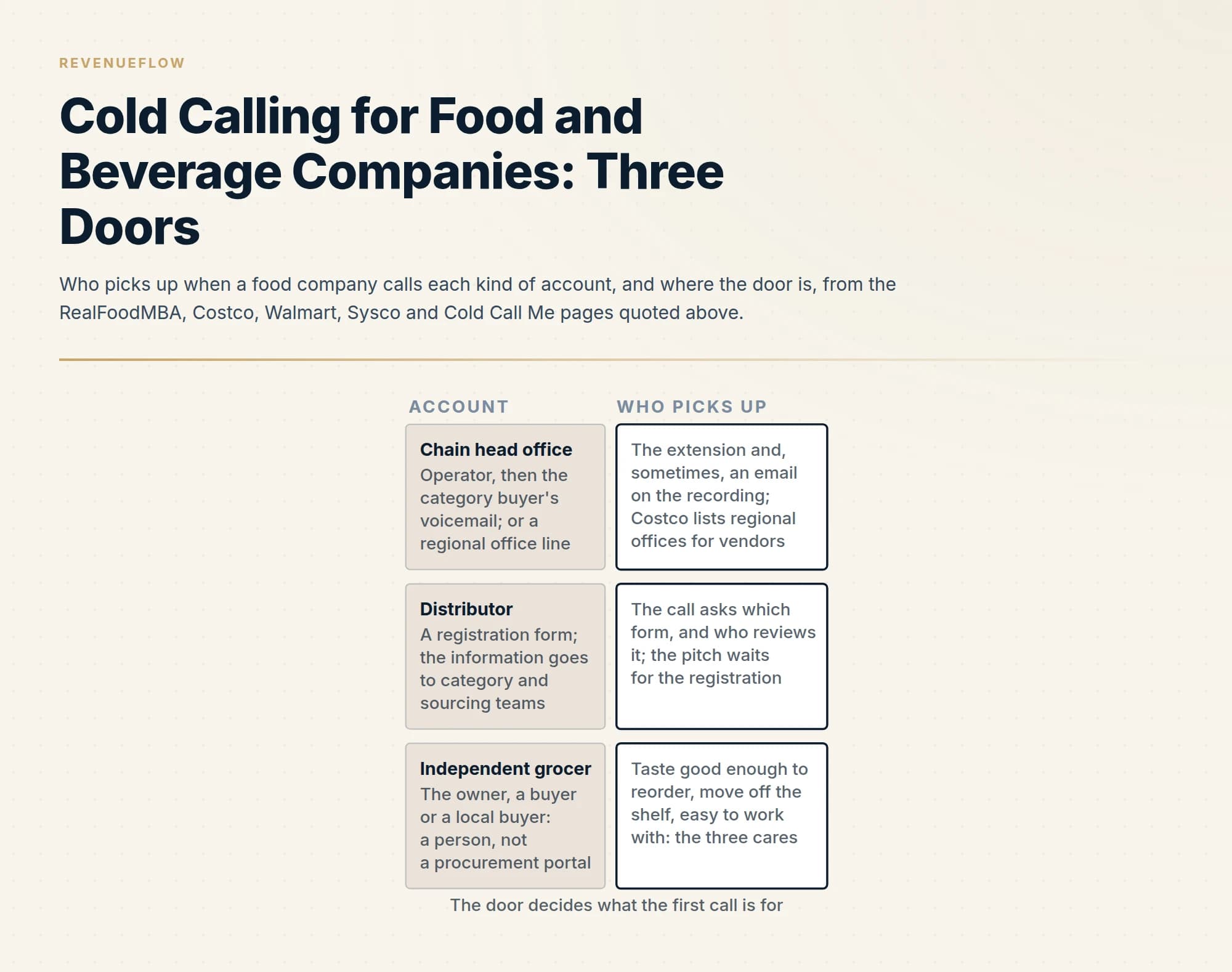
A food company's cold call reaches a different person at each account. At a chain the operator connects the caller to a category buyer's voicemail, or a page like Costco's names a regional office. At a distributor such as Sysco the door is a registration form. At an independent grocer the buyer is a person, usually the owner.
Key takeaways
- Costco's vendor inquiries page tells prospective vendors of food and sundry items to contact the appropriate division office and lists regional offices with telephone numbers; Walmart routes American makers to Open Call.
- Sysco's supplier page says a brand new supplier registers through a link and that the information goes to its category and sourcing teams for review, so the door at a broadline distributor is a form.
- A food entrepreneur's 2021 guide describes ringing a chain's corporate office and asking the operator for the category buyer, reporting that the operator connects the caller nine times out of ten, usually to a voicemail.
- Cold Call Me's August 2026 piece says an independent grocer's buyer is a person, not a procurement portal, usually the owner, who cares whether the product reorders, moves off the shelf and is easy to work with.
Reviewed and updated September 21, 2026
A beverage brand's founder rings a national grocer's head office and asks the operator for the buyer who handles ready-to-drink teas. The operator connects her to a voicemail, which is the best result that call can have, because the buyer's extension is now known and the recording may carry an email address. The same founder rings a broadline distributor and is told to fill in a registration form, and rings an independent grocer and gets the owner, who asks whether the tea tastes good enough to reorder. Three calls, three different doors, and the difference between them is the whole of cold calling in this trade.
This page is cold calling for the food and beverage company: the brand, the manufacturer, the co-packer or the importer whose own people phone retail, foodservice and distribution buyers. It is written for the people inside the food company, not for vendors selling to it, which is the food and beverage cold email guide's reader. It covers who picks up at each kind of account and where the door actually is, when a buyer can be reached, what the call may say, what the trade says against it, and when the phone is the wrong play. The buyer's calendar of category resets and shows, the file a buyer will ask for, and whether to pay an outside team to make these calls are covered in SDR outsourcing for food and beverage companies; the retailer's front-door form and the rules on what a food product may claim are in outbound sales for food and beverage companies; calling restaurants is cold calling scripts for restaurants. None of that is repeated. Every outside page below was fetched on 21 September 2026 and is dated where it publishes a date.
What a search for this returns
Six of the ten pages name the vertical, and three of those are about calling restaurants, which is a different call to a different buyer. Two are calling vendors' pages for food companies (Cold Call Me, SalesHive), one is a business publication's piece on the first twenty seconds of a food-industry call that refused every fetch from here, and the rest are generic cold-calling tips. No result in the ten describes the thing the founder above discovered, that the door is different at a chain, a distributor and an independent, and that the retailers publish which door is theirs.
Who picks up, and where the door is
At a chain's head office, the operator, and then a voicemail. A food entrepreneur's guide to reaching retail buyers, dated 14 February 2021, describes the route in its own words: "Find the corporate office phone number and give them a ring. When the operator answers, mention that you're looking for the category buyer of your department", and reports the outcome, "Nine out of ten times the operator will connect you", to a voicemail that yields the buyer's extension and sometimes an email address (RealFoodMBA). That is the practitioner's claim about the practitioner's own calls, quoted as such; the mechanism it describes, that a category buyer's line is reached through the switchboard by category rather than by name, is the one that matters.
Some chains publish the door outright. Costco's vendor inquiries page says "Prospective vendors of food and sundry items can contact the appropriate division office" and lists the regional offices with their addresses and telephone numbers, Northwest, Northern California, Los Angeles, San Diego, Texas, Midwest and onward (Costco vendor inquiries, as fetched). Walmart's supplier page routes a maker of American products to Open Call, which it describes as the chance to "Pitch products made, grown or assembled in the U.S. directly to Walmart and Sam's Club merchants", alongside an apply-to-be-a-supplier route (Walmart suppliers, as fetched). One retailer answers the phone by region; another answers through an event and a form.
At a broadline distributor, a form. Sysco's supplier resources page says "If you are a brand new supplier to Sysco, below is a link to the registration" and that "The information that you provide will be available to Sysco's Category and Sourcing teams for review and consideration" (Sysco suppliers, as fetched). A cold call to a distributor's category team, before the registration exists, is a call to ask which form to fill in.
At an independent grocer, a person. Cold Call Me's piece on growing into independent grocery, dated 18 August 2026, states the difference plainly: "In independent grocery, your buyer is a person, not a procurement portal, usually the owner, a category manager, or a specialty/local buyer", and says what that person cares about: "will it taste good enough to reorder, will it move off the shelf, and is the brand easy to work with" (Cold Call Me). It is a calling vendor's page and is quoted as the vendor's view, but the independent grocer is the one account type in this trade where the phone reaches the person who can say yes.
When a buyer answers
The chain buyer's calendar is the category reset and the line review, and the linked SDR page carries what the calling vendors say about those windows and the show calendar that surrounds them; none of it is restated here. What the phone adds is the independent grocer's clock. Cold Call Me's piece says "Independent grocers move faster than chains, decide locally", that at an independent "the buyer is often the owner, decisions happen in days", and that "a local win becomes the proof you take everywhere next". A brand that calls a chain in September is waiting for a review month; a brand that calls forty independents in September can have shelf placements by October and a story for the chain's buyer when the review month arrives.
The voicemail is the other clock. RealFoodMBA's route ends in a recording, and the recording is worth more than a conversation would have been at that moment, because the extension and the email address it yields turn the next contact into a written one. A food company that treats the switchboard call as list-building rather than selling has read the vertical correctly.
What the call may say
The rules on a business-to-business call, the federal exemption and its carve-outs, and the separate statute on autodialers and mobile numbers, are quoted in what cold calling is and which rules apply; an independent grocer's listed number is sometimes the owner's personal mobile, which is where the consumer-facing rules come nearest, and that hub draws the line. This page adds no legal reading.
Two things are specific to food. The first is that a food product's claims are regulated words, and the outbound page linked above carries the FDA's three categories of label claim and the organic rule; a call that describes the product uses the same words the label may use. The second is the door itself. Sysco's page says registration information is what its category and sourcing teams review; Walmart's page routes makers to Open Call; Costco's page names the regional office. A call that tries to talk its way around a published route is asking a buyer to do the founder's paperwork, and the buyer will not; the call's use is to confirm the route the page names and to ask where a sample should go.
The operator answers the chain's corporate line
Hello, we are a small beverage brand and we are looking for the buyer for the ready-to-drink tea category. Could you connect us so we can leave a voicemail? 1
On the voicemail: our name, the brand, the category, one sentence on the product, and the number to call back. 2
If the recording gives an email address, the next contact is one written message with the sell sheet attached and no second call. 3
- 1The ask is by category, not by name, which is how the guide says the switchboard routes a vendor.
- 2The voicemail is the product of the call; it yields the extension, and the guide says sometimes an email address.
- 3One written message, once: the buyer's calendar is a review window, and a second call does not move it.
What the trade says against it
The trade's own voice on the phone is thinner here than elsewhere, because the one first-person piece in the results is a restaurant call and the business publication's piece refused every fetch. What is on the record is from a founder and from the vendors who sell calling to food companies. RealFoodMBA's premise is that "cold calling isn't dead" for a food founder, written in 2021, and its method is the switchboard route above; the founder's own next steps, a product platform and LinkedIn research, are a statement that the phone is one of four doors and not the first.
Cold Call Me's piece makes the objection that matters from inside the trade: "Most direct-to-grocery programs fail on the list, not the pitch", and it warns against the assumption that scale requires a broker or a chain: "Emerging brands often assume they need a broker or a national chain to scale". Its food and beverage page describes the job as "navigating the complex world of category managers and buyers" (Cold Call Me food and beverage, as fetched). Read together, the objection is that the call is aimed at the wrong account type more often than it is worded badly.
When the phone is the wrong play
Four cases. The chain whose published route is a form or an event: Walmart's Open Call and Sysco's registration are the door, and a call cannot substitute for them. The account a broker or distributor already covers, where the SDR page's map applies and a brand calling around its own broker competes with itself. The brand that cannot fill the order, which the outbound page treats as the first disqualifier; a yes from an independent is a delivery commitment. And the institutional operator that buys through a group purchasing contract, where the door is the contract and no call reaches it.
RevenueFlow runs email and LinkedIn for clients and does not cold-call, so the phone described here is the trade's option and not our motion; how email and cold calling each fail compares the two. For a food company the written channel carries the sell sheet, the specification and the sample offer to the extension and the address the switchboard call produced; we send one message per campaign, with no bumps. If building that account list, door by door, is the part you would rather hand over, see what a first campaign would target.
Three openers, each on a fetched fact
Each opener below is one message, sent once, to one person; each rests on a page quoted above, names no real recipient and makes no claim about results. The brands and stores in them are invented for illustration.
The first is built on Costco's vendor inquiries page and is for a regional buying office that publishes its line.
This is a sales call from a small beverage brand, and we are calling the regional office because your vendor page says prospective food vendors should contact the division for their region. We make a shelf-stable iced tea in {{state}} and we would like to know which buyer reviews new beverage items for this region and whether a sample should go to this office or to another address. Nothing else on a first call.
The second is built on Sysco's supplier registration page and is for a distributor's category team, after the registration is submitted.
{{first_name}}, we submitted the supplier registration last week, and your page says the information goes to the category and sourcing teams for review. We are a co-packed snack brand with {{certifications}} and a {{shelf_life}} shelf life, and we would like to know whether the frozen and refrigerated category reviews new items on a schedule or as they arrive. If a sample would help the review, tell us where to send it.
The third is built on Cold Call Me's description of the independent grocer's three cares and is for the owner of an independent market.
{{first_name}}, this is a sales call from a local sauce maker and it will take a minute. Your store carries three sauces next to where ours would sit, and the three things we would want you to test are whether it tastes good enough to reorder, whether it moves, and whether we are easy to work with. May we drop a case and a sample this week and let the shelf answer the first two?
The short version
A food company's cold call reaches a different person at each kind of account, and the retailers say which. At a chain the operator connects a caller to a category buyer's voicemail, or a page like Costco's names the regional office to ring; at a broadline distributor such as Sysco the door is a registration form that the category and sourcing teams review; at an independent grocer the buyer is a person, usually the owner, who decides in days and cares whether the product reorders, moves and is easy to work with. The call's product is the door and the extension, and the written message that follows carries the sell sheet and the sample offer. Where the door is a form, an event, a broker's account or a group contract, the phone is the wrong play.
Frequently asked questions.
Frequently asked questions- How do you cold call a grocery chain's buyer?
- Through the switchboard, by category. A food founder's guide describes ringing the corporate office, asking the operator for the buyer of your department, and being connected nine times out of ten, usually to a voicemail that yields the buyer's extension and sometimes an email address. Some chains publish the door instead: Costco lists regional offices with phone numbers for prospective food vendors, and Walmart routes American makers to Open Call.
- Can you cold call a food distributor like Sysco?
- You can call to ask which form to fill in. Sysco's supplier page says a brand new supplier registers through a link and that the information provided goes to its category and sourcing teams for review and consideration. A call to a distributor's category team before the registration exists is a call about the door, and the pitch waits for the registration to be reviewed.
- Who answers when you call an independent grocery store?
- Usually the person who can say yes. Cold Call Me's piece on independent grocery says the buyer is a person, not a procurement portal, usually the owner, a category manager or a specialty buyer, and that independents move faster than chains, decide locally and decide in days. The three things that person cares about are whether the product tastes good enough to reorder, whether it moves off the shelf, and whether the brand is easy to work with.
- When is cold calling the wrong play for a food brand?
- When the account publishes a door that is not a phone: Walmart's Open Call and Sysco's registration form are the route, and a call cannot replace them. When a broker or distributor already covers the account, because the brand would compete with its own channel. When the brand cannot fill the order, since a yes from an independent is a delivery commitment. And when the operator buys through a group purchasing contract, where no call reaches the door.
About the author.

B2B cold email experts helping companies generate qualified leads through done-for-you outreach campaigns.
RevenueFlow Team
Explore more.
Ready to scale your outreach?
We build GTM engines that book real meetings. See the receipts.
Related articles.
Outbound Sales for Food and Beverage Companies: Who to Reach
Outbound sales for food and beverage brands: the four buyers behind a yes, the public show calendar, what a message may claim, and when outbound is the wrong play.
Cold Calling for PPC Agencies: What You Can See First
A paid media prospect is partly readable before the call and has already been told by the platform what to do when a stranger rings about its ads.
Cold Calling for Manufacturers: The Desk and the Floor
Cold calling for a manufacturer calling plants and OEMs: who answers the main line, the buyer's desk against the floor, the show calendar, the channel map, the limits.
Cold Calling for Consulting Firms: The Partner's Hour
Cold calling for a consulting firm: who it dials and who picks up, why partner-led economics argue against the phone, the client's fiscal year, and when to skip it.
Cold Calling for Chemical Companies: Who Picks Up
A chemical cold call rarely arrives first. It reaches a formulator who has already been comparing suppliers on a screen, for one of three published reasons.
Cold Calling for Legal Tech Companies: Who Answers at a Firm
What changes when a legal tech company cold calls a law firm: which desks answer, why the billable hour hurts the pitch, the 2027 show dates, and what not to ask.