Cold Calling Scripts for Restaurants: Call Between Services
Six call scripts for vendors calling independent restaurants: when the line can talk, who to ask for by name, the contract objection and the pre-opening call.
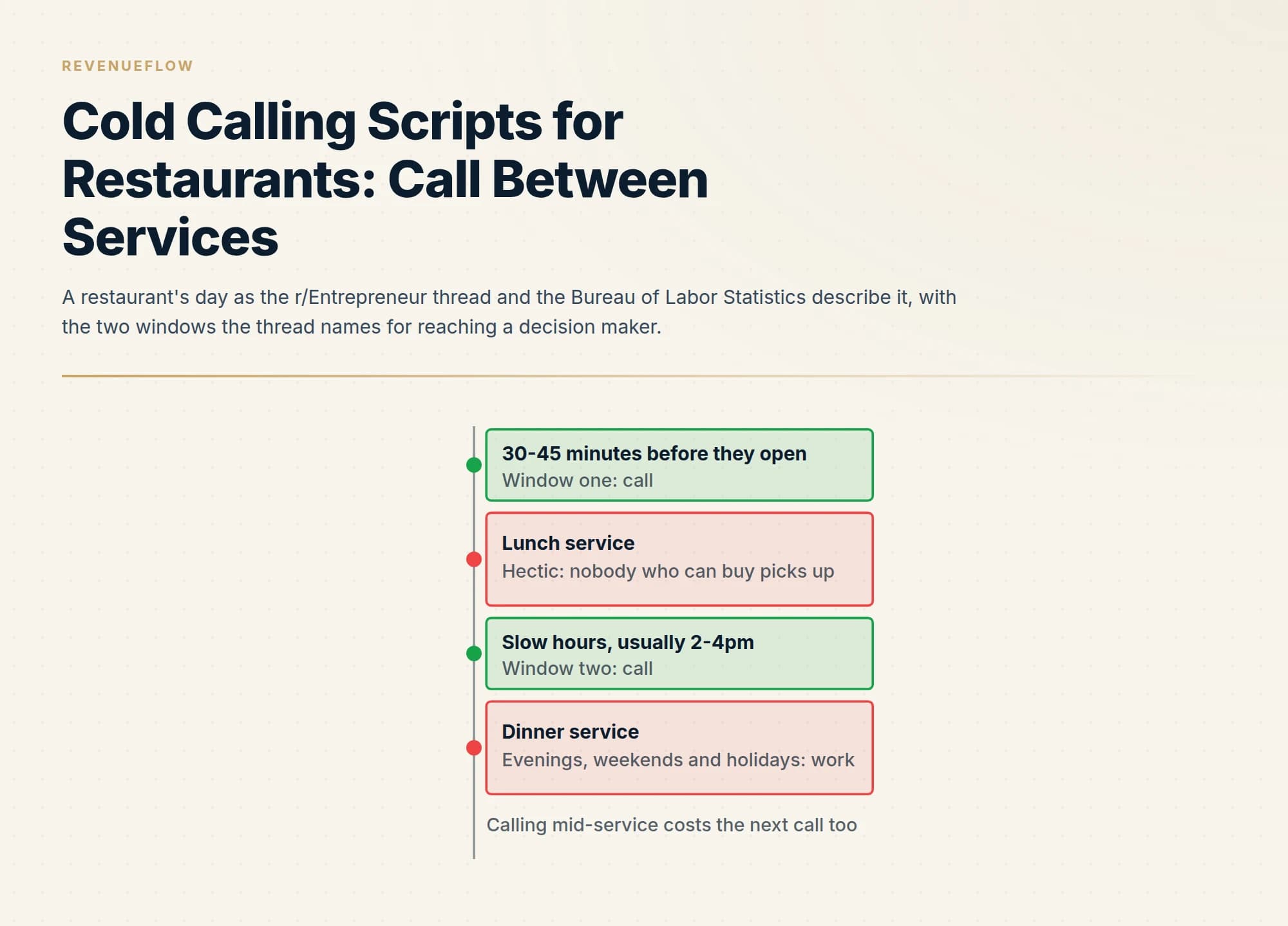
A restaurant's line can talk business in two windows: 30 to 45 minutes before opening and the slow hours, usually 2 to 4pm. Ask for the licence holder by name, say it is a sales call, open on something seen there, and answer the contract objection by asking only for its end date. Groups are reached in writing.
Key takeaways
- A reply in a 2015 r/Entrepreneur thread on fifty cold calls to restaurants gives the timing: call 30-45 minutes before they open, or in their slow hours, usually 2-4pm.
- A restaurant owner in the same thread says most operators are under contract on their point of sale, that the cost of switching is very high, and that new business licences are the better list.
- The Bureau of Labor Statistics says food service managers often work evenings, weekends and holidays, order food, equipment and supplies, and carry budgeting and cost responsibilities.
- Another reply advises looking up the licence holder and asking for that person by name, because staff give a true call-back time for a name and brush off a request for the manager.
Reviewed and updated September 18, 2026
Cold Calling Scripts for Restaurants: Call Between Services
At ten past twelve on a Friday the phone on the host stand rings for the ninth time that hour. Seven of those calls were bookings, one was a supplier confirming a delivery, and this one is a point of sale vendor asking to speak to the manager about an upgrade. The host has a queue at the door and a server asking about table six. She says the manager is busy, which is true, and the vendor writes "gatekeeper" in the notes.
This page is scripts for a vendor calling restaurants: a marketing agency, a point of sale or ordering company, a delivery platform, a food or equipment supplier. It is about the call to the restaurant's own line, answered by whoever is nearest, at an independent or a small local group. A multi-unit group buys through a corporate team that is reached in writing, and what those buyers respond to is measured in the hospitality cold email benchmarks. Every outside source here was fetched on 18 September 2026, and every name inside a script is a placeholder.
When a restaurant can talk, from the people who run them
The richest source for this call is an r/Entrepreneur thread from 23 July 2015, titled "Just made my first 50 cold calls to restaurants" (the thread). The poster, who was selling a point of sale upgrade, made fifty calls and got one lead. The replies include a restaurant owner and a hospitality salesperson of sixteen years, and between them they give the timing, the list and the objection.
On timing, one reply is as specific as this trade gets: "call 30-45 minutes before they open, or in their slow hours (usually 2-4pm)". The restaurant owner in the thread explains why it matters, writing that as an owner he is far less reachable by sales calls than he was as a software executive sitting at a desk next to a phone. The Bureau of Labor Statistics describes the same life in its Occupational Outlook entry for food service managers: they often work evenings, weekends, and holidays, and the work is often hectic. The entry lists what the manager is responsible for, which is a fair map of what a vendor can sell them: they order food and beverages, equipment, and supplies, schedule workers for each shift, and carry financial responsibilities that include budgeting, ensuring cash flow, and monitoring operational costs.
So the call has two windows and two walls. During lunch and dinner service nobody who can buy anything will come to the phone, and a call placed then costs the vendor the next one as well, because the host remembers.
Who picks up, and who to ask for
A host, a bartender or a shift lead answers. One reply in the thread observes that restaurant management is accessible compared with industries where the buyer is a vice president behind several gatekeepers, and that is right: there is one step between the phone and the person who decides. The poster's own opener shows how to waste it. It asked for "your manager regarding an upgrade to your Point of Sale system", and the poster concedes it sounded scripted and like a call centre.
Another reply supplies the fix. For any business that needs a licence, it says, "see if you can look up who the licence holder is", then ask for that person by name. Staff are more likely to give a correct time to call back for a named person than for an obvious sales call asking for the manager. The live page on cold calling business owners explains the underlying point: at this size the person answering is rarely a trained screener, and being plainly legible works better than technique.
Independents and groups part ways here. At an independent the owner or general manager is usually in the building and can say yes. At a group or a franchise the person in the building cannot sign, and the decision sits with a corporate team the restaurant's phone will never reach.
Script 1: whoever answers
Grounded in the licence-holder reply.
Hi, this is {{name}} from {{company}}. You're about to open, so ten seconds: is {{licence_holder}} in? It's a sales call about {{category}}, nothing urgent. When is {{licence_holder}} usually in and not slammed?
Saying that it is a sales call and that it is not urgent is what gets a true answer. A host who has been tricked into fetching the owner mid-prep does not forget the company's name.
Script 2: the owner or general manager, between services
Grounded in the timing reply: the call is placed before opening or in the slow hours, and says so.
{{owner_name}}, {{name}} with {{company}}. You're between services, which is why the call is now, and it will take ninety seconds. We {{one_line_offer}} for independent restaurants in {{area}}. At lunch on {{day}} we noticed {{specific_observation}}. Is that something you've already got in hand, or is it worth ten minutes one afternoon this week?
The observation has to be real. The hospitality salesperson in the thread, sixteen years in the industry and eight of them in sales, gives the method: "take the time to watch a lunch or dinner shift at that place sometime", which is how the writer finds the problems worth raising, often ones the owner was not aware of.
Script 3: the restaurant that has not opened yet
Grounded in the restaurant owner's advice in the thread. The owner writes that "Most people are under contract on their POS" and that the "cost of switching is very high"; the better bet is to look at a city's new business licences and call the people who have not committed yet.
{{owner_name}}, this is {{name}} at {{company}}. The new licence for {{restaurant_name}} on {{street}} came through, congratulations. We're calling before you've signed for {{category}}, not after. One page with what it costs, all of it, and what the term is can be with you today. Who is handling that decision for the opening?
Script 4: the restaurant that is under contract
Plenty of places are, and nobody is asking you to break it. Do you know when it ends? With the month, we'll contact you once, six weeks before, and leave you alone until then.
The restaurant owner in the thread says he does not understand these calls, because operators cannot switch even if they hate what they have. A caller who accepts that and asks for the date is the only one who will be remembered when the term ends. On the written side the same logic is house policy: one message per campaign, and a new approach only when something has changed.
Script 5: the call that lands in the middle of service
Then this was the wrong time, sorry. What time tomorrow is your quiet half hour? We'll call then, once.
Nothing else should be said. Any sentence after the apology is heard over a ticket printer.
Script 6: the voicemail
{{owner_name}}, {{name}} at {{company}}, {{phone}}. We work with independent restaurants in {{area}} on {{category}}. We'll try you once more around {{slow_hour}}. If it's not of interest, ignore this and we won't call again.
Under contract, and the cost of switching is very high. Ask for the end date, contact once before it, leave them alone until then.
Far less reachable than someone at a desk. Call before opening or in the slow hours, and say why you chose the time.
The opener sounded scripted and like a call centre. Ask for the licence holder by name and say it is a sales call.
No real observation to open on. Watch a lunch or dinner shift first.
The rules, and the other calls a restaurant gets
A call to a restaurant's business line about a business product is a business-to-business call; the federal position, the carve-outs, and the separate statute on autodialers and mobile numbers are quoted in is cold calling against the law. An owner-operator's listed number is often a personal mobile, which is where the consumer-facing rules come nearest, and that hub draws the line. This page adds no legal reading.
What is specific to restaurants is the company the call keeps. Google's help page on fraudulent calls and texts uses a restaurant as its example of a legitimate automated call, quoting a recorded voice that says it is helping people find restaurants and asks whether the business offers vegetarian dishes. The Federal Trade Commission's Scams and Your Small Business guide describes the illegitimate kind: callers who say they simply want to "confirm" the business's information and later send a big bill. A restaurant's line carries bookings, suppliers, robots and scammers in the same hour, so a vendor's first sentence has to establish a name, a company and a plain purpose before anything else.
When a script is the wrong tool
Three cases from the sources. The group or franchise, where the person who answers cannot sign. The operator mid-contract on the thing being sold, where the restaurant owner's verdict is that the call makes no sense. And the vendor who has not been in the building: the thread's poster made fifty calls for one lead with an opener that could have been read to any restaurant in the country. The response shapes for call objections in general are in cold call objections sort into three buckets, and the opening-line discipline is argued in bank cold calling scripts.
Where the call sits next to written outreach
RevenueFlow runs email and LinkedIn for clients and does not cold-call, so these scripts describe this market's reality and are not our motion. For the independent restaurant the phone has a real case, because the owner is in the building and rarely at a desk. For groups the case reverses: the corporate team reads email, and one verified reason can reach a few hundred of them in a morning. How email and cold calling each fail compares the two channels. If the group side of the list is the part you would rather have built and written for you, see what a first campaign would target.
The short version
A restaurant answers its phone all day and can talk business for about two hours of it: the half hour before opening and the slow stretch the thread puts at two to four in the afternoon. Ask for the licence holder by name, say it is a sales call, open on something seen in the dining room, accept the contract objection and ask for the date, and keep independents on the phone and groups in writing.
Frequently asked questions.
Frequently asked questions- What is the best time to cold call a restaurant?
- Between services. A reply in a 2015 r/Entrepreneur thread about fifty cold calls to restaurants puts it at 30 to 45 minutes before opening or in the slow hours, usually 2 to 4pm. The Bureau of Labor Statistics notes that food service managers often work evenings, weekends and holidays and that the work is often hectic, so a call during lunch or dinner service reaches nobody who can buy.
- Who should a vendor ask for when calling a restaurant?
- A named person. One reply in the thread advises looking up the licence holder for any licensed business and asking for them by name, because staff are more likely to give a correct time to call back than for an obvious sales call asking for the manager. At an independent that person is usually the owner or general manager and can decide.
- How do you handle a restaurant that says it is under contract?
- Accept it. A restaurant owner in the thread writes that most operators are under contract on their point of sale and that the cost of switching is very high. Ask only when the term ends, promise one contact six weeks before that date, and leave them alone until then. A caller who does that is the one remembered at renewal.
- Should restaurant groups be cold called the same way as independents?
- No. At a group or franchise the person in the building cannot sign, and the decision sits with a corporate team that the restaurant's phone never reaches. That team is reached in writing, with one verified reason sent to the right roles. The scripts on this page are for the independent restaurant or small local group whose owner is on site.
About the author.

B2B cold email experts helping companies generate qualified leads through done-for-you outreach campaigns.
RevenueFlow Team
Explore more.
Ready to scale your outreach?
We build GTM engines that book real meetings. See the receipts.
Related articles.
Cold Calling Scripts for SEO Agencies: After Google's Warning
Six call scripts for SEO agencies calling local businesses, written around what Google and the FTC tell owners about this call: no Google tie, no ranking guarantee.
Merchant Services Cold Calling Scripts: The Honest Version
Six call scripts for merchant services agents and ISO reps, built around what the FTC alleged about this exact call: no affiliation claim, no rate before a statement.
Cold Calling Scripts for 3PL Companies: One Lane at a Time
Six call scripts for brokers and 3PLs calling shippers: the front office line, the one-lane opener, the incumbent answer, the email brush-off and the voicemail.
Cold Calling Scripts for Accounting Firms, by Service Line
Six call scripts for accounting firms by service line, the Supreme Court case that lets CPAs call business prospects, and the filing calendar that says when to.
Cold Calling Scripts for Law Firms: Who Answers and What Works
Five call scripts for vendors calling law firms: the receptionist, the legal assistant, the firm administrator and the partner, plus why firms cannot cold call clients.
Appointment Setting for 3PL Companies: Fit Before the Calendar
For 3PLs, warehousing operators and brokers wanting shipper meetings: the five fit gates, the bid calendar, contract terms, the trade's rules and three openers.