Cold Calling Scripts for Credit Unions: Field of Membership
Five scripts for a credit union's own business development officer calling employers and businesses, written around the field of membership NCUA has to approve.
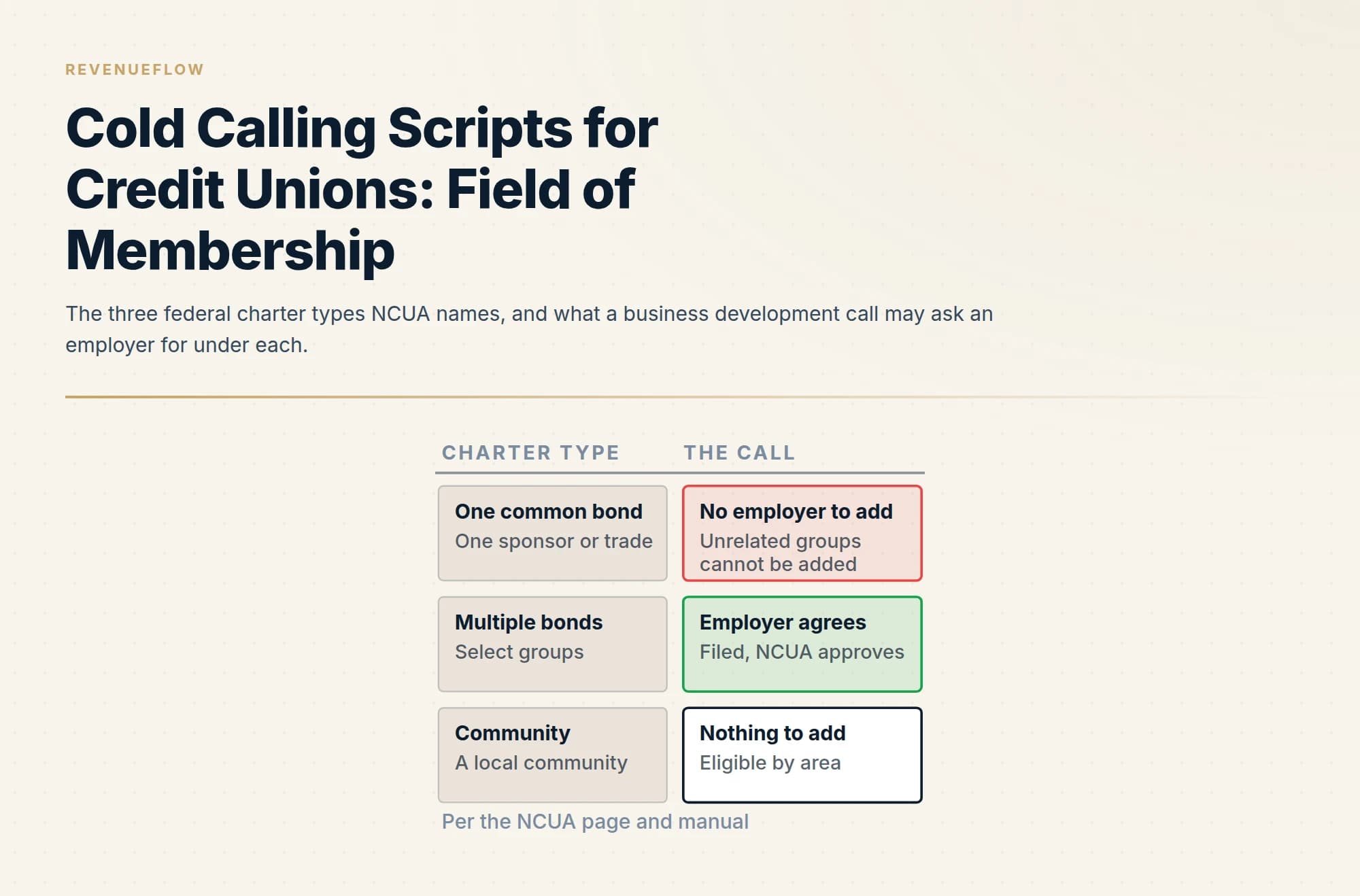
A credit union's business development call asks an employer to be added to the field of membership, not to buy. The scripts say credit union first, ask where the company is paid from because NCUA's manual requires the group to sit inside the service area, offer the no-cost letter, and ask eligibility before credit.
Key takeaways
- NCUA's field-of-membership page says a federally chartered credit union must receive NCUA approval before changing its field of membership, and that since 5 June 2025 multiple common bond credit unions can add occupational and associational groups of any size through CAPRIS.
- NCUA's manual says only the persons or legal entities specified in the field of membership can be served, and a select group must sit within reasonable geographic proximity, so the service-area question comes before any offer.
- Hanscom Federal Credit Union's own page tells employers there is no cost and that all it takes is a letter requesting to become a select employee group, which is the whole ask of the employer script.
- The FTC's guide says federal credit unions are not covered by the Telemarketing Sales Rule while any company contracted to call for them must comply with it, and the separate rule on mobile numbers applies to every caller.
Reviewed and updated September 21, 2026
A business development officer at a credit union has a constraint no bank caller has ever had to say out loud: the person on the other end of the line may not be allowed to join. The National Credit Union Administration puts it in one sentence on its field-of-membership page, read on 21 September 2026: a credit union's field of membership "determines who is eligible to join that credit union and access its financial products and services." (NCUA, Field-of-Membership Expansion.) Every script on this page is written around that sentence.
This page is scripts for the credit union's own callers: the business development officer, partner relations manager or member business lending officer phoning employers and local businesses. It is not scripts for a company selling software to credit unions, which is the call cold calling for fintech companies describes. The banker's version of the same call, with the condition opener, the gatekeeper line and the arithmetic behind a call quota, is in bank cold calling scripts and is not repeated here; what a credit union adds is the charter. Every outside source was read on 21 September 2026, nothing here is legal advice, and every name inside a script is a placeholder.
What the charter lets the call offer
The NCUA page describes three kinds of federal charter: "Federally chartered credit unions operate under one of three kinds of charters: single common bond, multiple common bond, or community. The type of charter a credit union holds determines what groups or geographic areas it may serve." And it states the rule that makes a business development call different from a sales call anywhere else: "A federally chartered credit union must receive approval from the National Credit Union Administration prior to making changes in its field of membership."
NCUA's Chartering and Field of Membership Manual, published as Appendix B to 12 CFR 701 and read on eCFR, describes the groups a multiple common bond credit union serves: "These groups are referred to as select groups." It sets the geography, "these groups must be within reasonable geographic proximity of the credit union", and the boundary of every conversation: "Only those persons or legal entities specified in the field of membership can be served." A new employer is added, in the manual's words, "through agreement between the group and the credit union directly," and "The Office of Credit Union Resources and Expansion Director must approve all amendments to a multiple common bond credit union's field of membership." (eCFR, 12 CFR Part 701 Appendix B.)
The process behind that approval changed recently. NCUA's page says: "On June 5, 2025, the NCUA updated its Consumer Access Process and Reporting Information System (CAPRIS) to allow more applications to be submitted through that system. This update allows multiple common bond federal credit unions the ability to add occupational and associational groups of any size." It adds that "For multiple common bond federal credit unions, most occupational and associational groups can be added quickly through CAPRIS."
So a call to an employer at a multiple common bond credit union is not a call to sell an account. It is a call to ask whether the employer will agree to be added, after which the credit union files and NCUA approves. A community charter has no such call to make, because eligibility comes from the area, which the manual describes as "a well-defined local community, neighborhood, or rural district". A single common bond credit union serves one sponsor or, in the manual's words, "a trade, industry, or profession (TIP)", and cannot add an unrelated employer at all. Which charter you hold decides which scripts below exist for you.
What the employer is being offered, in a credit union's own words
Hanscom Federal Credit Union explained the offer to employers on its own blog on 23 May 2020, and the explanation is the script's spine. Select employee groups, it writes, "are companies that partner with us to provide credit union membership for their employees." The range: "Our SEGs range from small businesses with fewer than 10 employees to major employers and local branches of national companies." What happens after the agreement: "Once a company or organization becomes a SEG, all of its employees can join the credit union". The cost and the paperwork: "For employers, it's a good move. There is no cost. All it takes is a letter requesting to become a SEG." And the reason a human resources lead takes the call: "Your human resources department can outsource training and education on a topic that requires expertise they may not have, thereby saving the department time." (Hanscom Federal Credit Union, What is a SEG?.)
Read that against the manual and the call has a shape. The employer signs nothing financial, pays nothing, and writes one letter; the credit union does the filing; NCUA does the approving. The person to call is whoever owns the benefits list, and the ask is a letter.
Script 1: the human resources or benefits lead
Good morning, this is {{name}} from {{credit_union}}. It's a cold call, and it's not to sell you anything. We're a credit union, and employers in this area can add credit union membership as a benefit for their staff at no cost to the company. It takes a letter from you and a filing from us. Could you tell us who looks after benefits, and whether a no-cost benefit is something you'd consider this year?
The script says credit union in the first breath, names the cost as nothing and the paperwork as a letter, both of which Hanscom's page states, and asks for the benefits owner rather than a decision.
To: whoever owns the employee benefits list
It's a cold call, and it's not to sell you anything. We're a credit union. 1
Employers in this area can add credit union membership as a benefit for their staff at no cost to the company. It takes a letter from you and a filing from us. 2
- 1Says what the caller is, because the field of membership is the first thing the listener has to hear.
- 2Hanscom's page: there is no cost to the employer and all it takes is a letter; the manual requires reasonable geographic proximity, and the credit union files for NCUA approval.
Script 2: whoever answers the employer's main line
The manual's geography test is the qualifying question, and the person on the main line can answer it. The manual says a select group is within the credit union's service area when "A majority of the persons in a select group live, work, or gather regularly within the service area", when "The group's headquarters is located within the service area", or when the group's paid-from or supervised-from location is.
Hi, this is {{name}} at {{credit_union}}. Quick one, and it isn't a sales call for you personally. Is the company headquartered here in {{area}}, or is this a branch that's paid from somewhere else? And who should we ask about employee benefits?
A branch paid from another state may not qualify under the service-area test even if its staff want the benefit, and the receptionist knows where payroll comes from.
Script 3: the business owner, for a commercial loan
The other call a credit union's business officer makes is to a business that could borrow, and the rule set is 12 CFR Part 723. A commercial loan, in the rule's definition, is a loan "to individuals, sole proprietorships, partnerships, corporations, or other business enterprises for commercial, industrial, agricultural, or professional purposes, but not for personal expenditure purposes." The rule also caps the book: "The aggregate limit on a federally insured credit union's net member business loan balances is the lesser of 1.75 times the actual net worth of the credit union, or 1.75 times the minimum net worth required under section 1790d(c)(1)(A) of the Federal Credit Union Act." (eCFR, 12 CFR Part 723.) The word member in that phrase is the field of membership again: the borrower has to be eligible to join before the loan exists.
{{owner_name}}, this is {{name}} at {{credit_union}}. Cold call, under a minute. We lend to businesses in {{area}}, and the first question isn't about your bank, it's whether you're eligible to join us: do you live or work in {{area}}, or is {{company}} one of our partner employers? If yes, the second question is whether {{trigger}} means you'll need a line or a term loan this year.
The script asks eligibility before it asks about credit, because a credit union that pitches a loan to a business that cannot join has wasted both people's time. The trigger is filled from something public about the business: a second location, a permit, a hire.
Script 4: the employer that already offers a bank
The objection is the one the bank page describes from the other side: a working relationship already exists. For a credit union the answer is in Hanscom's page, because a select employee group is not an exclusive arrangement and costs the employer nothing.
That's fine, and this isn't instead of that. Adding us costs the company nothing and takes nothing away from the bank; it gives your staff one more thing they can choose to join. The only question is whether you'd sign a one-paragraph letter so we can file. Would it help if we sent the letter as a draft?
Script 5: the voicemail
{{name}} at {{credit_union}}, {{phone}}. We're the credit union for employers in {{area}}, and membership can be added as a staff benefit at no cost to the company. One letter from you, the filing is ours. We'll send a one-page note to the address on your careers page. If it's useful, reply there. If not, this is the only call.
Objections, from the employer's side of the desk
Hanscom's page was written to answer the employer's questions before they are asked, which is why it is the best objection list available. Cost: "There is no cost." Effort: "All it takes is a letter requesting to become a SEG." Whether the employer must do anything afterwards: the credit union's partner relations team "can present webinars on financial topics of interest to your employees and participate in benefit fairs." Whether it is worth the HR lead's attention: the page argues that "Addressing your employees' financial stressors head-on can actually save your company money." Those are one credit union's own claims about its own programme, quoted as such; the script borrows the shape of the answers, not the promises.
The objection Hanscom does not answer is the one the manual raises: the group may not be within the service area. That is why Script 2 asks where the company is paid from before anyone asks for a letter. The general shapes for handling an objection are in cold call objection handling; the credit union's specific handling is to qualify eligibility first, so that the only objections left are the employer's.
The rules on the credit union's call
The Federal Trade Commission's guide to the Telemarketing Sales Rule, read on 21 September 2026, says that some businesses are not covered by the Rule even when they run telemarketing campaigns: "These three types of entities are not subject to the FTC's jurisdiction, and are not covered by the TSR: banks, federal credit unions, and federal savings and loans." The guide then closes the door a credit union might be tempted to walk through: "Nevertheless, any individual or company that contracts with one of these three types of entities to provide telemarketing services must comply with the TSR." (FTC, Complying with the Telemarketing Sales Rule.) Read those together: a federal credit union's own business development officer calling an employer's main line is outside the FTC's Rule, and an outsourced calling firm working for that credit union is inside it. The guide names federal credit unions; a state-chartered credit union should read its own position with its counsel.
The rule that ignores the exemption is the one on mobile numbers, which applies to every caller. The federal position on business calls, with the separate statute on autodialers and cell phones quoted, is in is cold calling against the law. A business owner's cell is a cell whatever the list calls it, and a credit union's own compliance function, not a script, decides how its calls are placed and recorded.
The federal credit union's own officer
Not subject to the FTC's jurisdiction and not covered by the TSR, per the FTC guide.
A contractor calling on the credit union's behalf
Must comply with the TSR, per the same guide.
Everyone, and the state charter
The separate federal statute on autodialers and mobile numbers applies to anyone dialling a cell. A state-chartered credit union is not named by the guide and reads its position with counsel.
When a script is the wrong tool
When the employer is outside the service area, where no letter can make its staff eligible. When the charter is single common bond or community, where there is no employer to add and the business call is only the lending call. When the number is a cell. And when the person is a consumer being offered an account, which is a different call under different rules and not this page.
Where the call sits next to written outreach
RevenueFlow runs email and LinkedIn for clients and does not cold-call, so these scripts describe a credit union's option and not our motion. The offer here is unusually easy to put in writing: Hanscom's page describes it in three sentences, and an employer can read a one-paragraph letter faster than it can take a call. We send one message per campaign, with no bumps, and a new campaign only when a new reason exists, such as an employer opening a second site inside the service area. If a list of employers inside your field and that one message are what you would rather have built, see what a first campaign would target.
The short version
A credit union's business development call asks an employer to be added, not to buy. Say what you are in the first sentence, because eligibility is the first thing the listener needs. Ask where the company is paid from before you ask for anything, because the manual's service-area test decides whether the group can be added at all. Offer what Hanscom's page offers, no cost and one letter, and let the credit union do the filing NCUA approves. On the lending call, ask eligibility before credit. And remember that the FTC's Rule that does not cover your own officer does cover anyone you hire to call for you.
The NCUA page, the Chartering and Field of Membership Manual on eCFR, 12 CFR Part 723, Hanscom FCU's blog and the FTC guide were read on 21 September 2026 from stored snapshots. Rules and charters change; read the current text and your own charter before relying on any of this. Nothing here is legal advice.
Frequently asked questions.
Frequently asked questions- What does a credit union business development officer actually ask an employer for?
- A letter agreeing to be added as a select employee group. NCUA's manual says a new group joins a multiple common bond credit union's field through agreement between the group and the credit union, after which NCUA's Office of Credit Union Resources and Expansion must approve the amendment. Hanscom Federal Credit Union's page tells employers there is no cost and that all it takes is a letter. The script asks for the benefits owner and the letter, nothing more.
- Why does the script ask where the company is paid from?
- Because the manual's service-area test decides whether the group can be added at all. It counts a select group as inside the service area when a majority of its people live, work or gather regularly there, when its headquarters is there, or when its paid-from or supervised-from location is there. A branch paid from another state may not qualify, and the person on the main line knows where payroll comes from.
- Does the Telemarketing Sales Rule apply to a credit union's own cold calls?
- The FTC's guide says banks, federal credit unions and federal savings and loans are not subject to the FTC's jurisdiction and are not covered by the TSR, and then says any company that contracts with one of them to provide telemarketing services must comply with it. The guide names federal credit unions, so a state-chartered credit union should read its position with counsel, and the separate federal rule on autodialers and mobile numbers applies to everyone.
- Can a credit union cold call a business about a loan?
- Only a business that can join. 12 CFR Part 723 defines a commercial loan as one to a business enterprise for commercial, industrial, agricultural or professional purposes rather than personal expenditure, and caps a credit union's net member business loan balances at the lesser of 1.75 times its actual net worth or 1.75 times the required minimum. The word member means eligibility comes first, so the script asks it before it asks about credit.
About the author.

B2B cold email experts helping companies generate qualified leads through done-for-you outreach campaigns.
RevenueFlow Team
Explore more.
Ready to scale your outreach?
We build GTM engines that book real meetings. See the receipts.
Related articles.
Cold Calling Scripts for Biotech Companies: Calling the Lab
Five scripts for a life science tools rep calling laboratories: the funded investigator, the lab manager, purchasing behind a punch-out, and the voicemail.
Cold Calling Scripts for Higher Education Vendors: Six Calls
Six scripts for a vendor calling a campus: the department assistant, the purchasing agent, the chair, the IT leader, the open-solicitation check and the voicemail.
Cold Calling Scripts for SEO Agencies: After Google's Warning
Six call scripts for SEO agencies calling local businesses, written around what Google and the FTC tell owners about this call: no Google tie, no ranking guarantee.
Cold Calling Scripts for 3PL Companies: One Lane at a Time
Six call scripts for brokers and 3PLs calling shippers: the front office line, the one-lane opener, the incumbent answer, the email brush-off and the voicemail.
Cold Calling for Consulting Firms: The Partner's Hour
Cold calling for a consulting firm: who it dials and who picks up, why partner-led economics argue against the phone, the client's fiscal year, and when to skip it.
Cold Calling for Chemical Companies: Who Picks Up
A chemical cold call rarely arrives first. It reaches a formulator who has already been comparing suppliers on a screen, for one of three published reasons.