Cold Calling for Fintech Companies: The Call Into a Bank
Cold calling for fintech companies that sell to banks and credit unions: where the call routes, what federal guidance makes the buyer check, and the consumer line.
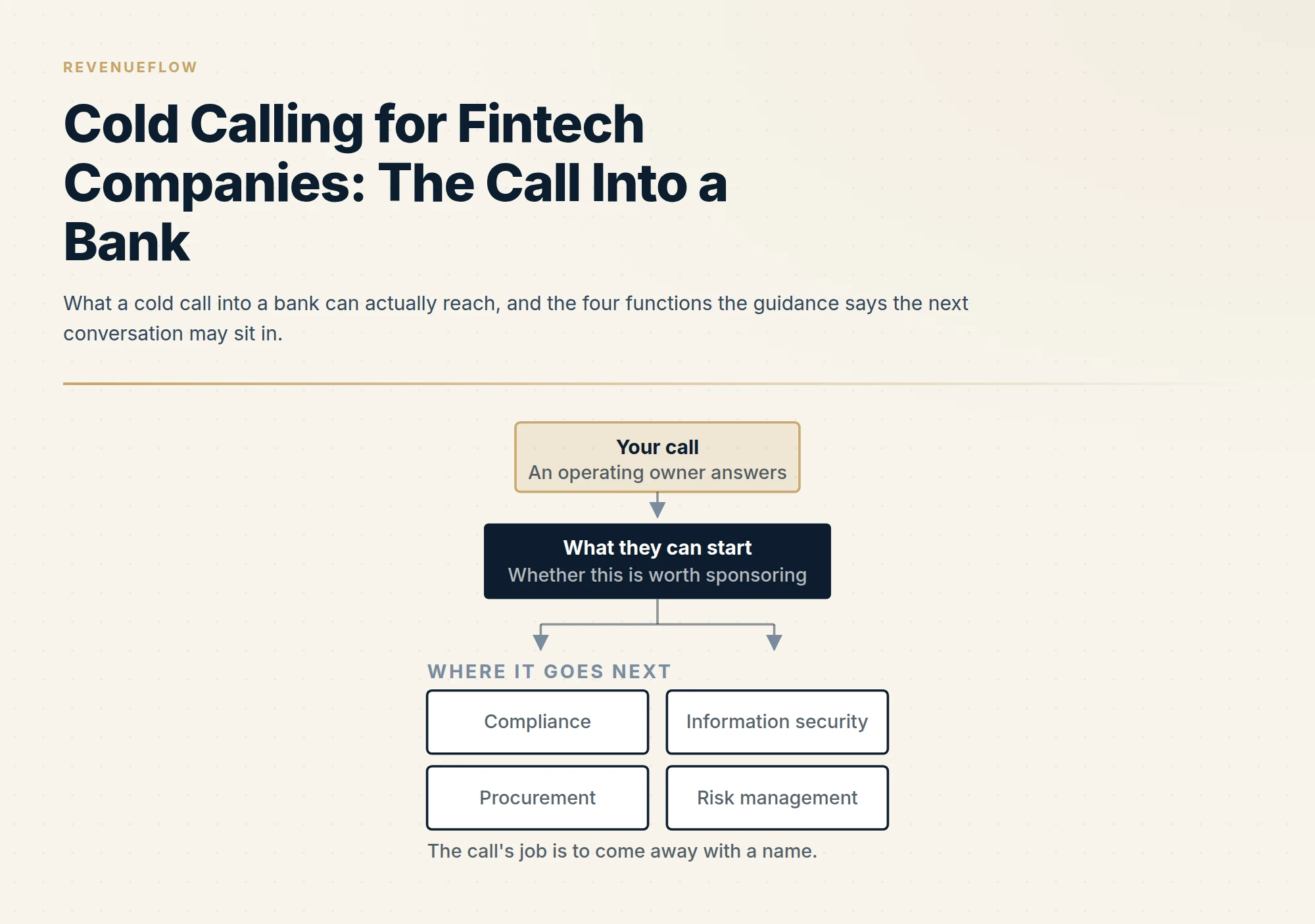
A fintech company's cold call into a bank reaches an operating owner, but federal guidance describes a five stage third-party risk life cycle that the purchase must pass through. Treat the first call as a routing call: find a sponsor and the function that runs vendor reviews, and say only what your documents will confirm.
Key takeaways
- The 2023 interagency guidance describes five life cycle stages: planning, due diligence and selection, contract negotiation, ongoing monitoring and termination.
- The guidance says banks may centralise the process under compliance, information security, procurement or risk management, which is where a good call gets routed.
- Due diligence may review a vendor's website and marketing materials to test its statements, so callers should claim only what documents confirm.
- The SEC's 2009 investor alert covers securities firms calling individuals at home, a consumer call this guide does not apply to.
Reviewed and updated September 18, 2026
A rep at a payments startup gets the head of treasury services at a regional bank on the phone at the first attempt. The conversation goes well. The banker likes the idea, asks two sharp questions, and ends with a sentence the rep has never heard from a software buyer: that nothing can move until vendor management has looked at the company. The rep logs a hot lead. What actually happened is that the call was handed to a process.
This guide is for fintech companies whose sales teams call banks, credit unions and the finance teams of other regulated firms. It covers what is different about that call: who it routes to, what federal guidance says the institution must do before it can buy from you, what you say on the phone that later gets checked, where the line to consumer calling sits, and when the phone is the wrong play. For the general method and the federal calling rules, read what cold calling is and which rules apply and where the B2B exemption stops. For why the vendor assessment belongs in your pipeline model, read our page on fintech lead generation, which this guide builds on.
A call into a bank is a routing call
In most B2B sales, the person who wants the product can start the purchase. In a bank, the person who wants the product starts a risk process, and the regulators have written down what that process contains.
The interagency guidance on third-party relationships, published by the Federal Reserve, the FDIC and the OCC in the Federal Register on June 9, 2023, organises that process into named sections, beginning with planning and due diligence and third-party selection and ending with termination. What matters on a call is the sentence about who runs it: some banking organizations "may centralize the processes under their compliance, information security, procurement, or risk management functions". (Federal Register, 88 FR 37920, fetched September 18, 2026.) Our page on sales strategy for fintech companies selling to banks works through the whole sequence as a sales process; this one stays with the phone.
Read those four functions as a map of where your call goes next. The person who answers and cares is usually an operating owner, the titles our fintech lead generation page lists. Whatever they decide, the conversation after yours belongs to one of the four, and the guidance is explicit that enthusiasm does not shorten it: "Relying solely on experience with or prior knowledge of a third party is not an adequate proxy for performing appropriate due diligence".
So the realistic goal of a first call is smaller than a meeting with the buyer. It is to find out whether the operating owner has a problem worth sponsoring, and who on the risk side would run the review if they did. That makes it a routing call, and a routing call succeeds when it comes off the phone with a name.
What you say on the phone gets checked later
A cold call feels like the least formal thing a company does. In this vertical it is the first entry in a file.
The same guidance, describing due diligence, says that "a review of the third party's websites, marketing materials, and other information related to banking products or services may help determine if statements and assertions accurately represent the activities and capabilities of the third party". The FTC's rule for business calls, as our calling rules page sets out, keeps one obligation in force even where everything else is exempt: do not misrepresent what is being sold. In a bank sale the two meet. A rep who says on the phone that the product is live at institutions like the prospect's, or that an audit report exists, has made a statement the risk team will later test against documents.
The practical rule for callers is dull and effective. Say only what your security package, your website and your reference list will confirm, in the words those documents use.
The guidance itself is about to change, which is worth knowing before a banker mentions it. On September 11, 2026 the FDIC, the Federal Reserve Board, the NCUA and the OCC requested comment on proposed third-party risk management guidance and said that, when it is final, they plan to rescind the existing guidance and replace it (OCC News Release 2026-77, fetched September 18, 2026). Until then the 2023 text is the one in force.
The consumer line, which a regulator drew in your search results
One page a search for this topic returns is an SEC investor alert, and it describes a different call. The alert, which tells readers to know their rights when a cold caller rings, is dated November 18, 2009 and is written for individuals who are phoned at home by securities firms. It explains the National Do Not Call Registry, and it notes that under FINRA rules an established business relationship includes having account activity with a firm within the past 18 months. (SEC investor alert, fetched September 18, 2026.)
That is the boundary for this article. A fintech calling an institution about software, infrastructure or a payments service is making a business call, and the rules for it are on the hub pages linked above. A fintech, broker or adviser calling individuals about an investment or a personal financial product is in the territory the SEC alert describes, with the Registry, FINRA's rules and the consumer protections that go with them. Nothing in this guide applies to that second call. If your list mixes the two, for instance sole traders on mobile numbers, split it before anyone dials.
What bankers and buyers say about the call
Bankers have said on the record what fintech sellers misjudge. In Independent Banker's November 28, 2023 piece on fintech partnerships, David Robinson, director of fintech partnerships at Dickinson Financial Corporation, said of fintech founders: "They [typically] haven't sat through a regulatory exam or worked through an MRA through the oversight of the OCC". Amy Foulks of First Utah Bank drew the distinction a caller can use: "A fintech that offers a BSA/AML service will understand regulatory requirements". (Independent Banker, fetched September 18, 2026.) The objection behind both is the same. The banker is listening for whether the caller knows what an exam is.
The other voice worth hearing is a buyer on the receiving end. Michael Halper of SalesScripter published an analysis on May 22, 2019 of a cold call he took from what he believed was a fintech startup selling cheaper wire transfers. He credits the rep for stating the value in a few words and for a fast qualifying question about whether he used wire transfers. His criticisms are about the opening, which he found "too salesy and cheesy for my taste", and about the rep asking whether he remembered an earlier email. His larger point is about the goal: "the goal of a cold call should be to start a conversation, not to sell the product". (SalesScripter, fetched September 18, 2026.)
Credited
- Stated the value in a few words: removing wire transfer fees.
- Asked a fast qualifying question about wire transfer use.
- Let a poor fit go quickly.
Criticised
- An opening the recipient found salesy.
- Asking whether he remembered an earlier email.
- Trying to sell, when the goal is to start a conversation.
That review is of a call to a small business finance buyer, the second of the two fintech markets, where one person can decide. It is included because the contrast is useful. The habits it rewards, few words and fast disqualification, work there. In a bank, disqualifying fast is still right, but the thing being qualified is whether a sponsor exists.
When this industry picks up
There is less published evidence on timing than sellers would like, and we will not invent any. Two things are on the record.
The industry gathers in one place each autumn. Money20/20 USA lists its 2026 event for October 18 to 21 in Las Vegas (Money20/20 USA, fetched September 18, 2026). The people you want to call may be travelling that week, and the event describes itself as a place to build partnerships, which is what the call is trying to start.
The rule-making calendar also matters more here than in most industries. The proposal of September 11, 2026 has a comment period that runs for 60 days after it appears in the Federal Register. While it is open, risk and vendor management teams have a reason to be thinking about what they ask of third parties, which makes it a better season than most for a call about how your company handles that review.
One opener, built on a source
A calling guide should show one opening and explain it. The caller, company and bank below are invented, and the call claims no results.
Call to the head of payments at a community bank
This is Maya at Wrenmark. We make reconciliation software for bank payments teams. Have I caught you in the middle of anything? 1
We are calling because the agencies put out the third-party risk proposal on September 11, and we have just rewritten our due diligence package around it. 2
Two questions. Is payment reconciliation a problem you own, and who runs vendor reviews at the bank? 3
- 1The permission question is the one the SalesScripter review recommends in place of small talk.
- 2The reason is a dated regulator release the banker can check, and it signals that the caller expects an assessment.
- 3It asks for the two things a routing call needs: a possible sponsor, and the function that would run due diligence.
When the phone is the wrong play for a fintech
When you cannot pass the review yet. A call that goes well at an institution whose assessment you would fail produces a sponsor with nothing to sponsor. Bankers have described that seller. Start with institutions close in size to your references.
When the buyer is reached through a partner. If your product is distributed through a core provider or a reseller, a direct call to the bank can cut across the partner's own team. The partner's account list is the one to work.
When the list is long and the accounts are small. Calling spends a person per attempt, which suits a few hundred institutions and does not suit tens of thousands of small finance teams. Our page on cold calling as a prospecting motion works through that ceiling. Written outreach covers the long list and leaves a record of exactly what was claimed, which a risk team may later ask to see. Cold email for fintech covers that channel.
When the person is a consumer. See the line above.
RevenueFlow does not make cold calls for clients. We run email and LinkedIn, one message per campaign, and we state that here so the advice can be read with our position in view.
The short version
A cold call into a bank or credit union reaches an operating owner, and the most it can do is get that person to ask whether your product is worth sponsoring. The conversation after yours sits with compliance, information security, procurement or risk management, so the call's real output is a name. Say only what your documents will confirm, because the guidance tells the institution to check your statements against them. Keep consumer calls out of the list entirely. And call in a season when the buyer's risk team has a reason to be thinking about vendors, which, with a new proposal out for comment, is now.
If you would rather open those conversations in writing, see what a first campaign looks like.
Frequently asked questions.
Frequently asked questions- Does cold calling work for fintech companies selling to banks?
- It can open a conversation with an operating owner such as a head of payments or treasury, which is useful. It cannot shorten the purchase. Interagency guidance from 2023 describes a third-party risk life cycle the bank works through before buying, and says prior knowledge of a vendor is no substitute for due diligence. The first call should find a sponsor and the reviewing function.
- Who should a fintech sales rep ask for when calling a bank?
- Start with the operating owner of the problem, not the compliance or security lead, who usually holds a veto and no mandate to buy. Then ask who runs vendor reviews. The 2023 guidance notes that some banking organizations centralise third-party risk under compliance, information security, procurement or risk management, and one of those functions will own the next conversation.
- Are fintech cold calls covered by the SEC's cold calling rules?
- The SEC's investor alert from November 18, 2009 is about securities firms phoning individuals at home, and it explains the National Do Not Call Registry and FINRA's established business relationship rule. A call to an institution about software or a payments service is a business call under different rules. If a list mixes individuals and institutions, separate them before dialling. This is not legal advice.
- When is the phone the wrong channel for a fintech company?
- When your company cannot yet pass the vendor review at the institutions you are calling, when your product is distributed through a core provider or reseller whose team owns the account, when the list is tens of thousands of small finance teams, and whenever the person on the list is a consumer. Written outreach suits the long list and keeps a record of what was claimed.
About the author.

B2B cold email experts helping companies generate qualified leads through done-for-you outreach campaigns.
RevenueFlow Team
Explore more.
Ready to scale your outreach?
We build GTM engines that book real meetings. See the receipts.
Related articles.
Cold Calling for PPC Agencies: What You Can See First
A paid media prospect is partly readable before the call and has already been told by the platform what to do when a stranger rings about its ads.
Cold Calling for Chemical Companies: Who Picks Up
A chemical cold call rarely arrives first. It reaches a formulator who has already been comparing suppliers on a screen, for one of three published reasons.
B2B Lead Lists for Travel Agencies: Registers and Gaps
The travel trade is written down in state consumer protection registers, not industry directories, and an exemption inside one decides who is missing from your file.
Cold Calling for Manufacturers: The Desk and the Floor
Cold calling for a manufacturer calling plants and OEMs: who answers the main line, the buyer's desk against the floor, the show calendar, the channel map, the limits.
Cold Calling for Consulting Firms: The Partner's Hour
Cold calling for a consulting firm: who it dials and who picks up, why partner-led economics argue against the phone, the client's fiscal year, and when to skip it.
LinkedIn Lead Generation for Financial Services Firms
A LinkedIn message from a regulated firm is a communication the rulebook already defines, and the definition turns on how many people receive it within thirty days.