Cold Email for Fintech Companies: Compliance and Trust
Fintech companies face unique cold email challenges: regulatory scrutiny, security concerns, and conservative buyers. Here's how to approach outreach effectively.
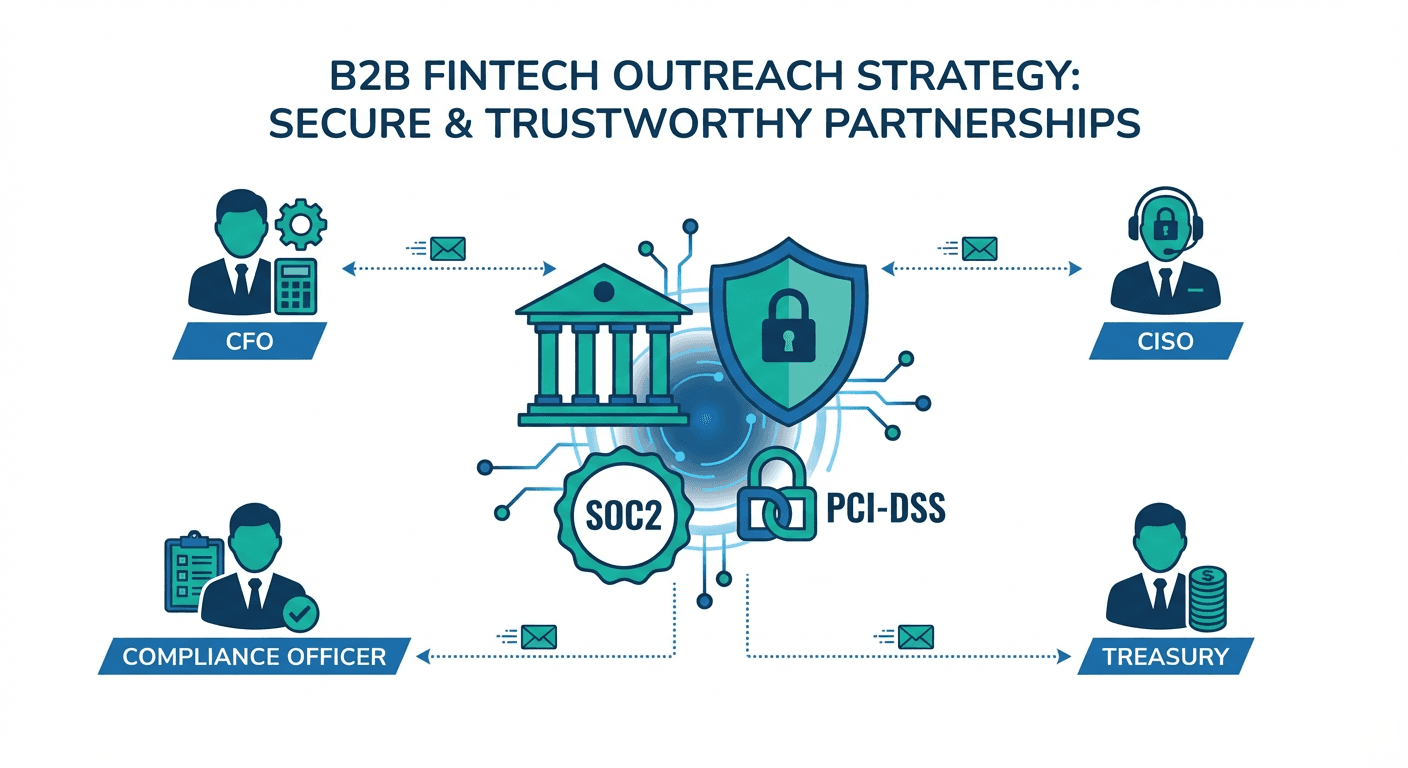
Cold emailing fintech companies requires acknowledging three core constraints: constant regulatory oversight from bodies like the SEC and FINRA, non-negotiable security requirements including SOC 2 Type II and PCI DSS certifications, and complex procurement involving seven or more stakeholders including Legal, Compliance, Security, and Finance. Successful outreach leads with compliance credentials, quantifies results conservatively, and targets specific roles like CFOs (cost reduction), CISOs (risk mitigation), or CCOs (examination readiness) based on timing triggers such as budget cycles or regulatory changes.
Key takeaways
- Financial institutions in the United States may answer to the SEC, FINRA, OCC, FDIC, CFPB, and state-level regulators simultaneously, creating a culture of risk aversion.
- Enterprise fintech purchases typically require sign-off from seven stakeholder groups: business owner, IT/Engineering, Information Security, Legal, Compliance, Procurement, and Finance.
- Security certifications including SOC 2 Type II, PCI DSS, and ISO 27001 are table stakes for vendor consideration in financial services.
- CFOs in fintech focus on quantifiable outcomes during annual budget planning, which typically occurs in Q4.
Reviewed and updated October 1, 2026
Cold Email for Fintech Companies: Navigating Compliance and Building Trust
Selling to financial services is different from selling to any other industry.
Your prospects deal with regulatory audits, security assessments, and procurement processes that can stretch for months. They receive dozens of cold emails daily from vendors promising to "revolutionize" their operations. Most of those emails get deleted within seconds.
A roundup of email warmup tools built for financial services explains how fintech senders can protect deliverability before those messages ever reach a compliance officer's inbox.
To break through in fintech, you need to understand the unique psychology of financial decision-makers, the compliance landscape they navigate, and the specific proof points that actually move the needle.
This guide covers everything you need to know about cold emailing fintech companies effectively.
Why Fintech Is Different
Financial services companies operate under constraints that most industries simply do not have. Understanding these constraints is essential before you write a single email.
Regulatory Pressure Is Constant
Banks, payment processors, lending platforms, and insurance companies face continuous oversight from multiple regulatory bodies. In the United States alone, financial institutions may answer to the SEC, FINRA, OCC, FDIC, CFPB, and state-level regulators.
This creates a culture of caution. Decision-makers in financial services have seen colleagues lose their jobs, and companies pay significant fines, for compliance failures. They are naturally risk-averse when evaluating new vendors.
Your cold emails need to acknowledge this reality. Promising "disruption" or "transformation" often triggers alarm bells. These prospects want stability, security, and proven results.
Security Is Non-Negotiable
Every vendor that touches financial data becomes a potential attack vector. A single breach can cost millions in direct damages, regulatory penalties, and reputational harm.
Before a fintech company will even consider your solution, they need to know you take security seriously. This means certifications matter. SOC 2 Type II, PCI DSS, ISO 27001, and similar credentials are table stakes for many conversations.
If you have these certifications, mention them early. If you do not, be prepared for the security conversation to end the discussion before it starts.
The same test runs in the other direction: a fintech deciding whether to let an outside team open its own conversations needs a setter who can state its SOC report, ISO certificate or Safeguards programme correctly, which is the subject of SDR outsourcing for fintech companies.
Procurement Is Complex
In most fintech companies, you will not close a deal by convincing one person. Enterprise purchases typically require sign-off from:
- The business stakeholder who owns the problem
- IT or Engineering for technical validation
- Information Security for risk assessment
- Legal for contract review
- Compliance for regulatory considerations
- Procurement for vendor management
- Finance for budget approval
Your cold email only needs to get you a conversation. But the person you email needs to believe you can survive this gauntlet, or they will not waste their time (and their internal capital) championing you.
A fintech running a gauntlet of its own, selling into banks and credit unions whose regulators name the stages of a vendor relationship, is the reader of sales strategy for fintech companies.
Key Decision Makers in Fintech
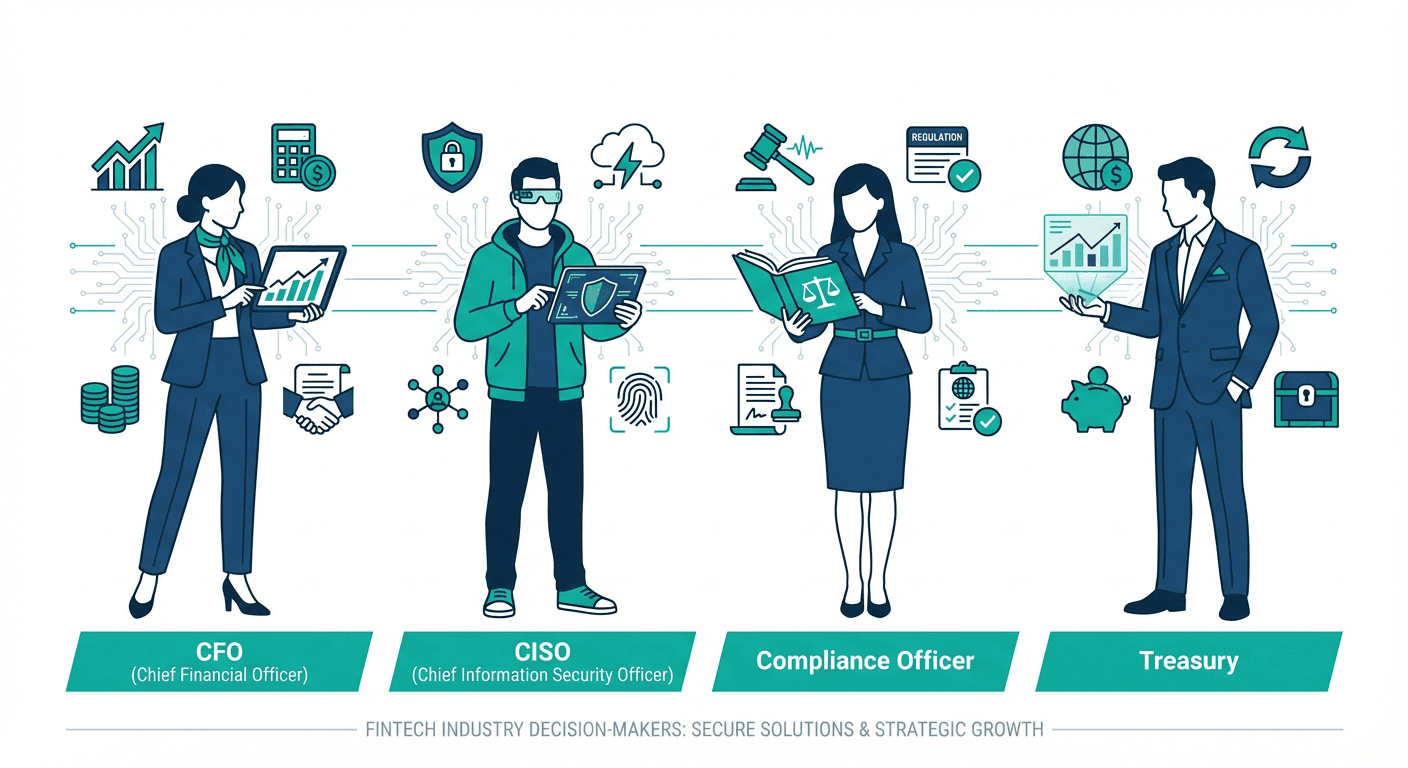
Knowing who to target is half the battle. Fintech organizations have distinct roles with different priorities.
Chief Financial Officer (CFO)
What they care about: Cost reduction, operational efficiency, audit readiness, financial reporting accuracy, regulatory compliance costs.
Pain points: Manual reconciliation processes, fragmented financial systems, audit preparation burden, rising compliance costs.
Trigger events: Preparing for an IPO, post-merger integration, new regulatory requirements, annual budget planning (typically Q4).
Email angle: Focus on quantifiable cost savings, efficiency gains, and audit simplification. CFOs respond to concrete numbers.
Treasury and Cash Management
What they care about: Liquidity visibility, cash forecasting accuracy, payment processing efficiency, counterparty risk management, interest income optimization.
Pain points: Disconnected banking relationships, manual cash positioning, limited real-time visibility, complex multi-currency operations.
Trigger events: Expanding internationally, banking relationship changes, implementing new ERP systems.
Email angle: Emphasize visibility, control, and operational efficiency. Treasury professionals value precision and reliability.
Chief Information Security Officer (CISO)
What they care about: Risk reduction, threat detection, compliance posture, vendor security, incident response capabilities.
Pain points: Growing attack surface, regulatory examination pressure, limited security budgets, vendor risk management burden.
Trigger events: Security incidents (industry-wide or company-specific), new compliance requirements, board-level security mandates.
Email angle: Lead with your security credentials and compliance certifications. CISOs need to trust you before they will consider your solution.
Chief Compliance Officer (CCO)
What they care about: Regulatory compliance, examination readiness, policy management, regulatory change management, audit trails.
Pain points: Manual compliance processes, regulatory change tracking, examination preparation, documentation gaps.
Trigger events: New regulations taking effect, failed examinations, consent orders, merger activity.
Email angle: Focus on compliance automation, audit trail capabilities, and regulatory expertise.
VP of Engineering or CTO
What they care about: System reliability, development velocity, technical debt, integration complexity, scalability.
Pain points: Legacy system constraints, integration challenges, talent retention, build vs. buy decisions.
Trigger events: Platform modernization initiatives, scaling challenges, security mandates.
Email angle: Emphasize integration flexibility, API quality, and technical architecture. Engineers appreciate specificity.
Compliance and Regulatory Considerations
When selling to fintech, your own compliance posture becomes part of the sales conversation. Here is what matters most.
SOC 2 Type II
SOC 2 (Service Organization Control 2) is an auditing standard developed by the AICPA. Type II reports cover an extended period (typically 12 months) and verify that security controls are operating effectively over time.
For most fintech buyers, SOC 2 Type II is the minimum bar for any vendor handling sensitive data. If you have it, mention it prominently. If you are working toward it, be transparent about your timeline.
PCI DSS
If your solution touches payment card data in any way, PCI DSS (Payment Card Industry Data Security Standard) compliance is mandatory. There are different levels based on transaction volume, but any fintech dealing with payments will ask about this.
ISO 27001
ISO 27001 is an international standard for information security management systems. Many global financial institutions require this certification from their vendors. It demonstrates a systematic approach to managing sensitive information.
Bank Secrecy Act and Anti-Money Laundering (BSA/AML)
If your solution involves transaction monitoring, customer onboarding, or payment processing, you will need to demonstrate understanding of BSA/AML requirements. This is particularly important for solutions targeting banks, payment processors, or cryptocurrency companies.
GDPR and Data Privacy
For any fintech operating in or serving European customers, GDPR compliance is essential. But data privacy requirements are expanding globally, with CCPA in California and similar regulations emerging worldwide.
How to Address Compliance in Your Emails
Do not list every certification you have. Instead, match your compliance credentials to your prospect's specific concerns.
For a US bank:
"SOC 2 Type II certified with dedicated financial services security protocols."
For a payment processor:
"PCI DSS Level 1 compliant, processing over $X billion annually."
For a global institution:
"ISO 27001 certified with data residency options for EU, APAC, and Americas."
The key is relevance. Show that you understand their specific compliance environment.
Building Credibility in Cold Emails
Generic credibility statements do not work in fintech. Prospects have heard "trusted by leading financial institutions" too many times to care.
Name Drop Strategically
If you work with recognizable financial institutions, use them. A mention of a known bank or fintech carries more weight than generic claims about your customer base.
Weak:
"We work with multiple Fortune 500 financial services companies."
Strong:
"Currently deployed at three top-20 US banks."
The specific reference signals that you have already passed rigorous security and compliance reviews, which dramatically reduces perceived risk.
That same review is what a phone call runs into, and cold calling for fintech companies treats the first call as the routing call it actually is.
Reference Regulatory Expertise
Show that you understand their regulatory environment. This signals that working with you will not create compliance headaches.
Example:
"Built specifically to meet OCC requirements for third-party risk management."
Example:
"Used by compliance teams preparing for CFPB examinations."
Quantify Results Carefully
Financial services professionals appreciate precision. Vague improvement claims will not resonate with people who deal in basis points.
Weak:
"We help companies save significant time on compliance."
Strong:
"Reduced SOX audit preparation time from 6 weeks to 2 weeks at [Company]."
Demonstrate Technical Depth
Fintech buyers, especially on the engineering side, can spot vendors who do not understand their technical environment. Use terminology accurately and show familiarity with their infrastructure patterns.
Example:
"Single-tenant deployment options with your AWS or Azure environment."
Example:
"RESTful APIs with comprehensive documentation and dedicated sandbox environments."
Addressing Security Concerns
Security concerns kill fintech deals more often than pricing or feature gaps. Proactively addressing security in your outreach can differentiate you from competitors.
Choosing which platform to send that outreach from is the next decision, so weigh options built for fintech's compliance needs in this comparison of fintech email platforms.
Lead with Security Credentials
For security-sensitive buyers, your compliance certifications should appear early in your email. This qualifies you before they consider your value proposition.
Example opening:
"SOC 2 Type II certified platform built specifically for financial services data handling."
Acknowledge Their Risk
Show that you understand the stakes. Financial decision-makers appreciate vendors who grasp the consequences of security failures.
Example:
"We know that any vendor you bring in becomes your risk. Here's how we mitigate that."
Offer Security Documentation Early
Most vendors make prospects ask for security documentation. Offering it proactively demonstrates confidence and saves time.
Example:
"Happy to send our SOC 2 report and security architecture overview before any call."
Reference Your Security Practices
Even brief mentions of security practices can build confidence.
Example:
"All data encrypted in transit and at rest, with customer-managed encryption keys available."
Example:
"Penetration tested quarterly by independent security firms."
Timing Your Outreach
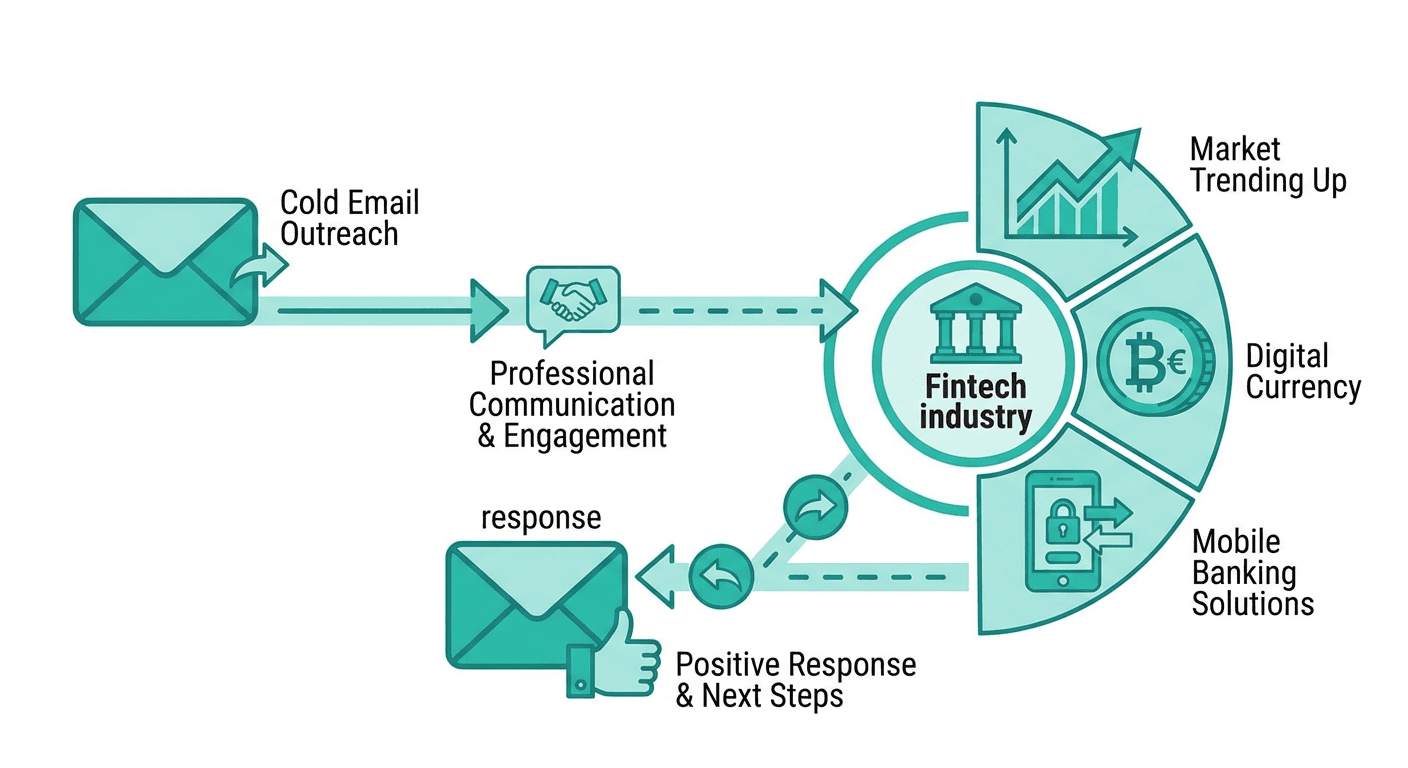
Fintech companies operate on distinct cycles that affect their receptivity to cold outreach.
Budget Cycles
Most financial institutions finalize annual budgets in Q4 for the following year. This creates two strategic windows:
Q4 (October through December): Decision-makers are planning next year's initiatives. They are receptive to solutions that fit upcoming budget allocations. Reach out early in Q4 to influence planning.
Q1 (January through March): New budgets are available, and teams are executing on approved initiatives. This is a strong window for solutions that align with existing plans.
Q2 and Q3: More challenging for new initiatives that were not budgeted. Focus on urgent needs, quick wins, or low-cost pilots.
Regulatory Calendars
New regulations create urgency. When compliance deadlines approach, relevant solutions get attention.
Track regulatory calendars and time your outreach accordingly. An email about DORA compliance six months before the deadline will land differently than one eighteen months out.
Examination Schedules
Banks and large financial institutions undergo regular examinations. The period immediately following an examination, especially if findings were identified, can create openness to solutions that address those findings.
Earnings Season
Publicly traded financial institutions are in quiet periods around earnings releases. Avoid major outreach during these windows, particularly to senior executives.
Industry Events
Major conferences like Money20/20, Sibos, and Finovate create natural conversation opportunities. Reaching out before or after these events with relevant context can improve response rates.
Email Templates for Fintech
Here are templates adapted for different fintech scenarios. Use these as starting points and customize based on your specific offering and target.
Template 1: Security-Forward Approach (for CISO or Security Teams)
Subject: SOC 2 certified approach to [specific problem]
Body:
[First Name],
Quick question: how much time does your team spend on [specific security or compliance task]?
We are SOC 2 Type II certified and work with [X] financial institutions on this exact challenge. Average reduction in [specific metric]: 40%.
Our security documentation (including SOC 2 report) is available before any conversation.
Worth a 15-minute call this week?
[Your name]
Why it works: Leads with compliance credential, shows relevance to their role, offers security documentation proactively, asks for minimal time commitment.
Template 2: Compliance-Focused Approach (for CCO or Compliance Teams)
Subject: [Specific regulation] deadline approaching
Body:
[First Name],
[Specific regulation] compliance deadline is [X months] away. We have helped [Y] institutions prepare, including [notable company if possible].
Most common gap we see: [specific common issue].
Compliance teams we work with typically reduce examination prep time by [specific amount].
Worth a quick call to discuss your approach?
[Your name]
Why it works: Creates urgency around regulatory timeline, demonstrates specific expertise, offers concrete value.
Template 3: Cost-Focused Approach (for CFO or Finance Teams)
Subject: [Specific process] cost reduction
Body:
[First Name],
Noticed [Company] recently [trigger event: expansion, acquisition, new product launch].
We help finance teams at similar institutions reduce [specific process] costs by [specific amount]. Currently working with [X relevant companies].
Most recent example: [specific company] reduced [process] costs from $X to $Y annually.
Worth exploring if there is fit?
[Your name]
Why it works: References observable trigger, focuses on quantifiable savings, provides specific proof point.
Template 4: Technical Approach (for Engineering or IT Teams)
Subject: [Specific technical challenge] at [Company]
Body:
[First Name],
Your engineering team is likely dealing with [specific technical challenge common in fintech].
We built [product] specifically for financial services infrastructure: single-tenant deployment, SOC 2 certified, with comprehensive API documentation.
Currently integrated with [X] financial institutions, including teams running [relevant technology stack].
Happy to share our API docs and sandbox access before any call.
[Your name]
Why it works: Shows technical understanding, leads with security, offers concrete resources upfront.
Template 5: Business Stakeholder Approach
Subject: [Specific business problem] at [Company]
Body:
[First Name],
[Trigger: saw your LinkedIn post about X, noticed job posting for Y, read about Z initiative].
We help fintech teams solve [specific problem]. Currently working with [relevant companies] on this.
Typical result: [specific quantified outcome].
Already SOC 2 certified and integrated with [relevant systems they likely use].
Worth a quick conversation this week?
[Your name]
Why it works: Personalizes with trigger, addresses specific business need, proactively addresses compliance concern.
Common Mistakes to Avoid
Mistake 1: Ignoring the Compliance Conversation
Many vendors treat compliance as a hurdle to overcome late in the sales process. In fintech, it should be front and center from the first email. If you cannot demonstrate compliance readiness early, you will not get far.
Mistake 2: Overpromising on Security
Fintech buyers will verify your claims. Do not overstate your compliance certifications or security capabilities. If you say you are SOC 2 certified when you are actually SOC 2 in progress, you will lose trust and likely the deal.
Mistake 3: Generic Financial Services Positioning
"We work with financial services" is not differentiated. Show specific understanding of your target sub-segment, whether that is community banks, payment processors, wealth management platforms, or insurance carriers.
Mistake 4: Underestimating the Sales Cycle
Enterprise fintech deals often take 6 to 12 months. Your cold email is starting a long process. Set appropriate expectations internally and with your prospects.
Mistake 5: Forgetting the Committee
The person you email is rarely the sole decision-maker. Write emails that give them ammunition to champion you internally. Provide clear value propositions they can articulate to colleagues.
Mistake 6: Using Consumer Fintech Language
B2B fintech buyers do not respond to the same messaging as consumer fintech customers. "Revolutionary," "disruptive," and "reimagining" are often red flags that signal a vendor who does not understand enterprise requirements.
Building a Fintech Cold Email Program
Success in fintech outreach requires systematic execution, not just good templates.
List Building
Quality matters more than quantity. Focus on:
- Companies that match your compliance capabilities
- Organizations with observable trigger events
- Decision-makers at the appropriate level
- Institutions in sub-segments where you have proof points
Segmentation
Do not send the same email to a CISO and a CFO. Segment your lists by:
- Role and function
- Company type (bank, payment processor, lender, insurer)
- Company size and regulatory profile
- Specific use case or pain point
Personalization at Scale
Fintech buyers can spot mass emails immediately. Invest in personalization:
- Reference specific company news or initiatives
- Mention relevant technology they use
- Acknowledge their specific regulatory environment
- Reference mutual connections when possible
Where we differ from standard practice
Much of the advice on this page reflects how outbound is commonly run. We run it differently, and since this page sits on our site it is worth saying where the difference is and what it costs us.
- A sequence of messages to each prospect over several weeks
- Later messages often land in the same email thread
- Every contact is reached more than once, so a distracted reader gets another chance
- The later messages go only to people who did not answer the first
- Reputation cost accrues on the sending domain across everything else it sends
- One message, then that campaign is finished for that contact
- No thread replies and no bumps
- More of the work moves into targeting and into the one message
- We reach each contact less often, and that is the cost we accept
The reasoning is mechanical rather than moral. A follow-up arrives underneath a message the recipient has already seen and chosen not to answer, so it is delivered to the population most likely to mark it as spam, and the reputation cost of that lands on the sending domain across every campaign running on it. We set that cost against the replies a sequence recovers and decided the trade was not worth it. The full argument, with the numbers from our own campaigns, is in why we stopped using follow-ups.
Follow-Up Strategy
Most programmes answer that with a follow-up; we answer it by putting the effort into the first message:
- Where follow-ups are used, five to seven business days between messages is the common spacing
- Lead with new value rather than a check-in
- Reference relevant industry news or regulatory updates
- Keep it even shorter than a generic pitch
Measurement
Track metrics that matter:
- Open rates by segment and role
- Reply rates by company type
- Meeting conversion rates
- Pipeline generated
- Deals closed by source
Use this data to continuously refine your targeting, messaging, and timing.
The Long Game
Fintech relationships often take time to develop. A prospect who does not respond today may be ready in six months when their regulatory environment changes or their current vendor disappoints them.
Build systems for staying visible:
- Share relevant industry content periodically
- Engage thoughtfully on LinkedIn
- Send occasional value-add emails (not pitches)
- Attend and participate in industry events
The best fintech cold email programs combine immediate outreach with long-term relationship building. They treat every contact as the potential start of a multi-year relationship.
Summary
Cold emailing fintech companies requires a specialized approach. Success depends on:
- Understanding the regulatory environment your prospects operate in
- Leading with compliance credentials to establish baseline trust
- Targeting the right decision-makers with role-appropriate messaging
- Addressing security proactively rather than waiting for objections
- Timing outreach around budget cycles and regulatory deadlines
- Providing specific proof points with quantified results
- Building for the long term with systematic follow-up
Financial services buyers are cautious, deliberate, and risk-averse. They respond to vendors who demonstrate understanding of their world and respect for the constraints they operate within.
Meet them where they are, and you will stand out from the generic "revolutionary solution" pitches filling their inboxes.
Related Reading
- Cold Email for Banking and Financial Services: The Complete Guide
- Cold Email for Security Services: The Complete Guide
If you would rather have this run for you, RevenueFlow books qualified meetings on a pay-per-meeting basis and publishes client results.
Frequently asked questions.
Frequently asked questions- Why is cold emailing fintech companies more difficult than other industries?
- Fintech companies operate under continuous regulatory oversight from multiple bodies, making decision-makers naturally risk-averse. They face security requirements where a single vendor breach can cost millions in damages and penalties. Additionally, enterprise purchases require approval from seven or more stakeholders including Legal, Compliance, Security, IT, Procurement, and Finance, creating lengthy evaluation cycles that can stretch for months.
- What security certifications do fintech companies expect vendors to have?
- SOC 2 Type II, PCI DSS, and ISO 27001 are considered table stakes for vendors serving financial services companies. These certifications demonstrate that your company takes security seriously and has undergone independent validation. If you lack these credentials, many fintech prospects will end the security conversation before evaluating your solution, as every vendor represents a potential attack vector for financial data.
- Who should I target with cold emails at fintech companies?
- Target varies by your solution. CFOs care about cost reduction and audit readiness, especially during Q4 budget planning. CISOs prioritize risk reduction and need to see security credentials immediately. Chief Compliance Officers focus on examination readiness and regulatory change management. Treasury professionals value liquidity visibility and cash forecasting. VPs of Engineering care about integration flexibility and technical architecture. Match your outreach to the pain point your solution addresses.
- When is the best time to reach out to fintech decision-makers?
- Timing depends on the role and organizational calendar. CFOs are most receptive during Q4 annual budget planning. Compliance Officers become more engaged when new regulations take effect or after failed examinations. CISOs respond to trigger events like security incidents or board-level mandates. Avoid earnings season when finance teams are occupied. Consider regulatory examination schedules and major industry events when planning outreach campaigns.
- Should I promise transformation or disruption in emails to fintech companies?
- No. Financial services decision-makers have seen colleagues lose jobs and companies pay significant fines for compliance failures. Promising "disruption" or "transformation" triggers alarm bells in an industry where regulatory caution is paramount. Instead, emphasize stability, security, and proven results. Focus on quantifiable outcomes, compliance automation, and risk reduction. Decision-makers in fintech want reassurance that you understand their constraints, not bold claims that suggest recklessness.
About the author.

Fernando Cao is CEO at RevenueFlow, which builds and operates outbound revenue engines for B2B companies. Previously at Accenture Strategy. Studied at University of Bath.
Fernando Cao · CEO
Connect on LinkedIn →Explore more.
Ready to scale your outreach?
We build GTM engines that book real meetings. See the receipts.
Related articles.
Cold Email for Telecom: Reaching Carriers and MSPs
Telecom companies face rapid technology changes and competitive pressures. Here's how to approach cold email outreach to carriers, MSPs, and UCaaS providers.
Cold Email for Banking and Financial Services: A Guide
A comprehensive guide to cold email outreach for banking and financial services, covering compliance requirements, decision-maker targeting, and proven strategies for reaching finance executives.
Cold Email for Architecture Firms: 2026 Strategy Guide
Architecture firms buy on project phases rather than fiscal quarters. How to build a list, time the spec window, and write cold emails principals answer.
Cold Email for Trucking and Fleet Companies: 2026 Guide
How to reach carriers, fleet operators, and safety buyers with cold email: FMCSA-driven list building, trigger timing, four templates, and compliance.
Cold Email for Cannabis Companies: 2026 Strategy Guide
The April 2026 rescheduling order split cannabis buyers into two tax realities. Here is how to segment, list-build, and write cold email for each.
Cold Email for Private Equity Firms: 2026 Strategy Guide
How to run cold email into private equity: mapping fund-level and portfolio-level buyers, list sources, four templates, and PE-specific deliverability rules.